
Restaurant reviews have become an essential part of the modern dining experience. Before choosing where to eat, customers often read restaurant reviews to learn about food quality, service, cleanliness, atmosphere, pricing, and overall customer experience.
This makes a thoughtful review response an essential part of restaurant reputation management.
When a customer leaves five stars or a detailed complaint, then your responses can influence how that customer and future readers view your business.
A genuine review response can show that your restaurant values customer feedback, appreciates loyal guests, and takes concerns seriously. On the other hand, a generic or defensive reply can make a negative situation more difficult to manage.
Using a clear restaurant review template can help your team to respond consistently while saving time. However, templates should provide a structure instead of encouraging the same copy-and-paste responses. Each reply should be personalized as per the customer’s comments, positive reviews, negative reviews, or online reviews.
Restaurants can also use review management strategies to identify recurring problems and improve operations. With sentiment analysis, businesses can better understand the way customers feel about different aspects of their experience.
Tools like Clariv can help restaurants to analyze customer feedback, identify recurring themes, and gain useful insights from reviews.
Through this blog, you will find practical review response templates, examples, best practices, and strategies for responding to different types of restaurant feedback professionally and effectively.
Also Read: Funny 1 Start Review Lessons for Restaurant Mistakes
Why Restaurant Review Responses Matter
When customers read restaurant reviews, then they are not only looking at the star rating. But they may also look at what the restaurant says in response.
A response gives your business an opportunity to demonstrate how it communicates with customers. Someone who has never visited your restaurant may learn something about your service standards simply by reading how you handle criticism.
For instance, compare these two responses:
Generic response:
“Thank you for your feedback. We appreciate your business and hope to see you again.”
Specific response:
“Thank you for letting us know that you had to wait a long time for your appetizers. Forty five minutes is quite longer than the service time we aim for, we understand how frustrating that must have been.We are reviewing the kitchen workflow and communication between the kitchen and service team.”
Here, the second response informs readers that the restaurant actually read the review. Such a response identifies the issue, acknowledges the customer’s frustration, and explains that their problem is being addressed. Your review responses can hence become an extension of your customer service.
Also Read: How Restaurant AI Customer Feedback Tools Turns Reviews into Actionable Insights
What Is a Restaurant Review Response Template?
A restaurant review response template offers businesses a clear structure for addressing customer feedback effectively. It should not be considered as a script that you copy and paste word by word.
A useful template gives you a basic structure such as:
- Acknowledge the customer.
- Mention something specific from the review.
- Thank them or apologize when appropriate.
- Address the main issue.
- Explain the next step when necessary.
- Invite them to return or continue the conversation privately.
The words used for responding should change based on the review. For instance, while responding to a customer who praises your pasta does not need to give the same response as someone complaining about cold food.
Similarly, a five-star review should not receive the same response for a one-star complaint. Assume restaurant review response template as a framework rather than a finished answer.
Also Read: Social Media Management Tips for Small Businesses
The Basic Formula for Responding to Any Review
A simple formula can make review responses easier to write.
Acknowledge + Personalize + Respond + Next Step
- Acknowledge: They must recognize that the customer took the time to leave feedback.
- Personalize: They must mention a specific dish, employee, occasion, problem or detail from the review.
- Respond: For positive feedback they must thank the customer, and for negative feedback, they must address their problem directly.
- Next Step: They must invite guests to visit the restaurant again, provide a contact option, or explain what your team is doing to improve.
For example:
“Thank you for mentioning our chicken biriyani and taking the time to share your experience. We are glad you enjoyed the flavors and found our team welcoming. We will share your comments with our kitchen and service team. We hope to welcome you back soon.”
This response is simple for busy restaurant managers while still allowing every response to feel personal.
Also Read: How to Use Customer Feedback to Grow Your Business
Restaurant Review Templates for Different Ratings
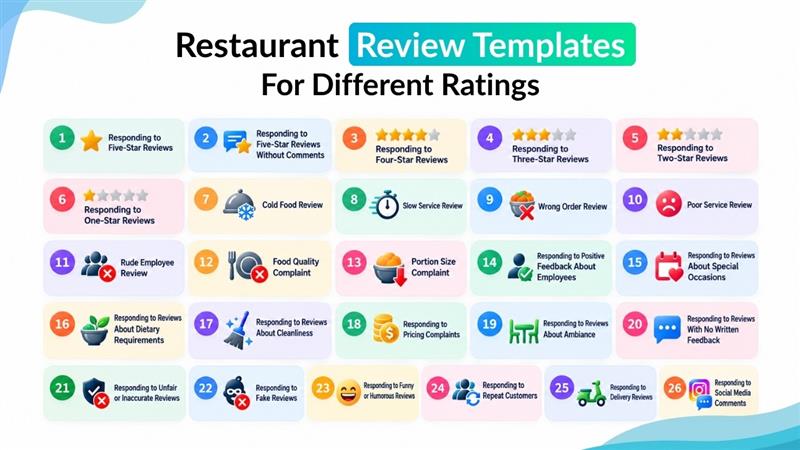
1. Responding to Five-Star Reviews
If restaurants receive five-star reviews, then restaurants have an opportunity to thank their customer and know about the aspects of the experience they enjoyed.
They must avoid using a simple “Thank you!” for every response. Rather than mentioning a specific dish, service detail, or experience from the review.
Template: “Thank you, [Name], for the wonderful review! We are delighted that you enjoyed[specific dish or experience]. Our team will appreciate hearing your kind words. We look forward to welcoming you back soon.”
Example: “We are delighted that you enjoyed our butter chicken and found our team friendly and efficient. Thank you for sharing your experience!”
Also Read: How to Respond to Negative Reviews
2. Responding to Five-Star Reviews Without Comments
Some customers leave a five-star rating without writing any feedback. As there are no specific details to refer to, keep your response short and avoid inventing information about their visit.
Template: “Thank you for the five-star rating, [Name]! We truly appreciate your support and look forward to serving you again.”
A short, genuine response is enough when the customer provides only a rating. The goal is to acknowledge their support without making the reply unnecessarily long.
Also Read: Restaurant Review Sentiment Analysis
3. Responding to Four-Star Reviews
Four-star reviews often combine positive feedback with a suggestion or complaint. Begin by recognizing what the customer enjoyed, then address the area that could be improved.
Template: “Thank you, [Name], for sharing your feedback. We’re glad you enjoyed [positive detail]. We also appreciate your comments about [specific concern]. We’ll share your feedback with our team and work to improve.”
This approach demonstrates that the restaurant has read the entire review rather than focusing only on the positive comments.
Also Read: Brand Reputation Management Software
4. Responding to Three-Star Reviews
Three-star reviews may provide a balanced view of the dining experience. Customers might praise the food while criticizing the service, atmosphere, or waiting time.
Template: “Thank you for your honest feedback. We’re pleased that you enjoyed [positive detail], but we’re sorry that [specific problem] affected your experience. We’ll share your comments with our team and use them to improve.”
They must avoid trying to persuade the customer that their rating was too low. They must focus on understanding their experience.
Also Read: How to Review Monitoring Software to Manage Your Online Reputation
5. Responding to Two-Star Reviews
Two-star reviews usually require a careful and professional response. Clearly acknowledge the customer’s concern without instantly making excuses or blaming employees.
Template: “Thank you for bringing this to our attention. We’re sorry that you experienced [specific problem]. We understand your frustration and are reviewing the issue with our team. Please contact [manager/contact information] so we can learn more.”
A calm response can show potential customers that complaints are taken seriously.
Also Read: How to Measure Customer Sentiment
6. Responding to One-Star Reviews
One-star reviews need particular care because an emotional or defensive response can further damage the conversation. Acknowledge the customer’s experience, apologize when appropriate, and invite them to discuss the matter privately.
Template: “We’re sorry to hear about your experience with [specific issue]. This does not reflect the experience we want to provide. We’d appreciate the opportunity to understand what happened. Please contact [manager/contact information] so we can follow up.”
They must keep the public response clear, respectful, and focused on resolving the problem.
Also Read: Customer Sentiment Score Explained
7. Cold Food Review
For instance, if a customer complaint as:
“The food arrived cold after we waited around 30 minutes.”
Response: “We are sorry that your food arrived cold, especially after such a long wait. You should be able to expect your meal to arrive at the appropriate temperature and within a reasonable time. We are reviewing this with our kitchen and service teams. Thank you for bringing it to our attention.”
Your response should address both problems rather than apologizing only for the food temperature.
Also Read: Google Review Management Software
8. Slow Service Review
For instance, if a customer complains:
“The food was good, but we waited almost an hour”.
Response: “Thank you for sharing your feedback. We are glad that you enjoyed the food, but we are sorry about the long wait. An hour is longer than the service time we aim to provide. We are reviewing our service process to understand whether the delay happened and how we can improve.”
They must not immediately blame staffing, the kitchen, or how busy the restaurant was.
Also Read: How Businesses Can Improve the Customer Satisfaction
9. Wrong Order Review
If a customer add review for wrong order like:
“We ordered two vegetarian dishes but received the wrong items.”
Response: “We’re sorry that your order was incorrect. We understand how frustrating it is to receive something different from what you requested, especially when dietary preferences are involved. We will review the ordering and verification process with our team. Thank you for bringing this to our attention.”
Also Read: How to Track Customer Feedback in Real-Time
10. Poor Service Review
If a customer complaints about:
“Our server barely checked on us during dinner.”
Response: “Thank you for sharing your feedback. We are sorry that the service felt inattentive during your visit. Our guests should feel looked after throughout their meal, and we clearly missed that mark during your experience. We will discuss your comments with our service team and use them as an opportunity to improve.”
They must keep the response professional by addressing the service issue without identifying or blaming individual employees.
Also Read: How to Use Review Monitoring Software to Manage Your Online Reputation
11. Rude Employee Review
If a customer complaints about:
“The employee at the counter was rude.”
Response: “We’re sorry to hear that you felt unwelcome during your visit. Friendly and respectful service is important to us, and we take comments like yours seriously. We’ll review the situation with our team. Thank you for bringing this to our attention.”
Employee-related problems must be handled privately instead of discussing personnel matters publicly.
Also Read: Online Reputation Management
12. Food Quality Complaint
If a customer complaints about the food quality such as:
“The steak was overcooked.”
Response: “We’re sorry that your steak was not prepared as requested. We understand that cooking temperature is an important part of the dish, and we appreciate you letting us know. We’ll share your feedback with our kitchen team and review the preparation process.”
Also Read: Funny Google Reviews How Humour Can Boost Your Restaurant Reputation
13. Portion Size Complaint
If a customer complaints about food portion size:
“The food tasted good, but the portions were too small for the price.”
Response: “Thank you for sharing your honest feedback. We are glad that you enjoyed the food, but we understand your concern about food portion size and value. We appreciate you bringing this to our attention and will share your comments with our management and kitchen teams.”
They must not automatically tell customers that your prices are justified. They must explain pricing only when necessary, and do so shortly.
Also Read: How to Write a Review on Facebook
14. Responding to Positive Feedback About Employees
When customers mention an employee positively, then they must acknowledge it.
Template: “Thank you for your kind words, [Name]! We are especially happy to hear that [employee name] helped make your visit enjoyable. We will make sure that they see your feedback. We appreciate your support and hope to welcome you back soon.”
This can also help to reinforce positive employee behavior internally.
This can also help reinforce positive employee behavior internally. A review that names a server, host, bartender, chef, or manager can offer valuable recognition for their individual contribution to the guest experience.
Also Read: Client Review Platform for Legal Service
15. Responding to Reviews About Special Occasions
Restaurants frequently receive reviews about birthdays, anniversaries, family gatherings, dates, and other occasions. These reviews offer an opportunity to make the response personal.
Template: “We are delighted that you chose us to celebrate[the occasion]. It was wonderful to hear that you enjoyed[specific detail]. Thank you for allowing our team to be part of such a special occasion. We hope to celebrate with you again in the future.”
Example: “We are delighted that you chose us for your anniversary dinner! We are especially glad you enjoyed the atmosphere and dessert. Thank you for allowing our team to be part of such a special evening. We hope to welcome you back for many more celebrations.”
Also Read: Best Social Media Management Tools for Small Businesses
16. Responding to Reviews About Dietary Requirements
Restaurants should respond thoughtfully and responsibly to customer feedback about dietary needs and food-related problems. If a customer praises your vegetarian, vegan, gluten-free, allergen-aware, or other options, acknowledge their experience without making unsupported safety claims.
If a customer praises your vegetarian, vegan, gluten-free, allergen-aware, or other options, acknowledge their experience without making unsupported safety claims.
Template: “Thank you for sharing your experience. We are glad you found options that worked well for your dietary needs and enjoyed your meal. We appreciate your feedback and will share your comments with our team. We look forward to welcoming you again.”
If the review raises a serious allergy or food-safety concern, the response should be handled promptly by management.
Also Read: How to Manage Your Online Reviews for Your Businesses
17. Responding to Reviews About Cleanliness
If a customer complains about complaints then it should never be dismissed.
Template: “Thank you for bringing this to our attention. We are sorry that the cleanliness of [specific area] did not meet your expectations. Cleanliness and comfortable dining areas are essential to us, and we take your feedback seriously. We will review this with our team and reinforce our cleaning procedures.”
Address the specific problem directly rather than relying on general phrases like “your experience.”
Also Read: Customer Sentiment Analysis Vs Customer Feedback Analysis
18. Responding to Pricing Complaints
Customers may describe your restaurant as expensive or say that portions do not justify the price. They must avoid becoming defensive.
Template: “Thank you for sharing your customer feedback about pricing. We understand that the value is an essential part of the dining experience. We appreciate your perspective about pricing and will share your comments with our management team as we keep reviewing our menu and pricing.”
If your restaurant offers suitable food choices, like a lunch menu or smaller food portions, mention them naturally while responding to the customer.
Also Read: Sentiment Analysis Demo
19. Responding to Reviews About Ambiance
Ambience about restaurants is subjective, but customers may have different preferences about lighting, music, seating arrangements, temperature, or overall restaurant decor.
Template: “Thank you for sharing your feedback about the ambience. We are glad you enjoyed[positive detail], and we appreciate your comments about [specific concern]. We will take your customer feedback into consideration as we continue improving the dining environment.”
The restaurants must not tell customers that their opinions about ambiance are wrong.
20. Responding to Reviews With No Written Feedback
If a customer leaves a one star rating, they must keep the responses that are appropriate to the less information provided and prevent making assumptions about their experience.
Five-star rating:“Thank you for the five-star rating! We really appreciate your support and hope you visit your restaurant soon.”
Three-star rating: “Thank you for taking your time to rate us. We would appreciate hearing more about your experience so we can understand the aspects that we could improve.”
One-star rating: “Thank you for sharing your rating. We are sorry that your experience with our restaurant did not meet your expectations. We had appreciated the opportunity to learn more about what happened. Please contact us at [contact information].”
Also Read: How to Delete a Facebook Page Permanently
21. Responding to Unfair or Inaccurate Reviews
Not every customer review accurately shows what happened. Because customers may misunderstand about charges, confuse businesses, or remember events differently.
They must respond calmly, avoid accusing them, and provide only verified facts. If any clarification is required, they must invite the customer to contact the restaurant privately so that the matter can be reviewed and resolved professionally.
Template: “Thank you for sharing your customer feedback. We are sorry to hear that you were disappointed. We would like to better understand the situation because some of the details in your review do not appear to match our records. Please contact us at [contact information] so we can review this with you directly.”
Such an approach maintains a professional image and allows both sides an opportunity to clarify the situation.
22. Responding to Fake Reviews
If you believe a review comes from someone who did not visit your restaurant, do not make accusations publicly.
Template: “Thank you for sharing your feedback. We take customer problems seriously, but we are unable to locate a visit matching the details in this review. Please contact us directly with additional information so we can investigate the situation.”
If the review violates the platform’s rules, use the platform’s reporting process separately. While the public response should remain professional.
23. Responding to Funny or Humorous Reviews
Some customers use humor while describing their experience.
For instance: “The burger was amazing. I waited so long that I had time to reconsider every decision that I have ever made.”
While, you can acknowledge the humor without ignoring the complaint.
Response: “We are glad you enjoyed the burger, but we are sorry the wait gave you so much time to reflect! We appreciate you pointing out the delay and will share your feedback with our team. We hope your next visit is much faster.”
Humor can work when the customer is clearly joking, but should not use humor when the customer is clearly joking, but do not use humor when the customer complaint involves serious problems such as food safety, discrimination, injuries, or harassment.
24. Responding to Repeat Customers
If a customer says that they have visited several times, then they must acknowledge their customer loyalty.
Template: “Thank you for continuing to choose us, [Name]. We are especially happy to hear that you have enjoyed[specific team or experience] across your visits. Your continuous support means great to our team. We look forward to seeing you again.”
If the review indicates a decline in food quality across several visits, they must take the criticism seriously rather than focusing only on the loyalty.
25. Responding to Delivery Reviews
Delivery reviews can involve problems which are different from dine-in experiences.
Customers may mention:
- Late delivery
- Missing items
- Cold food
- Damaged packaging
- Incorrect orders
- Delivery fees
- Food quality after travel
Template: “We are sorry that your delivery arrived late and that the food was no longer at the quality we expect. We understand how disappointing that can be. We will review the order and delivery process with our team. Thank you for bringing this to our attention.”
If a third-party delivery service was involved, avoid simply blaming the delivery company. The customer experienced the problem through your restaurant’s order.
26. Responding to Social Media Comments
Social media comments can require shorter responses than detailed review platforms.
For positive comments:
“Thank you! We’re so glad you enjoyed it.”
For a complaint:
“We’re sorry to hear that. Please send us a direct message with your order details so we can look into this.”
For a public complaint that requires investigation:
“We’d like to understand what happened and help resolve this. Please contact us directly at [contact information].”
The public response should acknowledge the concern while moving sensitive details into a private conversation.
Conclusion
Responding to restaurant reviews is an essential part of building trust, strengthening customer relationships, and showing that feedback matters. Whether the customer review is positive, negative, detailed, humorous, or limited to a star rating, each response should be thoughtful and relevant.
Thank customers for praise, acknowledge genuine concerns, and avoid defensive or generic language. When complaints involve service, food, atmosphere, pricing, or dietary needs, address the specific issue and explain how the restaurant can improve.