Funny feedback can make business interactions more engaging, and helps to gather honest opinions from customers, and improve customer relations.
Instead of using customer feedback forms, businesses can use humor in marketing, humorous survey questions, and witty responses in order to create memorable customer experiences.
When used properly, funny customer feedback can improve customer engagement, encourage customer satisfaction surveys, and support stronger customer communication.
However, it is essential for businesses to ensure humor to remain respectful and should never dismiss genuine customer complaints or problems.
Businesses can use feedback management strategies for understanding customer expectations, collect online reviews, and find opportunities for improving services.
Effective reputation management helps organizations to find recurring problems faced by customers and respond consistently across supported channels.
Platforms like Clariv support customer sentiment analysis and customer experience management and thereby helping businesses to understand customer opinions and identify common feedback patterns.
Such insights can direct teams to choose when a playful response is suitable and when it is appropriate to give direct assistance or be empathetic.
Combining funny feedback questions, thoughtful communication, and actionable insights, businesses can build stronger relationships, improve their service quality, and encourage customers to share their experiences.
This blog will walk you through practical ways to use humor effectively while keeping customer trust, satisfaction, and long-term loyalty at the center of every interaction.
Also Read: Funniest Google Reviews What they teach Us About Customer Experience
What Is Funny Customer Feedback?
Funny customer feedback involves using humor, funny language, amusing questions, or funny responses that makes customers share opinions more enjoyable.
Rather than depending entirely on formal surveys and questions, businesses can use a friendly tone in their interactions that encourages customers to participate.
For instance, rather than asking, “How satisfied are you with our service?” a business might ask “Did we make your day, or do we owe you a virtual high-five and a little improvement?” Such words add personality to your brand and also encourage an honest response from customers.
Funny feedback does not indicate to make every interaction funny. Rather it indicates to use humor whenever it is appropriate to not sound formal and create a more comfortable ambience.
Businesses can use humor into several customer interactions:
- Customer satisfaction surveys: Involves including playful questions that encourage people to complete feedback forms.
- Post-purchase messages: These messages involve inviting customers to share their experiences through friendly or memorable words.
- Social media conversations: These interactions involve responding to suitable comments with funny language that reflects their brand.
- Review requests: Sending review requests involves encouraging customers to share honest opinions without making the review request feel demanding.
- Customer support follow-ups: Businesses must use gentle humor when the situation is positive or routine as the customers would accept that tone.
- Employee feedback activities: Use funny prompts that help teams to discuss service challenges and improvement opportunities.
The most effective funny feedback should remain clear, respectful, and useful. Customers should always understand questions that they are being asked and feel comfortable to share positive or negative experiences.
Also Read: Funny 1 Star Review Lessons from Restaurant Mistakes
How Funny Feedback Can Strengthen Customer Relationships
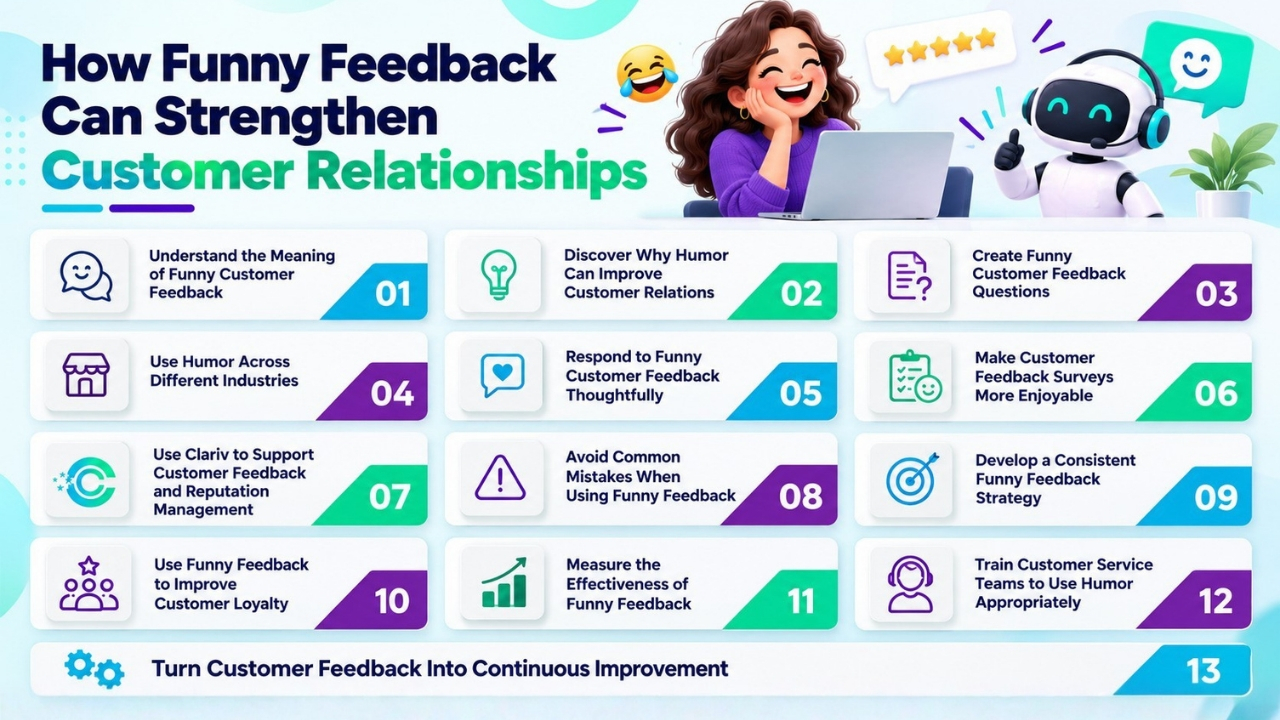
1. Understand the Meaning of Funny Customer Feedback
Funny customer feedback involves businesses using funny language, amusing questions, and funny responses that makes sharing opinions for customers more enjoyable.
Rather than relying only on formal surveys, businesses can use humor to create a friendly tone with customers and encourage them to communicate openly.
- Make surveys more engaging: Businesses must make surveys more engaging by replacing general questions with funny words that encourage customers to participate.
- Encourage honest opinions: Businesses must encourage honest opinions by using friendly prompts that help customers to share positive experiences and aspects that require improvement.
- Develop a recognizable brand voice: Businesses must develop a recognizable brand voice by consistently using appropriate humor while communicating with customers as this makes the conversation more personal.
- Keep feedback useful: Businesses must ensure that every funny thing still helps the businesses to understand customer needs.
For example, a restaurant could ask, “Was your meal a five-star masterpiece, or do our fries need a little more fame?” Such questions add personality and also encourage customers to check their dining experience.
Also Read: Funny Google Reviews How Humour Can Boost Your Restaurants Reputation
2. Discover Why Humor Can Improve Customer Relations
When businesses use humor they can make their conversations with customers more warm and less formal. As the customers regularly receive automated emails, standard surveys, and repetitive messages, a thoughtful joke can help your brand to stand out.
- Make feedback approachable: Businesses can make feedback more approachable by using a playful introduction that encourages customers to complete surveys which otherwise customers may ignore.
- Create personal connections: When businesses use friendly language can make businesses appear more relatable and let customers feel personally connected.
- Encourage conversations: Using interesting questions in feedback gives customers an easy way to share their experiences.
- Improve brand recall: Using memorable messages help customers to remember or recall your brand.
- Reduce the pressure of criticism: Using constructive, friendly questions may make it easier for customers to explain the aspects that didn’t work well for them.
For instance, a clothing retailer might ask, “Did your new outfit arrive ready for its fashion debut?” Customers can then respond about product quality, sizing, delivery, or packaging.
However, using funny language cannot be equal to reliable services. So it is essential for businesses to resolve problems, provide correct information, and treat every customer respectfully.
Also Read: Client Review Platform for Legal Services
3. Create Funny Customer Feedback Questions
Words which restaurants use while requesting feedback from customers can affect the way customers respond. Businesses using short, clear, and valid questions are more effective than complex jokes as it can distract customers from the core purpose of the survey.
Businesses can use these examples to encourage participation:
- Customer satisfaction: “Did we make your day, or is there room for a little magic?”
- Shopping experience: “Did you find everything you needed, or did our store send you on a treasure hunt?”
- Product quality: “Is your new purchase a keeper, or does it need a makeover?”
- Website usability: “Was checkout a breeze, or did it feel like solving a puzzle?”
- Customer support: “Did our team save the day, or do we owe you a better solution?”
- Future improvements: “What could we fix before your next visit?”
Businesses must use humorous questions with rating scales and optional comment fields. It allows customers to provide their feedback while explaining their answers in their own words.
Also Read: How to Use Customer Feedback to Grow Your Business
4. Use Humor Across Different Industries
Humor works for different audiences differently based on the product and customer situation. Businesses must use language that is well suited for their customers and for their brand.
- Restaurants and cafés: Ask, “Which dish deserves a standing ovation?” or “Did our coffee wake you up, or should we have added another espresso shot?”
- Retail stores: Use questions such as, “Did you find your perfect match today?” to collect opinions about products and shopping assistance.
- Online businesses: Ask, “Did checkout go smoothly, or did our payment page need a little polishing?” to identify usability problems.
- Software companies: Try, “Did the feature work as expected, or did it have other plans?” to encourage useful product feedback.
- Hospitality businesses: Ask, “Did your stay feel like a relaxing escape, or is there something we could improve?” to gather guest opinions.
The humor should be suitable as per the specific customer experience and must feel natural as per the situation. For instance, businesses should avoid joking about serious payment failures, safety problems, or significant service problems.
Also Read: How to Track Customer Feedback in Real-time
5. Respond to Funny Customer Feedback Thoughtfully
Within customer comments may have jokes, compliments, sarcasm, or frustration. So it is essential for businesses to understand the tone behind each customer comment before deciding how to respond.
- Responding to praise: If a customer says, “Your chocolate cake was so good that I considered hiding it from my family,” a friendly reply could be, “We promise not to tell! We’re delighted you enjoyed the cake.”
- Responding to constructive criticism: If someone says finding the return policy felt like a treasure hunt, acknowledge the difficulty and explain that the business will review how easily customers can find the information.
- Responding to negative feedback: If an order arrives late, apologize, acknowledge the inconvenience, and explain how the customer can receive assistance.
- Responding to sarcasm: If a customer jokes about contacting support four times, recognize the repeated effort and investigate why the issue was not resolved sooner.
The best responses from businesses should reflect their brand and also be accountable. Being funny and less formal can strengthen an interaction, but it is equally essential for businesses to be empathetic and provide practical solutions if the customer is not happy.
Also Read: How to Respond to Negative Customer Reviews
6. Make Customer Feedback Surveys More Enjoyable
Surveys help businesses to monitor customer satisfaction levels, identify service problems, and find opportunities to make improvements in their services.
Using humor in customer feedback surveys makes this process more engaging while the questions should be clear and easy to answer.
- Keep questions short: They must keep questions short by using short, playful words rather than long jokes.
- Provide clear answer options: Use a humorous question with a simple rating scale.
- Include optional comments: Businesses must let customers explain their experiences without requiring any lengthy responses.
- Test different approaches: They must test different survey approaches, one using playful survey words with straightforward words to see which approaches produce more useful feedback.
- Avoid excessive humor: Using too many jokes can make a survey both tiring or confusing.
For example, ask, “How smooth was your checkout experience?” and offer ratings ranging from very difficult to very easy.
Businesses must track survey completion levels, response quality, and the usefulness of the information collected. Even though a high response rate is essential but impactful customer feedback is what helps businesses to improve.
Also Read: How AI Can Analyze Customer Feedback
7. Use Clariv to Support Customer Feedback and Reputation Management
Collecting customer opinions is just the beginning for businesses, they need to understand customer sentiment, recognize recurring problems, and respond consistently across all channels.
Clariv supports customer feedback and reputation management by helping organizations to understand customer sentiment across all channels. These insights help teams to identify common themes, improve conversations with customers and plan customer engagement more effectively.
Businesses can connect these insights with their funny feedback strategy in several ways:
- Understand customer sentiment: It helps businesses to understand customer sentiment as it helps to review positive comments, neutral opinions, and complaints to find the way customers perceive different aspects of the business.
- Identify recurring concerns: When customers repeatedly joke about the return policy requiring an early expedition, then they must check and analyze website navigation rather than considering comments as jokes.
- Improve response consistency: Use a recognizable brand voice while choosing an appropriate tone for each situation.
- Learn from reviews: It helps businesses to identify repeated praise about staff friendliness or repeated customer complaints about slow service.
- Turn feedback into action: Businesses must focus on problems, assign follow-up responsibilities, and reveal later customer feedback to check whether their improvements helped.
For example, customers may appreciate friendly staff but repeatedly mention long checkout queues. It is essential for businesses to recognize themes that help businesses to preserve their strengths and also address essential service problems.
Clariv’s current features, supported platforms, reporting options, and integrations should be verified before selecting a specific workflow. While the goal is to use insights to improve customer experiences and not simply to collect entertaining comments.
Also Read: Online Reputation Management Complete Guide
8. Avoid Common Mistakes When Using Funny Feedback
Although using humor can help businesses to improve conversations with customers, careless jokes may make customers feel ignored or disrespected. It is essential for businesses to consider the context and seriousness of every interaction.
- Do not mock customers: Businesses must not mock customers and avoid joking about personal circumstances, mistakes, or technical knowledge.
- Do not joke about serious complaints: Businesses must not joke about customer problems regarding billing, privacy, safety, accessibility, or major service failure that require respectful communication.
- Avoid confusing wording: Businesses should avoid using confusing words rather customers should understand the queries without interpreting with complex words.
- Respect different preferences: Not every customer enjoys the same humor or conversation style so businesses should consider and respect different customer preferences.
- Address the actual issue: Just sending a witty response cannot address the actual customer problem, provide assistance, or a refund when appropriate.
- Avoid repetitive scripts: Businesses using general jokes can sound insincere if it does not match with the message of the customer.
- Encourage honest reviews: Businesses should not pressurize customers to give positive ratings about products or services.
- Keep promises realistic: Businesses must never claim that a customer problem has been resolved unless the necessary action has been completed.
Customers must review public responses as potential customers may also read them. Being professional and solution-based communication with customers can show that businesses take customer feedback seriously.
Also Read: Social Media Management Tools for Non-Profits
9. Develop a Consistent Funny Feedback Strategy
Having a successful customer feedback strategy involves using creativity with a commitment to customer satisfaction. Businesses do not require to make every interaction funny, rather they should identify suitable opportunities to adapt their approach to the audience.
- Understand your audience: Businesses may understand your audience by considering customer preferences, communication habits, and the type of services provided.
- Match humor to the situation: Businesses must use humor as per the situation while conducting routine surveys and positive interactions, but businesses must be empathetic while addressing customer complaints.
- Keep messages relevant: They must keep messages relevant by connecting humor to the product, service, or question.
- Make participation easy: Businesses must make participation easily by providing accessible forms, clear rating scales, and optional comment fields.
- Encourage honest opinions: Businesses must encourage customers to describe both positive experiences and their problems.
- Respond promptly: Businesses must respond quickly as timely replies show that customer feedback matters.
- Look for patterns: Businesses must review customer comments collectively to identify recurring problems and find recurring customer problems and find opportunities.
- Measure results: Businesses must measure results by tracking survey completion, sentiment patterns, complaint resolution, and customer satisfaction.
- Train employees: Businesses must train staff members to use humor whenever it is appropriate.
- Refine the approach: Businesses must use words appropriately based on customer reactions and feedback quality.
Following a consistent feedback strategy helps businesses to maintain a friendly brand voice by maintaining professionalism.
Also Read: Brand Reputation Management Software
10. Use Funny Feedback to Improve Customer Loyalty
Customer loyalty is built through positive experiences, reliable services, and consistent communication with customers. Using humor can help businesses to make interactions more memorable, but businesses must also show that customer opinions prompt them to make impactful improvements.
- Recognize customer preferences: Understand customer preferences from their feedback to know what customers appreciate about products and services.
- Improve weak areas: Businesses must address and resolve recurring problems faced by the customers around delivery, checkout, communication, or product quality.
- Personalize communication: Businesses must personalize their conversation with customers by personalizing messages as per the situation instead of sending the same jokes to every customer.
- Show appreciation: Businesses must thank customers for taking the time to share honest opinions.
- Follow up on improvements: Businesses must explain valid changes while doing so helps customers to understand that their customer feedback was considered.
For instance, if customers continuously mention that your website is difficult to navigate, then simplifying the layout can help to build customer loyalty rather than sending them a funny survey.
Businesses can use feedback insights, supported by Clariv that helps to connect customer opinions with practical decisions. Over time, this approach can help to create a more responsive and customer-based organization.
Also Read: Restaurant Review Sentiment Analysis
11. Measure the Effectiveness of Funny Feedback
Businesses should check if the humor used is improving customer participation and customer feedback quality instead of assuming that funny messages instantly produce better results.
- Survey response rate: Businesses must compare the number of customers who respond to playful and standard requests.
- Survey completion rate: Businesses must measure the number of customers who finish the feedback form.
- Feedback quality: Businesses must review feedback quality if customer comments include useful details about products, service, and customer expectations.
- Customer sentiment: Businesses must track changes in customer sentiments in both positive and negative feedback themes.
- Complaint resolution: Businesses must track how efficiently businesses are addressing the problems raised by the customer and resolving their problems.
- Customer satisfaction: Businesses must use adequate surveys and follow-up questions to understand if the customer experiences are improving.
- Engagement: Businesses must review customer engagement by reviewing relevant interactions, responses, and customer participation.
Testing different message phrases can help businesses to identify what works well for a specific audience. They must also compare results over certain periods and avoid drawing conclusions from a small number of responses.
The purpose of tracking customer responses is to understand whether humor makes feedback more useful and makes communication with customers more effective.
Also Read: Customer Sentiment Platform Vs Traditional Surveys
12. Train Customer Service Teams to Use Humor Appropriately
Businesses must train their staff to decide whether a customer interaction feels welcoming or dismissive. Staff training helps teams to use humor carefully and also maintain standard services consistently.
- Recognize customer tone: They must recognize if the customer is joking, criticizing, or expressing genuine frustration.
- Prioritize empathy: They must acknowledge customer problems before considering a warm response.
- Use natural language: They must avoid forcibly using jokes into conversations where they do not fit.
- Know when to be direct: Serious customer problems require clear explanations and need businesses to take appropriate action.
- Escalate when necessary: Staff members should know when a problem needs a supervisor or specialist.
Providing training to staff members can help staff members to develop confidence instead of depending on scripts. The objective is not to make every response funny, but to make every response appropriate, respectful, and helpful.
Also Read: AI Tools to Analyze Customer Reviews
13. Turn Customer Feedback Into Continuous Improvement
Funny feedback is most valuable when it becomes part of a wider customer experience strategy. Businesses can use communication to encourage more participation, and analyze their responses and take practical action.
- Collect feedback: Use surveys, reviews, support conversations, and other relevant channels.
- Organize responses: Group comments by themes such as product quality, service, delivery, and usability.
- Identify priorities: Focus on recurring concerns and issues with a meaningful effect on customers.
- Assign responsibilities: Make sure teams know who will investigate and address each issue.
- Implement improvements: Update processes, clarify instructions, improve service, or fix product problems where appropriate.
- Review the results: Collect further feedback to determine whether the changes helped.
- Maintain a suitable tone: Continue using humor where it supports engagement, while keeping serious communication direct and respectful.
Tools such as Clariv may support parts of feedback and reputation management, depending on the capabilities and integrations available. Businesses should verify those details and choose workflows that suit their needs.
Ultimately, funny feedback is not about making customers laugh. Rather it is about making conversations approachable, listening carefully, and using customer opinions to create better experiences.
When businesses combine thoughtful humor, useful feedback questions, consistent responses, and continuous improvement, can strengthen customer relations while maintaining trust and professionalism.
Conclusion
Funny feedback can make customer communication more engaging, encourage honest opinions, and help businesses develop more approachable relationships with their audiences.
Through playful survey questions, witty responses to positive reviews, and lighthearted follow-up messages can add brand personality to regular interactions if used thoughtfully.
However, humor should always support the customer experience instead of distracting customers from the interactions. When customers raise genuine problems, then businesses need to listen carefully, respond with empathy, and take appropriate action. Sending a clever reply may create a memorable moment but resolving the underlying problem is what builds long-term trust.
Businesses can strengthen this process by reviewing feedback consistently, identifying recurring themes, and measuring whether changes improve customer satisfaction. Clariv can support feedback and reputation management by helping organizations understand customer sentiment across supported channels and recognize areas that may require attention.
By combining respectful humor, actionable customer insights, and consistent follow-up, businesses can create a feedback strategy that feels human while delivering practical value. The ultimate goal is simple: make customers comfortable sharing their opinions, show them those opinions matter, and use what they learn to create better experiences.
If you still have any query about funny feedback and how humor can improve customer relations then you may write to us at Clariv and we are more than happy to assist you.