You put in the work. But when a potential customer searches your business on Google, the first thing they see isn’t your website or your team, it’s your reviews. And those reviews are either bringing people in or pushing them away.
But, most businesses don’t have a real system for managing this.
- A negative review goes unnoticed for days.
- Patterns in customer feedback get missed.
- And opportunities to improve and rank higher slip through the cracks.
Google reviews aren’t just about reputation. They directly impact your local search rankings, your click-through rates, and your revenue.
The businesses that are actually winning on Google local search aren’t doing anything magical. They’re just paying attention. They have a system that tells them what customers are saying, flags issues early, and helps them respond before small problems become big ones.
That’s what good review management software does. Not just alerts and templates but real visibility into customer sentiment, so you’re always one step ahead.
This guide breaks down how to actually monitor your reviews, respond in a way that builds trust, and turn your review strategy into something that moves the needle on your Google rankings.
Also Read: Restaurant Review Sentiment Analysis
The Real Cost of Not Managing Your Reviews
Most businesses don’t ignore their reviews on purpose. It just falls through the cracks. Someone meant to respond. Nobody flagged it. The week got busy. And before you know it, you have a string of unanswered reviews sitting on your Google profile, some of them not great, and no one’s touched them.
That silence is costing you more than you think.
1. Customers read reviews. Almost all of them
93% of consumers say online reviews influence their purchase decisions. That’s not a small segment of cautious buyers; that’s essentially everyone. And when they land on your Google profile and see negative reviews with no response, they don’t give you the benefit of the doubt. They move on.
2. One bad review left unaddressed does disproportionate damage
It’s not just about the rating. It’s about what your silence signals. 53% of customers expect businesses to respond to negative reviews within a week, but more telling is this: 63% say a business has never responded to their review at all. That’s a massive gap between what customers expect and what most businesses actually deliver.
And when that gap shows up publicly on Google? It reads as indifference.
3. Your rating has a direct impact on revenue, and the drop-off is steep
Businesses risk losing up to 22% of customers when just one negative article or review is found by users doing research. That number jumps to 44% with two negative results, and 59% with three. The compounding effect is real, and it accelerates faster than most business owners expect.
On the flip side, a one-star improvement in your rating can lead to a 5–9% increase in revenue. The difference between a 3.8 and a 4.2 isn’t just aesthetic. It’s financial.
4. Negative reviews that go unresponded to rank too
Here’s what most people don’t realize: Google doesn’t just show your reviews to people actively searching for you. Negative reviews surface in broader local searches. And unlike a social media post, they don’t disappear after 48 hours. A harsh review from 18 months ago that never got a response is still sitting there, still visible, still shaping first impressions.
Businesses that respond to reviews are 1.7x more trustworthy than businesses that don’t, according to Google’s own research. That alone should be reason enough.
And while you’re not watching, your competitors are.
The businesses showing up above you in local search results aren’t necessarily better than you. They’re just more consistent. They’re responding to reviews, generating new ones regularly, and using that activity as a signal to Google that they’re an active, credible business. Review management has quietly become a competitive moat, and most businesses don’t even realize the race is happening.
The good news is that none of this requires a massive effort. It requires a system. And that’s exactly what the right review management software gives you: visibility, structure, and the ability to act before small issues become reputation problems.
Also Read: Sentiment Analysis Demo
What Is Google Review Management Software And What Should It Actually Do?
If you search Google for review management software right now, you’ll find dozens of tools promising roughly the same thing. Monitor your ratings. Respond faster. Collect more reviews. They all look similar on the surface.
But there’s a real difference between a tool that helps you react to reviews and a platform that helps you understand them. Most businesses settle for the former without realizing the latter exists.
So, what should review management software actually do for your business?
- At minimum, it should centralize everything, every review, every location, in one place. No manual checking. No missed feedback. The moment a review goes live, you know about it.
- Beyond that, it should help you make sense of what customers are saying. Star ratings only tell half the story. Good software, powered by AI and sentiment analysis, reads the language inside reviews and surfaces the patterns.
- And finally, it should give you reportable data over time, not just individual reviews, but trends, which locations are underperforming, what topics keep coming up, and whether things are improving or declining quarter over quarter.
The businesses getting the most out of review management aren’t using it just to respond faster. They’re using it as a customer intelligence tool. That’s the standard worth looking for.
How Google Review Management Software Works And How It Actually Helps Your Business?
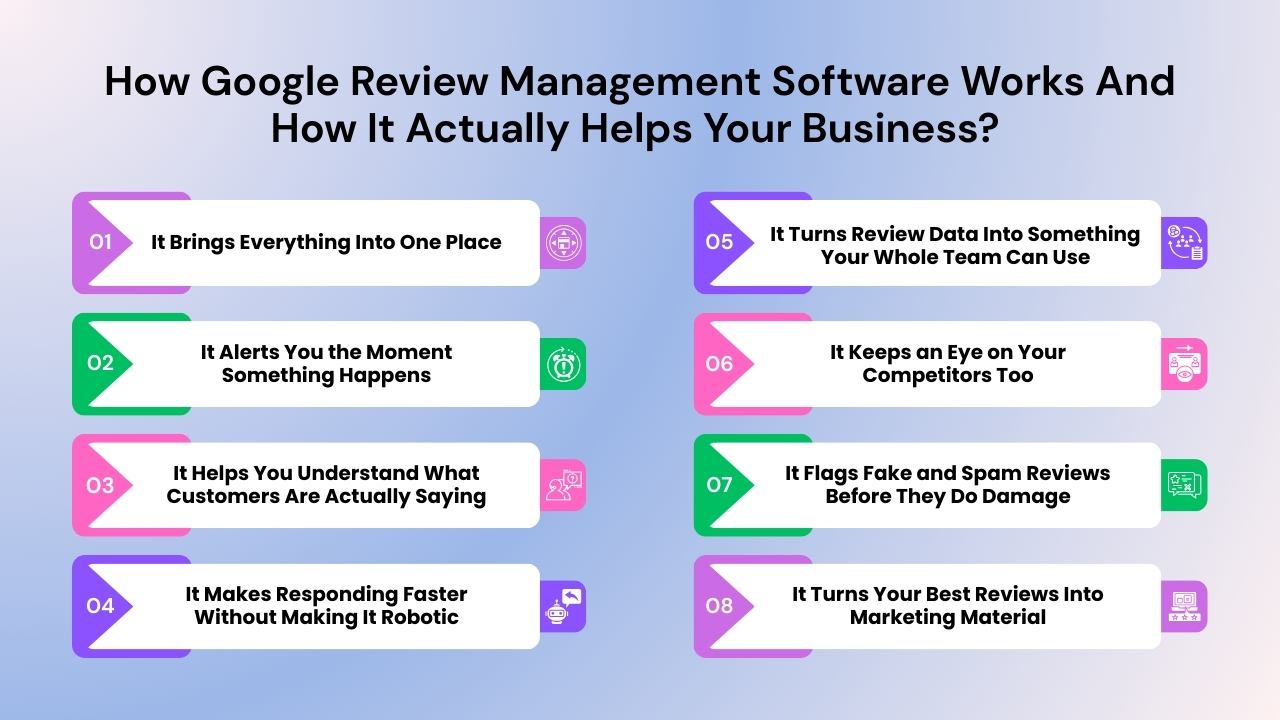
Knowing you need to manage reviews is one thing. Having a system that does it without eating up your day is another. Here’s how the right software works in practice and what it actually changes for your business.
1. It Brings Everything Into One Place
Without a tool, you’re logging into Google Business Profile manually, checking each location separately, and hoping nothing slips through. With review management software, every review across every location, every branch lands in a single dashboard.
Think about a business running five locations across the city. Before, the marketing manager was spending hours each week just finding reviews, let alone responding to them. With centralized monitoring, that same task takes minutes. Nothing gets missed. Nothing sits unread for a week. And when something does need your attention, you’ll know about it immediately.”
2. It Alerts You the Moment Something Happens
Timing matters. A negative review responded to within 24 hours reads very differently to a potential customer than one that sat ignored for two weeks. Good software sends you real-time alerts the moment a review goes live, so you’re always in a position to respond while the conversation is still relevant.
3. It Helps You Understand What Customers Are Actually Saying
This is where things get genuinely useful. Star ratings give you a number. Sentiment analysis gives you the story behind it.
Instead of manually reading through hundreds of reviews trying to spot a pattern, AI-powered platforms analyze the language, emotion, and context inside every review. You start seeing things like customers love the product but consistently mention long wait times. Or a specific location keeps getting flagged for staff behaviour, while others are fine.
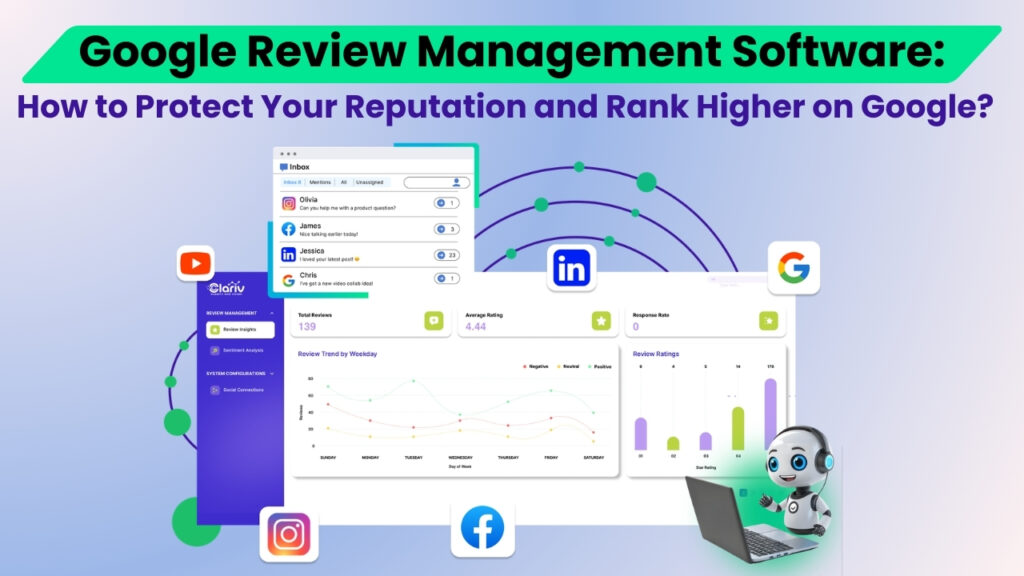
This is where a platform like Clariv changes the game. Clariv’s AI and ML engine processes customer feedback at scale and surfaces exactly these kinds of insights, not just what customers are saying, but what they’re feeling and which parts of your business it’s pointing to.
Also Read: How to Measure Customer Sentiment
4. It Makes Responding Faster Without Making It Robotic
Many review management and customer sentiment analysis platform comes with response management features as well that let you move quickly without sacrificing quality. Some platforms suggest responses based on the review content, giving you a solid starting point that you can personalize in seconds rather than starting from scratch every time.
A retail brand responding to 200+ reviews a month isn’t writing each one from the ground up. They’re using smart templates as a foundation and adding just enough personalization to make each response feel genuine. The customer feels heard. The Google algorithm sees consistent engagement. Everyone wins.
Clariv’s response features help you move fast without sounding like a template, so customers feel genuinely heard, and your response rate keeps signaling to Google that you’re an active, engaged business.
5. It Turns Review Data Into Something Your Whole Team Can Use
Good software generates reports that go beyond ratings. Trend lines, recurring themes, location comparisons, and sentiment shifts over time. When that data is in front of the right people, your ops team, your CX lead, your product manager, it stops being a reputation metric and starts being a business intelligence tool.
Clariv is built with exactly this in mind. The insights it surfaces don’t just sit in a marketing dashboard; they’re actionable across teams. If three locations are consistently getting feedback about the same issue, that’s an operations conversation, not a PR one. Clariv makes sure that conversation happens with data behind it, not just a gut feeling.
Also Read: Restaurant Review Sentiment Analysis
6. It Keeps an Eye on Your Competitors Too
Knowing your rating dropped from 4.3 to 4.1 is useful. Knowing your closest competitor climbed from 4.0 to 4.4 in the same period is more useful.
Good review management software lets you benchmark your performance against competitors in your area, tracking their review volume, rating trends, and response activity. So when a competitor starts gaining ground, you’re not finding out three months later when you notice a dip in leads. You’re seeing it in real time and adjusting.
7. It Flags Fake and Spam Reviews Before They Do Damage
Not every negative review is a genuine customer experience. Spam reviews, fake reviews from competitors, or reviews that clearly violate Google’s policies are more common than most businesses realise, and if left unaddressed, they sit on your profile doing damage they don’t deserve to do.
The right software identifies suspicious review patterns and makes it easy to flag and report them through the right channels. It’s not about gaming the system; it’s about making sure the reviews on your profile actually reflect your real customers.
8. It Turns Your Best Reviews Into Marketing Material
Your happiest customers are saying great things about you. Most businesses leave that sitting on Google and never do anything with it. Review management software with widget and social proof integration lets you pull your best reviews directly onto your website, into email campaigns, or across social channels.
A homepage that shows live, real customer reviews builds more trust in ten seconds than a carefully crafted headline ever could. And when those reviews are being updated automatically as new ones come in, it stays fresh without any manual effort.
Still reading through hundreds of reviews manually?
Clariv’s AI does that work for you, spotting patterns, tracking sentiment, and flagging what actually needs your attention. Try it free for 14 days. No credit card required.
Start Free Trial →
How to Choose the Right Google Review Management Software & What to Avoid
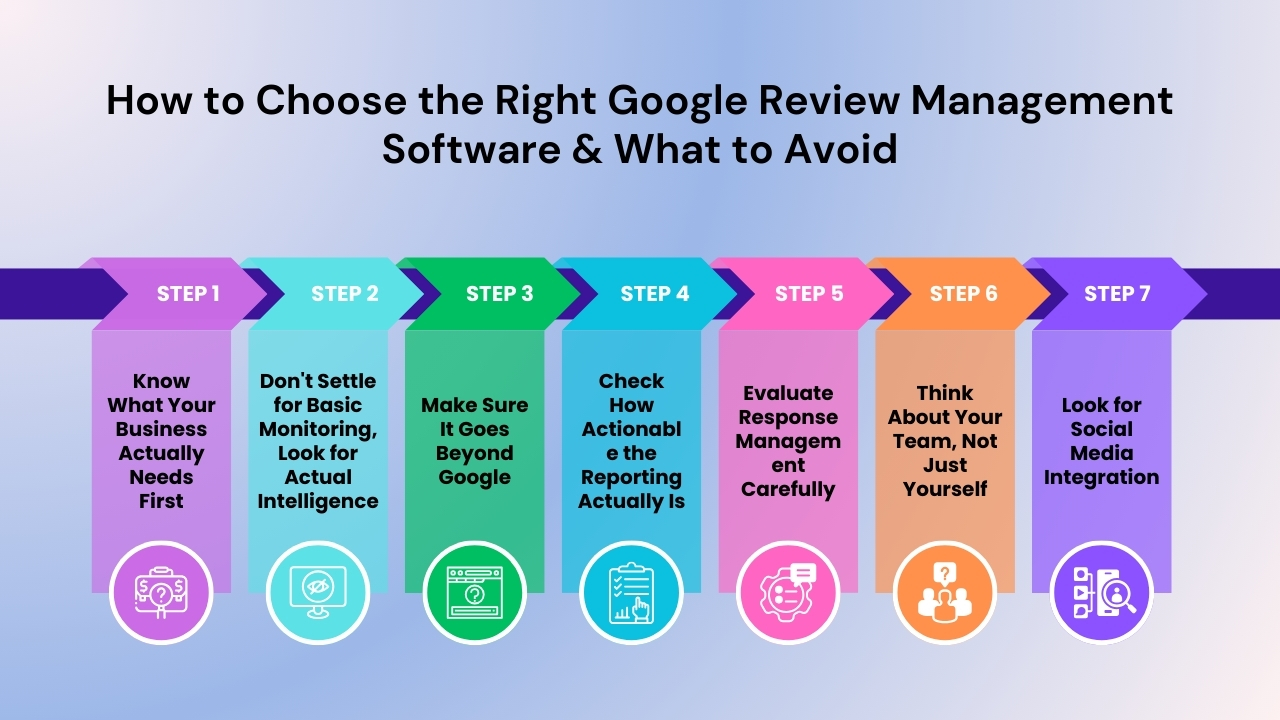
By now, you know what good review management looks like. The harder question is, how do you actually pick the right platform when every tool out there is making the same promises?
Here’s what to actually look for. And what should make you walk away?
1. Know What Your Business Actually Needs First
A single-location café and a 50-location retail chain don’t need the same tool. Before you start comparing platforms, get clear on your own requirements, how many locations you’re managing, how many reviews you’re getting monthly, how many team members need access, and what platforms your customers are most active on. A tool that’s perfect for a small business might completely fall apart at scale. You think long-term and make a decision accordingly.
2. Don’t Settle for Basic Monitoring, Look for Actual Intelligence
A lot of platforms will tell you when a new review comes in. That’s table stakes. What you want is a platform that tells you what customers are feeling, why they’re feeling it, and where in your business it’s coming from. That requires real AI and ML capability, not just keyword flagging or sentiment tagging that puts reviews in a positive or negative bucket and calls it a day.
The difference between surface-level monitoring and genuine sentiment analysis is the difference between knowing your rating dropped and knowing why it dropped.
3. Make Sure It Goes Beyond Google
Your customers don’t only talk on Google. They’re leaving feedback on Yelp, Trustpilot, Facebook, and industry-specific platforms, and if your software is only watching one channel, you’re getting an incomplete picture. Look for a platform that consolidates feedback from every relevant source so nothing slips through.
4. Check How Actionable the Reporting Actually Is
Pretty dashboards are easy to build. Useful ones are harder. Ask yourself, can I take this report and make a real business decision from it? Can my ops team use this? Can my CX lead act on it? If the reporting only tells you what your rating is and how many reviews you got this month, it’s not doing enough. You want trend analysis, sentiment breakdowns, location comparisons, and topic-level insights.
5. Evaluate Response Management Carefully
Speed and personalization both matter. Look for a platform that makes responding fast without making it robotic, offers smart suggestions, offers customizable templates, and provides enough context about each review that your response can actually be relevant. If the tool is pushing you toward copy-paste responses, customers will notice. So will Google.
6. Think About Your Team, Not Just Yourself
If review management sits with one person, it will always be inconsistent. Look for platforms that support team collaboration, role-based access, response approval workflows, and location-level assignments. As your business grows, you need a system that scales with it without creating chaos.
7. Look for Social Media Integration
Reviews and social media are two sides of the same coin — both are places where customers talk about your business publicly. A platform that brings both together gives you a complete picture of customer sentiment, not just a slice of it. Being able to analyze what customers are saying across review platforms and social channels in one place is a significant advantage most businesses haven’t tapped into yet.
Also Read: The Best Social Media Management Tools for Non-Profits
Red Flags to Walk Away From
1. They promise to remove negative reviews
No legitimate platform can remove genuine negative reviews from Google. If a tool is making this promise, it’s either misleading you or using tactics that violate Google’s policies, both of which will hurt you in the long run. Negative reviews need to be responded to and learned from, not deleted.
2. A UI your team won’t actually use
The best software in the world is useless if it’s too clunky to use consistently. If the demo feels complicated, the day-to-day experience will be worse. Your team needs to be able to jump in, find what they need, and act on it quickly without a two-hour training session every time someone new joins.
3. Review generation tactics that violate Google’s policies
Some platforms encourage incentivized reviews, bulk review requests, or other tactics that sit in a grey area or straight up violate Google’s guidelines. Getting caught doing this can result in your reviews being removed or your Business Profile being penalized. Make sure the platform you choose generates reviews through legitimate, policy-compliant methods only.
4. Lock-in contracts with no trial or demo
Any platform confident in what it delivers will let you see it in action before signing a contract. If a vendor is pushing you toward a long-term commitment without giving you a proper trial or demo, that’s a sign. The good platforms let the product speak for itself.
So What Does the Right Platform Actually Look Like?
It looks like something that brings your entire reputation picture together, reviews across Google and every other platform, social media sentiment, customer feedback trends, all in one place, powered by AI that actually understands what your customers are saying.
That’s exactly what Clariv is built to do.
Clariv is an AI-powered customer sentiment analysis platform that helps businesses manage reviews seamlessly across Google and other platforms, but it doesn’t stop there. Clariv also integrates social media management with customer sentiment analysis, so you’re not just tracking what people say in reviews, you’re understanding the full conversation happening around your brand across every channel and managing it better.
For a business owner who wants one intelligent platform instead of three separate tools stitched together, Clariv brings it all under one roof: review monitoring, sentiment analysis, social media insights, and actionable reporting that your whole team can use.
It checks every box on this list. And more importantly, it’s built for the way businesses actually operate, not just the way software companies think they do.
If you want to see what this looks like in your own business, Clariv offers a free 14-day trial, no credit card, no commitment. Just start and see what your customers are really telling you.
Conclusion
The businesses that win on Google local search aren’t doing anything extraordinary. They’re just paying attention consistently. They respond when customers talk. They catch patterns before they become problems. They use feedback as a signal, not a threat. And over time, that consistency compounds into better rankings, stronger trust, and more customers walking through the door.
Review management isn’t a marketing task you tick off once a quarter. It’s an ongoing conversation between your business and your customers. And the smarter your tools, the better that conversation goes.
If you’re just looking to start somewhere, check out Clariv’s 14-day trial. No credit card. No commitments. Just a clearer picture of what your customers are really saying.