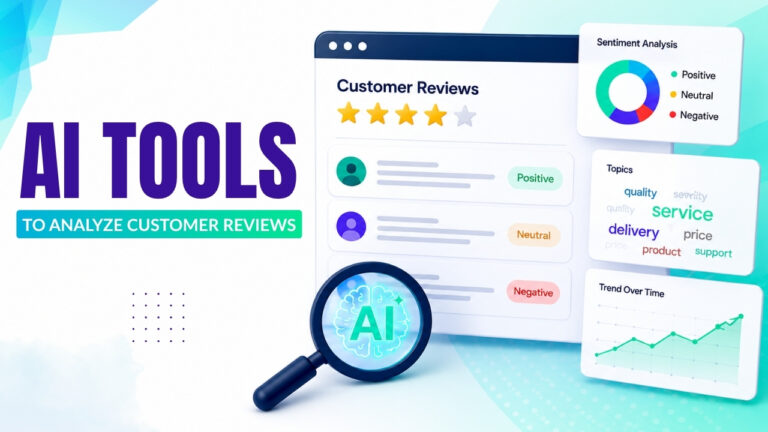
Customer feedback used to be manageable.
A few dozen reviews a month. A handful of support emails. You could actually sit down, read through it, and walk away with a clear sense of what people thought.
That’s not the world anymore.
Today, feedback comes from everywhere: Google reviews, app stores, support tickets, social comments, post-purchase surveys, chatbot transcripts, and return forms. The volume is overwhelming. And somewhere inside all of that noise is the exact reason customers are churning, the product fix that would’ve taken two weeks to build, the complaint that’s about to go viral.
AI is changing all of that. Here’s How?
Not in a complicated, hard-to-implement way, but in a way that’s making businesses genuinely smarter about their customers than they’ve ever been. Faster too. We’re talking about going from “we think customers are frustrated with checkout” to knowing exactly which step, exactly how many people, and exactly what they said about it.
That kind of clarity changes decisions. And decisions change businesses.
Here’s exactly how it works and how you can start using it.
Also Read: How AI Sentiment Analysis Turns Customer Feedback into Growth Opportunities
Why AI For Customer Feedback Analysis?
Analyzing customer feedback manually made sense when the volume was manageable. But today, the average business receives feedback across six to eight different channels simultaneously. By the time your team has sorted through it, tagged it, and summarized it, the moment to act on it has already passed.
AI doesn’t just speed that process up. It fundamentally changes what’s possible.
Here’s what AI brings to the table that traditional analysis simply can’t:
- It reads everything, not just a sample. Manual analysis means someone picks the most recent 50 reviews and calls them representative. AI processes every single piece of feedback, across every platform, every language, every channel, without missing a word. When you’re making product or marketing decisions, that difference matters enormously.
- It understands context, not just keywords. A customer saying, I can’t believe how fast the delivery was, and I can’t believe how fast my package got damaged are both using the word fast. A keyword tool treats them the same. AI understands the difference and categorizes sentiment accurately because it reads meaning, not just words.
- It catches problems before they become expensive. According to Qualtrics, companies that act on customer feedback in real time see a 77% higher customer retention rate than those that don’t. AI makes real-time analysis possible at scale, flagging emerging complaints weeks before they show up in your churn numbers.
- The volume of feedback is only growing. Globally, over 2.5 quintillion bytes of data are created every day, and a significant portion of it is customer-generated opinion. Businesses that can’t process that volume fast enough will always be reacting instead of leading, and will lose the edge to competitors.
- Customers expect you to already know. A study by Microsoft found that 77% of customers have a more favorable view of brands that actively seek out and apply customer feedback. The bar isn’t just collecting it anymore, it’s visibly acting on it.
- The ROI is hard to ignore. Companies that invest in AI-driven customer experience analysis see an average revenue increase of 10–15% while simultaneously reducing customer service costs by up to 20%.
- Human analysis doesn’t scale, and it’s inconsistent. Two analysts reading the same feedback will categorize it differently depending on the day, their mood, and their own biases. AI applies the same logic every single time, across a million data points, with zero fatigue.
AI has turned customer feedback software for small businesses into an easy and quick process. It provides businesses with a competitive advantage, and the gap between businesses using it well and those still doing it manually is only getting wider.
Also Read: How to Manage Online Reviews For Your Business
Manual Customer Feedback Analysis vs AI Customer Feedback Analysis
For years, manual analysis was the only option, and businesses made it work. Someone on the team would go through the reviews, tag the common themes, build a spreadsheet, and present a summary. It was slow, but it worked out well before 2020.
But things have changed in 2026. The volume is higher. The channels are more. The decisions are faster. And the cost of missing a signal is higher than it’s ever been.
Here’s an honest, side-by-side look at where the two approaches stand today:
| Factor | Manual Analysis | AI Analysis |
| Speed | Your team needs days, sometimes weeks, to get through. | AI works through it in real-time and automatically. |
| Volume | You read what you can, skip the rest, and cross your fingers | AI reads every single piece of feedback; nothing gets skipped |
| Consistency | Two analysts read the same review and categorize it differently. | AI applies the same logic every time, whether it’s processing 100 reviews or 100,000 |
| Sentiment accuracy | Catches the obvious. E.g., a one-star review is clearly bad. But misses the 4-star review where the customer is quietly frustrated about one specific thing | Understands context, tone, and even sarcasm. It reads what the customer actually meant, not just what they typed |
| Channel coverage | Most teams focus on one or two channels because of time constraints. | Pulls from every channel simultaneously all in one place |
| Cost at scale | Every time your feedback volume grows, your analysis cost grows with it | The cost stays relatively flat even as your volume doubles or triples |
| Pattern detection | By the time a pattern is spotted manually, it’s already a problem you’re reacting to | AI flags emerging trends early, often weeks before they show up |
| Language support | You’re limited to whatever languages your team speaks | AI handles dozens of languages without breaking a sweat |
| Actionable output | You get a summary report that tells you what happened, but not always what to do about it | You get specific insights tied to specific decisions. Here’s the problem, here’s where it’s coming from, here’s what needs to change |
| Scalability | Works fine when you’re small, but starts struggling the moment you grow | Built to handle scale, the more feedback you feed it, the smarter and more accurate it gets |
The difference isn’t marginal. It makes sure that the decision is based on everything your customers are saying, not just the fraction your team had time to read.
Also Read: Google Review Management Software
What AI Actually Does With Feedback (No Fluff) and How It Helps?
Most people assume AI just reads feedback faster. That’s the smallest part of what it actually does.
When you run your customer feedback through AI, here’s what’s actually happening under the hood and more importantly, what it means for your business:
1. It Breaks Down Sentiment Beyond “Good” or “Bad”
Traditional analysis gives you a score. AI gives you a story.
Instead of telling you “sentiment is 72% positive this month,” AI tells you that customers love your product quality but are consistently frustrated with your delivery experience and that frustration has been getting worse over the last six weeks.
That’s the accuracy that you with AI customer sentiment analysis tool.
How it helps: Your team stops guessing which part of the experience to fix and starts working on exactly what’s hurting you.
2. It Finds Patterns Across Thousands of Responses
One customer complaining about your checkout process is an isolated incident. Two hundred customers mentioning it across different platforms in different words is a pattern and a problem.
AI connects those dots automatically. It groups similar feedback together, even when customers describe the same issue in completely different ways, and surfaces it as a trend worth paying attention to.
How it helps: You catch recurring problems early, before they turn into a surge in churn, a spike in support tickets, or a public complaint that gains traction.
3. It Reads Every Channel at Once
Your customers don’t stick to one platform. They leave a Google review, send a support ticket, fill out your NPS survey, and post a comment on Instagram, sometimes about the same experience.
AI pulls all of that together in one place and analyzes it as a whole picture, not separate silos.
How it helps: You stop making decisions based on one channel’s feedback and start seeing the full, unfiltered picture of what your customers actually think.
4. It Detects Problems Before They Become Crises
This is the one that saves businesses real money.
AI doesn’t wait for a problem to become obvious. It flags when a specific complaint starts appearing more frequently even if the volume is still low, so you can get ahead of it before it scales.
How it helps: Instead of doing damage control after a wave of bad reviews, you’re fixing the root cause weeks before most customers even notice it.
5. It Tells You What Customers Actually Want Next
AI doesn’t just analyze what went wrong. It picks up on what customers are repeatedly asking for, features they wish existed, improvements they keep requesting, gaps they keep running into.
How it helps: Your product roadmap stops being an internal debate and starts being driven by what your actual customers are telling you they need.
6. It Responds and Recommends, Not Just Reports
The best AI feedback tools don’t just hand you data and walk away. They tell you what to do with it, flagging which complaints need urgent attention, suggesting response templates, and recommending which issues to prioritize based on volume and impact.
How it helps: Your team spends less time figuring out what the data means and more time actually acting on it.
Also Read: What is Customer Sentiment Analysis
The Hard Truth About How Most Companies Are Doing This Wrong
- Generic sentiment tools ≠ feedback intelligence
- The dashboard trap — pretty charts, zero decisions made
- The key diagnostic question: What have you done differently because of AI feedback analysis?
- Why disconnected tools don’t change outcomes
Where It Changes Operations, Not Just Reports?
Every department in your business is making decisions every day. What to build, what to say, what to fix, where to invest. And most of those decisions are being made without the one thing that matters most, a clear understanding of what your customers are actually experiencing.
AI bridges that gap. It takes everything your customers are saying and puts the right insights in front of the right teams, so everyone is moving in the same direction, toward what customers actually need.
Here’s how it works across your business:
1. Product Teams, Build What Customers Actually Need
Your product team is constantly deciding what to fix, what to improve, and what to build next. Without a clear customer signal, those decisions come down to whoever makes the loudest case in the room.
AI changes that by turning customer feedback into a clear product direction.
- It shows you exactly where customers are struggling — not through a rating, but through the specific words they use when something isn’t working. Your team can see the real friction points and fix what actually matters.
- It validates ideas before you build them — so your team isn’t spending weeks on a feature customers never asked for in the first place.
- It keeps your roadmap honest — grounded in what customers are telling you right now, not what your team assumed six months ago.
2. Marketing Teams — Speak Your Customer’s Language
Good marketing starts with understanding how your customers think and feel. What problems are they trying to solve? What made them choose you? What almost made them leave?
AI reads through all of that feedback and hands your marketing team something invaluable, a deep, honest understanding of your customer.
- It shows you the exact words customers use to describe your product, your value, and their experience. Those words belong in your campaigns, your ads, and your landing pages.
- It tells you which emotions are driving decisions — what customers feel when they first try your product, when something goes wrong, and when they decide to stay or leave.
- It helps you spot when messaging isn’t landing — so you can course-correct a campaign early instead of waiting until the numbers tell you it failed.
3. Customer Experience & Operations — Fix Problems Before They Pile Up
Your CX team hears from customers every day. But handling individual complaints is very different from understanding what those complaints are telling you about your business as a whole.
AI helps your CX and operations teams see the bigger picture and act on it.
- It connects the dots between individual complaints and shows you when they’re all pointing to the same underlying problem. One fix can eliminate dozens of recurring tickets.
- It shows you exactly where the customer journey breaks down — which step, which touchpoint, which moment is consistently creating frustration, so your operations team knows precisely where to focus.
- It helps your team respond faster and smarter — because they’re not just reacting to complaints, they’re working from a clear picture of what customers are feeling at every stage.
4. Sales Teams — Understand What’s Really Driving Decisions
Your sales team is having conversations with customers every day. But what customers say during a sales call and what they’re actually feeling aren’t always the same thing.
AI helps your sales team understand the real story, what’s winning customers over, and what’s quietly holding them back.
- It surfaces the real reasons behind lost deals — not “price” or “went with a competitor” but the specific concerns, gaps, and moments that actually made the difference.
- It shows what consistently converts hesitant prospects into customers — so your team can replicate what works instead of figuring it out from scratch every time.
- It gives your sales team the right stories to tell — pulling out the specific outcomes happy customers describe, which are far more persuasive than anything written in a pitch deck.
5. Leadership — Make Decisions You Can Stand Behind
At the leadership level, decisions carry real weight. New markets, new pricing, new investments. The pressure to get them right is high, and the cost of getting them wrong is higher.
AI gives leadership something that’s been missing from most strategy conversations — a clear, honest, real-time read on how customers are feeling about your business right now.
- It tells you whether your strategy matches what customers actually want — before you’ve committed the budget and the team to executing it.
- It shows you which parts of the business have strong customer loyalty and which parts are quietly at risk, so you know where to protect and where to act.
- It turns customer sentiment into a leading indicator — showing you where the business is heading before the financial reports catch up.
When every team is working from the same honest picture of what customers are feeling, something shifts. Decisions get faster. Problems get solved earlier. And the whole business starts moving in a direction customers actually want to go.
That’s what AI makes possible, not just better reports, but a better understanding of the people your entire business depends on.
Also Read: How to Measure Customer Sentiment
How to Get Started With AI Customer Feedback Analysis (And the Tool That Makes It Simple)
The good news is that getting started is simpler than most businesses expect. You don’t need a data science team. You don’t need to overhaul your existing processes. You just need to start in the right place.
Here’s how to approach it:
Step 1: Start With Where Your Feedback Already Lives
Before anything else, take stock of where your customer feedback is coming from right now. Google reviews, support tickets, social comments, post-purchase surveys, and app store reviews, list them all out.
Most businesses are surprised by how many sources they actually have. The goal isn’t to add more feedback channels. It’s to finally make sense of the ones you already have.
At Clariv, we connect to all of them: Google, Yelp, social platforms, support inboxes, in-app widgets, even in-store kiosks, so the moment a customer says something, anywhere, we’re already picking it up. No manual imports, no chasing data across platforms.
Also Read: Restaurant Review Sentiment Analysis
Step 2: Bring It All Into One Place
The biggest problem with feedback isn’t the analysis; it’s that it’s scattered everywhere. Your support team sees one slice. Your marketing team sees another. Leadership sees a summary of a summary.
When everything sits in one place, the full picture finally becomes visible. You start seeing connections between what’s happening on social, what’s coming through support, and what customers are saying in reviews, all at once.
That’s exactly what our dashboard at Clariv is built for. Everything, reviews, comments, direct messages, support chats, survey responses, lives in one clean, easy-to-read place. No switching between tools. No piecing together reports from five different sources. Just one clear view of everything your customers are saying.
Step 3: Decide Who Needs to See What
AI feedback analysis is only useful if the right people are acting on it. Before you dive in, decide upfront which insights go to which teams.
Your product team needs to know about recurring friction points. Your marketing team needs to see how customers are describing your brand. Your CX team needs early warnings on rising complaints. Your leadership team needs the bigger picture on where sentiment is heading.
With Clariv, you don’t have to manually route insights to the right people. Our dashboard lets every team see exactly what’s relevant to them, whether that’s sentiment trends by location, alerts on rising complaints, or a breakdown of what customers are saying about a specific product or experience.
Step 4: Act on It, Don’t Just Watch It
This is where most businesses stall. They set up the tool, watch the dashboard, and treat it like a reporting exercise. The businesses getting real value from this don’t just monitor their feedback; they build it into how they make decisions.
When a pattern surfaces, someone owns it. When sentiment drops in a specific area, a team is already on it. When a recurring complaint points to a product gap, it goes straight into the next planning conversation.
At Clariv, we make sure you never miss that moment. Our real-time alerts notify you the instant negative sentiment spikes, so your team can respond faster than they would have otherwise. You’re not finding out about problems after the damage is done. You’re catching them early enough to actually fix them.
Step 5: You Don’t Need to Figure It Out Alone
Getting started doesn’t have to be complicated. If you’re not sure where to begin, we’re happy to walk you through it. With Clariv, you can get set up with a 14-day free trial. No credit card required, and see exactly what your customers have been trying to tell you.
Sometimes the clearest signal you’ll ever get about your business is already sitting in your feedback. You just haven’t had the right way to read it. Until now.
Final Thoughts
Most businesses will finish reading this and think, yes, we should do this. And then Monday happens, the priorities stack up, and it gets pushed to next quarter.
The thing is, your customers aren’t waiting for next quarter. They’re forming opinions, making decisions, and choosing whether to stay or leave, right now, based on experiences your business may not even be aware of.
That’s the real cost of waiting. A missed opportunity to actually understand the people your business depends on.
When you’re ready to stop guessing and start knowing, Clariv can help. Book your 14-day free trial now.