
Choosing a lawyer is a crucial decision, and potential clients often research a firm’s reputation before scheduling a consultation. Online reviews for lawyers, ratings, testimonials, and client feedback can strongly influence the way prospective clients evaluate legal services.
This makes a reliable client review platform for legal services an essential part of modern law firm marketing and reputation management.
A legal review management platform can help firms monitor reviews, gather authentic client feedback, analyze client sentiment, identify recurring problems, and manage their online reputation across multiple channels.
Rather than focusing only on star ratings, law firms can use client sentiment analysis to understand the way clients feel about communication, responsiveness, professionalism, billing, case updates, and overall service quality.
Platforms like Clariv can further support legal reputation management by helping firms organize client feedback, monitor reputation signals, identify sentiment patterns, and turn unstructured feedback into actionable insights.
These capabilities can help law firms recognize potential service problems before they become larger reputation problems.
A strong client feedback management strategy should also consider professional responsibilities, confidentiality, privacy, and appropriate review-response practices. Law firms should focus on genuine feedback instead of simply pursuing positive ratings.
This blog will walk you through client review platforms, online reputation management for law firms, legal client feedback, review monitoring, and AI-powered sentiment analysis can help legal practices to build trust, improve client experiences, strengthen their online reputation, and support long-term growth.
Also Read: How to Use Review Monitoring Software to Manage Your Online Reputation
What Is a Client Review Platform for Legal Services?
A client review platform for legal services is a digital tool that helps law firms to collect, monitor, analyze, and manage client feedback on relevant review channels.
This tool supports legal reputation management by providing firms a clearer overview of client satisfaction and recurring problems.
Key capabilities may include:
- Review Monitoring: helps to track feedback across multiple platforms.
- Feedback Collection: can request genuine client feedback through structured processes.
- Sentiment Analysis: helps to identify positive, negative, and changing client sentiment.
- Review Management: Organize feedback and appropriate response workflows.
- Reputation Tracking: Monitor ratings and reputation trends over time.
- Multi-Location Management: Compare feedback across offices and teams.
- Client Experience Insights: Identify concerns involving communication, billing, responsiveness, and case updates.
Advanced platforms can convert reviews into actionable reputation intelligence, which helps firms to understand the reasons behind client satisfaction or dissatisfaction and identify opportunities to improve the overall client experience.
Also Read: How to Respond to Negative Customer Reviews
Why Client Reviews Matter for Law Firms
Legal services depend highly on trust, and prospective clients often research attorneys online before choosing a firm. Client reviews for law firms give social proof by showing the way previous clients experienced communication, professionalism, responsiveness, and service quality.
Reviews can help firms:
- Build Trust: Receiving authentic feedback can reassure prospective clients.
- Improve Visibility: Reviews can increase your chances of your clients finding your services on Google and legal directories.
- Strengthen Credibility: Consistent feedback can increase trust in a firm’s services.
- Improve Client Experience: Reviews can reveal concerns about billing, communication, and responsiveness.
- Protect Reputation: Monitoring feedback can highlight emerging reputation issues.
- Generate Insights: Review trends can reveal patterns across attorneys, practice areas, and locations.
Ultimately reviews work more than marketing of legal firms. Because they provide valuable client sentiment and operational intelligence, helping firms to identify service gaps, understand customer expectations, and improve the overall client experience.
Also Read: Why Customer Reviews are Important for Business Growth
Review Platforms vs. Review Management Platforms
A review platform is a website or directory where clients can read and submit reviews about law firms and attorneys. Some review platforms are Avvo, Google, Justia, Yelp and more. These platforms help prospective clients to research firms and compare their experiences.
A review management platform serves a different purpose. This platform helps law firms to track feedback from multiple sources, identify patterns, analyze client sentiment, and organize review-response workflows from a centralized system. It can reduce the need to check each website manually.
Key Differences
- Review Platforms: It provides locations where clients can publish and read reviews.
- Review Management Platforms: It helps firms to track and manage reviews across multiple sources.
- Review Platforms: These platforms mainly support public visibility and client research.
- Review Management Platforms: helps to focus on reputation monitoring, sentiment analysis, alerts, and response management.
- Both Together: Can help law firms strengthen their online reputation while gaining useful insights into client experiences.
For firms managing multiple attorneys or locations, a centralized legal reputation management platform can make tracking and analyzing client feedback more efficient.
Also Read: Google Review Management Software
What the Existing Legal Review Guides Get Right
The three sources offer unique perspectives on legal client review platforms, highlighting different approaches to reputation management, visibility, and client experience.
Together, they show that effective legal reputation management requires more than collecting positive reviews. Law firms also need visibility, review monitoring, client feedback analysis, and a strong focus on the complete client experience.
1. Greater : Focus on Legal Client Reviews
Greatr’s approach focuses on the concept of a client review platform for legal services. This perspective is valuable as law firms have specialized requirements that may not be fully addressed by general consumer-review tools.
A legal-based platform can help firms to gather authentic client feedback, track reviews, identify recurring problems, and understand client sentiment. But the larger opportunity is to go beyond simply displaying ratings.
Reviews can provide useful insights into communication, responsiveness, professionalism, billing, and overall satisfaction. Analyzing this information, helps firms to identify areas for improvement while strengthening their relationships with clients.
Also Read: Restaurant Review Sentiment Analysis
2. LawRank: Focus on Visibility
LawRank takes a directory-focused approach by identifying platforms where prospective clients can research attorneys and law firms. Its 2026 blog highlights 12 platforms, which includes Avvo, FindLaw, Justia, Martindale-Hubbell, Super Lawyers, BBB, Google, Yelp, and Facebook.
It shows the importance of maintaining visibility across relevant review and directory websites. However, being present on these platforms is only the beginning. Firms also need systems for tracking reviews, reputation trends, and understanding client feedback.
Also Read: How to Manage Online Reviews for Your Business
3. Gitnux: Focus on Client Experience
Gitnux approaches legal technology from a broader perspective, emphasizing client portals, secure document sharing, communication, matter management, billing, reporting, and workflow automation.
This demonstrates that the overall client experience is influenced by interactions throughout the entire legal journey, not simply by online reviews.
Timely communication, transparent billing, accessible information, and efficient service can highly influence customer satisfaction. Therefore, effective review management should connect reputation data with the underlying client experience.
Also Read: How to Respond to Negative Customer Reviews
What Should a Legal Client Review Platform Include?
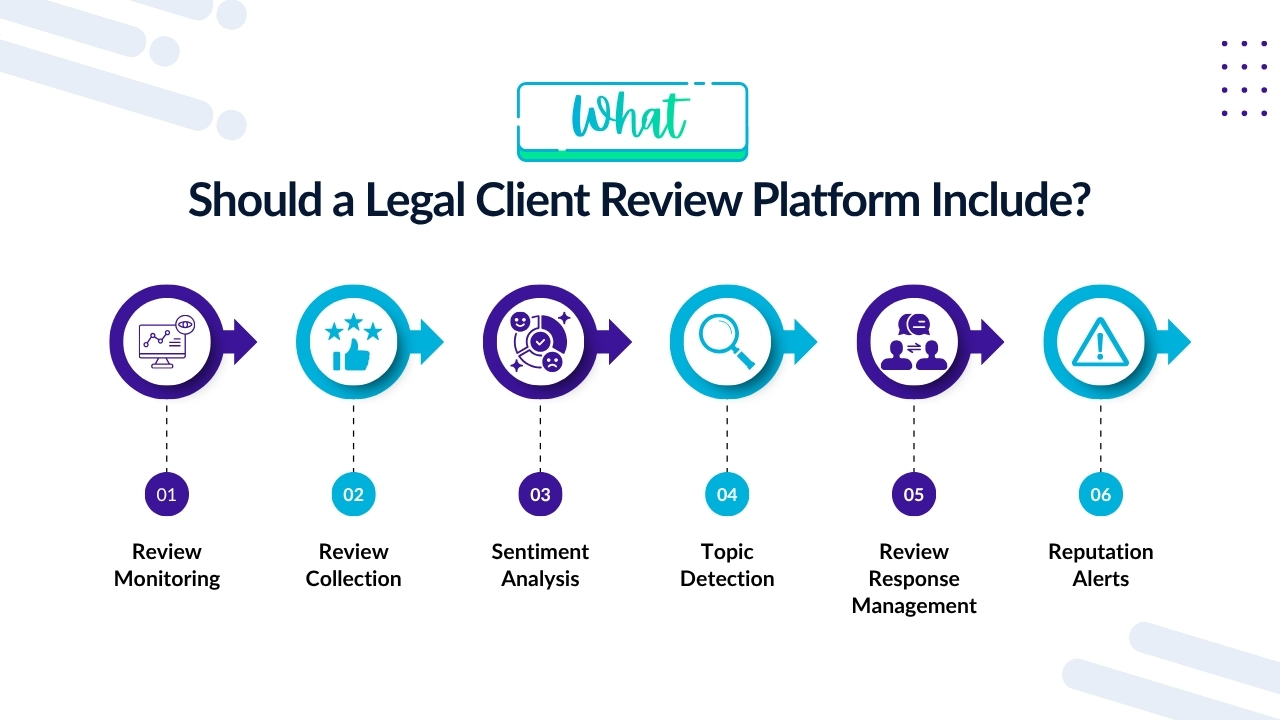
A strong client review platform for legal services should do more than collect ratings. It should help law firms track feedback, understand client sentiment, identify service problems, and manage their online reputation responsibly.
The most useful features include the following:
1. Review Monitoring
A platform should track reviews across crucial websites and notify firms when new feedback appears. Centralized tracking is especially valuable for firms with multiple attorneys, offices, practice areas, or high client volumes.
Rather than manually checking different platforms, teams can review reputation activity from one location and respond to crucial changes more efficiently.
Also Read: How to Write a Review On Facebook
2. Review Collection
A review platform should provide structured ways for firms to request authentic client feedback. Automated client feedback requests can make the process more consistent and reduce administrative work.
However, firms should follow professional, advertising, and platform requirements.The objective should be to encourage genuine client experiences instead of manipulate ratings or manufacture positive reviews.
Also Read: How to Use Customer Feedback to Grow Your Business
3. Sentiment Analysis
Sentiment analysis uses AI and natural-language processing systems to identify the overall tone and crucial themes within client feedback.
Reviews may reveal opinions about communication, responsiveness, professionalism, billing, accessibility, case updates, and overall satisfaction. It provides deeper insights than simply tracking an average star rating.
Also Read: How to Measure Customer Sentiment
4. Topic Detection
A capable platform should identify recurring subjects within reviews. For instance, if many clients mention communication problems, the system can help determine whether the problem involves slow responses, limited case updates, confusing messages, or difficulty contacting attorneys. These insights can help management to identify operational problems and improve client service.
5. Review Response Management
Firms should have tools to organize and track review responses while maintaining professional standards. Legal teams must be particularly careful while responding to negative feedback publicly discussing specific client matters could create confidentiality concerns. Response workflows should therefore support appropriate human review before publishing.
Also Read: Online Reputation Management
6. Reputation Alerts
Timely alerts can help firms to identify emerging reputation problems. Notifications may highlight sudden rating changes, repeated complaints, negative sentiment, billing concerns, or problems with a special attorney or practice area.
Early detection lets management analyze problems and address underlying client-experience problems before they become larger reputation challenges.
How Clariv Can Support Legal Reputation Management
Clariv can support law firms by combining client sentiment analysis, review monitoring, reputation management, and client-experience insights. Its legal solution is designed to bring feedback from sources like surveys, client communications, reviews, social media, and CRM systems into a wider reputation-management workflow.
This helps firms to identify recurring problems involving communication, billing, responsiveness, and client expectations.
Key benefits can include:
- Review monitoring: helps to track reputation activity across relevant channels.
- Sentiment analysis: helps to identify positive, negative, and changing client sentiment.
- Matter insights: helps to track feedback throughout the client relationship.
- Reputation alerts: Highlight emerging concerns and negative trends.
- Operational improvement: Use feedback to improve communication standards and response times.
- Client experience: Turn feedback into actionable changes that can strengthen satisfaction and encourage authentic positive reviews.
Also Read: Brand Reputation Management Software
From Review Monitoring to Client Sentiment Intelligence
Traditional reputation management often follow a straightforward process:
Review-> Response -> Monitor Rating.
This approach helps firms to track their public reputation, but it may not explain why clients are dissatisfied. A more advanced client sentiment intelligence model follows Feedback -> Sentiment -> Theme -> Root Cause -> Action -> Measurement.
This approach turns client feedback into actionable business intelligence.
For instance, if a law firm receives ten negative reviews within six months and eight mention communication problems, sentiment analysis can identify communication as a recurring theme.
Management can then investigate response times, case updates, staff responsibilities, and client expectations. The findings can guide practical improvements across the firm.
Key stages include:
- Feedback: To collect reviews and client comments
- Sentiment: To analyze positive, neutral, and negative opinions.
- Themes: To identify recurring problems like communication or billing.
- Root Cause: To investigate why problems are happening.
- Action: To improve processes and client communication.
- Measurement: To track whether sentiment and customer satisfaction improve over time.
Also Read: HOW To Track Customer Feedback in Real-Time
Client Reviews Should Be Connected to the Client Journey
Throughout the client journey, a law firm’s reputation is developed and not just when a client leaves a review. Important stages can include searching for a firm, requesting a consultation, completing intake, sharing documents, receiving case updates, managing billing, resolving the matter, and providing post-matter feedback. Tracking only final reviews may cause firms to miss earlier signs of dissatisfaction.
Monitoring only final reviews may cause firms to miss earlier signs of dissatisfaction.
A stronger approach connects client feedback and sentiment with different phases of the legal experience. It can help firms to identify concerns before they become public complaints.
Important stages to monitor include:
- Initial Contact: evaluating responsiveness and communication
- Intake: Identify delays or unclear processes
- Active matter: track updates, expectations, and engagement
- Billing: Identify recurring payment or transparency problems
- Matter Resolution: Understand overall satisfaction
- Post-Matter: Gather authentic feedback and identify improvement opportunities.
It supports proactive reputation management by addressing problems before they develop into negative reviews.
How to Build a Legal Client Review Strategy
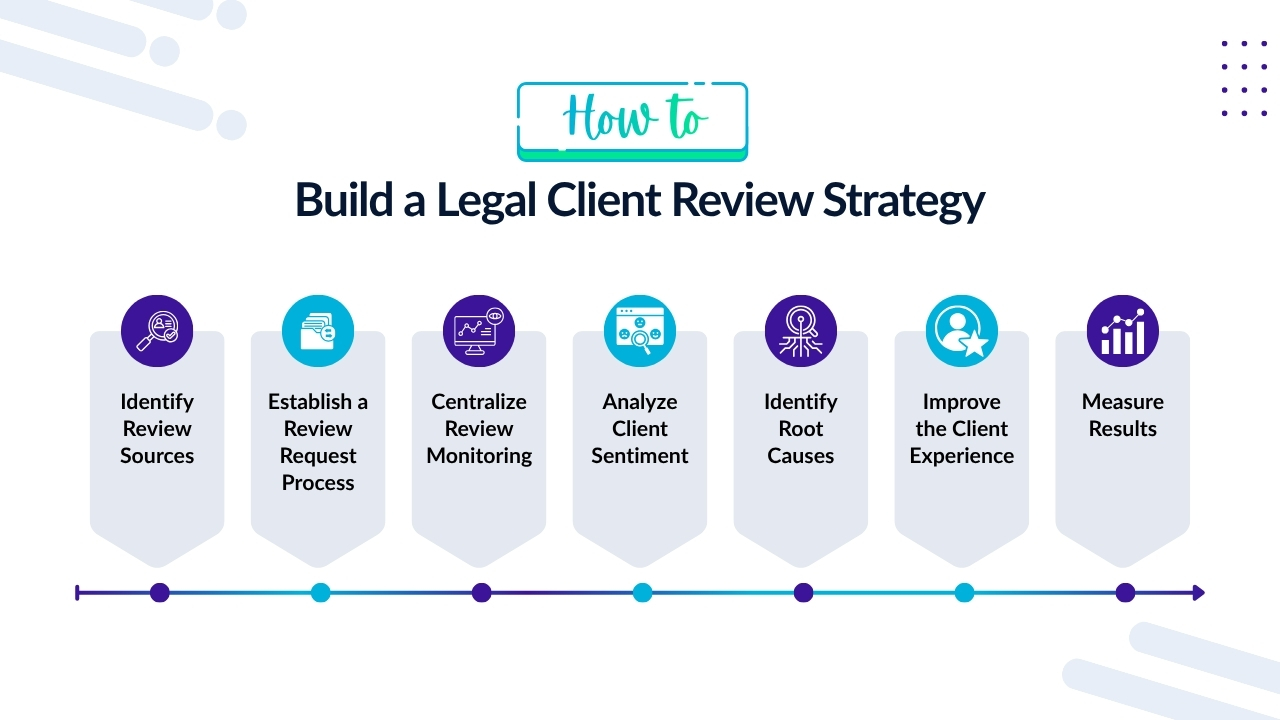
A successful legal client review strategy should combine review collection, reputation monitoring, sentiment analysis, and continuous client-experience improvement.
Below are the seven steps that can help law firms to create a structured approach.
1. Identify Review Sources
The initial step is to identify where clients and prospective clients are likely to find the firm. Important sources of reviews include Google, legal directories, social media, industry-specific review websites, and testimonials on the firm’s website.
2. Establish a Review Request Process
The next step is to create a consistent process for requesting authentic client feedback at appropriate phases of the client relationship. While requesting reviews law firms should follow professional, advertising, privacy, and platform requirements.
3. Centralize Review Monitoring
Use a centralized system to track feedback across multiple platforms. It can reduce manual work, provide timely alerts, and make it easier for firms to identify crucial reputation changes.
Also Read: Google Review Management Software
4. Analyze Client Sentiment
Law firms must go beyond star ratings by analyzing the language and themes within reviews. They must track concerns involving communication, responsiveness, professionalism, accessibility, billing, case updates, and staff interactions.
Also Read: Customer Sentiment Score Explained
5. Identify Root Causes
When negative feedback increases, firms must investigate the underlying problems instead of focusing only on the review itself. If there are recurring complaints, then it may indicate weaknesses in communication, workflows, billing processes, or client support.
6. Improve the Client Experience
Firms must turn feedback into practical improvements. They may introduce clearer billing expectations, faster response procedures, automated case updates, improved intake processes, accessible client portals, or stronger follow-up practices.
Also Read: How AI Can Analyze Customer Feedback
7. Measure Results
Firms must regularly evaluate the effectiveness of the strategy using metrics like review volume, average rating, sentiment patterns, response time, complaint frequency, recurring themes, client retention, and referral activity.
Tracking these measures helps firms to understand whether reputation and client-experience improvements are producing impactful results.
Legal Ethics and Review Management
Legal review management needs careful consideration because law firms operate under professional obligations that may not be applicable to ordinary businesses.
Reputation strategies should support client trust without compromising their confidentiality, advertising standards, or professional responsibilities.
Important considerations include:
- Confidentiality: Attorneys must avoid revealing confidential information while responding to public reviews.
- Advertising Rules: Their review campaigns and testimonials should follow legal advertising requirements.
- Client Communications: Firms should ensure that feedback requests and responses are professional and appropriate.
- Jurisdictional Requirements: Each location may have different ethical and professional rules, so firms should obtain suitable guidance before implementing review programs.
- Automated Responses: They must if there are any AI-generated or automated responses carefully before publication to avoid inappropriate disclosures.
- Negative Reviews: A critical review should not pressurize attorneys into publicly explaining confidential case details.
- Professional Responsibility: Reputation goals should never take priority over ethical obligations.
For instance, if a client claims that a lawyer ignored a case, then the firm may know the circumstances but should carefully consider whether responding could reveal confidential information or confirm an attorney-client relationship. The safest approach is to focus on professional duties while addressing legitimate service problems internally.
Also Read: Restaurant Review Sentiment Analysis
What Makes a Good Legal Review Platform?
A strong legal review platform should provide more than a basic review collection. It should combine reputation monitoring, reporting, and appropriate security and compliance considerations.
The goal is to help law firms understand client feedback and turn insights into meaningful improvements.
1. Review Monitoring and Alerts
The platform should track reviews across essential sources and notify authorized teams when new feedback, rating changes, or unusual activity occurs.
Also Read: Customer Sentiment Platform Vs Traditional Surveys
2. Sentiment and Topic Analysis
AI-based analysis can identify positive, neutral, and negative sentiment while detecting recurring topics like communication, billing, responsiveness, professionalism, or case updates.
Also Read: Customer Sentiment Analysis Vs Customer Feedback Analysis
3. Feedback Collection and Response Workflows
Firms should be able to request authentic client feedback and organize review-response workflows. Responses should remain consistent with applicable professional responsibilities.
4. Reporting and Multi-Location Management
Detailed reports can help firms to compare ratings, sentiment, recurring problems, and reputation patterns across attorneys, practice areas, and offices.
5. Integration, Security, and Collaboration
A useful platform should support authorized team collaboration and integrate with appropriate CRM or client communication systems while maintaining strong security and access controls.
Client Review Platforms for Small and Large Law Firms
The right client review platform for legal services depends on the firm’s size, number of locations, client volume, and operational complexity. A solution that works well for a solo attorney may not provide enough functionality for a multi-office legal organization.
1. Solo Attorneys
Solo practitioners often require simple tools for Google review monitoring, feedback requests, reputation alerts, basic sentiment analysis, and response management. An easy-to-use can provide important reputation insights without any unnecessary complications.
2. Small Law Firms
Small firms may benefit from centralized review monitoring, automated alerts, client feedback collection, sentiment reporting, team workflows, and social media monitoring. These features can help a small team manage reputation activity more efficiently.
3. Mid-Sized Firms
Growing firms may require multiple user permissions, multi-office monitoring, CRM integration, advanced analytics, and automated workflows. These capabilities can support collaboration across departments and locations.
4. Large and Multi-Location Firms
Enterprise firms may require centralized reputation management, location-level reporting, role-based access, advanced sentiment analysis, API integrations, governance controls, and cross-office benchmarking. The ideal client review platform should grow alongside the firm’s growing operational and reputation-management needs.
Also Read: How Businesses Can Improve Customer Satisfaction
Turning Negative Reviews Into Business Intelligence
A negative review should not always be viewed simply as a reputation problem. Rather it provides valuable business intelligence by revealing weaknesses in the client experience.
When several clients independently mention missed calls, delayed updates, or unclear communication, the pattern may indicate a broader operational problem.
Law firms can turn these insights into practical improvements by:
- Setting Communication Standards: They must set expected responses times and update schedules.
- Assigning Responsibilities: They must ensure specific team members manage client communication.
- Automating Updates: They must send appropriate routine notifications about matter progress.
- Creating Escalation Procedures: They must establish processes for handling unresolved problems.
- Measuring Performance: They must track response times and communication-related complaints.
- Monitoring Sentiment: They must evaluate client sentiment and improve after changes are introduced.
This approach converts review data from being a reactive reputation management tool into an actionable intelligence tool that can improve processes, improve client relationships, and support better long-term outcomes.
Also Read: Customer Satisfaction Metrics
How to Choose the Right Client Review Platform
Choosing the right client review platform for legal services requires comparing features, usability, security, and scalability with your firm’s specific reputation-management goals.
1. Review Coverage
Choose a platform that tracks the review websites, legal directories, and other channels where clients and prospects are likely to discuss your firm.
2. Sentiment and Topic Analysis
Firms must look for tools that analyze sentiment and identify recurring themes like communication, billing, responsiveness, professionalism and case updates instead of focusing only on star ratings.
3. Alerts and Response Management
Timely alerts can help teams to identify significant feedback instantly. Response-management features should allow authorized staff to organize reviews and coordinate appropriate responses.
4. Feedback Collection
They must evaluate whether the platform supports structured and authentic client feedback requests. The process should align with applicable professional, advertised, and ethical requirements.
5. Integration and Security
Check whether the platform integrates with existing CRM, communication, and client-experience systems. Having strong access controls and appropriate security measures are also essential for protecting business information.
6. Scalability and Reporting
Choose a solution that can support additional attorneys, offices, or practice areas as the firm grows. Detailed reporting should also help leaders to track sentiment, review patterns, recurring problems, and overall reputation performance.
Conclusion
A client review platform for legal services can play a crucial role in helping law firms to manage their online reputation while gaining deeper insights about client experiences.
However, effective reputation management should go beyond collecting five-star reviews or responding to negative comments. While the most value comes from understanding what clients are saying, identifying recurring themes, and connecting feedback with the underlying client journey.
Features like review monitoring, sentiment analysis, topic detection, reputation alerts, feedback collection, reporting, and response workflows can help firms to turn scattered feedback into actionable insights.
Platforms like Clariv can support this broader approach by connecting reputation data with client sentiment and experience signals.
Law firms should also consider security, scalability, integrations, and professional responsibilities while choosing a solution. Most importantly, review intelligence instead of simply a marketing metric, they can improve client relationships, improve experiences, and build a more sustainable professional reputation.
If you still have any query about the Client Review Platform for Legal Services then you may Contact Us at Clariv and we are more than happy to assist you.