Understanding what customers think, feel, and experience about your brand is essential for improving customer experience, increasing customer loyalty, and for making better business decisions.
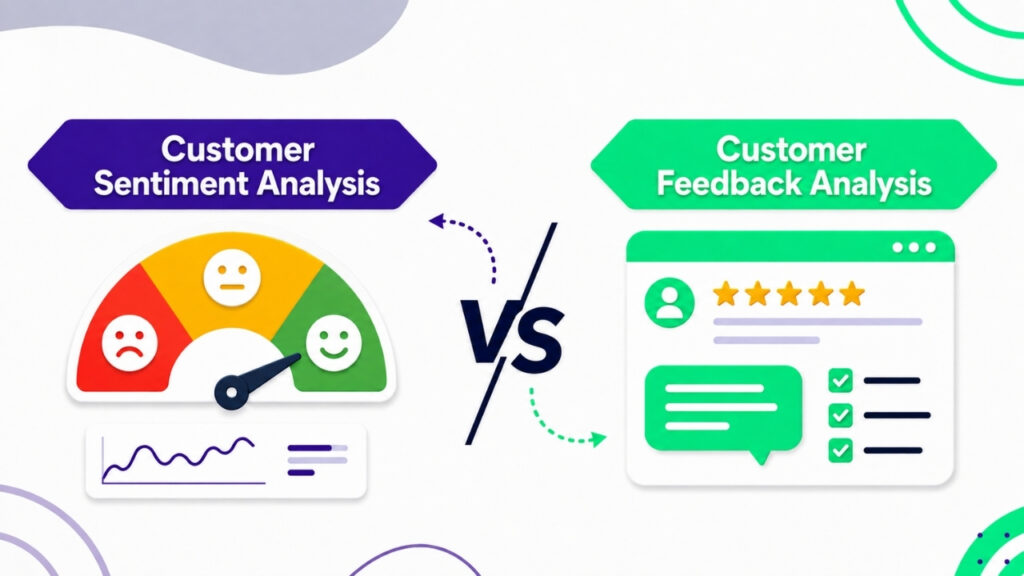
There are two approaches that businesses use to understand customer opinions which is customer sentiment analysis and customer feedback analysis.
Though customer sentiment analysis and customer feedback analysis are interconnected, both these analysis methods provide different types of customer insights.
Customer sentiment analysis involves finding the sentiments of customers behind each customer comments, reviews, surveys, social media posts, and other forms of customer communication.
This helps businesses to understand whether customers have positive sentiment, negative sentiment, or neutral sentiment toward a product, service, brand, or specific interaction.
Advanced customer sentiment analysis tools help to find customer emotions about your brand and changes in customer sentiments over time.
On the contrary, customer feedback analysis takes a wider approach by evaluating customer opinions and identifying recurring customer problems, suggestions, and customer pain points.
This helps organizations to know whether customers are satisfied or dissatisfied about your product or service and find opportunities to improve your product or services.
Understanding customer sentiment vs customer feedback helps businesses to choose the right analytics tools that help them to reach their business objectives.
Customer sentiment analytics mainly explains how customers feel about your brand, while customer feedback analysis provides deeper insights into what customers are saying and why.
Through this blog, we will compare customer sentiment analysis and customer feedback analysis, differences, benefits, tools, limitations, and explain the way both approaches support making decisions based on data and build stronger relationships with customers.
Also Read: How to Measure Customer Sentiment
What Is Customer Sentiment Analysis?
Such analysis uses technologies like Artificial Intelligence(AI), Natural Language Processing, and machine learning to find the positive or negative opinions that the customers have expressed.
Rather than focusing only on the topics that customers discuss, customer sentiment analysis analyzes the way customers feel about a product, service, brand, or experience.
Customer sentiment analysis can classify opinions into categories such as:
- Positive: It indicates customers are satisfied, they appreciate, or show enthusiasm.
- Negative: It indicates customers are dissatisfied, they are frustrated, or have complaints about products or services.
- Neutral: It indicates factual or balanced opinions about your products or services.
- Mixed: It indicates customers have both positive and negative emotions about your product or service.
Implementing advanced customer sentiment analysis tools helps to know customer emotions about your products or services whether they are happy, angry, excited, disappointed, trust or frustrated.
For instance, a customer may praise fast delivery, and also express dissatisfaction with slow customer support. Customer sentiment analysis can identify both emotions within one review.
Also Read: How AI Sentiment Analysis Software Turns Customer Feedback into Growth Opportunities
How Customer Sentiment Analysis Works
The process typically involves below steps:
- The initial step is to gather customer data from customer reviews, surveys, social media, chats, and emails.
- The next step is to clean and organize data and prepare it for further analysis.
- Then apply NLP algorithms to understand context of customer sentiments
- Then classify customer sentiment into categories like positive, negative, or neutral
- Generate reports and dashboards to visual customer sentiment patterns.
- Identify emerging customer problems and opportunities to improve customer experience about your products or services.
Also Read: What is Customer Sentiment Analysis
Common Sources of Customer Sentiment Data
Customers express their opinions across many digital channels, offering valuable data for customer sentiment analysis.
Businesses can collect customer sentiment data from different sources like:
- Social media platforms: These platforms have customer posts, comments, and mentions that show public opinions about products.
- Google and online reviews: Online reviews provide businesses insights about customer satisfaction levels and also their concerns.
- Customer support channels: These channels include chats, emails, and call transcripts that show recurring problems and also customer frustrations.
- Mobile app reviews: Mobile app reviews have customers frequently sharing experiences, their new feature requests, and also their complaints.
- Forums and online communities: Online communities and forums include discussions that show broader opinions about products, their preferences, and their emerging problems.
Analyzing all these sources of customer reviews together can help to monitor customer sentiment towards your brand, identify trends, and understand broader customer opinions without needing to manually review thousands of individual comments.
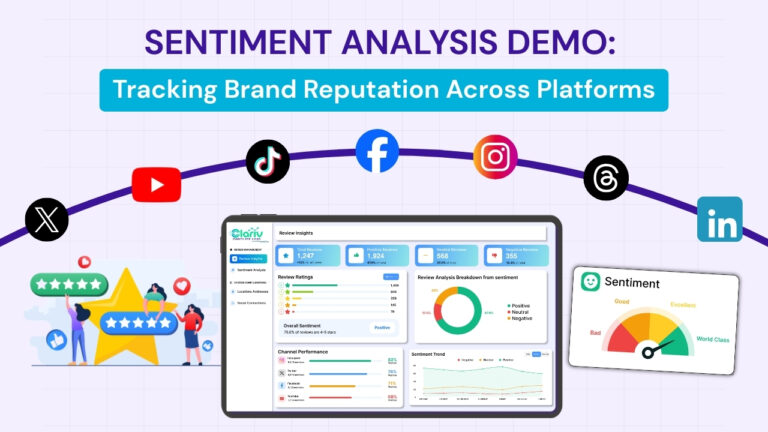
Also Read: Sentiment Analysis Demo
Benefits of Customer Sentiment Analysis
Customer sentiment analysis helps businesses to instantly know customer emotions with your products or services, and identify customer sentiments across a large number of customer feedback.
Key benefits include:
- Understand brand perception: Such analysis helps businesses to know the customers’ views about your brand whether it is positive, negative, or neutral.
- Detecting frustration early: Such analysis helps businesses to identify customer complaints and negative opinions before they become larger customer service problems.
- Monitor opinions: Such analysis helps businesses to track changes in customer sentiments in their reviews, on social media, and surveys.
- Measure campaigns: Such analysis helps to determine the way customers respond to marketing campaigns, promotions, and brand communications.
- Improve customer service: Such analysis helps businesses to identify recurring problems faced by customers and areas where customer experiences can be improved.
- Support product development: Such analysis involves using customer sentiments to identify product strengths, weaknesses, and improvement opportunities.
- Reduce customer churn: Such analysis helps businesses to identify customer dissatisfaction early and take action to improve customer retention.
- Strengthen reputation management: Such analysis helps businesses to track any negative customer conversations regarding your product or services and allows businesses to effectively respond to emerging reputation risks.
- Enhance customer experience: Such analysis helps businesses to use emotional insights to develop personalized and customer-based strategies.
- Save time: AI-based tools can analyze thousands of customer conversations instantly and reduce the need for manual analysis.
Also Read: Customer Sentiment Platform Vs Traditional Surveys
What Is Customer Feedback Analysis?
Such analysis involves the process of evaluating customer comments, suggestions, complaints, requests, reviews, and recommendations to understand customer experiences and find opportunities to improve products or services.
Although customer sentiment analysis mainly measures the emotional tone of customers, it also focuses on the real context about what customers convey.
The main purpose of customer feedback analysis is to find recurring customer patterns, pain points, service issues, and improvements.
Businesses can use these insights to make informed decisions about products, services, customer support, and overall customer experience.
Customer feedback analysis can help organizations understand:
- Customer problems: To find recurring problems affecting customer satisfaction levels.
- Feature requests: to discover products, services, or features that customers want.
- Reasons for dissatisfaction: To understand the specific causes behind customer complaints.
- Improvement priorities: To determine the customer issues that require immediate attention.
- Customer preferences: To find the factors that most satisfied customers value the most about your products or services.
- Service gaps: To find areas where customer support or operations can improve.
Businesses by analyzing customer feedback from surveys, reviews, support conversations, social media, and other channels, helps businesses to transform customer opinions into actionable insights which help businesses to launch better products, build stronger relationships with customers, and improve business performance.
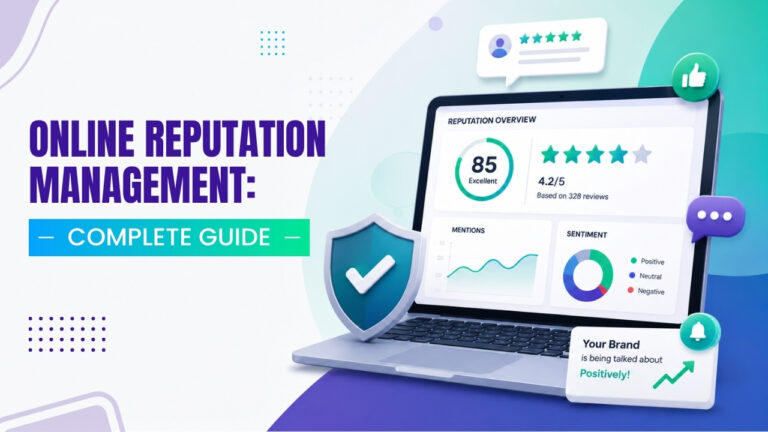
Also Read: Brand Reputation Management Software
Common Sources of Customer Feedback
Businesses gather customer feedback through structured and unstructured channels which helps them to understand customer experiences, their expectations, and customer concerns.
Collecting customer customer feedback from multiple organizations helps businesses to identify recurring problems and find ways to improve products, services, and customer support.
Common sources include:
- Customer satisfaction surveys: It involves measuring overall customer experiences and customer satisfaction levels.
- NPS and CSAT surveys: These surveys evaluate customer loyalty and customer satisfaction during specific interactions with them.
- Feedback forms: These forms capture customer suggestions, customer complaints, and customer recommendations directly.
- Product reviews: These reviews provide customer opinions regarding product quality, product features, and product usability.
- Support tickets: These tickets show repeated technical issues and customer service challenges that need immediate business attention.
- Live chats and emails: It reveals customer queries, customer complaints, and their requests.
- Interviews and focus groups: It provides detailed insights into customer experiences, expectations, preferences, and specific areas for improvement.
- Website widgets: It involves collecting feedback during website interactions.
- Post-purchase questionnaires: It involves evaluating customer experiences after a transaction.
When customers give this information, customer feedback analysis can reveal detailed recommendations and actionable insights for improving the overall customer experience.
Also Read: How to Use Customer Feedback to Grow Your Business
How Customer Feedback Analysis Works
Customer feedback analysis involves evaluating customer responses to identify customer patterns, customer problems, customer preferences, and customer opportunities for improvement.
This process helps businesses to convert large amounts of customer feedback into useful insights that support better products, customer services, and customer experiences.
A usual customer feedback analysis process includes:
- Collect feedback: It involves gathering responses from surveys, reviews, support channels, emails, and social media.
- Organize responses: It involves customer feedback into relevant categories, topics, or customer segments.
- Identify themes: It involves looking for recurring subjects, suggestions, and customer problems.
- Detecting complaints: It involves finding common problems that may affect customer satisfaction.
- Measure satisfaction: It involves evaluating customer opinions and satisfaction levels.
- Prioritize improvements: It involves determining the issues that require the most attention.
- Share insights: It involves conveying actionable findings about product, marketing, sales, and customer service teams.
Businesses can perform customer feedback analysis either manually or use AI-powered feedback analysis tools to analyze large volumes of customer responses more efficiently.
Also Read: How to Track Your CustomerFeedback in Real-Time
Benefits of Customer Feedback Analysis
Customer feedback analysis helps businesses to understand the needs, expectations, and experiences of customers. When businesses analyze direct customer feedback, it helps them to identify recurring problems faced by customers, improve opportunities, and make informed decisions about products, services or operations.
Key benefits include:
- Improve products and services: Such analysis helps businesses to use customer suggestions to identify areas that require improvement.
- Identify pain points: Such analysis helps businesses to find recurring customer problems that affect customer satisfaction.
- Prioritize development: Such analysis helps businesses to prioritize their resources on features and product improvements that customers value the most.
- Enhance customer support: Such analysis helps businesses to identify service issues and improve customer support services.
- Measure satisfaction: It helps to track customer opinions and customer satisfaction levels over time.
- Increase loyalty: It involves addressing concerns and creating experiences that encourage repeat business.
- Support innovation: It involves using customer ideas to find new opportunities for innovation.
- Improve operations: It involves identifying inefficient processes and service gaps.
- Strengthen relationships: Such analysis shows customers that their opinions are valued and they acted upon suggestions which helps businesses to improve relationships with customers.
As customer feedback comes directly from customers, it can show practical improvements that businesses might otherwise overlook.
Also Read: How to Use Review Monitoring Software to Manage Your Online Business
Customer Sentiment Analysis vs Customer Feedback Analysis
Although customer sentiment analysis and customer feedback analysis both help businesses to understand customer experiences, they focus on different types of information.
Customer sentiment analysis mainly focuses on the way customers feel, while customer feedback analysis focuses on the customer opinions about their products or services, and why they have those opinions about products or services, and about the improvements that customers expect in your products or services.
The key differences can be understood through the following points:
- Primary focus: Customer sentiment analysis involves tracking the emotional tone of customer interactions, while customer feedback analysis analyzes customer comments, suggestions, requests, and recommendations.
- Main question: Customer sentiment analysis answers “How do customers feel?” whereas Customer feedback analysis answers “What are customers saying and why?”.
- Sentiment categories: Customer sentiment analysis classifies customer opinions as positive, negative, neutral, or mixed while Customer feedback analysis analyzes customer opinions about product quality, pricing, product features, delivery, staff behavior, and customer expectations.
- Understanding causes: Customer feedback analysis helps businesses to understand the results by identifying customer comments about delicious food, friendly staff, limited parking, high prices, and convenient online reservations.
- Business value: Customer sentiment analysis helps organizations to track brand perception, customer satisfaction levels, and customer reputation across large volumes of conversations.
- Actionable insights: Customer feedback analysis offers detailed information that helps businesses to improve product, make service changes, pricing changes, and operational improvements.
- Technology used: Customer sentiment analysis uses technologies like Artificial Intelligence(AI), Natural Language Processing(NLP), and machine learning that helps to find patterns of customer emotions. Customer feedback analysis may combine AI classification, keyword analysis, topic detection, and human review.
- Data sources: Both customer sentiment analysis and customer feedback analysis involves analyzing customer reviews, surveys, social media, emails, support conversations, and chat interactions. But customer feedback analysis depends highly on detailed customer responses.
- Best use case: Customer sentiment analysis is useful when businesses require to understand the overall emotional tone of customer opinions instantly.
- Combined approach: Implementing both customer sentiment analysis and customer feedback analysis together provides a more complete view of the customer experience.
Businesses by understanding customer emotions can identify the specific problems responsible for negative or positive customer opinion.
Ultimately, customer sentiment analysis reveals the way customers feel about their products or services, while customer feedback analysis reveals the reasons behind the positive or negative opinions of the products or services.
Combining both approaches allows organizations to turn customer data into more meaningful and actionable business insights.
Also Read: How Businesses Can Improve Customer Satisfaction
Why Businesses Need Both Approaches
Businesses by implementing both customer sentiment analysis and customer feedback analysis provides businesses a complete understanding of customer experiences.
Customer sentiment analysis identifies the way customers feel whereas customer feedback analysis helps businesses to identify the way customers feel that way about your products or services.
Combining both these insights helps organizations to go beyond identifying problems and take meaningful action.
Key advantages include:
- Understand customer emotions: It helps to identify positive, negative, and neutral customer sentiment.
- Discover underlying issues: It helps to understand the specific reasons behind customer satisfaction or dissatisfaction.
- Identify trends: It helps to detect recurring patterns regarding customer reviews, customer surveys, social media, and support channels.
- Make data-driven decisions: It helps businesses to use customer insights to guide business strategies.
- Improve products and services: It helps to address customer needs and recurring customer complaints.
- Enhance customer experience: It helps to create more relevant and satisfying interactions.
- Increase retention: It helps to resolve problems before they cause customers to leave.
- Strengthen brand loyalty: Show customers that their opinions are valued and acted upon.
Both these approaches help businesses to respond instantly by revealing emerging customer problems, improve customer satisfaction, and build stronger long-term customer relationships that support sustainable business growth.
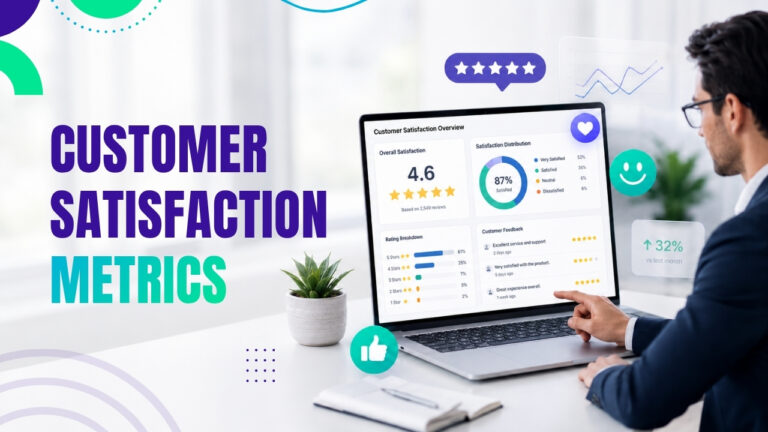
Also Read: Customer Satisfaction Metrics
Data Sources: Customer Sentiment Analysis vs Customer Feedback Analysis
Although customer sentiment analysis and customer feedback analysis both use customer data, they usually depend on different sources and offer different types of insights.
1. Customer Sentiment Analysis Sources
This analysis commonly uses customer conversations and digital interactions to determine how customers feel about a brand, product, or service.
These sources can provide large volumes of real-time data about public perception.
Common sources include:
- Social media posts
- Google Reviews
- Yelp reviews
- App Store reviews
- Online forums
- Community discussions
- Blog comments
- News articles
- Video comments
- Customer emails
- Live chat conversations
When customer sentiment analysis tools analyze these channels helps businesses to identify positive, negative, neutral, or mixed customer sentiment and monitor changing customer opinions across different platforms.
Also Read: How to Write a Review on Facebook
2. Customer Feedback Analysis Sources
Such analysis focuses more on the information that customers intentionally provide to share their experiences, suggestions, complaints, and their recommendations.
These sources provide detailed information that can support specific business improvements.
Common sources include:
- Customer surveys
- Net Promoter Score (NPS)
- Customer Satisfaction (CSAT)
- Customer Effort Score (CES)
- Feedback forms
- Product reviews
- Customer interviews
- Focus groups
- Support tickets
- Post-purchase surveys
- Website feedback forms
Both structured and unstructured responses help organizations to find recurring problems faced by customers, customer expectations, feature customer requests, and opportunities to improve products, services, and overall customer experiences.
Also Read: Google Review Management Software
The Role of AI and NLP in Customer Sentiment Analysis vs Customer Feedback Analysis
1. Artificial Intelligence and Natural Language Processing
Artificial intelligence(AI) has changed the way businesses analyze customer opinions by processing large volumes of customer conversations instantly and identifying customer patterns that may be difficult to detect if done manually.
Natural Language Processing(NLP) enables computers to understand and interpret human language, which makes it valuable for both customer sentiment analysis and customer feedback analysis.
NLP can help systems:
- Identify important keywords and phrases
- Understand sentence structure and context
- Detect emotions and sentiment
- Recognize different customer topics
- Group similar comments
- Analyze large volumes of text
All these capabilities help businesses to understand customer opinions more efficiently and identify important trends found in customer reviews, surveys, social media, emails, and customer support conversations.
2. Machine Learning and Advanced Analytics
Machine learning enables AI-based analysis systems to improve when they process more customer interactions. Instead of depending completely only on predefined rules, machine learning models help businesses to recognize patterns and relationships with customer data.
Machine learning can help businesses:
- Identify recurring complaints
- Detect emerging customer trends
- Improve sentiment classification
- Recognize frequently discussed topics
- Predict potential customer behavior
- Discover hidden relationships within feedback
Other technologies like deep learning, text analytics, predictive analytics, and topic modeling, can further improve generation of customer insights.
Together, these technologies help businesses understand “how customers feel” and “what they want improved”, enabling faster, more accurate, and more actionable decisions.
Also Read: Restaurant Review Sentiment Analysis
How to Combine Customer Sentiment Analysis and Customer Feedback Analysis
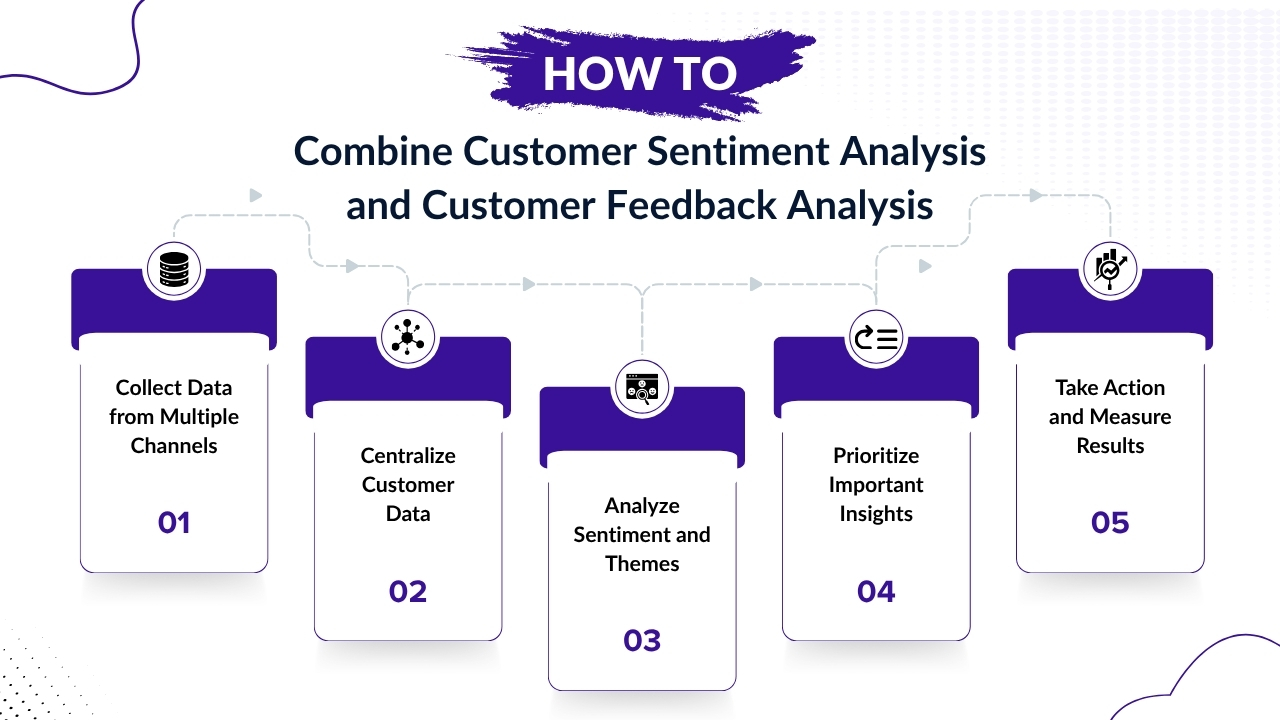
Combining Customer Sentiment Analysis and Customer Feedback Analysis helps businesses to understand both customer emotions and the reasons behind them.
Organizations can follow these steps:
1. Collect Data from Multiple Channels
- Collect surveys, online reviews, social media posts, support tickets, live chats, emails, website feedback, and mobile app reviews.
- Using multiple sources offers a broader view of customer experiences.
2. Centralize Customer Data
- Stores customer interactions in a centralized CRM or customer experience platform.
- Categorize customer feedback, remove duplicate records, track customer history, and compare trends over time.
3. Analyze Sentiment and Themes
- Use AI, Natural Language Processing(NLP) and machine learning to analyze customer conversations.
- Detect positive and negative customer sentiment, recurring customer complaints, requested features, service problems, and changing expectations.
4. Prioritize Important Insights
- Rank issues according to frequency, severity, customer impact, and business importance.
- Give greater attention to recurring negative sentiment and frequently reported problems.
5. Take Action and Measure Results
- Use insights to improve products, services, employee training, marketing, and customer support.
- Continue monitoring sentiment and feedback after implementing changes to measure results and create a continuous analysis, action, and optimization cycle.
Conclusion
Understanding the difference between Customer Sentiment Analysis vs Customer Feedback Analysis is important for organizations that want to deliver good customer experiences and build long-term relationships.
While sentiment analysis reveals the emotions behind customer interactions, customer feedback analysis reveals the specific reasons driving those opinions.
Together, they provide a complete understanding of customer expectations, satisfaction levels, and areas for improvement.
By collecting data from multiple channels, using AI-powered analytics, monitoring key performance indicators, and acting on customer insights, businesses can make informed decisions that enhance products, improve service quality, and strengthen brand reputation.
Whether you operate a retail store, restaurant, SaaS company, healthcare practice, hospitality business, or eCommerce platform, combining these two approaches helps create more personalized experiences, increase customer loyalty, and drive sustainable business growth.