68% of customers leave a company because they perceive indifference to their problems. Not because of bad products. Not even because of poor service. Because they felt ignored.
And when companies respond to issues within an hour, they see 7x higher conversion rates compared to those who wait even 60 minutes longer.
A real-time customer feedback system enables customers to share opinions instantly, across review sites, social media, support tickets, and chat conversations, which can now help you capture and analyze that feedback just as quickly.
This isn’t about drowning in more data. It’s about having the right intelligence at the right moment, when you can still do something about it. When a product issue surfaces in customer conversations, when service quality dips at a specific location, when a new feature resonates (or doesn’t), you need to know immediately, not next quarter.
In this guide, we’ll walk through why modern businesses are adopting customer feedback analytics in real-time and exactly how to track customer feedback that actually works for your business.
Also Read: How AI Can Analyze Customer Feedback
What is Real-Time Customer Feedback?
Real-time customer feedback is any opinion, comment, complaint, or praise from your customers that you can see and act on immediately or close to immediately. We’re talking minutes or hours, not days or weeks.
“Real-time feedback is about creating a continuous conversation with your customers. It’s not about annual surveys or quarterly reviews. It’s about knowing what your customers think and feel right now, so you can act on it while it still matters.”
— Shep Hyken, Customer Service Expert and Author, Forbes
It’s not just one thing. Real-time customer feedback includes:
- Reviews posted on Google, Yelp, Trustpilot, or industry-specific sites
- Social media mentions and comments on Facebook, Twitter, LinkedIn, and Instagram
- Support tickets and live chat conversations
- Email responses and survey replies
- In-app feedback and ratings
- Phone call transcripts (yes, these can be tracked too)
- Community forum posts and discussions
The keyword here is “real-time.” You’re not waiting for someone to manually compile this feedback into a monthly report. You’re not checking each platform separately whenever you remember. The feedback flows into one place, gets analyzed automatically, and alerts you when something needs attention.
Also Read: How AI Sentiment Analysis Software Turns CustomerFeedback into Growth Opportunities
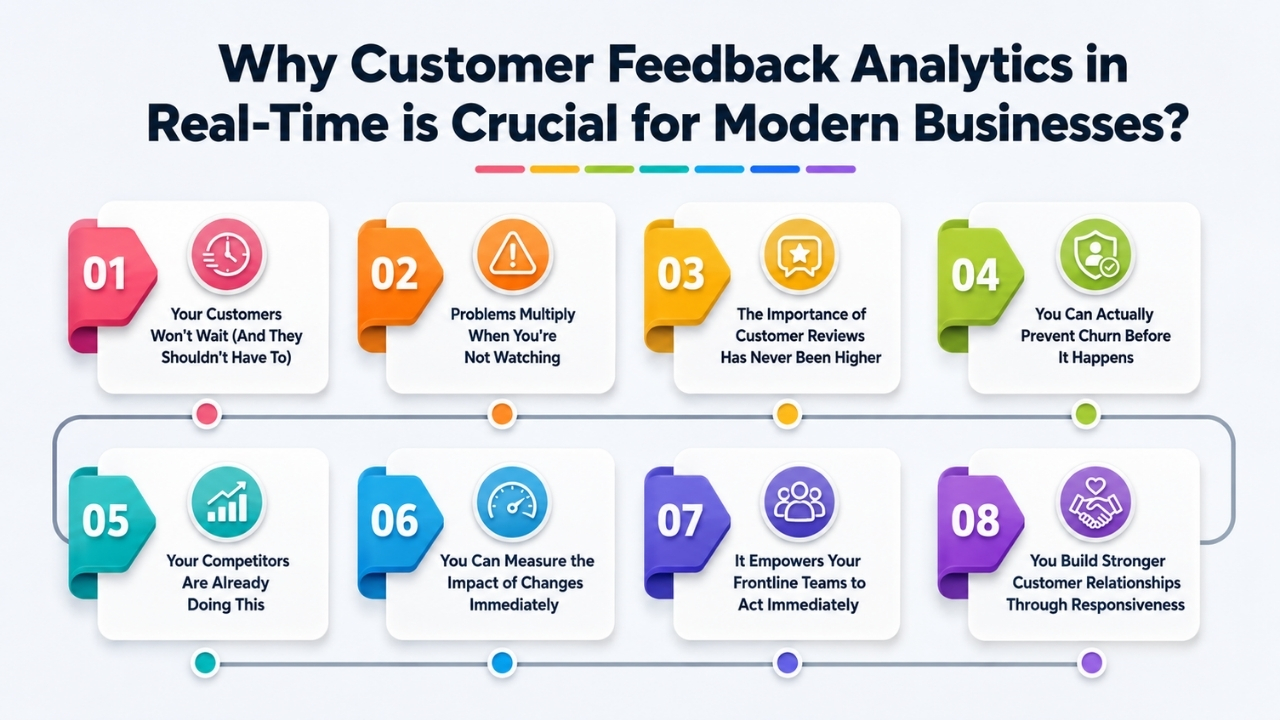
Why Customer Feedback Analytics in Real-Time is Crucial for Modern Businesses?
Let’s talk about what’s actually at stake when you’re still using last week’s data to make today’s decisions.
The business landscape has changed. Your customers expect instant responses, your competitors are moving faster, and the gap between “good enough” and “falling behind” has never been smaller.
Here’s why customer feedback analytics in real-time isn’t just a nice upgrade; it’s essential for survival.
1. Your Customers Won’t Wait (And They Shouldn’t Have To)
Speed isn’t a luxury anymore. It’s the baseline expectation.
90% of customers rate an “immediate” response as important or very important when they have a customer service question. And “immediate” to them means within hours or less. Not tomorrow. Not next week when your team reviews the feedback queue.
Here’s the reality: when you’re tracking customer feedback for small business in real time, you can actually meet that expectation. When you’re not, you’re apologizing for delays while your competitors are already solving the problem.
Also Read: How to Respond to Negative Customer Reviews
2. Problems Multiply When You’re Not Watching
Small issues become big disasters when they sit unnoticed.
Think about it: one customer has a bad experience with your checkout process today. If you catch it through real-time customer feedback, you fix it. If you don’t, five more customers will hit the same issue tomorrow. Ten more the day after. By the time it shows up in your monthly metrics, you’ve lost dozens of sales.
For every customer who complains, 26 others remain silent. That complaint you’re ignoring? It’s not one person’s problem. It’s likely affecting dozens of others who just left without saying anything.
This is where AI customer feedback analysis becomes a game-changer. Instead of manually reviewing every piece of feedback, AI can spot patterns instantly. When multiple customers mention the same issue, even if they word it differently, you know about it immediately, not weeks later.
Also Read: Brand Reputation Management Software
3. The Importance of Customer Reviews Has Never Been Higher
87% of consumers read online reviews for local businesses, and 73% of consumers only pay attention to reviews written in the last month. Those numbers tell you everything: the importance of customer reviews isn’t just about quantity, it’s about recency and responsiveness.
When a negative review goes unanswered for days, potential customers see it. They also see that you didn’t care enough to respond. That silence speaks louder than the complaint itself.
Also Read: How to Measure Customer Sentiment
4. You Can Actually Prevent Churn Before It Happens
Acquiring a new customer costs 5 times more than retaining an existing one. Yet most businesses only realize a customer is unhappy after they’ve already churned.
Real-time customer feedback systems flip this script. When a long-time customer suddenly leaves a frustrated review or submits a complaint, you can intervene immediately. Reach out, solve the problem, save the relationship, all before they’ve mentally checked out.
That’s the power of seeing problems as they emerge, not after they’ve already cost you revenue.
Also Read: How to Use Your Review Monitoring Software to Manage Your Online Reputation
5. Your Competitors Are Already Doing This
if you’re not tracking feedback in real-time, someone in your industry already is.
The companies pulling ahead aren’t just collecting more feedback; they’re acting on it faster. While you’re waiting for next month’s report, they’ve already fixed the bug, improved the feature, and responded to every review.
73% of companies are investing in customer experience as a competitive differentiator. The ones winning aren’t investing in better surveys; they’re investing in customer feedback analytics tools that give them speed and insight their competitors lack.
Also Read: Customer Sentiment Platform Vs Traditional Surveys
6. You Can Measure the Impact of Changes Immediately
Launched a new feature? Updated your pricing? Changed your return policy?
With traditional feedback methods, you’re flying blind for weeks.
Real-time customer feedback systems let you see reactions as they happen. Within hours of launching something new, you know if customers love it, hate it, or are confused by it. Companies that test and iterate based on customer feedback grow 10x faster than those that don’t without breaking things. You launch, you listen, you adjust, all within the same week.
7. It Empowers Your Frontline Teams to Act Immediately
Your support team, sales reps, and customer-facing employees are the first to hear when something’s wrong. But if they have to escalate through three layers of management and wait for the monthly review, you’ve wasted the most valuable moment.
Real-time tracking changes this dynamic entirely.
When your team has access to a customer feedback analytics tool that surfaces issues as they happen, they can act. A support agent sees that five customers today mentioned the same shipping delay, so they can proactively update the website. A store manager notices negative feedback about a specific employee, and they can provide coaching that afternoon, not next quarter.
Also Read: Google Review Management Software
8. You Build Stronger Customer Relationships Through Responsiveness
Customers don’t expect perfection. They expect you to care when things go wrong. When companies respond to and resolve complaints, 70% of complaining customers will do business with the company again.
The difference? Speed and acknowledgment.
How to track customer feedback effectively means creating systems that let you respond while the customer still cares. When someone leaves a negative review, and you respond within hours, it shows you’re paying attention. When you fix a reported bug before the customer even follows up, you’ve turned a complaint into loyalty.
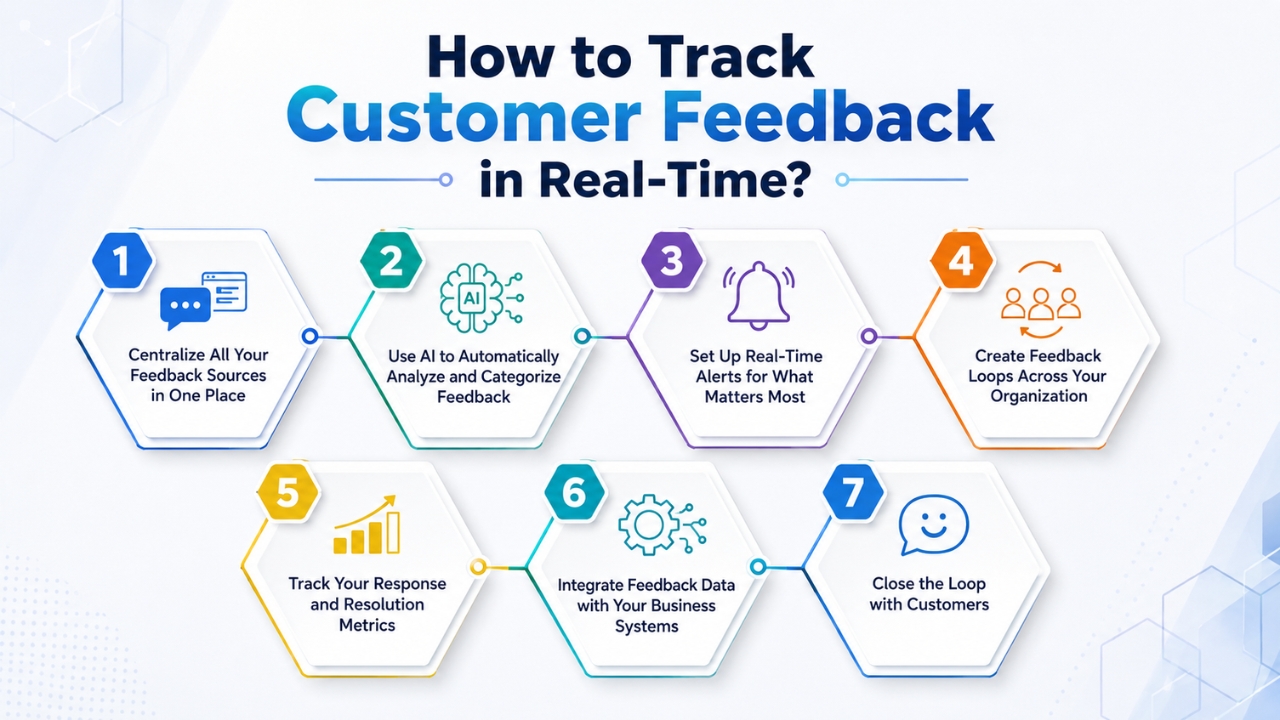
How to Track Customer Feedback in Real-Time?
Now let’s get practical. You understand why real-time customer feedback matters. Let’s talk about how to actually do it without adding three hours to your team’s daily workload.
The key is building a system that captures, analyzes, and surfaces feedback automatically, so you’re spending time acting on insights, not hunting for them.
Step 1: Centralize All Your Feedback Sources in One Place
Your customers aren’t leaving feedback in one convenient location. They’re everywhere:
- Google reviews and Yelp
- Facebook comments and Twitter mentions
- Support tickets in Zendesk or Intercom
- Email responses and survey replies
- In-app ratings and feedback forms
- Phone call transcripts
- Live chat conversations
Customer feedback analytics tool connects directly to all your feedback sources and pulls everything into a single dashboard. You’re not juggling ten browser tabs. You’re looking at one screen that shows you everything.
So, look for tools that offer:
- Direct integrations with major review platforms (Google, Yelp, Trustpilot, Facebook)
- API connections to your support software (Zendesk, Freshdesk, Help Scout)
- Social media monitoring (Twitter, LinkedIn, Instagram)
- Survey tool connections (Typeform, SurveyMonkey, Google Forms)
Without centralization, you’re always playing catch-up. With it, you have a complete picture of what customers are saying across every channel.
Step 2: Use AI to Automatically Analyze and Categorize Feedback
Here’s where manual tracking falls apart. Even if you could see all your feedback in one place, reading through hundreds or thousands of comments, reviews, and messages every day is impossible.
You need to know:
- What are customers talking about most?
- Which issues are trending up or down?
- How has sentiment changed this week versus last week?
- Which problems are critical versus minor annoyances?
Doing this manually takes hours. AI customer feedback analysis does it in seconds.
Modern customer feedback analytics tools automatically:
- Categorize feedback by topic: Product quality, shipping, customer service, pricing, specific features. You see exactly what customers are talking about without reading every single comment
- Analyze sentiment: Not just positive/negative, but the intensity and context of emotions
- Identify trends: When a new issue emerges, or an old problem resurfaces, you see it immediately
- Prioritize urgent issues: Critical complaints get flagged for immediate action
- Detect patterns across languages: If you serve global markets, AI can analyze feedback in multiple languages and surface consistent themes
This isn’t just convenient, it’s the difference between reacting to problems after they’ve scaled and catching them early. One retail brand caught a supplier quality issue affecting a specific product batch within 48 hours because their AI flagged the pattern. Manual tracking would have taken weeks.
Step 3: Set Up Real-Time Alerts for What Matters Most
Not all feedback needs immediate attention. A five-star review praising your team? Great, but not urgent. A complaint from a major client about a billing error? That’s an emergency.
A good real-time customer feedback system knows the difference.
Set up custom alert rules based on your business priorities:
- Notify the executive team immediately when a review drops below 3 stars
- Alert customer service when the same issue is mentioned by three or more customers in 24 hours
- Flag any mention of competitors in negative feedback
- Send urgent notifications for reviews from high-value customers
- Trigger alerts when sentiment drops below a certain threshold for specific products or locations
You’re not constantly monitoring a dashboard. The system watches for you and only interrupts when something truly needs attention. This is how busy leadership teams stay on top of feedback without it consuming their entire day.
Most customer feedback analytics tools allow you to route alerts to different channels:
- Email for non-urgent issues
- Slack or Teams messages for time-sensitive problems
- SMS for critical emergencies
- Dashboard notifications for ongoing monitoring
The goal is getting the right information to the right person at the right time, before small problems become big crises.
Step 4: Create Feedback Loops Across Your Organization
How to track customer feedback effectively means building feedback loops that connect insights to action:
For Support Teams: Give them access to real-time dashboards showing current issues, common questions, and emerging problems to proactively address issues.
For Product Teams: Set up weekly (or daily) digests of feature requests, bug reports, and usability complaints. Also, integrate feedback directly into your product management tools, so insights appear where decisions get made.
For Marketing Teams: Share what customers actually say about your products, not just the sanitized testimonials. The language customers use reveals what really resonates and what messaging falls flat.
For Executives: Provide high-level dashboards showing trends, sentiment scores, response times, and how feedback connects to business metrics like churn, retention, and revenue.
The best customer feedback analytics tools offer role-based views, so everyone sees what matters to them without getting overwhelmed by irrelevant data.
Step 5: Track Your Response and Resolution Metrics
Collecting customer feedback in real time is only half the battle. You also need to track how well you’re responding to it.
Key metrics to monitor:
Response Time: How quickly do you acknowledge feedback? Companies that respond within an hour see 7x higher conversion rates than those who wait longer. Track average response time across channels and team members.
Resolution Time: How long does it take to actually solve the problem, not just respond to it? Customers care more about resolution than acknowledgment.
Response Rate: What percentage of feedback gets a response? Aim for 100% on critical channels like reviews and support tickets. 70% of complaining customers will do business with you again if you resolve their complaint.
Sentiment Change: After you respond and resolve an issue, does the customer’s sentiment improve? This measures whether your solutions actually work.
Repeat Issues: Are the same problems recurring? If you’re addressing feedback but the same complaints keep coming up, you’re treating symptoms instead of fixing the root causes.
Step 6: Integrate Feedback Data with Your Business Systems
The most powerful use of real-time customer feedback systems happens when feedback connects to the rest of your business data.
Connect feedback to:
Your CRM: When a customer leaves feedback, your sales and support teams should see it in their CRM alongside purchase history, support tickets, and account details. This context helps them respond more effectively.
Your Analytics: Combine feedback data with product usage data, purchase behavior, and web analytics. See which features get positive feedback and high usage versus which get complaints and abandonment.
Your Financial Systems: Connect customer satisfaction scores to lifetime value, churn rates, and revenue. Prove that improvements in feedback metrics drive improvements in business metrics.
Your Project Management Tools: When feedback reveals a bug or feature request, automatically create tickets in Jira, Asana, or Monday.com so product teams can prioritize based on real customer impact.
This integration transforms customer feedback analytics from a standalone activity into something woven throughout your entire operation. Feedback informs every decision, every team, every day.
Step 7: Close the Loop with Customers
Closing the loop means:
Responding publicly: Reply to reviews and social media comments, even positive ones. Show everyone watching that you’re engaged.
Following up privately: When someone reports a problem, reach out when it’s fixed. “Hey, remember that shipping delay you mentioned? We’ve resolved it. Here’s what we did.”
Showing impact: When customer feedback leads to a change, a new feature, a policy update, or a product improvement, tell the customers who asked for it. “You spoke, we listened” isn’t just good marketing; it’s honoring the relationship.
Measuring satisfaction post-resolution: After solving a problem, ask if the customer is satisfied with the outcome. This tells you whether you’re truly addressing issues or just checking boxes.
Top Customer Feedback Analytics Tools for Real-Time Feedback
Let’s cut through the noise. Here’s what actually matters when choosing a customer feedback analytics tool: which one solves your specific problem, and when to walk away.
Here’s what actually matters: which tool solves your specific problem.
1. Clariv
Clariv is a comprehensive customer feedback analytics platform that centralizes feedback from reviews, social media, support tickets, and surveys into one AI-powered dashboard. We don’t just collect feedback or automatically categorize feedback; we also help you analyze customer sentiment, what exactly they are feeling, so you can take action accordingly in real-time.
Also, Clariv helps you with end-to-end social media scheduling and management as well, so that, as per the customer feedback analysis and categorization, you can manage social media reputation accordingly.
Choose Clariv When:
- Feedback comes from 5+ sources (reviews, social, support, surveys), and no one’s seeing the complete picture
- You need social media scheduling and management capabilities as well
- You need to spot patterns automatically, not monthly reports that arrive too late
- Your team needs insights they can act on immediately, without learning complex tools
- You’re scaling and can’t hire analysts to make sense of growing feedback volume
- Real-time customer feedback needs to drive decisions today, not next quarter
Best For: Businesses drowning in scattered feedback who need AI-powered insights without technical complexity.
Skip It When: You’re a single-location business just monitoring Google reviews.
2. Qualtrics CustomerXM
Qualtrics is an enterprise-grade experience management platform that goes beyond feedback collection into predictive analytics, journey mapping, and deep system integrations.
It connects customer data across every touchpoint, predicts behavior patterns, and integrates with enterprise systems built for organizations with dedicated CX teams managing complex, global operations.
Choose Qualtrics When:
- You have $100K+ budget, 50+ locations, and full-time CX analysts
- Predicting customer churn and lifetime value drives your strategy
- You need feedback flowing into Salesforce, ServiceNow, and data warehouses automatically
- Compliance requirements demand enterprise-grade security and governance
- Your scale justifies the complexity and price
Skip It When: You’re mid-sized without dedicated CX staff or need results fast.
Best For: Enterprises with dedicated CX teams needing predictive analytics and deep system integrations.
3. Medallia
Medallia specializes in capturing feedback at the exact moment of experience at checkout, after service, within apps, with a focus on multi-location businesses. It delivers location-specific insights to frontline managers in real-time to ensure issues get resolved at the specific location where they occurred.
Choose Medallia When:
- You operate retail, restaurants, hotels, and healthcare, where managers need same-day feedback
- Each location’s performance matters independently
- Immediate feedback lets frontline teams fix problems before customers leave
- You need session replay showing what customers actually did, not just what they said
- Location managers must act on feedback today, not next week
Best For: Multi-location physical businesses needing immediate, location-specific feedback.
Skip It When: You’re digital-only or single-location without independent managers.
4. Zendesk QA
Zendesk QA is purpose-built for analyzing support conversations at scale. It automatically scores every customer service interaction for quality, categorizes issues from ticket content, identifies coaching opportunities for specific agents, and surfaces patterns buried in thousands of support conversations, all while integrating seamlessly with Zendesk, Intercom, and similar helpdesk platforms.
Choose Zendesk QA When:
- Support tickets are your primary feedback source (500+ conversations daily)
- You’re manually reviewing conversations for QA, and it’s eating management time
- Critical insights are buried in thousands of support interactions
- You need every conversation scored automatically for quality and coaching opportunities
- You already use Zendesk or similar platforms
Best For: Support-heavy businesses where conversation quality and buried insights matter most.
Skip It When: Support is just one of many feedback sources, not your primary one.
5. Birdeye
Birdeye is a reputation management platform built specifically for multi-location, consumer-facing businesses.
It doesn’t just monitor reviews; it actively generates them through automated SMS and email requests, manages business listings across Google, Bing, and directories for local SEO, provides competitive benchmarking by location, and consolidates all customer communication (reviews, social, webchat, SMS) into one unified inbox.
Choose Birdeye When:
- You operate 5+ locations where each reputation matters independently
- You need more reviews, not just better monitoring of existing ones
- Local SEO directly drives revenue (“dentist near me” searches)
- Review volume is inconsistent across locations
- You want competitive benchmarking showing how each location stacks up locally
Skip It When: You’re in a single-location or B2B environment where online reviews aren’t primary drivers.
Final Thoughts
The gap between what your customers are telling you and what you actually hear isn’t just inefficiency; it’s lost revenue, damaged reputation, and missed opportunities to turn critics into advocates.
Real-time customer feedback isn’t about technology for technology’s sake. It’s about respecting the time and effort customers put into telling you what’s wrong, what’s working, and what they need.
The businesses that win aren’t the ones with perfect products. They’re the ones who hear problems first, fix them faster, and show customers their voice actually matters.
If you’re tired of insights that arrive too late and feedback that stays scattered across platforms nobody checks consistently, and are looking for a platform, see how Clariv turns real-time feedback into decisions you can act on today. Book your free 14-day trial today. No credit card required.