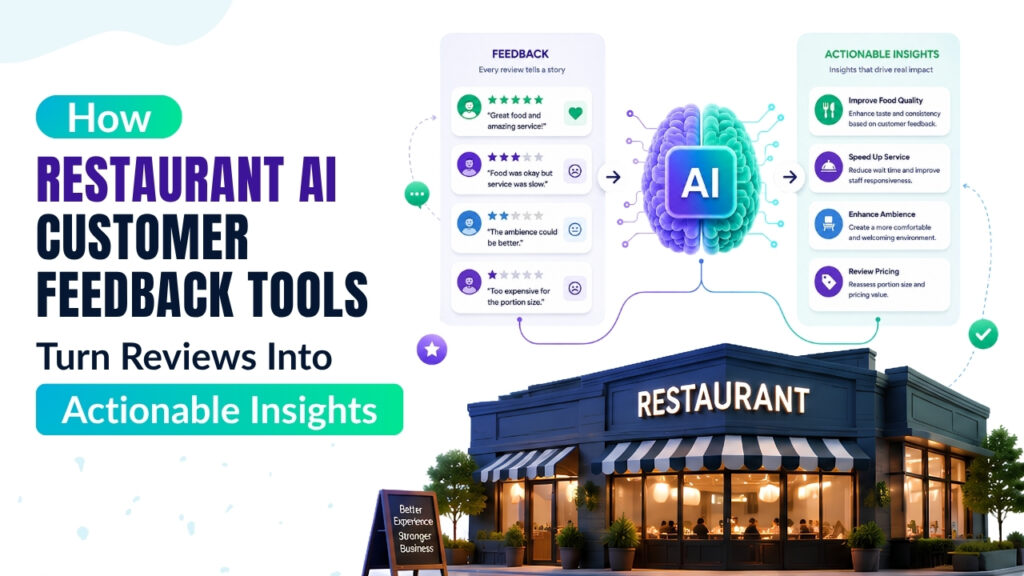
Restaurants that are seeking to understand their guest expectations and improve their dining experience, for them analyzing customer reviews have become essential.
But, manually analyzing thousands of comments and feedback across different platforms can be time-consuming, and often cause important aspects to be overlooked.
This is where restaurant AI customer feedback tools implementation can be a more efficient approach for understanding customer opinions about products or services.
With AI customer feedback analysis, restaurants can process large volumes of customer reviews, find recurring problems, evaluate customer sentiment, and find emerging problems.
AI-powered restaurant feedback tools categorize comments based on food quality, service, cleanliness, pricing, staff behavior, delivery, and overall satisfaction.
Restaurant review analysis enables managers to understand whether individual customer complaints indicate broader operational issues.
But the real value comes from converting customer feedback into actionable insights. Through restaurant customer sentiment analysis, businesses can identify positive experiences and find areas that require improvement.
AI review analysis can also show sales and operational patterns across locations, menu items, service periods, and customer segments. Analysis along with restaurant business intelligence, customer experience analytics, and operational data can support restaurant managers to make better decisions.
Using restaurant feedback analytics, restaurants can focus on recurring problems, analyze root causes, improve service processes, and measure results.
Ultimately, AI restaurant analytics helps restaurants go beyond simply tracking ratings and use customer opinions as a practical resource for improving performance, loyalty, and the overall guest experience.
Also Read: Restaurant Review Sentiment Analysis
What Is Restaurant AI Customer Feedback Analysis?
Restaurant AI customer feedback analysis uses AI systems to process and understand large volumes of guest comments from reviews, surveys, social media, and other feedback channels.
AI systems enable restaurant managers to instantly identify patterns, categorize comments, and find aspects that require customer attention.
Common categories include:
- Food quality: involves analyzing taste, freshness, temperature, and presentation.
- Service: involves analyzing friendliness, responsiveness, and service speed.
- Restaurant experience: involves analyzing cleanliness, ambiance, pricing, and menu varieties.
- Order experience: involves analyzing accuracy, portion sizes, packaging, and delivery.
- Customer service: involves analyzing complaints, requests, and problem resolution.
- Sentiment: involves analyzing positive, negative, neutral, or mixed options.
For instance, a guest might say, “The pasta was excellent, but we waited 30 minutes for our food.” AI can recognize positive feedback about quality while identifying service speed as a problem.
Such distinction helps managers to evaluate staffing, kitchen capacity, ticket times, or order flow. Hence, AI feedback analysis converts customer reviews into practical insights that helps them to make right decisions in operations.
Also Read: How to Use Customer Feedback to Grow Your Business
Why Restaurants Need AI to Analyze Customer Feedback
Restaurants collect customer feedback from review websites, surveys, delivery platforms, social media, emails, customer service, interactions, and website forms.
This data is scattered across different channels, so manually reviewing every comment can be time-consuming and cause important trends to go unnoticed. AI customer feedback analysis helps to bring these insights together and organize them into useful categories.
For instance, AI can identify recurring issues such as:
- Location patterns: Shows whether problems are concentrated at a particular restaurant.
- Staffing connections: Helps compare complaints with staffing changes.
- Operational trends: Connects feedback with ticket times and service performance.
If many customers complain about slow service, then AI can show when and where the problem happens rather than considering every review or feedback separately. It helps managers to analyze potential causes, focus on improvements, and make more informed operational decisions.
Also Read: Why Customer Reviews are Important for Business Growth
How Restaurant AI Feedback Tools Work
Restaurant AI feedback tools help businesses to convert large volumes of customer comments into organized information that managers can use for making decisions.
This process involves gathering customer feedback, categorizing comments, analyzing sentiment, identifying recurring problems, and tracking trends over time.
1. Collect Feedback From Multiple Channels
The first step is to bring customer feedback into a single centralized system. On the basis of the platform, customer feedback can be collected from online reviews, surveys, delivery services, social media, customer support, SMS messages, website forms, and in-store facebook. Gathering data from different systems into a centralized platform gives restaurants a broader view of the customer experience.
For instance, one guest may praise the food in a public review but complain about delivery through a private survey. Another customer may provide detailed feedback on a review platform without completing a questionnaire.
Combining these sources helps restaurant managers to avoid depending on a single channel and offers more complete restaurant customer feedback analytics.
Also Read: How to Respond to Negative Customer Reviews
2. Categorize Customer Comments
After gathering customer feedback, AI can organize comments into relevant topics. Common categories include:
- Food quality: Taste, temperature, freshness, and presentation
- Service: Staff behavior, responsiveness, and speed
- Cleanliness: Restaurant hygiene and dining areas
- Delivery: Late orders, packaging, and delivery experience
- Pricing: Value, menu prices, and perceived affordability
- Menu: Variety, descriptions, and portion sizes
For instance, “The burger was cold” can be categorized as food quality, while “Our server was very friendly” can be classified under staff service. Such AI review analysis makes large amounts of feedback easier to understand and helps managers to identify the topics that appear most frequently.
Also Read: Google Review Management Software
3. Analyze Customer Sentiment
AI systems enable restaurants to evaluate the emotional tone of customer comments. Feedback may be classified as positive, negative, neutral, or mixed.
However, effective AI sentiment analysis for restaurants can evaluate different parts of the same review rather than assigning one overall sentiment.
For instance, a customer might write, “The atmosphere was beautiful and our server was excellent, but the food took too long.” AI can identify positive sentiment toward the atmosphere and staff while recognizing negative sentiment about service speed.
Such detailed analysis helps restaurants to understand exactly which aspects of the guest experience are performing well and which aspects require improvement.
Also Read: What is Customer Sentiment Analysis
4. Identify Recurring Themes
AI systems can evaluate customer feedback across hundreds or thousands of customers to find recurring customer problems.
Common themes may include:
- Long wait times
- Cold food
- Incorrect orders
- Poor packaging
- Staff communication
- High prices
- Portion concerns
- Cleanliness issues
If there is a single complaint then it may indicate a single incident, but repeated comments means a wider operational problem.
For instance, if customers regularly mention late delivery during weekend evenings, then managers can analyze food preparation times, delivery staffing, dispatch procedures, and third-party delivery performance. Identifying these patterns helps restaurants to address problems based on customer insights.
Also Read: Customer Satisfaction Metrics
5. Detect Trends Over Time
The last phase is to track how customer feedback changes over time. Rather than asking what customers are saying today, restaurants can examine whether sentiment and specific themes are improving or declining.
AI can identify trends such as:
- Increasing negative sentiment
- Growing praise for a menu item
- Declining service complaints
- Rising delivery concerns
- New cleanliness issues
- Improved feedback after a menu change
Restaurant feedback analytics enables managers to compare sales during periods, locations, menu items, or service periods. This helps businesses to find emerging problems earlier and find whether operational changes are improving the customer experience.
Through consistently tracking feedback, enables restaurants to create a loop of collecting, analyzing, acting, and measuring customer insights.
Also Read: How to Measure Customer Sentiment
From Reviews to Actionable Insights
Analyzing customer feedback is just the initial step. The real value of restaurant AI feedback tools comes from turning review patterns into specific operational actions.
For instance, if an AI dashboard shows that long wait times are the most common negative theme during Friday and Saturday dinners, managers can investigate the underlying causes rather than simply monitoring complaints.
Key questions may include:
- Wait times: How long are guests waiting?
- Timing: When does the issue begin?
- Locations: Which restaurants are affected?
- Staffing: Are enough employees scheduled during peak periods?
- Kitchen performance: Are ticket times increasing?
- Menu bottlenecks: Are certain dishes slowing preparation?
- Table turnover: Is seating capacity being used efficiently?
Managers can then create a measurable action plan. For example:
- Problem: Long dinner wait times
- Possible cause: Insufficient peak-hour staffing
- Action: Adjust weekend schedules
- Owner: General manager
- Success metric: Reduce average ticket time by 15%
This transforms customer feedback into actionable insights and connects guest opinions with measurable operational improvements.
Also Read: How to Write a Review on Facebook
How Clariv Can Support Restaurant Customer Feedback Analysis
Clariv can help restaurants centralize customer feedback, analyze sentiment, and strengthen reputation management. Rather than manually checking multiple review platforms, restaurant teams can use a more organized approach to understand guest experiences and identify aspects that require attention.
Clariv can support restaurants by:
- Centralizing feedback from different customer channels for easier monitoring.
- Analyzing sentiment and topics such as food quality, service speed, pricing, order accuracy, and wait times.
- Identifying trends and patterns across reviews and restaurant locations.
- Providing alerts when negative sentiment or recurring complaints increase.
- Supporting review responses through AI-assisted response capabilities.
These features help managers to go beyond star ratings and understand the certain problems that customers are discussing.
Also Read: How to Track Customer Feedback in Real-Time
Connecting Customer Feedback With Restaurant Operations
Customer feedback becomes valuable when restaurants connect it with operational data. Reviews can show what customers experienced, while business data can help restaurant managers to investigate why the experience may have happened.
This wider approach supports better decision-making, and helps restaurants to go beyond simply tracking ratings.
For example, repeated complaints about slow service can be investigated alongside:
- Ticket times: Determine whether kitchen preparation is taking longer.
- Staffing levels: Check whether fewer employees were scheduled during peak periods.
- Order volume: Identify increases in dine-in, takeout, or delivery orders.
- Menu performance: Find dishes that may require longer preparation.
- Table turnover: Examine whether service delays are affecting seating capacity.
- Sales data: Compare customer complaints with changes in transaction volume.
- Labor metrics: Evaluate workload and productivity during busy periods.
- Customer retention: Determine whether service issues may affect repeat visits.
Combining restaurant customer feedback analytics with restaurant business intelligence, helps management to investigate relationships between customer experiences and operational conditions, focus problems, and develop more informed improvement strategies.
Also Read: Online Reputation Management Complete Guide
How AI Helps Restaurants Turn Customer Feedback Into Actionable Insights
AI-powered customer feedback analysis helps restaurants to go beyond simply gathering customer reviews. By organizing comments into specific themes, restaurants can identify recurring problems and connect customer opinions with operational decisions.
Clariv can support this process by helping businesses analyze sentiment, identify topics, and monitor customer feedback across different channels.
1. Improve Food Quality
Food quality is one of the most frequently discussed aspects in restaurant reviews. AI can help to identify recurring comments about:
- Taste and freshness
- Food temperature
- Presentation
- Portion size
- Ingredients
- Cooking consistency
For instance, if multiple customers mention receiving cold fries, then AI can identify this as a recurring theme. Management can then analyze food preparation time, holding periods, packaging, kitchen workflow, delivery distance, or pickup procedures.
Clariv’s restaurant-focused AI capabilities can help identify food-related topics and customer sentiment, allowing managers to recognize whether complaints are isolated or becoming recurring patterns. The AI does not necessarily determine the exact operational cause, but it can highlight where investigation should begin.
Also Read: Social Media Management Tips for Small Business
2. Improve Service Quality
Customer feedback can reveal essential information about service performance. Restaurants can analyze comments related to:
- Staff friendliness
- Responsiveness
- Wait times
- Order accuracy
- Communication
- Table service
- Checkout
- Complaint handling
Suppose customers consistently praise staff friendliness but complain about slow table service. Then management should not immediately assume that employees are performing poorly. The problem could be due to staffing levels, table allocation, kitchen delays, reservation volume, order workflow, or manager coverage.
Clariv can help restaurants identify recurring service-related topics and sentiment patterns. This allows managers to distinguish between positive employee interactions and operational problems affecting service speed.
Also Read: Brand Reputation Management Software
3. Generate Menu Insights
Customer feedback can also give valuable information regarding menu performance. AI can analyze comments mentioning specific dishes, ingredients, prices, portions, menu descriptions, availability, and newly introduced products.
For instance, if a new dish receives frequent positive comments, then AI systems can help to identify the characteristics customers mention most often, like flavor, presentation, food portion size, ingredients, or value. Restaurants can use these insights while planning promotions or evaluating future menu decisions.
Similarly, if restaurants repeatedly receive complaints about a particular dish, it indicates an opportunity for restaurants to review its recipe, pricing, portion size, preparation process, or presentation.
Clariv’s topic and sentiment analysis can help organize these comments so restaurant teams can identify which menu-related issues deserve further attention.
Also Read: How to Manage Online Review for Your Business
4. Understand Delivery Feedback
Delivery gives a different customer experience from dining in the restaurant. Feedback may be about delivery speed, food temperature, packaging, incorrect orders, spills, driver experiences, and order tracking.
AI systems can separate delivery-specific complaints from broader restaurant problems. For instance, if dine-in guests consistently praise food temperature while delivery customers frequently report meals being served cold, then management may need to investigate packaging, holding time, or delivery timing instead of changing the meal preparation process.
Clariv’s centralized feedback approach can help restaurants monitor these customer signals alongside other review and social feedback. This provides additional context for determining whether a problem is related to food preparation, delivery operations, or another stage of the customer journey.
Multi-Location Restaurant Analytics
AI-powered analytics can be especially useful for restaurant groups managing multiple locations. When a business receives thousands of reviews across different restaurants, manually comparing customer feedback can become difficult.
A centralized restaurant AI customer feedback tool can organize reviews, identify customer sentiment patterns, and highlight differences between locations.
Management can evaluate:
- Location performance: Which restaurants receive the strongest customer sentiment?
- Declining locations: Where are ratings or satisfaction levels falling?
- Common issues: Which complaints appear across the entire brand?
- Local problems: Which concerns are limited to specific locations?
- Service quality: Which restaurants receive positive service feedback?
- Menu performance: Which dishes generate the most positive comments?
- Emerging trends: Where are complaints increasing?
Clariv highlights cross-location visibility and sentiment monitoring as part of its restaurant-focused capabilities.
All these insights help corporate and franchise teams to further evaluate location-specific issues while avoiding assumptions that the same solution will work everywhere.
Also Read: How to Add Business to Apple Maps
Turning Customer Feedback Into an Action Plan
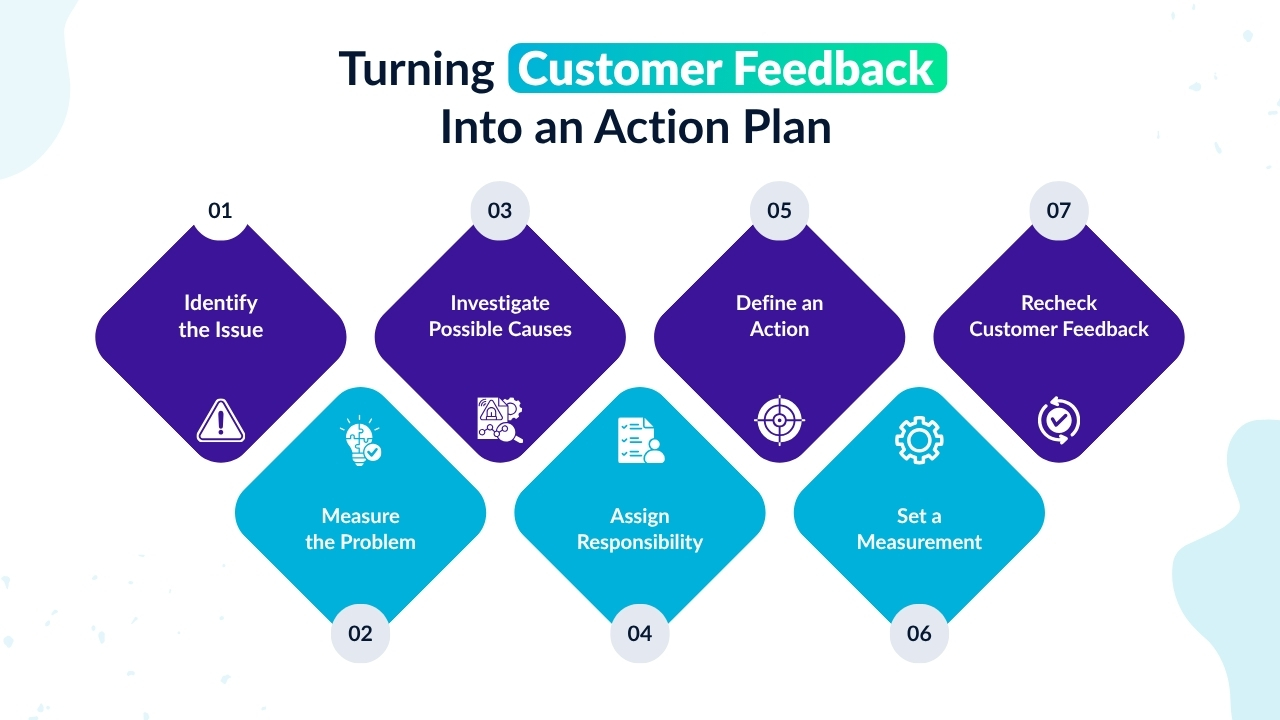
Customer feedback becomes more valuable when restaurants use it to guide specific improvements. AI-powered feedback analysis can help to identify recurring problems, but restaurant teams still require a structured process for investigating problems, assigning responsibility, and measuring results.
1. Identify the Issue
Start by identifying the most frequent or essential customer problem. For instance, AI analysis may show repeated complaints about slow dinner service.
Managers should evaluate whether the issue is isolated or appearing consistently across multiple days, shifts, or locations.
2. Measure the Problem
Determine the scale and seriousness of the problem by reviewing relevant operational and customer data. Evaluate average ticket times to identify service delays, complaint frequency, to measure how often customers report the problem, and peak complaint periods to identify when problems happen most often.
Determine the scale and seriousness of the problem by reviewing relevant operational and customer data. Evaluate average ticket times to identify service delays, complaint frequency to measure how often customers report the problem is isolated or widespread.
Finally, review customer sentiment trends to understand whether satisfaction is improving, declining, or remaining stable over time.
Also Read: AI Tools to Analyze Customer Reviews
3. Investigate Possible Causes
Customer feedback shows what guests experienced, but operational data can help investigate why. Compare feedback with:
- Staffing levels
- Sales volume
- Kitchen capacity
- Menu mix
- Reservations
- Delivery orders
4. Assign Responsibility
Every improvement initiative should have a clear owner. Based on the issue, responsibility may belong to the general manager, operations manager, kitchen manager, or another appropriate team member.
5. Define an Action
Develop a practical response based on the analysis. For instance, management could increase peak-hour staffing, adjust kitchen schedules, simplify food preparation processes, or review menu challenges.
6. Set a Measurement
Having a clear target makes it easier to determine whether the action worked. For instance, the restaurant could aim to reduce average ticket time by 15% within 30 days while tracking customer sentiment.
7. Recheck Customer Feedback
After implementing changes, continue monitoring reviews, surveys, ratings, and customer sentiment. If customer complaints decrease, the action may be giving positive results.
If problems keep happening, then management can investigate further. This creates a continuous improvement cycle:
Feedback -> Analysis -> Investigation -> Action -> Measurement -> New Feedback.
Also Read: How AI Can Analyze Customer Feedback
Benefits of Restaurant AI Customer Feedback Tools
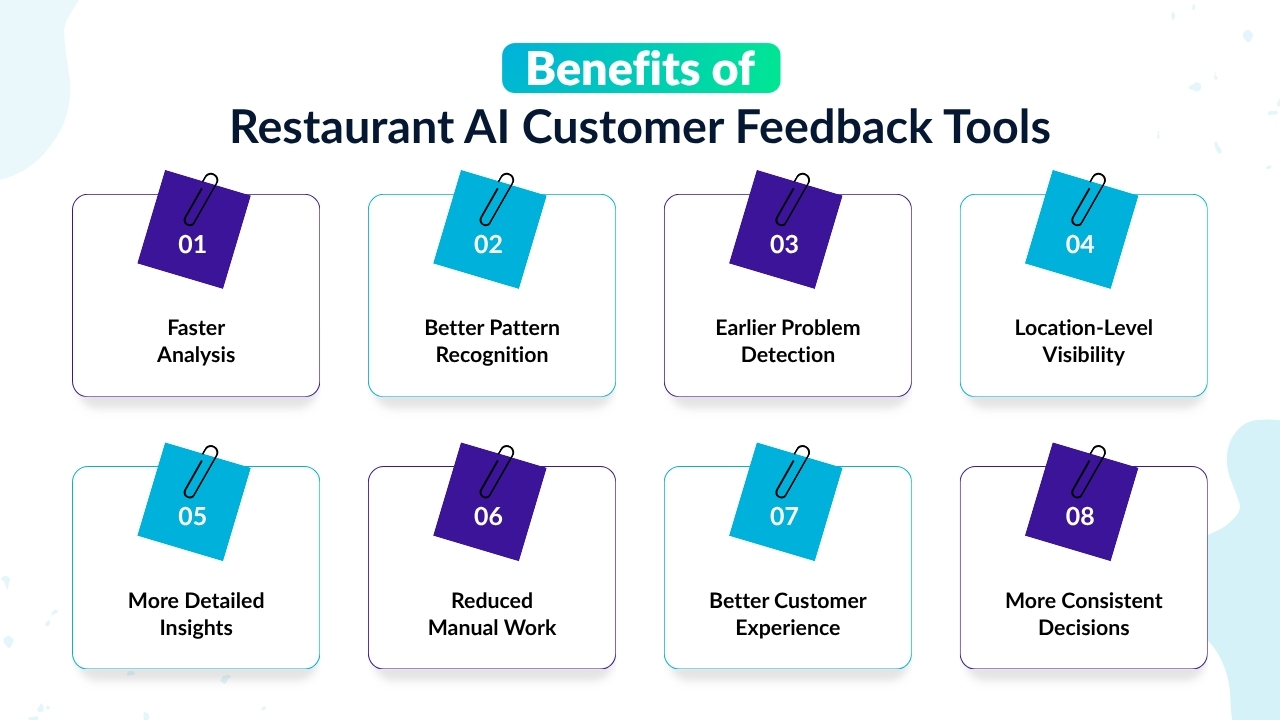
Restaurant AI customer feedback tools can help businesses to turn volumes of reviews and comments into organized insights. Key benefits include:
1. Faster Analysis
AI systems can process thousands of customer comments quickly, reducing the time managers spend manually reading and organizing reviews.
2. Better Pattern Recognition
AI systems can identify recurring themes across different customer feedback sources, that help restaurants to recognize problems that may be difficult to identify individually.
3. Earlier Problem Detection
Sudden increase in negative sentiment of customer complaints can help teams to identify emerging customer experience problems sooner.
4. Location-Level Visibility
Restaurant groups can compare customer sentiment, ratings, and recurring problems across individual locations to identify performance differences.
5. More Detailed Insights
AI systems can separate multiple aspects within one review, showing that customers may appreciate one aspect while criticizing another aspect.
6. Reduced Manual Work
AI-powered categorization and sentiment analysis can reduce the time managers spend reading, sorting, and organizing customer reviews. It allows teams to focus more on interpreting insights and improving operations.
7. Better Customer Experience
Identifying recurring complaints and customer preferences helps restaurants to focus on improvements that resolve genuine guest problems. This can support better service, food quality, and overall satisfaction.
8. More Consistent Decisions
Structured customer feedback gives management teams a shared source of information. It can support more consistent evaluations, clearer discussions, and better-informed decisions about customer experience improvements.
How to Build a Restaurant AI Feedback Strategy
A successful restaurant AI feedback strategy should be practical, focused, and connected to business goals. Restaurants can start with a small number of priorities and grow their approach as teams become comfortable with AI-powered analysis.
1. Define the Objective
Start by identifying the specific aspects that the restaurant wants to improve. Goals may include service speed, food quality, delivery performance, customer satisfaction, online reputation, or customer retention. Having a clear objective keeps the feedback strategy focused.
2. Select Important Feedback Sources
Choose channels that provide valuable customer information. These may include online reviews, surveys, delivery platforms, social media, website forms, and direct complaints. Combining multiple sources gives a broader view of guest experiences.
3. Establish Core Topics
Create categories that match with restaurant operations. Common topics include food quality, staff service, cleanliness, pricing, wait times, order accuracy, menu performance, and delivery.
4. Monitor Sentiment
Track positive, negative, neutral, and mixed customer feedback. Tracking customer sentiment regularly can reveal changes in customer perception and highlight emerging customer perception and highlight emerging problems.
5. Identify Recurring Issues
Focus on repeated themes instead of isolated comments. Consistent complaints about the same problem may indicate an operational problem requiring further analysis.
6. Connect Feedback With Operations
Compare customer insights with restaurant KPIs, which includes ticket times, staffing, sales, labor expenses, inventory, and table turnover. It can help restaurant managers to evaluate.
7. Assign Actions
Every crucial insight should lead to a specific action. Assign responsibility to a manager or relevant team member and establish a clear timeline for implementation.
8. Measure Results
Set measurable targets to evaluate whether improvements are working. And then compare customer sentiment and operational KPIs before and after implementing charges.
9. Repeat the Process
Consider feedback analysis as an ongoing management activity instead of treating it as a one-time project. Regular tracking helps restaurants to identify new patterns, evaluate past actions, and continuously improve the customer experience.
Conclusion
Restaurant reviews contain valuable information, but simply gathering ratings and comments is not enough. Restaurant AI customer feedback tools can help businesses to organize large volumes of customer feedback, identify recurring themes, analyze sentiment, and recognize emerging customer experience problems.
When these insights are connected with operational data like sales, staffing, ticket times, menu performance, and delivery volume, restaurants can better analyze potential causes and make informed decisions.
Clariv can support this approach by helping restaurants analyze customer sentiment, identify feedback topics, track trends, and improve visibility across locations and channels. These capabilities can make it easier for restaurant teams to go beyond scattered reviews to structured insights.
The most crucial step, however, is converting insights into action. Restaurants can identify a problem, analyze its possible causes, assign responsibility, implement improvements, and measure the results.
By continuously repeating this process, businesses can use AI customer feedback analysis to strengthen operations, respond to customer needs, and create a more consistent and satisfying restaurant experience.
If you still have any query about how restaurant AI customer feedback tools turn reviews into actionable insights then you may write to us at Clariv and we are more than happy to assist you.