Google reviews are more than star ratings and customer comments. It gives valuable insights about the way people experience a business.
Some of the funniest Google reviews can make readers laugh, but even behind the humor, sarcasm, and unexpected observations are essential lessons regarding customer experience, customer feedback, and online reputation.
If there is a clear review regarding slow service, unusual food, confusing processes, or friendly employees can reveal what customers remember most about a business.
For businesses, these reviews can highlight crucial areas like customer satisfaction, service quality, customer expectations, brand reputation, customer engagement, review management, customer sentiment, business reputation, service improvement, and customer loyalty. Even humorous complaints can identify recurring problems that customers face that may affect the overall experience of customers.
Understanding these patterns become highly essential when businesses receive customer feedback across multiple platforms. Platforms like Clariv can help businesses to analyze customer reviews and sentiment, identify recurring themes, track reputation trends, and transform customer feedback into actionable insights.
This blog explores some of the funniest Google reviews and examines what businesses can learn about real customer experiences. Whether humorous complaints, unexpectedly positive observations, these reviews show that laughter can sometimes reveal valuable information.
Going beyond the joke, businesses can find opportunities to improve customer experience, improve relationships with customers, and create experiences that customers genuinely remember.
Also Read: Google Review Management Software
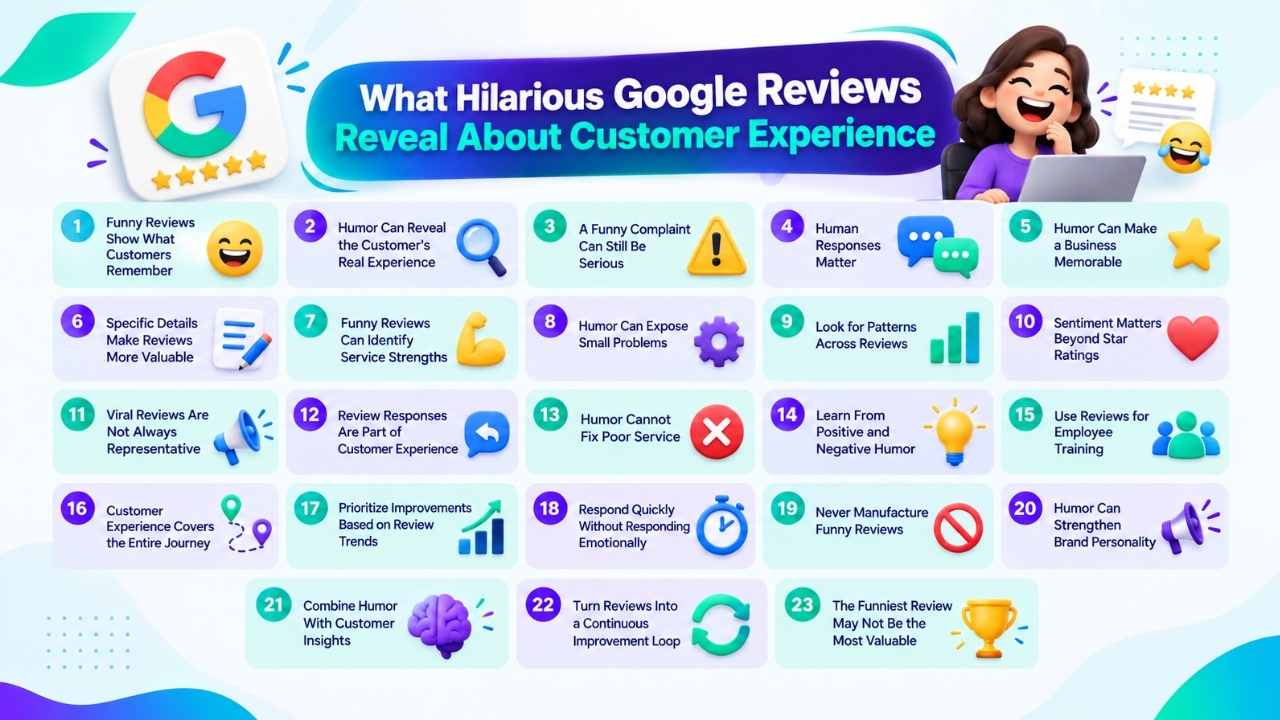
What Hilarious Google Reviews Reveal About Customer Experience
Funny Google reviews can make people laugh, but they can also reveal valuable insights into customer experience. Customers often use humor, sarcasm, exaggeration, and storytelling to describe their interactions with restaurants, hotels, retailers, salons, and other businesses.
Behind the jokes, however, there may be important information about service quality, waiting times, employee behavior, product quality, convenience, pricing, atmosphere, and other parts of the customer journey.
For businesses, the essential lesson is to look beyond the humor. A funny review can highlight something customers loved, expose a problem that needs attention, or reveal an experience that customers are likely to remember.
Below are the following lessons that explain how businesses can turn humorous Google reviews into useful customer experience insights.
1. Funny Reviews Show What Customers Remember
Customers may not remember every detail of a transaction. They tend to remember moments that surprise them, delight them, frustrate them, or make them laugh.
A customer may forget the exact time they entered a restaurant but remember that the food portion was so large that they needed a nap afterward.
Another customer may forget an employee’s name but remember how friendly the staff were. Someone else may remember spending too much time searching for parking and describe the experience humorously.
Such comments identify memorable aspects of the customer journey. Businesses should therefore look beyond star ratings. A four-star review with a detailed comment may reveal more about customer experience than a five-star review that simply says, “Great Service.”
Humorous reviews can work as informal customer research by showing businesses what customers remember most.
Also Read: Why Customer Reviews are Important for Business Growth
2. Humor Can Reveal the Customer’s Real Experience
Traditional surveys often provide answers on whether customers are “satisfied” or “very satisfied”. Customer reviews let customers to convey in their own language.
Some customers use sarcasm while other customers exaggerate or tell stories. A customer saying, “I came for one coffee and somehow stayed for three hours” may be expressing satisfaction about the ambience. Someone saying that “parking was the real adventure” may be expressing frustration.
Businesses should understand the humor in customer reviews and focus on its underlying message. A funny review may highlight problems about waiting time, staff friendliness, pricing, cleanliness, convenience, ordering, or product availability.
When similar humorous comments appear repeatedly, it may indicate a consistent customer experience problem that deserves attention.
Also Read: Customer Satisfaction Metrics
3. A Funny Complaint Can Still Be Serious
Humor does not always mean that a customer is satisfied. A funny review can hide a genuine problem that businesses should take seriously. Customers may use jokes to describe frustrating experiences without directly sounding angry.
For instance, a customer might humorously describe waiting too long for food. The joke may make readers laugh, but the actual message is that service was slow and affected the overall experience.
- Look beyond the humor: Focus on the actual problem mentioned.
- Identify operational issues: Pay attention to concerns about waiting, service, quality, or convenience.
- Respond appropriately: Acknowledge the concern instead of responding only to the joke.
- Take action: Use repeated complaints to identify areas that need improvement.
Humor can soften criticism, but it does not remove the customer’s problem.
Also Read: How to Respond to Negative Customer Reviews
4. Human Responses Matter
Customers appreciate responses that feel genuine rather than either copied or automated. Although standard phrases like “Thank you for your feedback” are professional, they may not show that the business should understand the review.
- Match the customer’s emotion: They must respond warmly to positive comments, acknowledge customer frustration when something went wrong, and use light humor when the customer is clearly joking.
- Show personality: If there is a playful review about a dessert ruining someone’s diet could receive a friendly, humorous response.
- Know when to stay serious: Avoid jokes when reviews mention food safety, discrimination, injuries, or major service failures.
The important principle is to align the emotion with customer emotion, and not just the words. A thoughtful response shows customers that the business is listening, understanding, and genuinely interested in their experience.
Also Read: How to Measure Customer Sentiment
5. Humor Can Make a Business Memorable
Many businesses offer similar products and services. Having a unique business personality can therefore help a company to stand out. Funny reviews and thoughtful responses can make a business appear more warm.
Customers reading Google reviews are not just evaluating ratings, but they are also trying to understand what interacting with the business might feel like.
A restaurant may have reviews about enormous portions while a cafe may receive comments about customers becoming obsessed with their coffee. A hotel might have guests joking that they never wanted to leave. These comments help readers to understand what the business experience feels like.
Businesses should let humor develop naturally because genuine humor feels more authentic.
Also Read: How Restaurant AI Customer Feedback Tools Turn Review into Actionable Insights
6. Specific Details Make Reviews More Valuable
Funny reviews often stand out because they include specific details about the customer’s experience. Rather than simply saying a restaurant is “great”, a humorous comment about ordering dessert despite being completely full tells readers much more.
- Reveal customer experiences: Specific comments can show what customers enjoyed, noticed, or found frustrating.
- Identify recurring patterns: Repeated praise for friendly employees can highlight a strength, while frequent jokes about long queues may reveal a service problem.
- Understand the customer journey: The words customers use can help businesses identify which parts of their experience need improvement.
Detailed reviews provide useful insights while making customer feedback more memorable and meaningful.
Also Read: How to Manage Your Online Reviews for Business
7. Funny Reviews Can Identify Service Strengths
Humorous reviews are not always negative. Many funny comments show genuine customer satisfaction and can reveal what customers value most about a business.
- Highlight positive behaviors: Jokes about employees remembering complicated orders can show strong personalization and attention to detail.
- Recognize customer service: Comments about exceptionally friendly staff can demonstrate effective hospitality.
- Learn from positive feedback: Businesses can identify behaviors related to service quality, consistency, convenience, and atmosphere.
Managers should look beyond the humor to understand why customers responded positively. All these insights can help businesses to recognize effective employee behaviors and encourage staff to repeat them.
Also Read: How to Use Review Monitoring Software to Manage Your Online Reputation
8. Humor Can Expose Small Problems
Customers do not always submit formal complaints when something goes wrong with a product or services. Sometimes, they use humor to point out everyday problems. A joke about unreliable Wi-Fi, or broken air conditioning may seem harmless but it can reveal a problem that affects the customer experience.
- Identify recurring problems: If there are repeated jokes about Wi-Fi, waiting times, parking, seating,cleanliness, or noise may indicate operational weaknesses.
- Look for patterns: One humorous comment may be an isolated incident, while several similar comments can signal a genuine trend.
- Take action: Businesses should investigate repeated concerns and address them before they become larger customer satisfaction problems.
Humorous feedback can therefore provide valuable insights into small problems that customers may otherwise overlook or ignore.
Also Read: Restaurant Review Sentiment Analysis
9. Look for Patterns Across Reviews
A small business may be able to read every review about your products or services manually. Larger companies with multiple locations may receive hundreds or thousands of comments.
Identifying patterns across many reviews helps businesses to uncover recurring problems faster than analyzing each review separately.
For instance, a restaurant might discover that 35 customers praise its staff, 28 mention excellent food, 22 mention long waiting times, and 18 mention parking difficulties.
The funniest review might attract attention, but repeated patterns in customer reviews are more essential for management.
This is where sentiment analysis and review intelligence can help businesses to identify recurring topics and customer emotions. Clariv describes its platform as an AI-powered customer sentiment and reputation management solution designed to bring review information together and identify recurring patterns.
Also Read: AI Tools to Analyze Customer Reviews
10. Sentiment Matters Beyond Star Ratings
Star ratings provide a quick overview, but they do not always capture the complete customer experience. Because even if the customer leaves a five-star review ratings can still mention long waits, while a three-star review ratings may praise the food and staff.
- Separate positive and negative themes: Sentiment analysis can identify what customers like and dislike within the same review.
- Find specific issues: Businesses can track sentiment around food, service speed, staff behavior, pricing, and product quality.
- Make better decisions: According to the source material, Clariv’s AI can categorize feedback by emotions and topics, providing deeper insights than overall star ratings alone.
This helps businesses to understand exactly what customers appreciate and where improvements are needed.
Also Read: Sentiment Analysis Demo
11. Viral Reviews Are Not Always Representative
A funny review may grab customer attention because it is unusual or entertaining, but popularity does not necessarily mean the experience reflects most customers. Businesses should look beyond viral comments and examine broader customer feedback.
- Check whether it is isolated: One unusual complaint may simply describe a single customer’s experience.
- Look for repeated patterns: If many customers mention the same issue, such as limited parking, it may indicate a genuine problem.
- Use data for context: Businesses can compare individual reviews with larger trends to determine which issues matter at scale.
Humor helps businesses to notice essential reviews, while data helps to determine whether those experiences represent a broader customer trend.
Also Read: Client Review Platform for Legal Services
12. Review Responses Are Part of Customer Experience
Customer experience with the brand does not necessarily end when a customer submits a review. While the way businesses respond to public response becomes part of its reputation. Future customers can read both the original review and the response.
A thoughtful response can show accountability, empathy, professionalism, personality, willingness to improve, and respect. For a playful review, a light response may work well. For a serious customer complaint, empathy and resolution should take priority.
A useful response structure is:
- Acknowledge the customer.
- Recognize the specific issue.
- Apologize when appropriate.
- Explain what action is being taken.
- Invite further conversation if needed.
- Maintain an appropriate tone.
This makes the response warm without sacrificing professionalism.
Also Read: How to Track Customer Feedback in Real-Time
13. Humor Cannot Fix Poor Service
Humor can make a business appear friendly, but it cannot replace good customer service. If customers repeatedly experience slow service, incorrect orders, or rude employees, clever responses will not solve the underlying problems.
- Address root causes: Businesses should investigate repeated complaints and improve processes, training, and service quality.
- Use reviews as signals: Customer feedback can reveal problems that require immediate attention rather than simply entertaining responses.
- Focus on lasting satisfaction: The goal should be to reduce the reasons customers complain, not make negative reviews appear humorous.
Although humor can make a brand more approachable, lasting customer satisfaction comes from consistently improving the overall customer experience.
Also Read: How to Add Business to Apple Maps
14. Learn From Positive and Negative Humor
Businesses often pay close attention to negative reviews because they can affect ratings and reputation. However, positive humorous reviews can provide equally valuable insights into what customers enjoy.
- Recognize positive experiences: Comments about staff remembering orders, irresistible desserts, or customers wanting to stay longer can reveal genuine satisfaction.
- Identify the reasons: Businesses should find whether such reactions come from excellent hospitality, delicious food, fast service, personalization, or a welcoming atmosphere.
- Repeat successful behaviors: Once when businesses understand what customers value, then they can encourage employees to maintain and strengthen those positive experiences.
It is essential for businesses to learn from both positive and negative humor helps businesses to understand customer expectations and improve the overall customer experience.
Also Read: Social Media Management Tips for Small Businesses
15. Use Reviews for Employee Training
Customer reviews can become practical tools for businesses to improve employee performance. When customers regularly praise a staff’s ability to remember customer preferences, then managers can use that insight as an example of excellent service.
- Identify successful behaviors: They must look for actions that customers consistently appreciate such as instant greetings, personalized service, or helpful communication.
- Investigate recurring problems: If there are jokes about slow service, then it may point to staffing, workflow, or communication problems.
- Create clear standards: Instead of simply asking employees to “improve customer service,” managers can provide specific behaviors that they should follow.
When businesses look beyond the humor, then businesses can transform customer feedback into practical staff training lessons that improve service quality and consistency.
16. Customer Experience Covers the Entire Journey
Businesses sometimes focus too much on the product itself. A restaurant can have excellent food but poor parking. A hotel can have beautiful rooms but slow check-in. An online retailer can sell excellent products but have a confusing return process. Customer experience includes every interaction.
Businesses should examine the entire journey:
Discovery -> Booking -> Arrival -> Service -> Payment -> Follow-up -> Review
At each phase, managers should examine what customers praise, criticize, joke about, and repeatedly mention. Funny reviews can be particularly helpful because customers often describe these smaller moments in everyday language.
17. Prioritize Improvements Based on Review Trends
Every customer complaint cannot be fixed immediately. So businesses should prioritize customer issues based on factors like frequency, severity, customer impact, business impact, ease of improvement, location, department, and trend direction.
A complaint that a customer mentioned once may not require instinct action. An increase in the number of customer complaints about service delays deserves more attention.
Review trends can help management to determine which problems are becoming more common and which strengths remain consistent.
The key question should change from:
“What is the funniest review?”
to:
“What does the pattern behind these reviews tell us?”
That is where customer feedback becomes business intelligence.
18. Respond Quickly Without Responding Emotionally
Businesses should respond to funny reviews instantly, as they should avoid reacting emotionally or impulsively. Humor may sometimes hide customer frustration, so teams should understand the customer’s messages before replying.
- Read the tone carefully: They must determine whether the customer is happy, joking, frustrated, or if you are seeking a solution.
- Consider the impact: A joke that may seem harmless to employees could appear dismissive to other customers.
- Prioritize professionalism: When the meaning is unclear or the complaint is serious, then a thoughtful and respectful response is safer than an overly clever one.
Although an instant response is valuable, it is also essential to carefully review those comments before humor.
19. Never Manufacture Funny Reviews
Authenticity is essential for building customer trust. Businesses should never create fake reviews to make their reputation appear more entertaining or positive. If customers discover fabricated feedback, then the businesses quickly lose credibility.
- Encourage genuine feedback: They must make it easy for customers to share their experiences without telling them what to write.
- Value authentic language: Real customer comments provide useful insights into actual experiences and expectations.
- Focus on improvement: Businesses should listen to feedback, respond thoughtfully, learn from it, and improve their services.
The funniest and most valuable reviews are naturally created by real customers sharing their genuine experiences, not manufactured by businesses.
20. Humor Can Strengthen Brand Personality
A strong brand personality can make a business more recognizable and memorable. Customers that interact with brands through websites, social media, reviews, emails, and messages, that makes communication style essential.
- Match the brand: A playful cafe can use casual humor, while a luxury hotel may prefer subtle wit.
- Consider the industry: Healthcare and financial businesses should be careful while discussing sensitive subjects.
- Choose the right tone: Humor should reflect the industry, customer, context, and situation.
The goal is to use humor naturally without distracting from the brand’s message. When humor is appropriate, then it can make communication feel more warm and help customers develop a stronger connection with the business.
21. Combine Humor With Customer Insights
Funny Google reviews can provide more than entertainment. They can help businesses to understand customer experiences, identify patterns, and find opportunities for improvement.
- Attract attention: Humor makes reviews memorable and encourages businesses to notice them.
- Understand experiences: Customer language can reveal what people genuinely enjoy or dislike.
- Identify patterns: Repeated comments can highlight common strengths or problems.
- Take action: Businesses can use these insights to improve products, services, and customer experiences.
The goal is not simply to laugh at a funny review. Businesses should understand why it was funny, what it reveals, whether others share the experience, and what action can improve it.
22. Turn Reviews Into a Continuous Improvement Loop
Businesses can create a simple review process that turns customer feedback into ongoing improvements. Rather than treating reviews as isolated comments, teams can use them to understand experiences, identify trends, and measure progress.
- Collect and read: Gather reviews and examine the language customers actually use.
- Categorize and analyze: Group feedback into areas such as service, food, pricing, staff, convenience, and atmosphere, then assess customer sentiment.
- Identify patterns: Look for recurring strengths and problems across multiple reviews.
- Respond and act: Provide appropriate responses and make meaningful operational or service improvements.
- Measure results: Monitor future feedback to determine whether customer sentiment changes.
Such a continuous loop transforms funny reviews from simple entertainment into valuable customer experience insights that support long-term improvement.
23. The Funniest Review May Not Be the Most Valuable
A hilarious review may attract attention without providing much actionable information. Another review may contain one simple sentence that identifies a major operational problem.
Businesses should therefore avoid measuring customer feedback purely by entertainment value.
The most valuable review may be the one that clearly answers:
What happened? Why did it matter? What should change?
Funny reviews are useful because they capture attention and emotion. They can make ordinary experiences memorable. But the ultimate purpose of customer feedback is understanding and improvement. Businesses should enjoy the humor while paying attention to the operational information hidden inside it.
Conclusion
Funny Google reviews are more than entertaining comments, that they can provide valuable insights into how customers experience a business. Humor often makes feedback memorable, but behind the jokes there may be crucial messages about service quality, employee behavior, waiting times, pricing, convenience, food, atmosphere, and overall satisfaction.
Businesses should therefore look beyond the humor and pay attention to the details customers share. Positive reviews can reveal behaviors worth repeating, while humorous complaints can expose problems that need attention.
Analyzing sentiment, identifying recurring patterns, and comparing feedback across multiple reviews can help businesses to understand what truly matters to their customers.
Most importantly, businesses should respond with empathy and authenticity. A clever response may create a positive impression, but it cannot replace genuine improvements. The real value of customer feedback comes from turning insights into action.
When businesses collect, analyze, respond to, and learn from reviews continuously, even the funniest comments can become useful tools for improving customer experiences, strengthening brand personality, building trust, and encouraging long-term customer loyalty.
If you still have any query about funny Google reviews and what they teach us about customer experience then you may Book a Call at Clariv and we are more than happy to assist you.