
A positive review for food left by a customer can influence dining decisions made by other potential diners. Positive reviews build customer trust, and also improve the online reputation of the restaurant.
When customers through their reviews share experiences about tasty meals, fresh ingredients, friendly staff services, and welcoming surroundings, that helps potential diners to understand what makes a restaurant worth visiting.
These positive food reviews give restaurant owners insights into customer preferences and service quality.
However, satisfied customers do not leave positive reviews instantly. So restaurants require effective review management strategies to encourage customers to add positive feedback without pressurizing guests.
Through simple approaches like sharing Google review links, displaying review QR codes, sending polite follow-up messages, and providing excellent customer service that makes it easier for customers to leave feedback.
While restaurants must respond to customer reviews professionally as it shows that customers are being appreciated and thereby strengthening customer relationships.
Restaurants should focus on providing memorable dining experiences rather than chasing five-star ratings from customers. While receiving genuine customer feedback, maintaining consistent food quality, and attentive service provide a stronger foundation for achieving long-term success.
Tools like Clariv can further support customer sentiment analysis and restaurant reputation management by helping teams to organize customer feedback, identify recurring customer problems, and understand customer opinions.
When restaurants provide good hospitality services, good review requests and thoughtful feedback management, restaurants can encourage happy customers to share their experiences and help more diners to find the restaurant.
Also Read: Restaurant Review Sentiment Analysis
Why Positive Food Reviews Matter
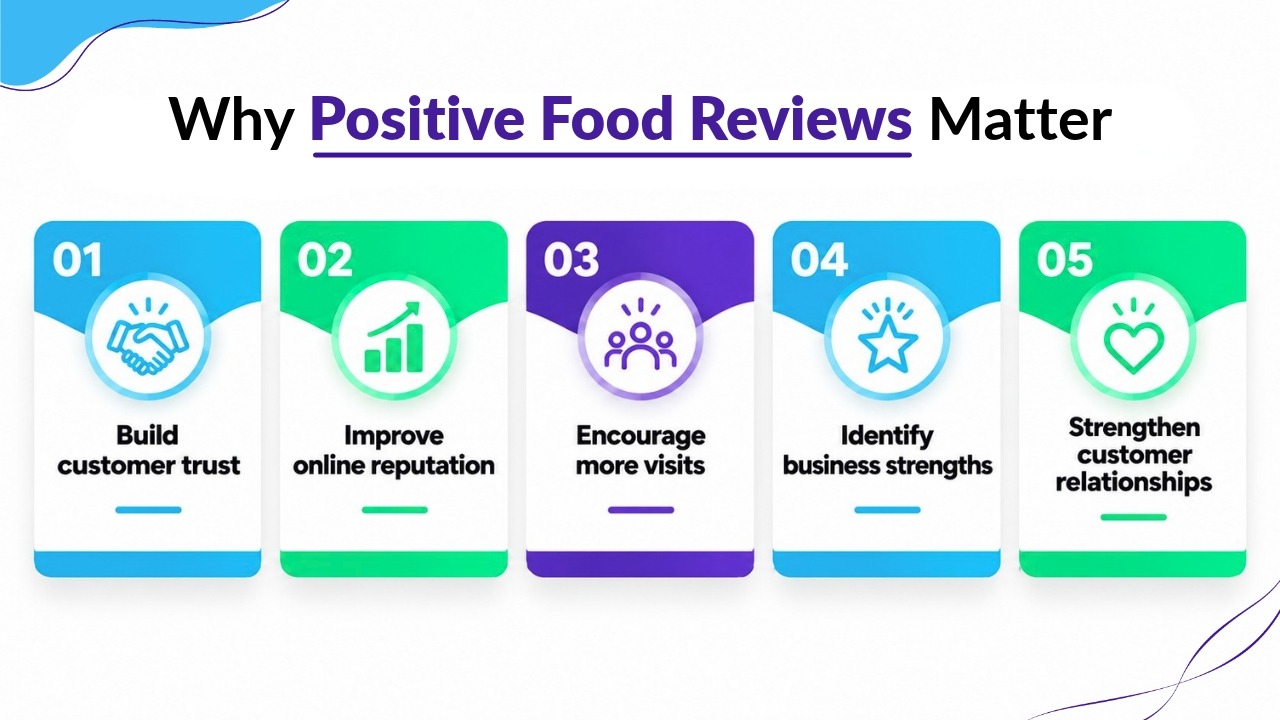
Positive food reviews received from customers help potential diners to understand the food and services that restaurants offer before they visit. A detailed customer review might describe the taste of a popular dish, fresh ingredients, friendly staff, or the overall dining ambiences.
Such details provided in customer feedback provide more insights to restaurants than star ratings.
1. Build Customer Trust
Today diners often check customer reviews before they select to dine at an unfamiliar restaurant. If restaurants receive genuine reviews from customers describing certain dishes and good hospitality experiences, let potential diners have an expectation about the restaurant.
Also Read: Brand Reputation Management Software
2. Improve Online Reputation
When restaurants consistently receive positive reviews from customers, they can improve the reputation of the restaurant on Google, review platforms, and social media. If there are recent, authentic reviews help potential diners to know the food and services that the restaurant currently offers.
Also Read: How to Manage Online Reviews for Your Business
3. Encourage More Visits
Positive reviews encourage more visits from customers because when restaurants receive a customer review mentioning excellent biryani, freshly baked pizza, good food portions, or attentive service may encourage someone with same food preferences to try at the restaurant.
Also Read: Customer Sentiment Score Explained
4. Identify Business Strengths
When restaurants receive repeated praise through positive reviews can reveal the aspects that their customers value the most. Restaurant owners might find that guests mostly appreciate a signature dessert, quick lunch service, vegetarian options, or friendly staff.
Also Read: Google Review Management Software
5. Strengthen Customer Relationships
When restaurants acknowledge their customer reviews shows customers that their opinions matter to restaurants. Sending thoughtful responses to customers can turn a single dining experience into a long-term relationship with customers.
Also Read: What is Customer Sentiment Analysis
How to Encourage Customers to Leave Positive Food Reviews
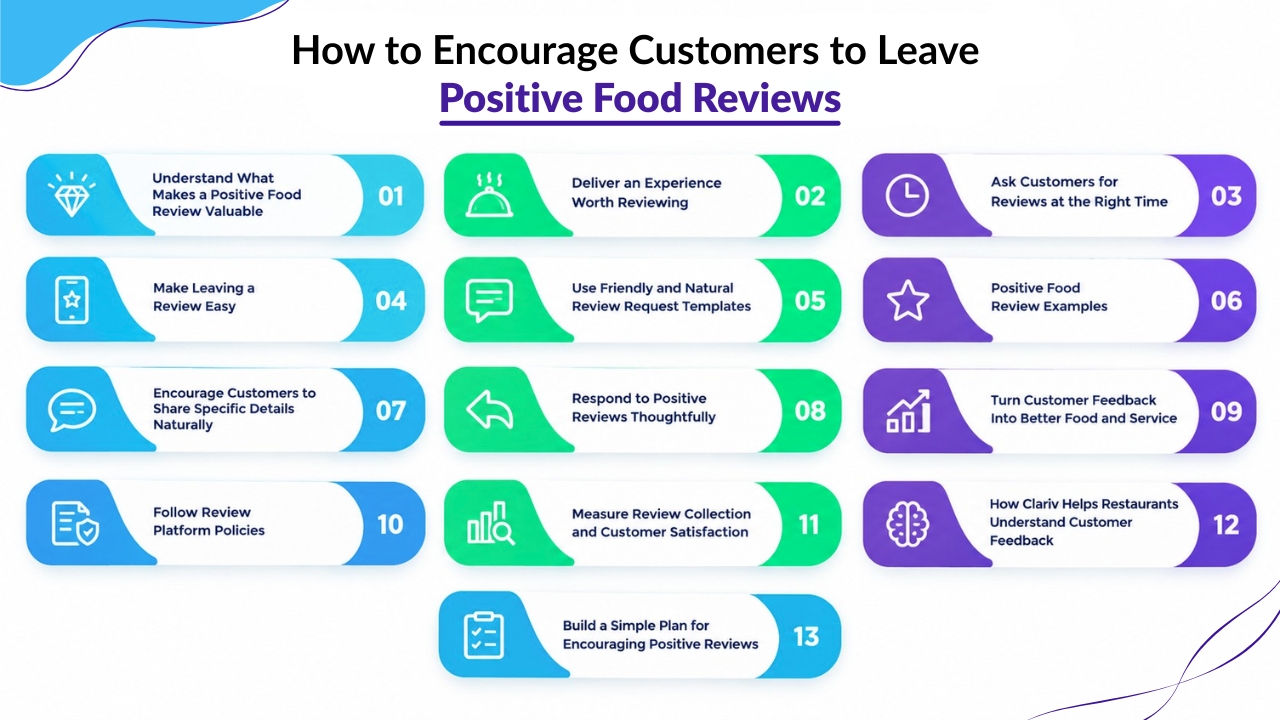
1. Understand What Makes a Positive Food Review Valuable
Every positive review from the customer gives insights about their food and services. If a restaurant receives a comment from a customer like “Great food!”It shows that customers are satisfied, but this comment does not explain the aspects that made their experience with the restaurant memorable.
When customers describe in detail about food and services in reviews, it helps other diners to imagine the meal and also gives restaurant owners useful insights about their food and services.
A valuable positive food review often includes:
- Specific dishes: mention the name of the food, dessert, drink.
- Taste and texture: describes tastes, freshness, seasoning, or food preparation.
- Service quality: mentions about helpful staff, attentive service, or their efficient ordering services.
- Dining atmosphere: mentions about restaurant cleanliness, comfort, lighting, or ambiance.
- Value for money: mentions if the food portion size and food quality is worthy of their value.
- Personal experience: mentions if their visit was enjoyable.
- Recommendation: explains whether the reviewer would return or recommend the restaurant.
While customers should never be needed to mention every aspect of your restaurant. Instead the goal of the restaurant should be to make it easier for their customers to share the aspects that they loved about the restaurant whether food or services.
Also Read: How to Use Review Monitoring Software to Manage Your Online Reputation
2. Deliver an Experience Worth Reviewing
One of the most sustainable ways for restaurants to encourage customers to leave positive food reviews is by providing an experience that customers genuinely appreciate.
Because sending review requests to customers can remind people to share their opinions but it cannot replace experiences of good food and reliable services.
1. Prioritize food quality
Restaurants should focus on serving quality food to their customers. They must maintain consistent food recipes, ensure appropriate cooking temperatures, fresh ingredients, and good food presentation. Customers are more likely to remember the food meals if it meets their expectations.
2. Make service welcoming
Restaurants must make their service more welcoming. They must train staff to greet their guests warmly, explain food meals to customers clearly, and fulfill customer requests, and check if customers require any assistance with food or services without interrupting while they are dining unnecessarily.
3. Maintain cleanliness
Restaurants must maintain cleanliness by keeping clean tables, utensils, dining spaces, and restrooms that provide an overall good experience to the customers. Because even if customers are served a tasty meal but still customers may not have a positive impression of your restaurant if your ambience is not clean.
4. Improve order accuracy and timing
Restaurants must improve order accuracy and timing by confirming food orders carefully, informing customers if there are any service delays, and good coordination between kitchen and service teams. If there are any takeaway and delivery orders, then the staff members must verify the food, meals, and packaging to be accurate.
5. Create memorable moments
Restaurants must do small gestures that make customers visit special. For instance, staff members remembering dietary requirements of a customer, explaining signature dishes to customers, or helping a family to choose the best dishes that will have a positive impression about your restaurant to customers.
While restaurants should also monitor customer complaints and take corrective actions for problems faced by customers. A reliable customer experience helps restaurants to establish positive customer feedback.
Also Read: AI Tools to Analyze Customer Reviews
3. Ask Customers for Reviews at the Right Time
Even satisfied customers do not think about leaving a positive review about food and services unless the restaurant sends a reminder to leave reviews. While the timing of sending review requests to customers is also essential for restaurants instantly after the visit.
1. Ask after a successful dining experience
Staff members of the restaurant must politely ask customers to leave their feedback after they have finished their meals or are about to leave the restaurant. While the staff members must not interrupt the dining experience of customers.
2. Send a post-visit message
Restaurants must collect contact details with permission from the customer. Restaurants can either send a short follow-up email or message. Sending a review request to the customer shortly after their restaurant visit helps customers to remember their experience with the restaurant and leave detailed reviews.
3. Include a reminder on receipts
Including a short message on printed or digital receipts gives customers an opportunity to leave feedback about their product or services as per their convenience.
4. Use table cards
Restaurants can use a small displaying a review link or QR code that makes the process accessible without requiring staff to approach every table.
5. Keep requests pressure-free
Customers should not feel stressed to leave an honest review whether their experience with your restaurant was positive, mixed, or negative. Restaurants should not just ask satisfied or happy customers to post public reviews.
Also Read: How AI Sentiment Analyze Software Turns Customer Feedback into Growth Opportunities
4. Make Leaving a Review Easy
Restaurants must make the review adding process easy for customers because customers who want to share their feedback may abandon the process if they find the review page taking too much time to load or navigate to. So restaurants must reduce unwanted steps so that customers can leave a review without any confusion.
1. Provide a direct review link
Restaurants must provide a direct review link to the restaurant’s review page or to a relevant platform. and include the review link appropriately on receipts, and website pages.
2. Display a QR code
Restaurants must display a QR code that can connect to the review page using their phone. And place QR code on restaurant tables, printed receipts, takeaway packaging, menu inserts, billing counters, thank-you cards. While restaurants must ensure that the provided QR code can be scanned easily.
3. Optimize for mobile devices
Many customers open review pages or links from their mobile phones. So, restaurants must ensure that review links open correctly, pages load problems, and also the instructions are simple for customers to follow.
4. Offer multiple feedback options
Some customers prefer to write their Google reviews, while other customers may use a delivery platform or a feedback form of a restaurant. Customers must be offered with valid feedback options without confusing customers with too many choices.
Providing convenient feedback options to customers encourages them for more participation and does not influence customers what they want to write in their review.
Also Read: Client Review Platform for Legal Services
5. Use Friendly and Natural Review Request Templates
Restaurants must politely ask and send simple review requests that encourage customers to share honest feedback without feeling stressed to add reviews.
Restaurants can ask for reviews in person, through email, or using messaging apps. While requesting reviews should be friendly, short, and easy to understand.
When speaking with customers, staff can say, “Thank you for dining with us! We hope you enjoyed your meal. We would appreciate your honest feedback if you have a moment.”
For follow-up emails, they must thank customers for selecting the restaurant, explain to them that their feedback will help to improve food and services, and include a direct review link. A good subject link for review requests must be “Thank you for visiting our restaurant.”
While restaurants must always respect communication preferences of customers, avoid many reminders, and never offer incentives in exchange for reviews.
Also Read: How to Measure Customer Sentiment
6. Positive Food Review Examples
Positive food reviews often mention tasty meals, friendly services, and enjoyable dining experiences. Such sample templates show how customers can describe different restaurant visits.
- General Restaurant Review: “The food was delicious, the staff were friendly, and the atmosphere was welcoming. I would happily visit again.”
- Indian Food Review: “The paneer curry was flavorful, the naan was soft, and the portions were satisfying. We enjoyed our meal.”
- Pizza Review: “The pizza had a crispy crust, generous toppings, and excellent flavor. It arrived hot, and the service was friendly.”
- Fine-Dining Review: “Every dish was beautifully presented, and the staff provided attentive service. It was a memorable evening.”
- Family Restaurant Review: “The menu offered options for everyone, and the staff were welcoming. We look forward to returning.”
- Café Review: “The coffee was smooth, the pastries were fresh, and the atmosphere was relaxing.”
- Delivery Review: “Our order arrived on time, was carefully packaged, and tasted fresh.”
Also Read: Good Reviews for Restaurants What Makes them Stand Out
7. Encourage Customers to Share Specific Details Naturally
Customers sometimes hesitate to write a review as they do not know what to include in their review. Instead of asking customers to add ready-made praise for them to copy, restaurants can mention about their experiences that may be helpful for other diners.
For example, customers might choose to mention:
- Which dish they ordered
- What they enjoyed about its flavor or texture
- Whether the portion was satisfying
- How the staff treated them
- Whether the restaurant suited the occasion
- How easy the ordering process was
- Whether they would consider returning
A customer who enjoyed a dish may mention its seasoning, freshness, or food presentation. Customers visiting with family might discuss the ambience and food menu options.
Such details make customer reviews more insightful and also preserve the review of individual customers.
Restaurants should not demand customers to add certain phrases, include keywords, staff names, or five-star ratings. Encouraging customers to add reviews should let customers add their own experiences honestly rather than not convert reviews into scripted advertisements.
Also Read: How Restaurant AI Customer Feedback Tools Turn Reviews Into Actionable Insights
8. Respond to Positive Reviews Thoughtfully
Collecting reviews from customers is only part of reputation management. While it is essential for restaurants to respond to them as it helps hold a conversation with customers and shows appreciation for their reviews.
1. Thank the reviewer
Restaurants must use a simple thank-you message while responding to customer reviews. They must avoid replies that are automated or overly promotional.
2. Mention a relevant detail
If the customer praises a specific dish or staff member, then the restaurant must acknowledge that detail naturally.
Customer review: “The chocolate cake was excellent, and the staff were very welcoming.”
Restaurant response: “Thank you for visiting us! We are glad you enjoyed the chocolate cake and felt welcomed by our team. We appreciate your feedback and hope to see you again.”
3. Keep responses concise
Restaurants must avoid sending log replies as they are hardly necessary. Rather restaurants must focus on appreciating their customer and a genuine invitation to return when appropriate.
4. Maintain a consistent voice
Whether a restaurant is casual, family-oriented, or formal, their responses should reflect their brand and also remain professional.
5. Avoid identical replies
Restaurants must avoid sending the same message under every customer review as it can make interactions feel impersonal. Rather restaurants must send personalized responses if possible especially when customers mention a certain experience.
Also Read: How to Respond to Negative Customer Reviews
9. Turn Customer Feedback Into Better Food and Service
Positive reviews can reveal what a restaurant should continue doing, while critical feedback may reveal problems that need attention.
Restaurants must begin by reviewing comments regularly and group these comments into categories like food quality, menu variety, service, cleanliness, delivery, pricing, and atmosphere.
They must look for patterns among restaurants. For instance, if diners regularly praise a specific dish, then managers must evaluate the aspects that make this dish successful.
If customers frequently mention slow service, then the restaurant must check staffing levels, kitchen workflows, or order handling.
A practical feedback process includes:
- Collect feedback: Monitor reviews across the platforms the restaurant uses.
- Identify patterns: Separate recurring themes from isolated comments.
- Investigate causes: Discuss findings with the relevant staff.
- Take action: Introduce practical changes where necessary.
- Measure progress: Review subsequent feedback to see whether the experience improves.
Positive reviews should not cause restaurants to overlook genuine customer complaints. They must listen to all types of customer experiences that support sustainable improvement.
Also Read: Customer Sentiment Analysis Vs Customer Feedback Analysis
10. Follow Review Platform Policies
Restaurants should encourage genuine feedback without manipulating ratings or filtering out unfavorable opinions. Ethical review collection protects customer trust and reduces the risk of policy violations.
Google allows businesses to ask customers to share genuine experiences, but it prohibits incentives in exchange for reviews and discourages selectively from soliciting positive reviews. Restaurants must not pressurize customers to post reviews or provide them with the content that customers should include.
Avoid the following practices:
- Offering discounts, free meals, gifts, or loyalty points in exchange for reviews.
- Purchasing reviews or asking people who have not visited to post them.
- Requesting only five-star ratings from customers.
- Sending review links exclusively to customers expected to be happy.
- Asking customers to remove negative reviews in exchange for compensation.
- Providing scripted testimonials for customers to publish as their own experiences.
Rather they must provide an opportunity for customers to add honest reviews regardless of their experience. If a customer raises a problem, respond respectfully and work to resolve the problem through appropriate channels.
Also Read: How to Write a Review on Facebook
11. Measure Review Collection and Customer Satisfaction
Restaurants can improve their approaches by collecting practical measures from customers instead of prioritizing only on the number of five-star ratings.
Useful metrics include:
- Review volume: The number of customer reviews received over a certain period.
- Average rating: The overall score shown on the relevant platform.
- Response rate: The number of reviews receiving a response.
- Response time: Time within which the team addresses customer feedback.
- Sentiment trends: Changes in customer opinions over time.
- Recurring topics: Common praise and complaints about dishes, service, or delivery.
- Resolution progress: Whether reported issues lead to follow-up action.
Restaurants must review these measures weekly or monthly, based on the restaurant’s size and feedback volume.
For example, a restaurant might notice that customers are highly praising their new lunch menu while still receiving complaints about takeaway packaging improvement.
Restaurants must not assume that if there are high numbers of customer reviews it means high customer satisfaction level. While the quality of the experience, the relevance of customer feedback, and the restaurant’s response to problems matter just as much.
Also Read: Restaurant Review Template How to Respond to Every Review
12. How Clariv Helps Restaurants Understand Customer Feedback
Clariv helps restaurants organize customer feedback and understand sentiment across supported channels. Its restaurant customer sentiment analysis page has features for managing guest reviews, delivery feedback, and social interactions.
Important features of Clariv include centralized feedback management, sentiment analysis, trend monitoring, and AI-assisted responses. These tools help restaurant teams to find recurring comments about food quality, service speed, pricing, order accuracy, and ambience.
Clariv can also support multi-location restaurant groups by helping teams to track customer feedback across different locations and maintain consistent communication.
For example, repeated complaints about delivery delays may require managers to review food preparation and delivery processes. Restaurants before choosing Clariv, must verify its current integrations, supported platforms, reporting features, access controls, and pricing.
Staff should review AI-generated replies for accuracy and ensure customer feedback causes impactful improvements.
Also Read: Funny One Star Reviews from Restaurant Mistakes
13. Build a Simple Plan for Encouraging Positive Reviews
Having a consistent routine helps restaurant teams to encourage feedback without adding unnecessary complexity.
Daily
- Deliver consistent food quality and service.
- Check new reviews and respond to feedback that require attention
- Record urgent or recurring customer concerns.
Weekly
- Review common positive and negative themes.
- Discuss feedback with kitchen, service, and delivery teams.
- Check unresolved complaints and follow-up actions.
Monthly
- Review rating and review-volume trends.
- Identify frequently praised dishes and service practices.
- Evaluate whether recent improvements are working.
- Assess whether review monitoring tools meet the restaurant’s needs.
Smaller restaurants may manage these tasks with a simple checklist. Larger restaurant groups may use centralized monitoring and sentiment analysis tools.
It is essential for restaurants to be consistent with service practices. Restaurants should make review requests easy, respond thoughtfully, and use feedback to improve the customer experience over time.
Conclusion
Encouraging a positive review for food begins with providing an experience to customers that are worth sharing. Delicious meals, consistent quality, welcoming service, clean surroundings, and accurate orders give customers genuine reasons while recommending a restaurant.
However, even satisfied diners may forget to leave feedback unless the review adding process is convenient and the review request is sent at the right time to the customer.
Restaurants can encourage more reviews by using direct links, QR codes, polite follow-up messages, and natural in-person requests. Restaurants responding thoughtfully to customer feedback and learning from recurring comments can improve relationships with customers and reveal opportunities to take corrective action.
The review collection must remain honest. Avoid incentives, purchased reviews, selective requests for positive ratings, and pressure to publish particular comments. Instead, invite customers to share their genuine experiences.
For restaurants managing feedback across several channels, Clariv may help organize reviews, identify sentiment trends, and support customer engagement.
Combined with attentive service and consistent operational improvements, these practices help restaurants build a trustworthy reputation and encourage customers to return.
If you still have any query about encouraging happy customers to add positive reviews for food then you may write to us at Clariv and we are more than happy to assist you.