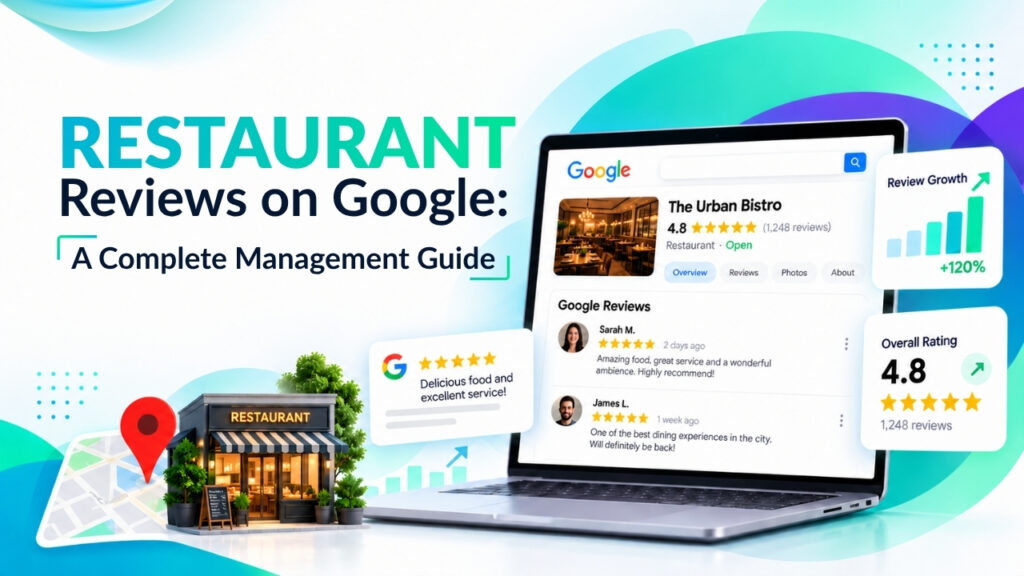
Restaurant reviews on Google have an important role helping diners to find restaurants, compare available dining options, and to confidently select a restaurant.
Today before visiting a restaurant, customers check Google reviews, star ratings, food quality, customer service, and dining experience.
Receiving positive reviews from customers can increase customer trust, improve their online reputations, and also encourage customers for repeat visits. However, managing Google reviews effectively requires more than gaining five-star ratings from customers.
It is essential for restaurants to track customer feedback, respond to positive reviews, address negative reviews, and encourage genuine reviews that show that they had authentic experiences with your restaurant.
Having a well-maintained Google Business Profile helps customers to find right information regarding food menus, opening hours, locations, and contact details.
Further by following ethical review management practices, helps businesses to identify service improvements and build stronger customer relationships.
Platforms like Clariv help restaurants to organize feedback, analyze customer sentiment, and enable reputation management across different communication channels.
Understanding local SEO, review response strategies, and customer satisfaction helps restaurant owners to make informed decisions based on real customer experiences.
This blog will walk you through practical ways to manage Google reviews, improve customer engagement, handle complaints professionally, and develop a trustworthy online presence that supports long-term restaurant growth.
Also Read: Restaurant Review Template How to Respond to Every Review
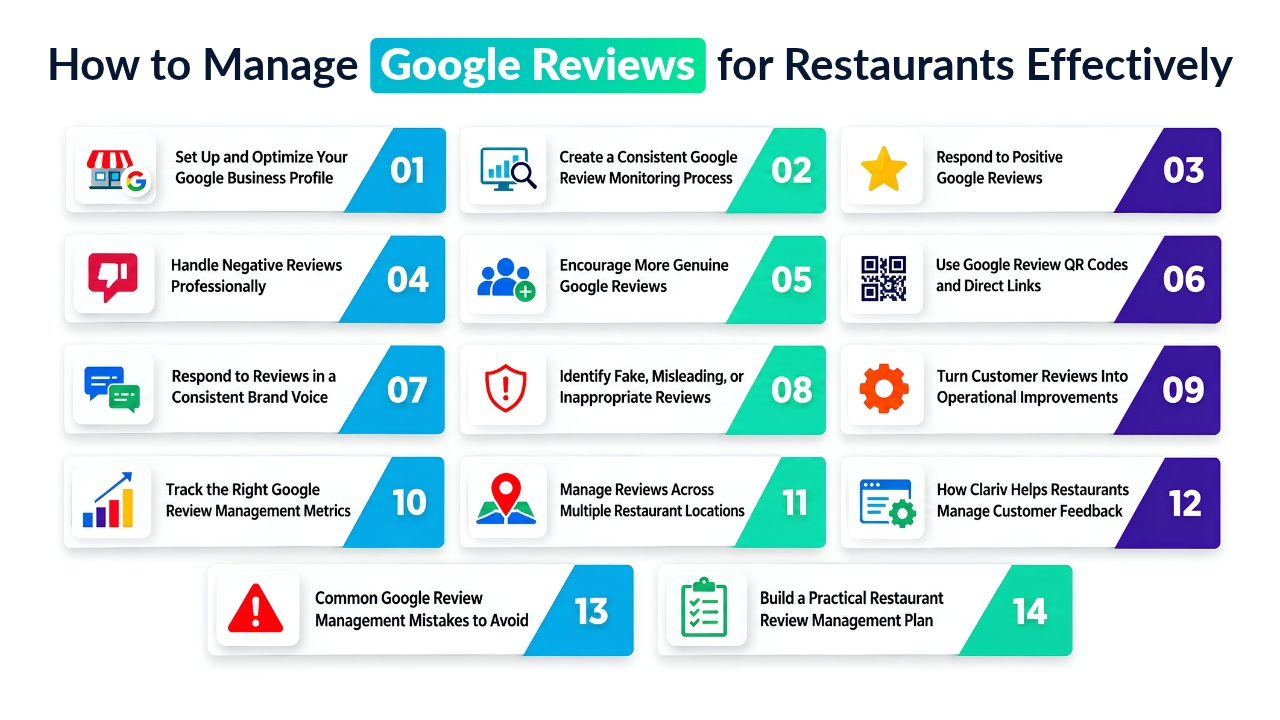
How to Manage Google Reviews for Restaurants Effectively
1. Set Up and Optimize Your Google Business Profile
Managing customer reviews effectively begins with setting up a complete Google Business profile. Your Google business profile should provide important details about restaurants to customers. Through your Google Business profile, restaurants must be able to find your location, working hours, food menu, photos, and customer reviews.
Restaurants must start by claiming or creating your profile and completing verification of the profile. Then review below details:
- Restaurant name: Use your actual business name without using any unnecessary keywords.
- Address and location: Customers must be provided with accurate address and location so that the customers are able to find the right location.
- Opening hours: Within Google Profile, must keep regular hours and holiday schedules accurately.
- Contact information: Provide accurate contact details and valid website links.
- Restaurant category: Choose the category that describes your restaurant.
- Menu information: Add the right menu or link to your existing menu.
- Photos: Upload appropriate photos of dishes,dining spaces, and the restaurant.
- Business attributes: Complete information about amenities, and service options.
They must provide right information regarding your restaurant that reduces confusion and lets customers form an opinion about your restaurant even before arriving.
While Google Business profile must be reviewed regularly by managers. Because if there is any change in food menu, new working hours, or new contact details may frustrate customers if the information provided on the Google Business Profile is outdated.
Also Read: How to Add Business on Apple Maps
2. Create a Consistent Google Review Monitoring Process
Restaurants often have busy ambiences so there are high chances that managers may overlook most Google reviews while handling daily responsibilities.
With a consistent Google review monitoring process ensures that every customer feedback receives attention from restaurants at the right time.
Establish a Daily Review Routine
Restaurants must assign a manager or team member to check reviews regularly. Responsibilities of this manager must include:
- Check if there are new customer reviews.
- Identify if there are any urgent complaints from customers.
- They must respond professionally to positive and negative feedback from customers.
- They must record recurring problems.
- They must check increasing service or food safety problems.
- They must monitor unresolved problems until the follow-up is complete.
Through Google Business profile notifications, customers get to know if there is any new activity in the restaurant. While managers must also regularly check reviews from customers regularly.
Track Review Details
Managers must keep a record of review dates, ratings, customer problems, response status, and must take corrective actions. Restaurants that are running in multiple locations must track the locations to find patterns accurately.
By consistently monitoring reviews and having a centralized feedback system help restaurants to know about the problems faced by restaurants, respond quickly, improve their service quality, know customer preferences, and improve overall customer satisfaction levels.
Also Read: Google Review Management Software
3. Respond to Positive Google Reviews
Restaurants must respond positively to Google reviews even if their customers have no complaints. Even a single since reply from restaurants to customers shows that they appreciate, and value customer feedback.
Examples of Positive Review Responses
Customer review: “The pasta was delicious, and the staff were very friendly.”
Restaurant response: “Thank you for dining with us! We are delighted you enjoyed the pasta and friendly service. We appreciate your feedback and look forward to welcoming you back.”
Customer review: “Our server was attentive, and our family had a great evening.”
Restaurant response: “Thank you for sharing your experience. We are happy our team made your family dinner enjoyable. We hope to see you again soon!”
Best Practices for Positive Responses
- They must thank customers sincerely for their feedback.
- They must mention specific dishes or service experiences if valid.
- They must keep responses friendly, natural, and clear.
- They must avoid using the same replies for several customer reviews.
- They must encourage customers to return without sounding promotional.
Sending personalized responses to customers makes relationships with customers more genuine. Having a consistent, thoughtful approach in managing customer reviews helps restaurants to show their commitment toward good services and encourage diners to visit your restaurant again.
Also Read: How to Manage Online Reviews for Your Business
4. Handle Negative Reviews Professionally
Although negative reviews from customers can be uncomfortable especially if customers mention about poor services, bad taste, long waiting times, or any billing problems.
However, sending an appropriate response to customers indicates that restaurants are accountable and ensures that good services are provided to customers. The initial step to be followed by the restaurant is to understand the customer complaint instead of quickly defending their restaurant services.
Follow a five-step response process
- Acknowledge the concern: Restaurants must acknowledge the problem of the customer by reading and understanding the customer’s complaint.
- Express empathy: Restaurants must express empathy by recognizing the inconveniences or disappointment described by the customer.
- Apologize appropriately: Restaurants must apologize to their customers if their experiences with your restaurants are below their expectations.
- Suggest a resolution: They must invite the customer to reach out to the restaurant privately so that the team can analyze the details.
- Investigate internally: Restaurant owners must speak to valid employees, check available records, and find whether the process needs improvement.
Example: Complaint about slow service
Customer review: “We waited nearly an hour for our food, and nobody explained the delay.”
Restaurant response: “We are sorry that the waiting time and lack of communication affected your visit. We understand how frustrating this must have been. We appreciated the opportunity to look into what happened and improve the experience. Please contact our management team so we can discuss your visit.”
Restaurants must avoid arguing with their customers publicly, or must not blame individual employees, disclose customer details, or make promises to customers that the restaurants are not able to keep.
And if the complaint of the customer is justified, then restaurants must analyze it and take corrective action. While if the customer review seems inaccurate, then restaurants must respond calmly and explain to them that if given the opportunity given, they would take the opportunity to verify the details. Restaurants must respond both professionally and consistently rather than emotional reactions.
Also Read: How to Respond to Negative Customer Reviews
5. Encourage More Genuine Google Reviews
Restaurants need a reliable way to encourage customers to share their experiences through reviews. Most satisfied diners just leave without writing a positive review as nobody reminds them or the review giving process seems to be inconvenient.
The best solution is to make the feedback adding process easy for customers and encourage customers to add reviews without pressurizing them.
Practical ways to request reviews
- Table cards: Restaurants can place a small table card with a QR code that opens the Google review form of the restaurant.
- Receipts: Through receipts, restaurants can politely include invitation and review links on printed or digital receipts.
- Takeaway packaging: Restaurants can request customers to add reviews by including a QR code to packaging if it is appropriate.
- Follow-up messages: Restaurants can ask customers to add reviews in follow-up messages where customers have agreed to receive communications, and send a short thank-you message with a direct review link.
- Staff requests: Restaurants can also train their employees to encourage all customers to share their honest feedback genuinely.
For instance, a staff member might say, “Thank you for visiting us today. If you have a moment, we would appreciate an honest review of your experience on Google.” While restaurants must ensure that the link opens the correct restaurant profile and also works on mobile devices.
Follow Google’s review policies
Restaurants must not offer discounts, gifts, loyalty points, or incentives in exchange for positive reviews from customers. They must not buy customer reviews, or ask their staff members or relatives to post misleading customer feedback, or only encourage satisfied customers to add reviews.
Restaurants must also avoid review gating, that means screening customers by their satisfaction level and asking only those customers with positive experiences to post their reviews.
Rather restaurants must establish a fair review process that helps customers to share honest opinions whether their experience is positive or negative.
Providing incentives for reviews, or filtering out negative feedback through review gating, or purchasing customer reviews may violate review policies of Google that can affect customer trust.
Also Read: Client Review Platform for Legal Services
6. Use Google Review QR Codes and Direct Links
Sending a review request to customers is more effective when customers can access the review without searching it on the restaurant’s website manually.
Restaurant owners can use a review link through Google Business Profile and convert it into a QR code for printed or digital materials.
Consider placing QR codes on:
- Table tents and menu holders
- Receipts and takeaway bags
- Restaurant feedback cards
- Suitable checkout displays
- Post-visit messages and emails
They must keep the messages sent to customers simple. For instance:
“Thank you for dining with us! Share your honest experience on Google and help us continue improving.” Restaurants must ensure that the QR code is large enough to scan, and test it on different mobile devices, and ensure that the QR link directs customers to an accurate location.
While if the restaurants are running in multiple branches, each location must use the appropriate review link. It helps to ensure that the customer feedback is associated with the restaurant that customer actually visited.
Also Read: Customer Sentiment Analysis Vs Customer Feedback Analysis
7. Respond to Reviews in a Consistent Brand Voice
Customers may interact with different staff members or visit different restaurant locations, but public responses to each location should show the same service standards.
When restaurants have a consistent brand voice does not mean that every response from restaurants use the same words. Instead restaurants must establish guidelines for tone, length, privacy, and escalation.
For instance, a casual cafe may use a warm and conversational style, while a fine-dining restaurant may use a formal tone. While both cafe and restaurant should remain respectful, authentic, and specific.
Create response guidelines that explain:
- How to thank customers for positive feedback.
- How to acknowledge complaints without arguing.
- Which issues require a manager’s approval.
- When to move a conversation to a private channel.
- How to handle sensitive or potentially legal concerns.
- Who has permission to publish public responses.
AI-based tools help restaurant managers to draft replies, but staff members should verify that each message shows the real situation. Restaurants must avoid claiming that a problem has been fixed unless their team confirms it.
A response from the restaurant should show that they are listening to their opinions and not sending generated messages from automated systems.
Also Read: Why Customer Reviews are Important for Business Growth
8. Identify Fake, Misleading, or Inappropriate Reviews
Every customer review does not necessarily show genuine experiences from customers. Because restaurants may experience spam, irrelevant content, conflicts of interest, or reviews that seem to describe an event that never happened.
However, restaurants should not consider even a single negative from customers to be fake only because the restaurant does not agree with it.
What restaurant owners should do
Initially, they must check the reviews of the customer carefully. They must check if the details mentioned by the customers in their negative reviews match to a known visit, whether their review is valid, and if it seems to violate Google’s policies.
If there is a reasonable basis to believe a review violates policy:
- They must save valid information for internal records.
- They must use the reporting option available on the review management tools of Google.
- They must select the policy category that best matches their issue.
- They must track the report and follow the available appeal process of Google if appropriate.
- They must respond publicly in a calm and with facts when their response would help to clarify the situation.
Restaurants must not threaten reviewers, disclose personal details of customers, or ask customers to report a review only because it is unfavourable.
Google reviews are removed only when they violate Google’s policies, so restaurants should document if there are suspected violations and submit reports through appropriate channels without assuming that removal is guaranteed.
Also Read: Restaurant Review Sentiment Analysis
9. Turn Customer Reviews Into Operational Improvements
Google reviews help restaurants to find regular problems faced by customers and understand the aspects that affect dining experiences of customers. Received written customer feedback explains the reasons behind customer ratings and shows areas that require improvement.
Common problems faced by customers include cold food, long waiting times, unavailable dishes, inattentive service, missing takeaway items, and unclear pricing. Restaurants should consider these comments as useful insights instead of complaints.
Create a Feedback-to-Action Process
- Categorize feedback: It involves grouping comments by food quality, service, cleanliness, pricing, delivery, and atmosphere.
- Identify patterns: They must look for repeated concerns across reviews and locations.
- Investigate causes: They must investigate causes of customer concerns and discuss findings with their relevant team members.
- Implement improvements: They must adjust workflows, provide staff training, or clarify menu information.
- Measure results: They must track future reviews to assess progress.
Positive customer feedback is also essential for restaurants. When restaurants recognize dishes that are frequently praised by customers and staff members helps restaurants to implement successful practices and improve customer satisfaction levels.
10. Track the Right Google Review Management Metrics
Tracking the right metrics for managing reviews helps restaurants to understand customer satisfaction levels and find aspects of the restaurant that need improvement.
Beyond star ratings and review numbers, restaurants should track how quickly they respond and what customers consistently mention.
Important metrics include:
- Average Star Rating: This metric shows the overall rating shown on the profile.
- Review Volume: This metric monitors new customer reviews received during a certain period.
- Response Rate: This metric shows the number of reviews that require to be responded to.
- Response Time: This metric measures how quickly the team responds.
- Sentiment Trends: This metric reveals changes in customer opinions.
- Recurring Topics: This metric identifies frequently mentioned concerns or positive experiences.
- Location Performance: This metric compares feedback across restaurant branches.
- Resolution Tracking: This metric monitors whether reported problems receive follow-up action.
Reviewing these metrics on a weekly or monthly basis. Restaurants must focus on resolving recurring problems faced by customers rather than ratings alone, and remember that Google rankings are based on several factors, so more positive reviews cannot ensure high search rankings.
11. Manage Reviews Across Multiple Restaurant Locations
For restaurant groups and franchises, review management becomes more complex when the number of branches of restaurants increases.
Every restaurant location may have different staff, menus, working hours, customer expectations, and service challenges. When restaurants review every customer profile individually it can be difficult for restaurants to identify problems and maintain consistent standards.
A structured multi-location process should include:
- An owner for each location’s reviews.
- Must have a centralized process for serious customer complaints
- Must establish a location-specific reporting and performance comparisons
- Must hold regular meetings to discuss recurring customer feedback.
- Establish clear permissions for staff members who track or publish responses.
For instance, if a branch receives repeated complaints about takeaway orders while other locations perform well, managers can analyze the order-checking process of the branch instead of changing processes across the entire organization unnecessarily.
Having a centralized monitoring system helps restaurant groups to understand where action is required while letting individual managers address local problems.
12. How Clariv Helps Restaurants Manage Customer Feedback
Managing customer reviews on Google, delivery platforms, and social media can be challenging for restaurants operating in several locations. Clariv has customer sentiment and reputation management facilities that help restaurants to organize customer feedback and engagement.
Its restaurant-focused tools can help teams:
- Centralize Feedback: It brings supported reviews, delivery comments, and customer messages on a centralized system.
- Analyze Sentiment: helps to identify recurring problems about food quality, service, pricing, and waiting times.
- Detecting Emerging Issues: helps to recognize customer feedback patterns that require investigation.
- Support Responses: supports AI-based replies for staff review before publication.
- Coordinate Locations: Monitor customer feedback across restaurant branches.
- Improve Operations: Use recurring themes to guide service improvements.
Before choosing Clariv, restaurants should verify its current integrations, supported platforms, reporting features, access controls, and pricing. While it is essential for restaurants to check AI-generated responses must be checked to be accurate and authentic. Clarive supports review management, while genuine hospitality and effective operational decisions is important.
13. Common Google Review Management Mistakes to Avoid
Even restaurants with good food and service can have poor online reputation if restaurants follow inconsistent review practices.
Avoid these common mistakes:
- Ignoring positive reviews: sending a short, personalized thank-you message can strengthen relationships with customers.
- Leaving complaints unanswered: if the restaurant does not respond to customer complaints then the customer questions would question if the business takes customer problems seriously.
- Arguing with customers: If restaurants argue with customers for even a small complaint then they may appear more serious.
- Copying identical responses: Repetitive messages from customers can seem impersonal and fail to address certain problems of customers.
- Offering incentives for reviews: Restaurants must not offer rewards in exchange for reviews as it may violate Google’s policies.
- Requesting only five-star ratings: Restaurants must encourage honest feedback from customers rather than attempting to manipulate customer ratings.
- Ignoring recurring problems: Repeated complaints should require quick investigation and not just public apology.
- Overlooking individual locations: Every restaurant branch requires a clear process for tracking and resolving customer feedback.
- Publishing unchecked AI responses: Sending automated AI responses may make customers misunderstand a customer complaint or make inaccurate promises.
- Focusing only on ratings: The written comments often have the information essential to improve services.
Having a reliable management process requires quick response, policy compliance, operational follow-up, and consistent service quality.
14. Build a Practical Restaurant Review Management Plan
Having a practical restaurant review management plan helps restaurants to track customer feedback, respond consistently, and improve customer experiences. They must establish clear responsibilities and regular routines make the process easier to maintain.
Daily Tasks
- Checking new Google reviews and responding quickly.
- Must escalate urgent customer complaints and record unresolved problems.
Weekly Tasks
- Identify both recurring positive and negative customer feedback
- Involves discussing operational problems and review response consistently
- Follow up on positive complaints.
Monthly Tasks
- Analyze rating and review-volume trends.
- Compare branch performance where relevant.
- Evaluate improvements and update staff guidelines.
- Assess whether existing monitoring tools meet business needs.
The review management process of the restaurant should align with the size and resources of the restaurant. For instance, small cafes may use simple checklists, while larger restaurant groups may use centralized monitoring and sentiment analysis tools.
It is essential to be consistent with review management. Restaurants must track customer reviews regularly, address customer problems seriously, and convert useful customer feedback into impactful improvements.
Conclusion
Effective Google review management helps restaurants to build customer trust, improve their online reputation, and improve dining experiences. Monitoring customer reviews regularly, and responding to reviews professionally, and encourage customers to add genuine feedback help restaurant owners to understand the diners value and identify aspects requiring attention.
Tracking review metrics like ratings, response times, review volume, and recurring problems helps teams to track progress and make informed decisions.
Restaurants should consider both positive and negative reviews as opportunities to know about their customer opinions. Addressing customer complaints, recognizing successful practices, and implementing practical improvement helps to improve customer relationships over time.
For businesses managing multiple locations, centralized monitoring and sentiment analysis tools help to simplify feedback management. Platforms like Clariv support these efforts helping teams to organize customer feedback and identify customer sentiment patterns.
Ultimately, consistently managing reviews, maintaining authentic communication, and a commitment to excellent service help restaurants to maintain credibility and encourage customers to return. So what are you waiting for? Get started with Clariv.