Funny reviews from customers can not just entertain readers but also give good marketing opportunities for restaurants.
Funniest reviews on Google often gather customer attention through funny comments, unexpected dining experiences, sarcastic observations, and clever restaurant responses.
Such memorable interactions with customers help restaurants to show their brand personality, encourage customer engagement, and generate shareable social media content.
Whether reviews include funny food descriptions, playful complaints about oversized food portion sizes or delayed orders, funny reviews give potential customers knowledge about your restaurant’s personality.
However, restaurants should look beyond the funny reviews to understand the actual experience of each customer behind each comment.
By responding professionally to funny reviews while using appropriate humor can improve online reputation management and build stronger customer relationships.
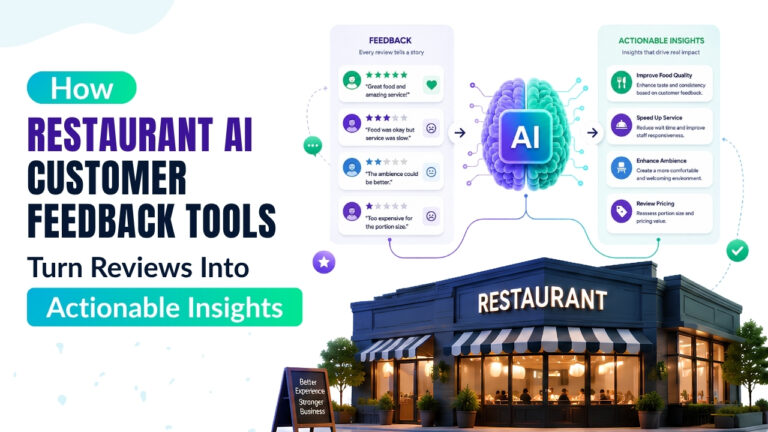
Platforms like Clariv are a review intelligence and customer sentiment tool that can help restaurants to evaluate customer feedback, identify recurring customer review patterns, and understand customer sentiment across locations.
Restaurants using humor with thoughtful review responses and data-driven insights helps restaurant operators identify service improvements while making their businesses more memorable.
This blog will walk you through the way restaurants can use funny Google reviews, effective restaurant marketing strategies, and Clariv to improve their online presence and create positive customer experiences.
Also Read: Funny Review How Humor Can Boost Your Restaurant Reputation
How Funny Customer Reviews Can Strengthen Your Restaurant’s Online Reputation
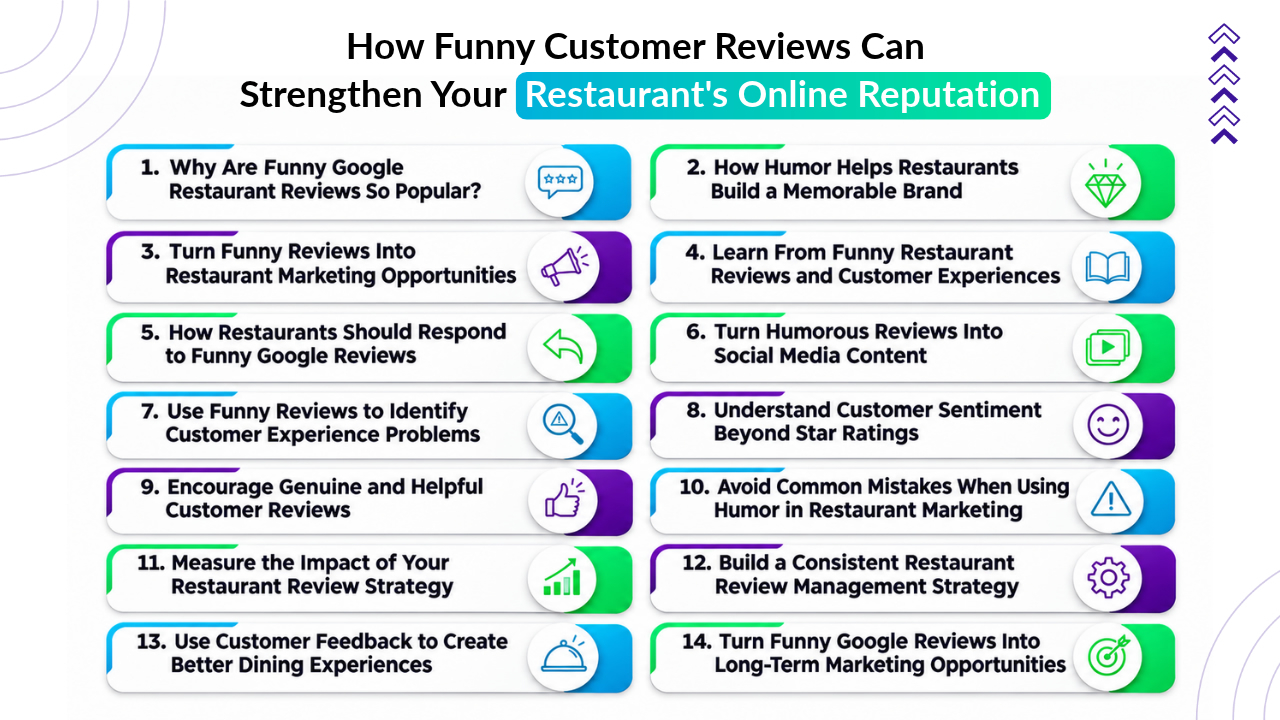
1. Why Are Funny Google Restaurant Reviews So Popular?
Funny Google restaurant reviews attract customer attention as such reviews describe familiar customer dining experiences in an entertaining way.
Because customers use sarcastic words, stories, and clever comparisons to mention their experience during their restaurant visits. Rather than writing a simple review, customers can convert an ordinary dining experience into a memorable story that makes other readers laugh.
For instance, a customer might write, “The burger was so big that I needed a second person to help me finish it.” Another might comment, “The coffee was strong enough to make my Monday morning disappear.”
Such funny comments are entertaining and also creates an emotional connection with readers. Then people may then share such reviews with friends, discuss on social media, or visit the restaurant’s Google profile to know more about the restaurant. Such funny reviews also help restaurants to stand out among ordinary customer comments.
For restaurant owners, funny feedback gives an opportunity to understand the aspects that customers remember about their dining experiences.
Whether the customer comment is about a memorable food meal, an unexpected situation, or a friendly staff interaction can become a story that encourages other customers to know about the restaurant.
Also Read: Funny Google Reviews What They Teach Us About Customer Experience
2. How Humor Helps Restaurants Build a Memorable Brand
A restaurant’s brand is not just shaped by its logo, menu, and interior design. Rather the restaurants are recognized by customers by the way their staff members interact, customer communicates, online reviews, and public reviews.
Humor can help restaurants to reflect their brand identity and to become more approachable to potential customers.
For instance, a casual burger restaurant might use playful language while responding to reviews, while a family-owned cafe may prefer warm and friendly messages.
A fine-dining restaurant might choose subtle humor that shows their restaurant’s ambience and services.
Consider this example:
Customer review: “Your chocolate cake was so good that I forgot I had ordered dinner.”
Restaurant response: “We are delighted dessert made such an impression! We hope to welcome you back for another sweet experience.”
Such conversations between restaurants and customers show friendliness without being promotional. It is essential for restaurants to maintain a consistent communication style as it helps customers to know about their brand personality on social media and online platforms.
However, restaurants should avoid forcibly using jokes in every response. Humor works well when it feels natural and must reflect the actual brand personality of the restaurant.
Also Read: Funny Feedback How Humor Can Improve Customer Relations
3. Turn Funny Reviews Into Restaurant Marketing Opportunities
Restaurants can turn funny reviews into restaurant marketing opportunities because such reviews reflect the actual dining experience of the customers with the restaurant.
They may use appropriate comments to gain customer attention, encourage more customer engagement, and introduce their restaurant to new diners.
For instance, imagine a customer comment, “I ordered a small serving of fries. Apparently, the restaurant misunderstood and sent enough to feed the entire neighbourhood.”
A restaurant could respond, “We believe fries are better when there are plenty to share!” Such interactions show that the restaurants serve high food portions and also give them an entertaining experience.
Some marketing benefits include:
- Increased brand awareness: Interesting customer reviews can attract more diners to your restaurants who have not even visited your restaurant before.
- Better customer engagement: Funny responses can encourage better interactions between customers and businesses.
- Social media opportunities: Funny comments from customers can become excellent content for posts and stories.
- Stronger brand personality: Humor allows restaurants to show their brand personality.
- Customer relationships: Thoughtful responses from restaurants shows that the businesses pay attention to customer reviews.
Although funny reviews from customers does not ensure more sales, it can help restaurants to establish a memorable online presence. Restaurants must not just use humor but also provide good food, reliable service, and authentic interactions with customers.
Also Read: Good Reviews for Restaurants that Makes them Stand Out
4. Learn From Funny Restaurant Reviews and Customer Experiences
Funny restaurant reviews show the way how customers differently describe their dining experiences. Although some customer comments are playful, other comments convey serious disappointment through sarcastic comments or stories.
For instance, restaurant reviews may have stories about delayed takeaway orders, poor service, misleading menu information, and unpleasant dining experiences.
Although such comments from customers are entertaining to read, it also reveals important lessons for restaurant operators.
Businesses can learn several things from these experiences:
- Food quality matters: Customers expect food meals to meet certain standards of freshness, taste.
- Service consistency is important: Long waiting times and poor communication can affect an enjoyable experience of customers.
- Accurate information builds trust: Promoted food menu items and available food options should match with what customers actually receive.
- Order management needs attention: Takeaway restaurants should verify orders and convey if there are any delays clearly.
- Customer treatment matters: Respectful interactions can affect when customers decide to return back to your restaurant.
Restaurant owners should use not just humorous words and understand what actually happened. Rather, a funny complaint from customers can still identify a problem faced by customers that need attention.
Responding appropriately to such reviews helps to protect customer relationships and show that the restaurants take customer feedback seriously.
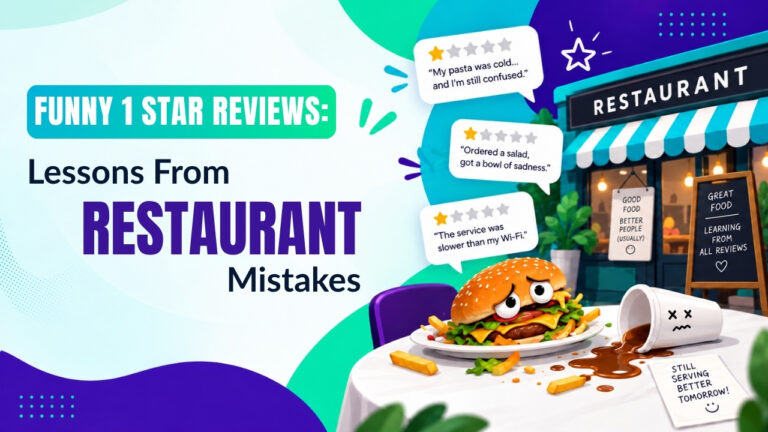
Also Read: Funny One Star Review Lessons from Restaurant Mistakes
5. How Restaurants Should Respond to Funny Google Reviews
Responding to funny Google reviews gives restaurants an opportunity to show their personality and build stronger relationships with customers. Sending a short, relevant reply can be more memorable than just a thank-you message.
For instance,
Customer review:”The pizza disappeared so quickly that I barely had time to take a picture.”
Restaurant response: “We are happy you enjoyed it!Next time, we will try to make it last long enough for a photo.”
Another example:
Customer review: “The coffee woke me up before my alarm had a chance.”
Restaurant review: “We are glad your morning got off to an energetic start. See you for your next cup!”
Restaurants should follow a few guidelines while replying:
- It is essential for restaurants to understand the customer’s tone behind their funny review, whether their review is playful or has a customer complaint within it.
- They must keep responses valid through sharing actual experiences instead of using unrelated jokes for response.
- They must use natural language that shows the restaurant’s personality.
- They must keep public replies respectful, even if customers criticize their food meals through comments.
- They must reply seriously if customer complaints about food safety, allergies, discrimination, or any service failures as it require quick professional attention.
A good response should make the customer feel heard rather than turning every customer review into an opportunity for the restaurant to show their fun side.
Also Read: Good Reviews for Restaurants What Makes them Stand Out
6. Turn Humorous Reviews Into Social Media Content
Social media provides many opportunities for restaurants to increase their reach of funny reviews received from customers. Because a good Google review can become an Instagram post, Facebook update, short video, story, or customer appreciation feature.
Restaurants can use several content ideas:
- They must highlight reviews of the week as the most entertaining customer comment and send a friendly response to that customer.
- They must share staff reactions to brilliant customer reviews with their permission.
- They must thank customers for sharing entertaining experiences.
- They must turn a humorous review into a video with captions and visuals.
- They must highlight selected customer comments in a dedicated social media section.
For instance, a restaurant can introduce a weekly feature called “Reviews That Made Our Day.” One post might highlight a customer joking about the size of a restaurant’s dessert.
The caption could say, “We serve generous desserts, but we cannot guarantee you will have room for anything else!”
Before sharing reviews, it is essential to consider customer privacy, permission, and the original context. They must consider editing a customer review in a way that changes its meaning.
Also Read: Customer Sentiment Analysis Vs Customer Feedback Analysis
7. Use Funny Reviews to Identify Customer Experience Problems
Funny restaurant reviews give insights into customer experiences and also reveal operational problems faced by customers due to food quality, staff performance, delivery services, and order accuracy.
For instance, repeated jokes about customers having to wait too long for food could indicate kitchen delays, staffing shortages, or inefficient order management.
Similarly if they receive food comments about missing takeaway items might indicate bad packaging and also need for order verification.
Restaurants should monitor feedback involving:
- Food quality: Taste, freshness, temperature, and portion sizes.
- Service speed: Waiting times, delayed orders, and slow table service.
- Order accuracy: Incorrect meals, missing items, and special requests.
- Employee interactions: Staff friendliness, communication, and professionalism.
- Pricing and value: Portion sizes, menu prices, and unexpected charges.
- Restaurant atmosphere: Noise, cleanliness, seating, and comfort.
Some customers may jokingly mention about drinks were served after the meals, managers should evaluate drink preparation and serving processes
Identifying recurring problems faced by customers helps restaurants to make meaningful improvements rather than considering every funny comment to be a single incident.
Also Read: How to Write a Review on Facebook
8. Understand Customer Sentiment Beyond Star Ratings
Customer star ratings do not instantly give customer satisfaction levels, but it does not always indicate the complete dining experience.
For instance, even after leaving a five-star review, customers may mention that they had to wait long for the food, while a three-star review might praise the food and staff members but criticize the ambience of the restaurants.
Reading comments of the customers helps restaurant operators to understand the aspects that customers appreciate and the aspects that they want restaurants to improve.
For instance, a restaurant might receive feedback such as:
- “The food was amazing, but the waiting time tested my patience.”
- “The staff were wonderful, and the dessert deserves its own fan club.”
- “The restaurant was beautiful, but finding parking was a real adventure.”
Every customer comment conveys a different experience. So restaurant managers should identify both positive and negative review patterns from customers rather than focusing only on the overall ratings.
Understanding customer sentiment helps restaurants to recognize successful service practices, focus on operational improvements, and create a more complete view of customer expectations.
It helps restaurants to understand if humorous comments truly indicate genuine customer satisfaction or are hiding an unresolved problem.
Also Read: How to Measure Customer Sentiment
9. Encourage Genuine and Helpful Customer Reviews
Restaurants should make the process to add feedback easy for customers. Because honest reviews from customers help diners to understand food and services that they need to expect and provide businesses with useful information about their performance.
However, businesses should not create humorous comments, or pressure customers to leave positive ratings, or offer rewards in exchange for favorable reviews. Honest customer feedback is more valuable than actual dining experiences.
Some practical ways to encourage genuine customer reviews include:
- They must make the review link of the restaurant easy to access for customers
- They must include review information on receipts or appropriate in-store materials.
- They must politely encourage customers to share honest opinions about their visit.
- They must provide opportunities for customers to leave feedback conveniently.
- They must respond to reviews regularly and respectfully.
- They must use customer suggestions to improve food and services.
- They must follow applicable platform policies while requesting reviews.
Customers must feel free to describe their experiences in their own words. A genuine comment from customers about an oversized burger, a friendly server, or a memorable dessert can become memorable content without the restaurant needing to create a joke.
Also Read: Sentiment Analysis Demo
10. Avoid Common Mistakes When Using Humor in Restaurant Marketing
Humor can help a restaurant appear approachable, but inappropriate responses from restaurants may damage its reputation. Businesses should consider the customer’s experience and the broader audience before publishing a reply.
Common mistakes include:
- They must never use a review to embarrass or humiliate someone.
- They must ignore customer complaints because a funny response should not replace a genuine solution.
- They must avoid using offensive jokes involving sensitive personal characteristics or difficult circumstances.
- They must avoid being overly sarcastic as a clever comeback may entertain some readers but discourage others from visiting.
- They must avoid overused jokes as repeating general replies can make communication feel automated.
- They must not disclose customer details in public responses.
- They must not ignore repeated complaints requiring further investigation and not just entertaining replies.
Restaurants should also avoid making jokes about serious problems due to food safety, allergies, billing disputes, or discrimination. These situations require clear communication, empathy, and appropriate action.
While the main objective is to build a long-term customer trust instead of winning arguments in a public review section. Humor should make the restaurant’s reputation stronger and not cause unnecessary conflict.
Also Read: How Businesses Can Improve Customer Satisfaction
11. Measure the Impact of Your Restaurant Review Strategy
Restaurants should regularly monitor if their review management efforts are improving customer engagement levels and overall reputation. Monitoring useful review indicators helps restaurant managers to evaluate progress and identify aspects that need their attention.
Important metrics include:
- Average Google rating: They must track changes in the overall customer rating of the restaurant.
- Review volume: They must monitor how frequently customers share feedback.
- Response rate: They must measure how quickly customer comments receive attention.
- Customer sentiment: They must evaluate positive, neutral, and negative customer feedback.
- Recurring complaints: They must identify the customer problems that happen repeatedly.
- Social media engagement: They must track social media shares, comments, and interactions, with review-related posts.
- Customer retention: They must observe whether customer relationships and repeat visits improve.
For instance, if a restaurant changes its kitchen workflow after receiving repeated complaints about slow services, then restaurant managers must track customer reviews to understand whether customers notice an improvement.
The goal of a restaurant is not just to collect more funny comments from customers. But to use customer feedback to improve the restaurant’s reputation, understand customer expectations, and improve the dining experience.
Also Read: How to Use Review Monitoring Software to Manage Online Reputation
12. Build a Consistent Restaurant Review Management Strategy
Funny Google reviews should be part of a wider restaurant reputation management strategy. Businesses require a consistent process for tracking customer opinions, responding to comments, and improving operations.
A practical approach includes six steps:
- Monitor: To check Google reviews and other customer feedback channels regularly.
- Understand: To identify whether customer comments are positive, negative, neutral, or humorous.
- Respond: Provide timely replies that show the restaurant’s brand personality.
- Resolve: To address genuine customer complaints and convey appropriate solutions.
- Improve: Use recurring customer feedback to make changes to food, staffing, packaging, and service.
- Measure: They must review customer ratings, sentiment, response activity, and customer engagement over time.
Restaurants with multiple locations should compare customer feedback across different locations. One location may receive praise for friendly staff members while another location may receive repeated customer complaints about long waiting times.
Reviewing these differences helps restaurant managers to identify successful practices and areas that require attention. Having a consistent restaurant management strategy also ensures that customer feedback is considered to be an important part of restaurant operations instead of simply an online marketing activity.
Also Read: Restaurant Review on Google a Complete Management Guide
13. Use Customer Feedback to Create Better Dining Experiences
The most effective way to encourage positive and memorable reviews is to provide customers with experiences worth discussing. Although humor can attract customer attention, food quality, service, cleanliness, and convenience affect how customers evaluate a restaurant.
Restaurant operators should regularly review their menus, staff training, order preparation, packaging, and customer communication procedures. Customer feedback can help to identify the aspects that are performing well and the aspects that require improvement.
For instance, if customers frequently praise a restaurant’s friendly staff, then management can recognize these well-performing employees and encourage similar service practices across other shifts.
If customer reviews repeatedly mention confusing food menu descriptions, the business can update its food menu descriptions.
Customer feedback can also help restaurants to identify popular dishes, understand customer expectations about food portion sizes, and evaluate whether pricing matches with perceived value.
Platforms like Clariv can support this process by helping restaurant operators evaluate customer feedback themes and customer sentiment. Using these insights with direct customer communication and operational reviews lets restaurants make more informed decisions.
Ultimately, the best marketing opportunity comes from offering an experience that customers genuinely want to recommend.
Also Read: Positive Review for Food How to Encourage Happy Customers
14. Turn Funny Google Reviews Into Long-Term Marketing Opportunities
Funny Google reviews can become an essential marketing strategy for restaurants when restaurants manage those reviews thoughtfully.
Although a memorable comment can attract customer attention, a friendly response reflects the personality of the restaurant, and a shared review can introduce more new audiences to your restaurant.
Restaurants should use humorous customer interactions with regular review monitoring, professional responses, social media engagement, and continuous service improvements. They should also differentiate between playful feedback and genuine customer complaints so that customers receive appropriate attention.
Clariv can further support restaurant operators by helping them analyze customer sentiment, identify recurring feedback themes, and understand reputation trends across locations. These insights can guide restaurants to implement improvements in food quality, service speed, staff interactions, and overall customer experience.
The goal is not just to make every review funny or encourage customers to write jokes. Rather, restaurants should create experiences that customers feel worth mentioning about, respond to customer feedback respectfully, and use customer opinions to improve their businesses.
When humor is used along with excellent services and thoughtful reputation management, even an unexpected Google review can become an opportunity to improve customer engagement, build brand recognition, and encourage long-term loyalty.
Conclusion
Funny Google reviews provide restaurants with an opportunity to attract customer attention, to show brand personality, and build stronger relationships with customers.
A funny comment about an oversized meal, a memorable dining experience, or an unexpected service interaction can become entertaining content that people enjoy sharing. However, humor should always be balanced with genuine customer care and a willingness to address complaints.
Restaurants can make the most of humorous feedback by responding naturally, sharing suitable reviews on social media, and identifying recurring customer problems.
Platforms like Clariv can further support this process by helping restaurant operators to analyze customer sentiment, recognize customer feedback patterns, and track reputation trends.
Ultimately, the goal is not to make every customer review funny. This is to create experiences worth talking about and use customer feedback to improve the business.
When restaurants combine humor with excellent service and thoughtful review management, even an unexpected Google comment can become a valuable opportunity for stronger customer engagement and long-term loyalty.
If you still have any query about funniest reviews on Google and the power of humor in restaurant marketing then you may write to us at Clariv and we are more than happy to assist you.