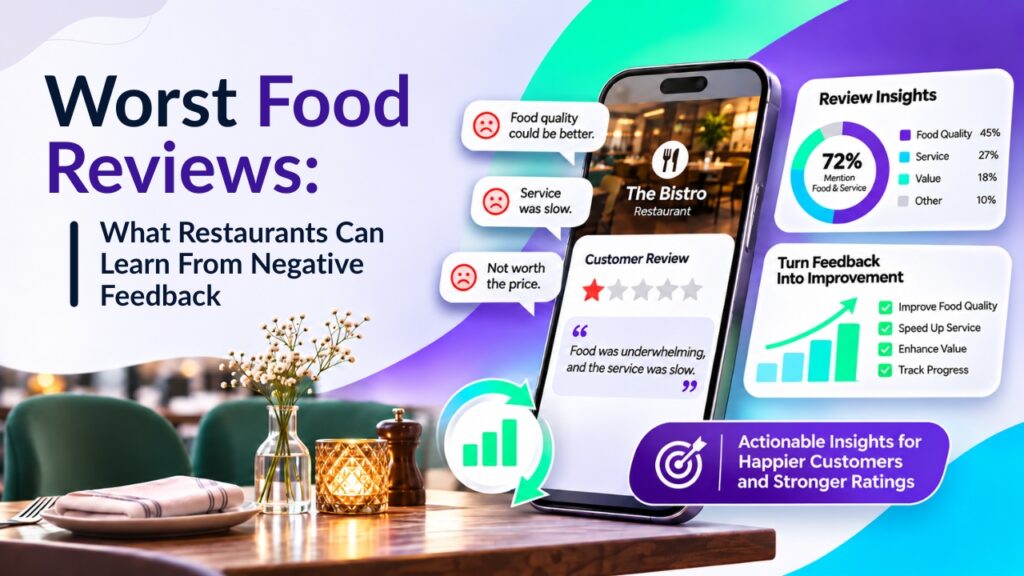
Negative food reviews can highly impact a restaurant’s reputation, customer trust, and future sales. Whether customer complaints are about poor food quality, cold meals, incorrect orders, slow services, or unprofessional staff, customer feedback can show the aspects that require improvement.
Although the worst food reviews from customers may initially seem damaging, it also provides insights about customer expectations and their dining experiences.
Instead of ignoring customer complaints or responding defensively, restaurant owners must understand the reason behind customer dissatisfaction and find practical solutions.
Effective restaurant reputation management involves tracking online food reviews, addressing negative customer feedback, improving food quality, and delivering consistent customer service.
Restaurants can also use customer review management software to identify repetitive problems faced by customers, improve staff performance, and improve overall customer satisfaction.
Using modern restaurant technology tools makes this process easier as it helps restaurants to track reviews, analyze customer sentiment, and manage online communication.
Platforms like Clariv support review management, sentiment analysis, and AI-assisted responses, letting restaurant teams to understand customer opinions and organize their reputation management activities.
This blog will walk you through the way restaurants can understand customer opinions from negative feedback, resolve common customer complaints, improve dining experiences, and turn unfavorable customer reviews into opportunities for achieving restaurant growth and achieve long-term success.
Also Read: How to Respond to Negative Customer Reviews
Worst Restaurant Reviews: Common Complaints and How to Handle Them
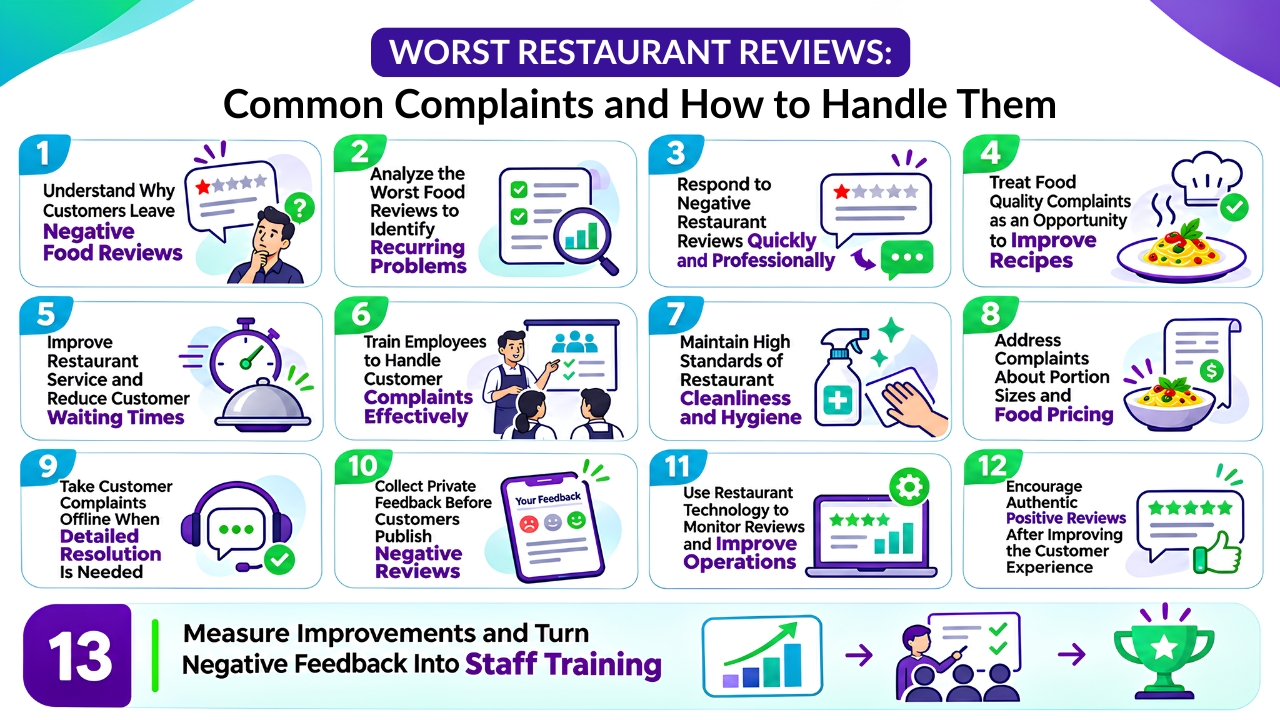
1. Understand Why Customers Leave Negative Food Reviews
The initial step for improving restaurant performance is to understand the aspects due to which customers are leaving negative feedback. Customers often leave a bad review when their dining experience does not match up to their expectations.
Sometimes the customer adds negative reviews about food being served while other complaints may be about services, pricing, cleanliness, or communication.
Common reasons customers write negative food reviews include:
- Poor food quality: Customers may complain about food to be undercooked, tasteless, highly salty, or poor food presentation.
- Cold or stale food: Customers may complain about food to be served cold or stale food before it reaches the table.
- Incorrect orders: Customers may complain if they receive the wrong dish, if ingredients are missing, incomplete takeaway as it can frustrate them.
- Slow service: Customers may complain about seating, ordering, food preparation, and billing that can negatively affect the dining experience.
- Unprofessional staff: customers may complain if they experience rude behavior from staff, experience inattentive staff, or find the staff to be unwilling to resolve their problems which can damage relationships with customers.
- Cleanliness concerns: customers may complain if they find dirty tables, unclean washrooms, and poorly maintained dining areas as it can reduce customer trust.
- Poor value for money: Customers may feel dissatisfied when food portion sizes, food quality, and service do not justify the prices.
Restaurant owners should not consider every negative review raised by the customer to be a single incident. Rather they should analyze customer complaints and determine if similar complaints have been raised by the customers in the past.
Understanding common customer problems helps management to work on improvements and avoid repeated dissatisfaction from customers.
Also Read: Why Customer Reviews are Important for Business Growth
2. Analyze the Worst Food Reviews to Identify Recurring Problems
If restaurants receive a single negative review from customers it may be an unusual experience, but if they regularly receive complaints from customers about the same problem it can indicate an operational problem.
Restaurants must regularly check customer feedback to find customer review patterns and understand the areas that they need to give attention.
For instance, if several customers mention that their meals were served cold, then the management staff should evaluate food preparation, coordination between staff members, order dispatch, and delivery handling.
While restaurants may be also required to review staffing, table management, or order-processing procedures.
Organize customer complaints into categories like:
- Food taste, freshness, and presentation
- Food portion sizes and menu accuracy
- Order preparation and delivery delays
- Staff behavior and communication
- Restaurant hygiene and cleanliness
- Pricing and perceived value
- Payment, billing, and refund problems
Keeping a record of customer feedback allows restaurant managers to compare customer complaints over time. This helps to find the specific dish that receives regular criticism, service problems happening during busy hours, or whether customer complaints are raised only at specific locations.
Restaurants must also consider the date, time, location, and order type associated with each customer complaint. As these details can help to find if the customer is facing a problem due to a specific shift, staff training requirement, menu item, or delivery process.
Also Read: Food Feedback Comments How to Collect and Analyze Guest Opinions
3. Respond to Negative Restaurant Reviews Quickly and Professionally
Restaurants responding to negatives indicates that a restaurant takes customer opinions seriously. But when restaurants ignore complaints from customers, then the customers may have an impression that management does not care about customer satisfaction.
However, restaurants must not respond emotionally or defensively to negative reviews as it can make the situation even more worse.
While restaurants must establish a process to track review platforms and must respond to negative reviews within a timeframe. Although restaurants responding to negative reviews instantly is useful as even the management needs more time to investigate the problem.
An effective response should include:
- Thank the customer for sharing their experience.
- Acknowledge the specific problem mentioned in the review.
- Offer a sincere apology if restaurants fail to meet customer expectations.
- Explain that the matter will be investigated.
- Invite the customer to contact the restaurant privately if further details are required.
- Convey a genuine commitment to improving the experience.
When restaurants respond thoughtfully, then they can reassure both the reviewer and potential customers who read the conversation. The objective of responding to a negative review is to be accountable rather than argue who was right.
Also Read: How to Track Customer Feedback in Real-Time
4. Treat Food Quality Complaints as an Opportunity to Improve Recipes
One of the most crucial factors affecting customer satisfaction levels is food quality. Because diners expect their meals to taste good, must have fresh ingredients, and match the food descriptions provided on the menu. When restaurants fail to meet these expectations, then customers may leave negative comments about food meals served.
Customers may complain about bland flavors, high seasoning, undercooked ingredients, poor food presentation, and inconsistent food portions, which restaurants need to investigate carefully.
Restaurant managers can improve food quality by taking several steps:
- Review recipes and food preparation instructions for popular menu items.
- Check ingredient freshness and storage practices.
- Establish consistent cooking temperatures and preparation times.
- Train kitchen staff members to follow standardized recipes.
- Track food portion sizes and presentation standards.
- Collect feedback about new dishes before adding them to the menu.
Restaurants should also regularly conduct food quality checks during service hours. Because a dish that tastes well during a quiet afternoon service should maintain the same taste and freshness standards even during busy dinner hours.
If a certain menu item repeatedly receives criticism, then the management should check if its recipe, ingredients, food preparation method or description requires adjustment. Removing an unpopular dish may sometimes be more effective than consistently trying to promote it.
Also Read: How Restaurant ai Customer Feedback Tools Turn Reviews into Actionable Insights
5. Improve Restaurant Service and Reduce Customer Waiting Times
One of the most common reasons for which customers leave poor restaurant reviews is due to slow services. Diners may become frustrated if they have to wait too long for a meal, struggle to communicate with staff members, receive food late, or experience delays while requesting the bill.
But, long waiting times do not always happen because staff members work inefficiently. Rather, it indicates understaffing, poor coordination among kitchen staff members, incorrect order entry, or ineffective table management.
Restaurants can address these problems through better operational planning.
- Monitor busy periods: Review customer traffic patterns to find peak dining hours. And it helps restaurants to schedule staff members accordingly to handle expected customer demand.
- Improve communication: Front office staff members should inform customers about unexpected order delays rather than leaving them uncertain about their orders.
- Coordinate kitchen operations: When there is clear communication between servers, kitchen staff members, and managers helps them to reduce mistakes and from making unwanted food preparation delays.
- Use suitable technology: Restaurant POS systems and kitchen display systems help to organize orders and improve communication between departments.
- Track service performance: measure food preparation times, table turnover, and billing delays to identify aspects that require improvement.
Customers may be more understanding if restaurants beforehand honestly inform about waiting times. Providing accurate food order details and regular updates can help to maintain a positive experience even if any unexpected delays happen.
Also Read: Restaurant Review Template How to Respond to Every Review
6. Train Employees to Handle Customer Complaints Effectively
Staff members of restaurants have a direct influence on the way customers perceive your restaurant. Because even if the food quality and ambience are good, if the staff rudely communicate with customers then it can be a disappointing experience to customers.
Any negative review from customers about staff members should be taken seriously. Restaurant managers should regularly check if their staff members require additional training, responsibilities, or more support during busy shift hours.
Effective staff training should cover:
- Greeting customers politely and professionally.
- Listening to customers carefully without interrupting.
- Understanding food menu ingredients and available options.
- Communicating delays and order changes clearly.
- Handling incorrect food orders and customer complaints.
- Following food handling and cleanliness procedures.
- Remaining calm even when customers express dissatisfaction.
Restaurant managers should also encourage staff members to report customer problems promptly. For instance, if a diner complains about a cold meal, then the server should communicate with the kitchen team and provide an appropriate solution based on their restaurant policies.
Conducting regular team meetings helps staff members to discuss recurring customer complaints and share solutions. Recognizing staff members who regularly provide good services can also encourage to establish a stronger customer-based workplace culture.
Also Read: What is Customer Sentiment Analysis
7. Maintain High Standards of Restaurant Cleanliness and Hygiene
Customers who complain about cleanliness can seriously damage a restaurant’s reputation because customers equate food hygiene with food safety and overall business management.
If customer reviews about dirty tables, sticky menus, unpleasant smells, unclean washrooms, or poorly maintained dining spaces may discourage potential diners.
Restaurants should establish cleaning responsibilities and ensure that hygiene is maintained throughout operating hours.
Important practices include:
- Clean dining tables regularly: Staff members should sanitize tables and surfaces between customer visits.
- Maintain washrooms: Staff members should check washrooms regularly throughout the day to ensure that they remain clean, and functional.
- Follow kitchen hygiene procedures: Staff members should maintain appropriate food storage, cleaning, and handling practices to reduce risks of contamination.
- Inspect serving equipment: Staff members must keep plates, glasses, cutlery, and food preparation equipment clean and in good condition.
- Manage waste properly: Staff members should remove waste regularly and maintain appropriate procedures to avoid unpleasant odors and pest problems.
- Conduct routine inspections: Managers should use cleaning checklists to verify that staff members complete assigned tasks.
If customers repeatedly report about cleanliness problems, then restaurants must evaluate instantly rather than ignoring customer complaints. Because any hygiene problem faced by customers require corrective action and not just a public apology.
Also Read: Customer Satisfaction Metrics
8. Address Complaints About Portion Sizes and Food Pricing
Customers do not necessarily expect restaurants to offer the cheapest meals. However, customers generally want prices that show the food quality, food portion size, ingredients, and services they receive.
If customers complain about expensive dishes, small food portions, or unexpected food charges may indicate that customers do not understand the restaurant’s pricing or believe that the overall experience offers insufficient value.
Restaurants can address these problems by:
- Reviewing portion sizes across similar menu items.
- Checking whether menu descriptions accurately represent dishes.
- Displaying prices clearly and transparently.
- Explaining additional charges before customers complete their purchases.
- Reviewing ingredient costs and menu profitability.
- Comparing customer expectations with the actual dining experience.
For instance, if several customers describe a specific dish as overpriced, management should check its ingredients, food portion size, food presentation, and customer demand before deciding whether they need to adjust the price.
Restaurants should not instantly lower prices when a customer complains. Rather they should determine if the customer is facing problems with pricing, unclear menu descriptions, inconsistent food portions, or if food or services are not meeting customer expectations and the food being offered.
Also Read: How to Manage Your Online Reviews for Your Business
9. Take Customer Complaints Offline When Detailed Resolution Is Needed
Reviewing public platforms are essential for acknowledging customer complaints, but these platforms are not always suitable for discussing sensitive customer transaction details or evaluating individual incidents.
Public review platforms are useful for acknowledging customer complaints, but they are not always suitable for discussing sensitive transaction details or investigating individual incidents.
If a customer describes a serious problem, then restaurant management should respond publicly with a short acknowledgement and invite the reviewer to continue the conversation privately.
For instance, a complaint about an incorrect payment, missing delivery items, or a specific staff interaction may require additional information that should not be shared publicly.
A suitable approach includes:
- Acknowledge the complaint in the public response.
- Provide an official contact method, such as a business email or customer service number.
- Request relevant details privately.
- Investigate the incident using available transaction or order records.
- Offer an appropriate resolution according to company policy.
- Record the outcome for future reference.
Even if restaurants resolve customer complaints privately, then restaurants must acknowledge the problem publicly to show transparency and show customers that their feedback is taken seriously. Here, the goal is not just to resolve the individual problem while protecting customer privacy and maintain professional communication.
Also Read: Funny Google Reviews How Humor Can Boost Your Restaurant Reputation
10. Collect Private Feedback Before Customers Publish Negative Reviews
One of the useful ways to reduce unresolved customer complaints is to make customer feedback to be part of the dining experience. Some unhappy customers do not complain directly as they feel uncomfortable for approaching staff members or believe that the management will not respond.
Providing convenient feedback channels allows restaurants to find customers’ problems while they still have time to address them.
Restaurants can collect customer opinions through:
- QR codes placed on tables, menus, and receipts.
- Short post-meal feedback surveys.
- Digital forms on restaurant websites.
- Follow-up messages after online orders.
- Direct conversations with customers.
- Feedback options within loyalty programs.
Restaurants must keep surveys simple and valid. Requesting customers to rate food quality, service speed, cleanliness, and overall satisfaction levels can provide useful information without requiring customers to write lengthy responses.
Restaurants should also explain the way customer feedback will be used. While restaurant managers must review customer feedback regularly and take actions against customer problems.
Restaurants should also consider resolving customer complaints privately to understand customer problems while continuing to track public reviews and respecting customer’s right to share genuine opinions online.
11. Use Restaurant Technology to Monitor Reviews and Improve Operations
Managing customer reviews across several websites, delivery platforms, and social media channels can be challenging for restaurant owners. Without properly monitoring customer reviews, important customer reviews may go unnoticed, and recurring problems can affect customer satisfaction levels.
Technologies help businesses to organize customer feedback, understand customer expectations, and improve daily operations.
Useful technology features include:
- Centralized Review Management: Gather customer reviews from supported platforms in one dashboard for easier monitoring.
- Customer Sentiment Analysis: Analyze customer reviews to identify positive, negative, and neutral feedback to understand customer opinions.
- Review Alerts: Restaurants receiving notifications about negative comments and urgent customer complaints.
- Response Management: Prepare timely, professional, and consistent replies to customer feedback.
- Reporting and Trend Analysis: Compare reviews across locations, menu items, and service periods.
- Operational Insights: Identify recurring problems involving order accuracy, food preparation, and service delays.
Although restaurant technology tools support better decisions, restaurants must still focus on food quality, staff training, and excellent customer service to achieve long-term improvements.
12. Encourage Authentic Positive Reviews After Improving the Customer Experience
Positive reviews help potential customers understand the aspects that restaurants do well. But, encouraging favorable feedback should never involve manipulative ratings, purchasing reviews, or offering rewards in exchange for positive comments.
The best approach is to improve the dining experience and make it easy for satisfied customers to share honest opinions.
Restaurants can encourage authentic feedback by:
- Providing excellent food quality and consistent service.
- Asking customers politely to share their experiences.
- Adding review links to receipts or follow-up communications.
- Displaying QR codes that direct customers to appropriate review platforms.
- Maintaining an active presence on relevant online channels.
- Responding appreciatively to positive comments.
Managers should also read positive reviews from customers carefully. Customers may mention popular menu items, friendly employees, efficient service, or attractive dining spaces. These comments reveal the aspects that restaurants should continue doing well.
A balanced reputation is based on genuine customer experiences. Restaurants should never pressure customers to change unfavorable reviews or provide incentive in exchange for not leaving negative reviews.
13. Measure Improvements and Turn Negative Feedback Into Staff Training
Responding to a complaint is just the beginning of the improvement process. Restaurants must determine the corrective actions that they have taken to improve customer experiences.
Management should track relevant performance indicators and compare results over time.
Useful measures include:
- Average customer review ratings.
- Number of complaints received by category.
- Frequency of food quality complaints.
- Average order preparation and delivery times.
- Number of billing and order accuracy issues.
- Customer satisfaction survey results.
- Complaint resolution time.
- Repeat customer visits and feedback.
For instance, if a restaurant receives repeated complaints about incorrect takeaway orders, management can conduct an order verification procedure and train staff members to check packaging before dispatch.
After implementing the change, managers must track if similar complaints from customers have decreased. If the problem continues then they must investigate other causes like menu configuration, order entry, or communication between staff members.
Negative reviews from customers can also become useful training materials. Managers can discuss anonymously during staff meetings, explain what went wrong, and demonstrate the way staff members should respond in similar situations. The purpose is not just to improve systems and staff performance instead of publicly blaming individual workers.
Conclusion
Although the worst food reviews can be difficult for restaurant owners to receive, they often reveal reviews which can be difficult for restaurant owners to receive, but they often reveal essential lessons about customer expectations and business performance.
When customers complain about food quality, slow service, staff behavior, cleanliness, pricing, and incorrect orders should be considered as opportunities to find weaknesses and improve operations.
Having a successful restaurant feedback management strategy involves restaurants responding professionally, evaluating repetitive problems, training staff members, collective customer feedback privately, and measuring the results of corrective actions.
Using restaurant technology tools can make this process more organized by helping businesses to track reviews, identify customer sentiment, and manage communication across different platforms.
Platforms like Clariv can support these efforts through centralized feedback management, sentiment analysis, smart alerts, and AI-based review responses.
However long-term improvement is based on how effectively restaurant teams act on the information they receive. When restaurants regularly listen to customer opinions, correct operational problems, and consistently improve the dining experience, restaurants can turn every negative feedback into impactful progress, stronger customer relationships, and long-term business success.
If you still have any query about worst food reviews and what restaurants can learn from negative feedback then you may write to us at Clariv and we are more than happy to assist you.