Restaurants use customer opinions to know about the aspects that their guests enjoy, and whether they need to improve the dining experience of customers.
Whether food taste, presentation, staff behavior, cleanliness, and waiting times, food feedback comments from customers give insights about different aspects of restaurant operations.
However, collecting customer feedback is just the first step. Restaurants also need to analyze customer feedback, identify recurring problems, and use those insights to make meaningful improvements.
There are several ways to collect restaurant feedback, such as QR-code surveys, comment cards, online reviews, social media, direct conversations, and post–visit messages.
Every customer feedback method helps restaurants to know about customer expectations and opportunities to improve food quality, customer service, and overall satisfaction levels.
Classifying customer opinions into different categories can help restaurant managers to recognize trends and to make informed business decisions.
Using modern technology can make the customer feedback collection process simple. Platforms like Clariv help restaurants to centralize customer feedback from supported channels, know about customer sentiment, monitor customer reviews, and identify recurring patterns.
This blog will walk you through ways to collect customer feedback, analyze customer opinions, respond to customer complaints, and convert insights into better dining experiences, stronger customer loyalty, and long-term restaurant growth.
Also Read: Positive Review for Food How to Encourage Happy Customers
What Are Food Feedback Comments?
Food feedback comments are basically opinions, suggestions, ratings, and complaints that they leave about your food and services. Their comments may be about the taste of a dish, food portion sizes, service quality, cleanliness, ambience, pricing, or the convenience of ordering and paying.
Some customers may leave positive comments like a guest praising a signature dish or may compliment attentive servers. While other comments from customers may be complaints like food was served cold or a takeaway order missing an item.
Any constructive feedback from customers may also give many suggestions for businesses to improve the food menu, introduce new food options, or make the dining experience more convenient.
Common feedback categories include:
- Food quality: describes taste, freshness, temperature, presentation, and consistency.
- Service quality: comments describing staff friendliness, responsiveness, and professionalism.
- Waiting time: Delays during ordering, food preparation, and payment.
- Cleanliness: Dining tables, restrooms, kitchen hygiene, and service areas.
- Value for money: Portion sizes, menu prices, and perceived quality.
- Ambience: Lighting, music, seating comfort, and noise levels.
- Order accuracy: Correct dishes, customizations, packaging, and delivery.
- Overall satisfaction: Whether the guest would recommend the restaurant or visit again.
Classifying customer feedback into different categories helps restaurants to find recurring customer issues, focus on improvements, and address areas that require their attention.
Also Read: How to Track Customer Feedback in Real-Time
Why Restaurant Customer Feedback Matters
Customer opinions give essential information about customer opinions which even sales figures cannot explain. For instance, a dish may sell well while customers may complain about its food portion size. Similarly, a restaurant may receive repeat orders but may receive recurring customer complaints about delivery delays.
Gathering feedback from customers helps managers to understand the reasons behind these customer feedback whether positive or negative.
1. Improve Food Quality
Guests often point out problems in food or services that management may overlook. Comments received from customers about seasoning, food temperature, freshness, or food portion consistently helps kitchen teams to make required changes in food recipes and food preparation processes.
For instance, if several guests mention that a popular pasta dish is too salty, then the chef can review the recipe and further make changes to food portioning.
Also Read: Good Review for Restaurants What Makes Them Stand Out
2. Strengthen Customer Loyalty
Customers will leave their opinions about a restaurant when they will feel that their opinions will be taken seriously and will take corrective action. When businesses thoughtfully to a customer complaint shows that the business values its guests and can make improvements.
When businesses respond well to a customer complaint, they show that they value its guests and are willing to make improvements or take corrective action.
Also Read: Customer Sentiment Score Explained
3. Identify Operational Problems
If restaurants repeatedly complain from customers for waiting times, incorrect orders, or slow payment processes then it may indicate operational problems.
Then the managers must analyze staffing, kitchen workflows, order routing, and service procedures rather than treating every customer complaint as a single incident.
Also Read: Restaurant Review on Google a Complete Management Guide
4. Improve Menu Decisions
Customer feedback can reveal the food dishes that customers like the most, options that they need improvement, and the new dishes that they would like to get added.
Using both customer feedback and sales and food expenses data provides insights that help restaurant managers to make informed menu changes.
Also Read: AI Tools to Analyze Customer Reviews
5. Protect Your Online Reputation
Online reviews can influence the way your potential customers consider your restaurant before visiting. Restaurants consistently monitoring and responding to customer reviews indicates that the business is paying attention to customer experiences.
Customer feedback management allows restaurants to make improvements in operations and reputation management.
Also Read: How to Use Review Monitoring Software to Manage Your Online Reputation
10 Effective Ways to Collect Food Feedback Comments
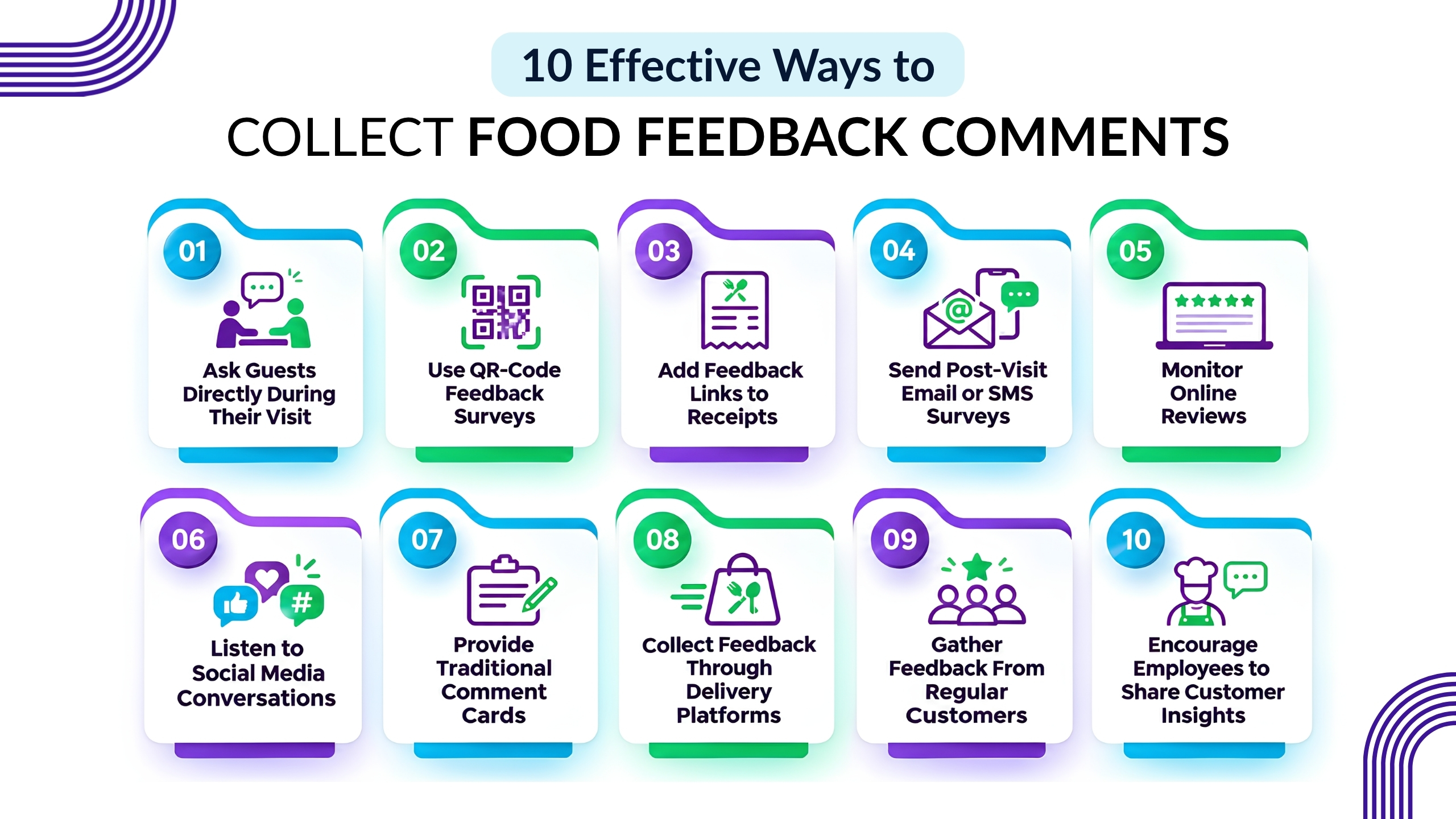
Restaurants should simplify the process to share customer feedback simple and convenient for customers. Through several feedback collection methods restaurants can gather customer opinions from different customer groups and at different phases of the dining experience.
1. Ask Guests Directly During Their Visit
During their visit, restaurants can ask guests to write their feedback about their food and services. It is one of the simplest ways to collect instant feedback from customers.
Servers can check on guests after food arrives and ask whether everything meets their expectations. Rather than asking, “Is everything okay?”, staff members must use a question that encourages customers to give a more useful response.
Staff members can instead ask questions like:
- “How are you enjoying your meal?”
- “Is there anything we could improve?”
- “Was your order prepared the way you expected?”
- “How was the waiting time today?”
When staff members ask questions to customers gives them a chance to mention their problems while the restaurants can address those problems.
Staff members must be trained to listen to customer complaints patiently without strongly defending their food and services. Staff members should make note of suggestions or repetitive complaints made by customers and share them with managers during their shifts.
Also Read: How AI Can Analyze Customer Feedback
2. Use QR-Code Feedback Surveys
Staff members can share QR codes with feedback surveys. Through this QR-codes customers can add their customer comments through their mobile phones. QR-codes can be placed on tables, receipts, menus, takeaway packaging, or payment counters.
When customers scan QR-code, it will navigate them to a short survey with questions about food quality, service, cleanliness, and overall customer satisfaction levels.
Staff members must keep the customer feedback collection process straightforward. For instance preparing a survey asking four or five main questions is often easier to complete than a lengthy questionnaire.
For instance, guests could rate their meal between one to five and find an optional question, “What is one thing we could improve?”
For encouraging customers to leave feedback, use a clear invitation such as “Share your feedback and help us serve you better.” While staff members must not pressurize customers to give surveys.
Also Read: Best Social Media Management Tools for NonProfits
3. Add Feedback Links to Receipts
Restaurants must add feedback links to receipts. Such receipts encourage customers to share their opinions after paying.
It includes adding a short survey or QR code with a short explanation of the way customer feedback will be used. This approach helps restaurants to collect customer opinions about their complete experience about ordering, service, food quality, and checkout.
Restaurants may offer discounts on future visits if it is within budget and promotional policies. Survey participation and redemption rates should be monitored to know if the incentive encourages meaningful customer engagement.
Also Read: Customer Sentiment Platform Vs Traditional Surveys
4. Send Post-Visit Email or SMS Surveys
Sending follow-up messages or SMS surveys after their visit, gives them time to provide feedback on their experience. If restaurants have the consent from the customer to send messages then they must send a short mail or text message thanking customers for visiting and inviting them to provide customer feedback.
Questions to ask customers include:
- What did you enjoy most?
- Was your order accurate?
- How would you rate the service?
- What could make your next visit better?
Restaurants must send only relevant messages to customers and avoid reaching out to customers too often. For instance, a short survey at regular intervals can provide more insights than repeated requests for customer feedback.
Also Read: How to Add Business to Apple Maps
5. Monitor Online Reviews
Customers may share their experiences on social media platforms like Google, Yelp, Tripadvisor, and other review platforms. These comments can reveal both strengths and weaknesses of your restaurant services.
Review platforms provide customer context that even private surveys may miss to capture because customers often explain their experiences in their own words.
Restaurants must track customer reviews regularly and respond to those reviews professionally. This involves thanking guests for positive comments and acknowledging their legitimate customers without arguing or blaming staff members.
When a customer complains about further investigation, then they must invite guests to continue the conversation with them privately.
6. Listen to Social Media Conversations
Guests may mention your restaurant in posts, comments, photographs, or direct messages without adding a review. So, it is essential for restaurants to regularly monitor social channels to check comments about food, service, promotions, and customer experiences.
Restaurants must respond to customer queries quickly and address their complaints with care. While if a customer shares a problem publicly, then restaurants must acknowledge it and if needed invite customers to discuss the details privately.
Tracking social media conversations can also reveal the dishes that customers capture, promotions that attract attention, and know about experiences that encourage recommendations.
Also Read: How to Write a Review on Facebook
7. Provide Traditional Comment Cards
Restaurants may consider offering traditional comment cards which will be a good option for them to collect customer feedback on paper or if customers want to share their opinions anonymously.
These comment cards must be placed in a convenient location along with pens and a collection box. Through these comment cards, restaurants must ask specific questions rather than blank comment fields.
For example:
- What did you enjoy most about your visit?
- Was there anything that disappointed you?
- Which menu item would you recommend?
- What would make your next visit better?
Restaurants must review the comment cards regularly and share recurring patterns with valid team members.
Also Read: Client Review Platform for Legal Services
8. Collect Feedback Through Delivery Platforms
Takeaway and delivery customers may experience different problems as compared to dine-in guests. Customer comments can be about packaging, missing items, food temperature, delivery time, or order accuracy.
Restaurants must track ratings, written reviews, and customer complaints on their delivery platforms. Restaurant managers must separate food-related problems from delivery-based problems. For instance, a meal served cold may indicate problems in food preparation, packaging, delivery time, or several factors together.
Restaurants must use customer comments to evaluate the actual cause of their problems instead of simply assuming that every customer complaint is about the kitchen.
Also Read: Funny 1 Star Review Lessons from Restaurant Mistakes
9. Gather Feedback From Regular Customers
Feedback from regular customers give essential perspectives about food and services as they share their experiences across several visits.
Collecting feedback from regular customers involves inviting them to complete surveys occasionally or participate in short conversations regarding food menu changes, new dishes, service improvements, or loyalty programmes.
Customers must ask essential questions while collecting feedback from customers. Customer suggestions and customer feedback from first-time visitors, online reviews, sales data, and other sources should be considered.
Also Read: How to Manage Online Review for Your Business
10. Encourage Employees to Share Customer Insights
Servers, hosts, cooks, and delivery staff often receive from customers that they may not find on feedback channels.
Restaurants must organize short meetings with customers to discuss recurring customer questions and complaints. Even staff members must use a simple method to document useful observations during their shifts.
For instance, servers may notice that customers are repeatedly asking for smaller food portions, while the kitchen staff may find dishes that customers often leave unfinished.
Using both staff observations and direct customer feedback help restaurant managers to analyze customer problems earlier. Customer feedback collection works well when restaurants select a customer feedback method that suits their size, customer base, and staffing.
How to Analyze Food Feedback Comments
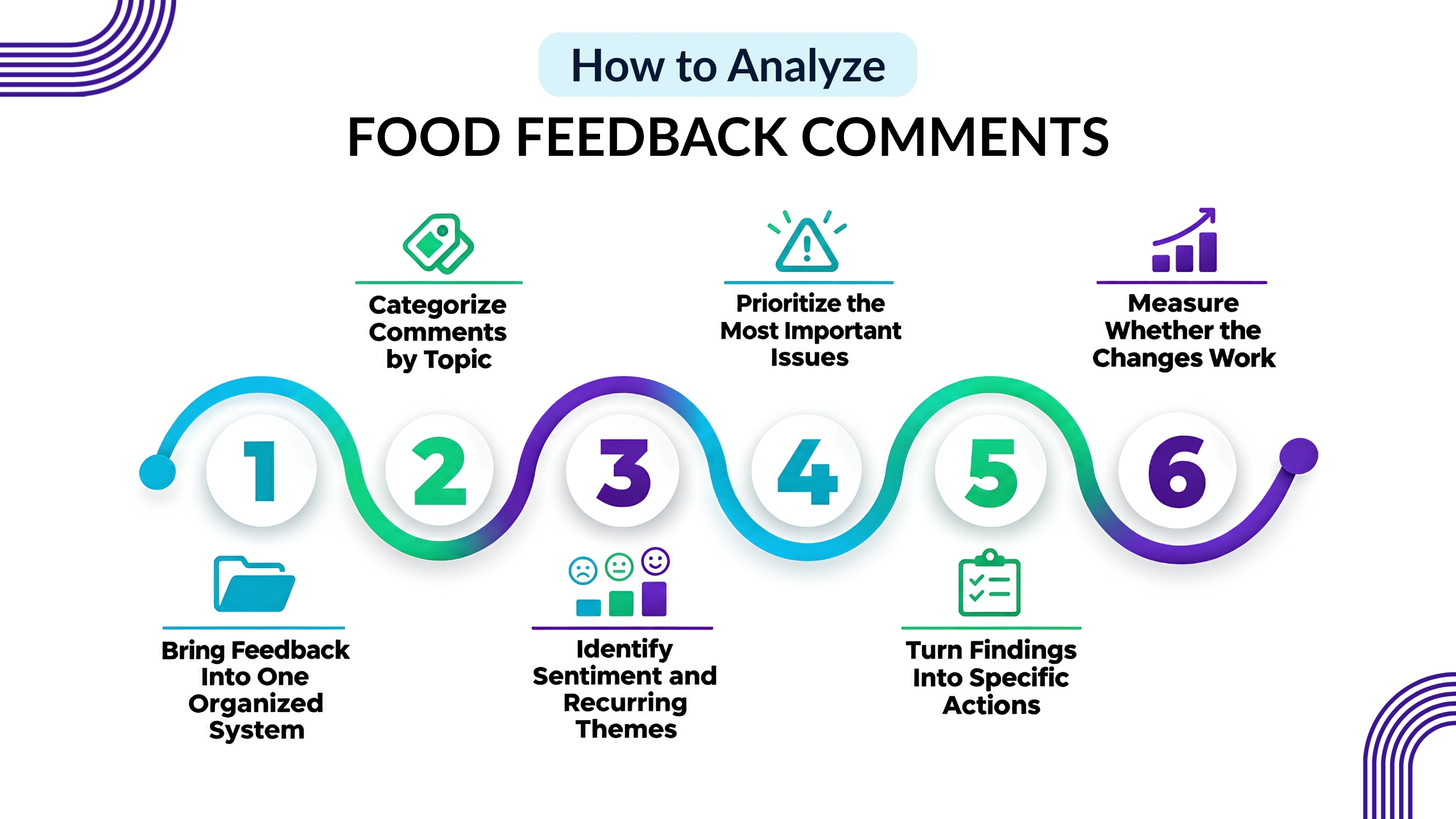
Collecting thousands of comments from customers will not be useful if staff members do not review them or determine what each customer comment means.
A structured feedback analysis process helps restaurants to convert individual customer opinions into clear priorities.
Step 1: Bring Feedback Into One Organized System
The first step to analyze food feedback comments from customers is to collect feedback from surveys, comment cards, review platforms, delivery apps, social media, and staff reporting.
For managing customer comments, restaurants can use either spreadsheets or feedback management platforms to organize this information.
Restaurants must document each comment’s date, source, location, category, sentiment, and follow-up requirements. While collecting customer feedback, avoid collecting unwanted personal information. Instead managers must restrict access to customer details and also follow applicable privacy requirements.
Step 2: Categorize Comments by Topic
Classify comments to different categories like food quality, service, cleanliness, value, waiting time, and order accuracy.
Consider this example:
- “The burger was delicious, but the fries were cold.” — Food quality.
- “Our server was friendly and helpful.” — Service.
- “We waited 25 minutes for our order.” — Waiting time.
- “The portions were smaller than expected.” — Value for money.
Some comments from customers come under more than one category. For instance, if a customer complains about cold delivery food, then they are complaining about food quality and packaging. Consistently classifying customer complaints into different categories makes it easier to compare customer feedback over time.
Step 3: Identify Sentiment and Recurring Themes
Restaurants must determine if customers received from them is positive, negative, or mixed response. They must look for recurring patterns within each customer comment.
If customers are repeatedly praising a specific dish, then that dish must be prominently placed on the menu. And if many guests complain about slow service during weekend evenings, then managers must increase kitchen staffing and kitchen capacity.
Restaurants must not consider every single comment as proof of a widespread problem. Instead restaurants must consider the number of customer complaints to verify its severity, and other operational problems.
Step 4: Prioritize the Most Important Issues
Not every complaint from the customers requires the same response. When customers face a serious food safety problem requires instant attention, while if customers provide suggestions about background music may be less urgent.
A practical priority framework considers:
- Severity: How seriously does the issue affect guests or safety?
- Frequency: How often does it occur?
- Business impact: Could it affect repeat visits, costs, or reputation?
- Ease of correction: Can the team address it quickly?
- Evidence: Is the pattern supported by several sources?
Restaurants must use these factors to establish clear priorities instead of responding only to the most recent complaint.
Step 5: Turn Findings Into Specific Actions
For every priority, restaurants must define a specific action, assign a staff member to assign it, and set a date to review progress.
For instance, repeated customer complaints about slow lunch services might
Require changes in staff scheduling, ingredient preparation, or order management. If customer comments about inconsistent food portions might need recipe standardization and staff training.
If there is any change then managers should explain those changes to staff members and ensure that the proposed solution addresses the underlying problems faced by customers.
Step 6: Measure Whether the Changes Work
Restaurants must keep collecting feedback from customers after making improvements. They must compare valid measures before and after the change such as satisfaction ratings, complaint frequency, average waiting times, order accuracy, and repeat customer activity.
Restaurants must consider differences in customer volume, seasonality, and the number of responses while interpreting results. While the main goal is to create a consistent improvement process which involves collecting feedback, identifying patterns, making changes, and checking whether those changes produce better experiences.
Also Read: Social Media Management Tips for Small Business
How Clariv Can Help Restaurants Manage Customer Feedback
Managing customer feedback from multiple platforms can be challenging for restaurants. Because comments, ratings, and complaints may appear on review websites, delivery apps, and social media.
Clariv helps simplify this process by integrating feedback from different digital channels into a centralized platform. Its features include sentiment analysis, topic categorization, review monitoring, AI-assisted replies, alerts, and insights across restaurant locations. Features are based on integrations and configurations.
Restaurants can use Clariv to support several feedback management activities:
- Centralize Customer Conversations: integrates supported reviews, delivery ratings, and social interactions into a centralized platform. This helps restaurant managers to track guest opinions without checking each platform separately.
- Understand Customer Sentiment: Use AI-based analysis tools to classify comments by sentiment and topics like food quality, waiting times, service, pricing, and ambience.
- Prioritize Urgent Feedback: Identify serious complaints through alerts and prioritization tools. Serious problems involve food safety or other sensitive matters should follow the restaurant’s established escalation procedures.
- Support Consistent Responses: Use AI-based reply features to draft responses more efficiently. Managers should review replies before sending, especially when customer complaints about further investigation or compensation.
- Compare Feedback Across Locations: Identify differences in customer opinions between restaurant branches and use recurring patterns to guide staff training and operational improvements.
Before choosing Clariv, restaurants should review its integrations, pricing, data handling practices, and available features to ensure the platform meets their feedback management needs.
Best Practices for Writing and Responding to Food Feedback Comments
Restaurants can receive quality feedback from customers by asking clear questions and making the customers feel comfortable while sharing honest opinions.
- Keep surveys short: Keep surveys short by including a few important questions and provide an optional space for additional comments.
- Ask specific questions: Asking about food temperature or service speed often gives more actionable insights than simply asking whether the overall experience was good.
- Make feedback accessible: Make feedback accessible for dine-in, takeaway, and delivery customers.
- Avoid pressuring guests: Customers should be able to share honest feedback without feeling obligated to provide positive ratings.
- Respond respectfully: Thank guests for their comments, acknowledge genuine problems, and explain appropriate next steps.
- Protect customer privacy: Do not publish personal information or discuss sensitive complaint details publicly.
- Avoid selective feedback practices: Request honest reviews consistently rather than directing only satisfied customers toward public review platforms.
- Close the feedback loop: Tell staff what customers are saying, explain what will change, and review whether the changes improve results.
- Recognize positive feedback: Share appropriate compliments with employees and recognize the behaviours that contributed to a good experience.
These practices help make feedback a regular part of restaurant operations rather than an occasional marketing activity.
Conclusion
Food feedback comments help restaurants to understand guest expectations, identify service problems, improve menu decisions, and build stronger customer relationships.
Whether customer comments come from direct conversations, QR-code surveys, receipts, online reviews, delivery platforms, or social media,
can provide useful information about the dining experience.
But restaurants have to analyze customer feedback systematically. Classify comments, identify recurring themes, focus on problems according to their severity and business impact, and assign clear actions to the right team members. Consistently collect customer feedback to find whether those changes improve customer satisfaction levels.
Tools such as Clariv may support this process by centralizing feedback from supported channels, analyzing customer sentiment, helping teams manage responses, and identifying patterns across restaurant locations. The right solution depends on your restaurant’s size, existing systems, and operational needs.
Ultimately, customer feedback should be part of everyday restaurant management. When teams listen carefully, respond respectfully, and act on what they learn, they can improve service consistency, strengthen their reputation, and create dining experiences that encourage customers to return.
If you still have any query about food feedback comments and how to collect and analyze guest opinions then you may write to us at Clariv and we are more than happy to assist you.