A restaurant’s online reputation can influence where customers choose to eat, and Funny Google Reviews is an unexpected way to capture the attention of customers.
From witty complaints to clever compliments, humorous feedback can convert an ordinary customer experience into memorable Restaurant Reviews that usually people enjoy reading and sharing.
For restaurant owners, such moments provide more than entertainment, because they support Reputation Management, strengthen Customer Engagement, and show an authentic Brand Personality.
If handled thoughtfully, humor can make a restaurant seem to be more approachable, confident, and warm. Whether a clever response, or a playful review, can encourage positive conversations, increase online visibility, and attract new Customers.
However, not every negative review should be a joke. Understanding Customer Sentiment, recognizing genuine customer complaints, and responding professionally are essential for protecting a restaurant’s Online Reputation.
Modern Review Management tools make this process easier. Tools like Clariv help restaurants to track customer feedback, analyze customer sentiment, identify recurring themes, and understand what guests are saying across different channels.
These insights help restaurant teams to differentiate between harmless humor and valuable feedback that may reveal problems with Food Quality, Customer Service, Dining Experience, or Restaurant Marketing.
Through this blog, we will explore how restaurants can use Google Reviews, humor, and Customer Feedback strategically to build trust, strengthen their reputation, and turn memorable customer experiences into opportunities for growth.
Also Read: How to Manage Online Reviews for Your Business
What Makes a Google Review Funny?
Funny reviews usually work because they offer an unexpected and entertaining take on the dining experience. A customer may describe an ordinary restaurant experience in an unusually dramatic way.
Another way to use sarcasm to explain a minor inconvenience. Someone else may turn a simple food complaint into a memorable one-liner.
The humor often comes from:
- Unexpected comparisons
- Exaggerated descriptions
- Sarcasm
- Unusual storytelling
- Self-deprecating comments
- Clever wordplay
- Honest observations
- Unexpected restaurant responses
- Strange misunderstandings
- Dramatic descriptions of ordinary experiences
It shows the different forms of restaurant reviews, from unusual customer complaints to clever and humorous owner responses. The funniest reviews often feel authentic as they reflect genuine customer experiences instead of carefully written advertisements.
Their natural tone makes them relatable, memorable, and engaging for readers. Such authenticity makes user-generated content valuable for restaurants that helps businesses to show their personality, connect with customers, encourage conversations, build trust, and create memorable moments that can strengthen their overall online reputation.
Also Read: Why Customer Reviews are Important for Business Growth
Why Funny Reviews Get Attention
Traditional restaurant reviews often focus on factors like food quality, service speed, cleanliness, and pricing. Funny reviews have an emotional aspect by making customers laugh, feel curious, or being able to connect with the experience.
An entertaining review can encourage people to:
- Read the complete review and explore other customer feedback.
- To visit the restaurant’s Google Business Profile or website.
- To share a review with friends or post it on social media.
- To follow the restaurant and become interested in visiting your restaurant.
Humor can go beyond a review’s reach beyond Google, as it turns memorable customer feedback into social media content, Instagram posts, TikTok discussions, or conversations among staff.
It can also contribute to a restaurant’s brand personality and make the business feel more approachable.
However, customer attention does not always mean a positive reputation of the brand. A funny review may hide a genuine complaint. For instance, joking about a two-hour wait can still indicate a serious service-speed problem.
Restaurants should therefore combine humor with thoughtful reputation management and address the underlying customer problem.
Also Read: How to Respond to Negative Customer Reviews
How Humor Can Boost Your Restaurant’s Reputation ?
Humor can make your restaurant more warm, approachable, and memorable to customers. A clever response or funny Google review can show customers that your business listens, appreciates customer feedback.
When humor is used appropriately, it can increase customer engagement, encourage social sharing, and make your restaurant have a competitive edge over competitors.
It should always compliment excellent customer service and genuine customer care rather than dismissing valid complaints or serious customer issues.
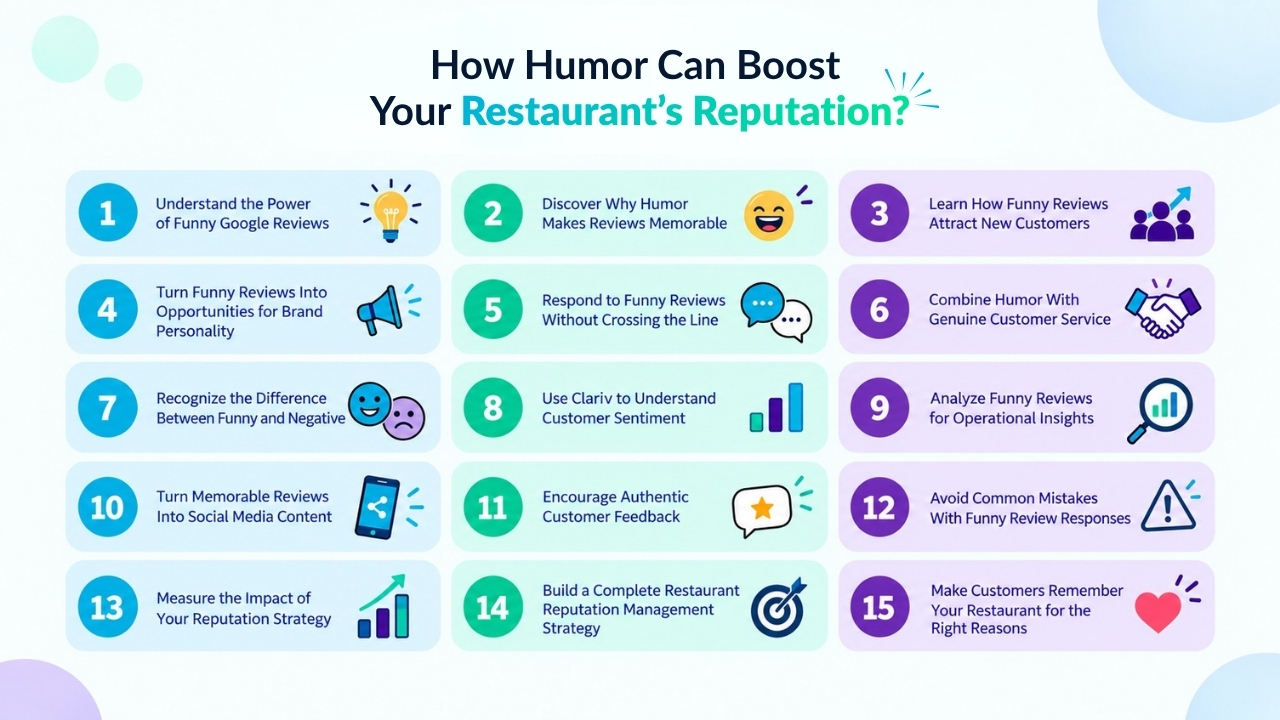
1. Understand the Power of Funny Google Reviews
Google Reviews has a crucial role that helps customers to find and choose your restaurants. Today before choosing where to eat, customers usually look at ratings, read comments, examine photos, and compare experiences shared by past guests.
Although most customer reviews focus on food service, pricing, and ambience, funny reviews can stand out as they create an emotional reaction.
A humorous review can transform an ordinary dining experience into a memorable story. Customers may describe a long wait time with sarcasm, or make a clever observation about the restaurant. Such comments can attract attention as they are entertaining and informative.
For restaurants, funny reviews from customers can give opportunities for them to show their brand approach. A thoughtful response can show that the business is approachable and confident. This can also encourage other customers to interact with the restaurant.
Humor can strengthen the customer experience, but it should never take the place of excellent service and genuine customer care. A funny review may still contain a crucial complaint. Restaurant owners should therefore enjoy the humor and also pay attention to the underlying customer feedback.
Also Read: How to Use Review Monitoring Software to Manage Your Online Reputation
2. Discover Why Humor Makes Reviews Memorable
Funny reviews are memorable as they go beyond basic descriptions of a dining experience. Instead of simply saying that the food was good or the service was slow, customers use storytelling, exaggeration, sarcasm, or unexpected comparisons. Such emotional aspects can make readers more likely to remember the restaurant.
For instance, a customer who writes, “The dessert was so good I considered hiding it from my family” creates a stronger mental image than someone who simply says, “The dessert was good.”
Humor can make user-generated content feel authentic by reflecting customers’ natural language, personal observations, and genuine experiences, that make customer reviews more relatable, engaging, and trustworthy for potential diners.
Restaurants can benefit from authentic humor because genuine customer experiences often feel more trustworthy than promotional messages.
Humor should develop naturally instead of being manufactured. Businesses should avoid fake reviews or misleading content, as honest feedback creates credibility, strengthens customer relationships, and supports long-term trust.
Also Read: How to Write a Review On Facebook
3. Learn How Funny Reviews Attract New Customers
A memorable review can encourage potential customers to spend more time exploring the online presence of restaurants.
Someone who notices an unusual or funny review may:
- Read the complete review.
- Explore the restaurant’s Google Business Profile.
- Look through other customer reviews.
- Visit the restaurant’s website.
- Check the menu.
- Explore social media pages.
- Share the review with friends.
- Become curious enough to visit.
It means humor can increase customer engagement beyond the original review. A restaurant does not necessarily need to create a separate marketing campaign around every funny comment. Sometimes the review itself becomes the content.
A memorable customer story can also be shared on social media, provided the restaurant handles customer content appropriately and considers permission, privacy, and platform rules.
The crucial point is that humor can make an ordinary customer interaction more visible. However, visibility should always be viewed along with customer sentiment. A highly entertaining one-star review may attract attention while simultaneously damaging the restaurant’s reputation.
However, visibility should be balanced with customer sentiment, as entertaining negative reviews can attract attention while harming reputation. Restaurants must focus on understanding genuine customer problems behind the humor.
Also Read: How to Measure Customer Sentiment
4. Turn Funny Reviews Into Opportunities for Brand Personality
Every restaurant develops its own unique identity, shaped by its atmosphere, service style, communication, and customer experience.
A restaurant might be:
- Casual and playful
- Warm and family-oriented
- Modern and energetic
- Elegant and sophisticated
- Friendly and community-focused
Review responses should show that identity. A casual restaurant might respond to a playful customer comment with a lighthearted joke. A fine-dining restaurant may prefer subtle humor that maintains a sophisticated tone. They have to be consistent with their strategies.
If a restaurant communicates warmly on its website and social media but responds aggressively to negative reviews, customers may receive mixed signals.
Funny reviews give restaurants a natural way to showcase their personality and connect with customers. A clever response can make the brand feel more warm and approachable.
However, humor should only be used selectively, ensuring responses remain genuine, relevant, and consistent with the restaurant’s overall tone and customer experience.
Also Read: Best Social Media Management Tools for Non-Profits
5. Respond to Funny Reviews Without Crossing the Line
Humorous responses can improve a restaurant’s reputation, but poor judgement may create the opposite effect. Restaurant owners should first determine whether a review is genuinely playful or expresses real frustration.
Before using humor, consider:
- Is the customer clearly joking?
- Is the issue relatively minor?
- Does humor suit the restaurant’s brand?
- Could the response embarrass the customer?
- Would future customers react positively?
When there is uncertainty, a polite and professional response is usually safer. Restaurants should never use humor to target sensitive characteristics like appearance, background, disability, religion, gender, or personal circumstances. They should also avoid revealing private information during public disputes.
Review responses are visible to many potential customers, not just the original reviewer. Therefore every response should help the restaurant to appear confident, respectful, professional, and customer-focused, even while addressing humorous criticism.
Also Read: Brand Reputation Management Software
6. Combine Humor With Genuine Customer Service
One of the biggest mistakes restaurants can make is using humor to avoid responsibility. Assume a customer complains about receiving an incorrect order.
A funny response might make readers laugh, but if the restaurant does not acknowledge the mistake, then the customer may feel ignored.
A better strategy is:
Acknowledge → Apologize → Explain → Resolve → Add humor when appropriate.
For instance, a customer might jokingly complain that their meal arrived so late that they “had time to reconsider their life choices.”
The restaurant could acknowledge the wait, apologize, explain that the experience was below its standards, and then add a small joke. This approach works because humor supports customer service instead of replacing it.
Serious customer complaints involving food safety, allergies, discrimination, accessibility, billing problems, or significant service failures should receive professional and empathetic responses.
The principle is simple: use humor to improve communication and not to dismiss customer concerns.
Also Read: Customer Sentiment Analysis Vs Customer Feedback Analysis
7. Recognize the Difference Between Funny and Negative
Humor does not always indicate that a customer is satisfied. Sarcasm can make a negative experience sound positive on the surface.
For instance, “Fantastic service. Only took an hour and half to get our drinks” clearly conveys frustration despite the positive wording.
Restaurants should look beyond individual words or star ratings and consider:
- Overall sentiment: Is the message positive, neutral, or negative?
- Review context: What experience is the customer describing?
- Recurring topics: Are similar complaints appearing repeatedly?
- Customer expectations: Did the experience meet reasonable expectations?
- Complaint frequency: How often is the issue mentioned?
- Changes over time: Is the problem becoming more common?
A funny review about slow service may indicate a broader operational problem. Restaurants should analyze the underlying problem rather than simply appreciating the humor. Humor can reveal problems that require attention.
Also Read: How AI Can Analyze Customer Feedback
8. Use Clariv to Understand Customer Sentiment
As restaurants grow, manually monitoring customer reviews across multiple platforms can become time-consuming. Clariv can help to analyze customer feedback for small businesses, identify customer sentiment, and recognize recurring themes across review channels.
For restaurants, this analysis can highlight patterns related to:
- Food quality and portion sizes
- Service speed and staff behavior
- Pricing and cleanliness
- Delivery and order accuracy
- Atmosphere and customer satisfaction
For instance, several humorous comments about long waiting times may seem harmless individually. However, repeated mentions of the same problem.
Analyzing customer sentiment and recurring topics, helps restaurants to move beyond simply responding to reviews and understanding the reasons behind customer feedback. This makes review management more strategic, helping businesses to identify problems, improve experiences, and protect their online reputation.
Also Read: How AI Sentiment Analysis Software Turns Customer Feedback into Growth Opportunities
9. Analyze Funny Reviews for Operational Insights
Customer reviews can provide valuable insights into restaurant operations. Even humorous comments may reveal recurring problems or highlight strategies that businesses can build upon.
For instance, repeated comments about:
- Slow food delivery: May indicate kitchen delays or coordination problems.
- Small portions: Could reveal concerns about value.
- Long queues: May suggest staffing or table-management issues.
- Friendly employees: Can highlight service behaviors worth recognizing.
- Excellent desserts: May identify popular dishes for promotion.
Hence, humorous reviews are therefore more than marketing content, they can serve as informal customer research. Restaurants can categorize customer feedback and monitor recurring themes over time.
For instance, if complaints about slow service decline after staffing changes during busy hours, review data can help to measure whether the changes improved customer experiences.
This creates a continuous cycle:
Customer Feedback → Analysis → Operational Change → Better Experience → Improved Feedback.
Also Read: Restaurant Review Sentiment Analysis
10. Turn Memorable Reviews Into Social Media Content
A particularly funny review can go beyond Google and become engaging content across several marketing channels. Restaurants can repurpose memorable customer feedback for:
- Instagram and Facebook: Turn amusing comments into attractive graphics.
- TikTok and YouTube Shorts: Create short videos featuring funny reviews or employee reactions.
- Websites and newsletters: Share memorable comments as authentic customer stories.
Restaurants could create a weekly feature highlighting unusual customer feedback or turn a series of reviews into entertaining videos. However, businesses should consider privacy, attribution, permission, and context before reusing customer content.
The goal should be to celebrate customers rather than exploit them. When handled thoughtfully, funny reviews can generate customer engagement, strengthen credibility, encourage social interaction, and provide authentic social proof that helps potential customers to feel more confident.
Also Read: Social Media Management Tips for Small Businesses
11. Encourage Authentic Customer Feedback
Restaurants should encourage customers to leave honest customer feedback, but they should never attempt to manufacture positive reviews. The most valuable customer reviews come from genuine customer experiences.
Restaurants can make feedback easier by:
- Providing clear review information.
- Making review links easy to find.
- Asking customers for honest feedback.
- Responding to existing reviews.
- Making customer service a priority.
- Learning from recurring complaints.
A restaurant should not ask customers to add only positive reviews. It should encourage customers to write their genuine opinions. It creates a more credible review profile.
Interestingly, authentic feedback may naturally include humor. Customers who have a memorable experience may describe it creatively without being prompted.
Restaurants should therefore focus on creating an experience that is worth talking about. The best reputation strategy is not to convince customers to say good things. It is to give them genuine reasons to say good things.
Also Read: Best Social Media Management Tools for Businesses
12. Avoid Common Mistakes With Funny Review Responses
Humor can strengthen a restaurant’s reputation, but using it poorly can cause negative publicity. Restaurants should consider the following common mistakes:
- Making fun of customers: Never humiliate customers for entertainment.
- Mocking serious complaints: Genuine concerns require empathy and appropriate action.
- Trying too hard: Forced jokes can make a business appear unprofessional.
- Ignoring the complaint: Humor should not distract from issues involving service, food quality, or incorrect orders.
- Responding emotionally: Owners should pause before replying when frustrated or angry.
- Repeating the same jokes: Overused responses can feel scripted and inauthentic.
- Revealing private information: Customer details should never be shared publicly.
- Treating critics as enemies: Negative reviews can provide useful insights for improvement.
The safest approach is to focus on long-term reputation, professionalism, and customer relationships rather than trying to win a public argument.
Also Read: Sentiment Analysis Demo
13. Measure the Impact of Your Reputation Strategy
Restaurants should measure whether their review management efforts are actually improving customer perception.
Important metrics include:
- Average Google rating
- Review volume
- Response rate
- Response time
- Positive sentiment
- Negative sentiment
- Recurring complaints
- Customer retention
- Social engagement
- Mentions of specific menu items
- Mentions of service quality
For instance, if customers frequently complain about slow service, management can track whether those complaints reduce after operational changes. Technology like Clarive can help restaurants to organize customer feedback and identify sentiment and recurring themes.
This allows restaurant teams to make decisions based on patterns instead of isolated comments. Implementing a successful reputation strategy should ultimately produce measurable improvements in the customer experience.
The objective is not to just generate more humorous reviews simply as they receive attention. It is to understand customers better and build a stronger relationship with them.
14. Build a Complete Restaurant Reputation Management Strategy
Funny reviews should be part of a wider online reputation management strategy. Restaurants can build an effective approach by focusing on:
- Monitor: Track reviews and customer feedback regularly.
- Analyze: Identify sentiment, trends, and recurring concerns.
- Respond: Provide timely, thoughtful, and appropriate replies.
- Improve: Use feedback to address operational problems.
- Engage: Build stronger customer relationships through authentic communication.
- Measure: Monitor reputation and customer-experience metrics over time.
This process converts customer reviews from passive customer opinions into an active business-improvement system. Platforms like Clariv can help restaurants to analyze customer feedback and identify crucial patterns across customer comments.
For instance, managers may find that one location receives praise for friendly employees while another receives repeated complaints about waiting times. These insights can guide staff training, scheduling, service improvements, and customer-care strategies, connecting online feedback with real-world restaurant operations.
Also Read: How to Add Business to Apple Maps
15. Make Customers Remember Your Restaurant for the Right Reasons
Funny Google Reviews can provide restaurants with something traditional advertising often struggles to create which is authentic attention.
A clever customer comment can attract customer attention, while a witty response can showcase a restaurant’s personality. However, humor alone cannot build a lasting reputation.
Restaurants must deliver excellent food, reliable service, genuine hospitality, accurate orders, and consistent experiences. Funny comments can also reveal valuable insights like service delays, pricing problems, popular dishes, or exceptional employees.
Tools like Clariv can help restaurants to analyze customer sentiment and recurring themes at scale. Ultimately, restaurants should listen, respond with empathy, use humor appropriately, fix recurring problems, and celebrate genuine positive experiences. A funny review may attract customers, but an excellent experience encourages them to return.
Conclusion
Funny Google Reviews can give restaurants a valuable opportunity to showcase their personality, connect with customers, and attract attention in a highly competitive digital environment.
A clever customer comment or thoughtful response can make a restaurant appear more warm, approachable, and memorable. However, humor should always support, rather than replace, excellent customer service.
Restaurants should go beyond the humor and understand what reviews are conveying. A humorous comment about slow service, pricing, food quality, or portion sizes may reveal genuine customer problems.
Analyzing these patterns helps businesses to identify opportunities to improve their operations and customer experience. Tools like Clariv can help restaurants to monitor feedback, understand customer sentiment, identify recurring themes, and turn customer conversations into actionable insights.
Ultimately, successful reputation management requires a balanced approach: listen carefully, respond respectfully, use humor appropriately, and continuously improve.
When great experiences inspire customers to share positive and memorable stories, humor can become a powerful part of a restaurant’s long-term reputation strategy.