Understanding the way customers perceive your products, services, and overall brand experience is essential for businesses to achieve long-term business success.
In this highly competitive market, providing good customer experiences is no longer optional; instead , it is a crucial differentiator that drives customer loyalty, customer retention, and business revenue growth.
This is why all sizes of businesses rely on customer satisfaction metrics to monitor performance, evaluate customer experiences, and find improvements for consistent improvement in operations.
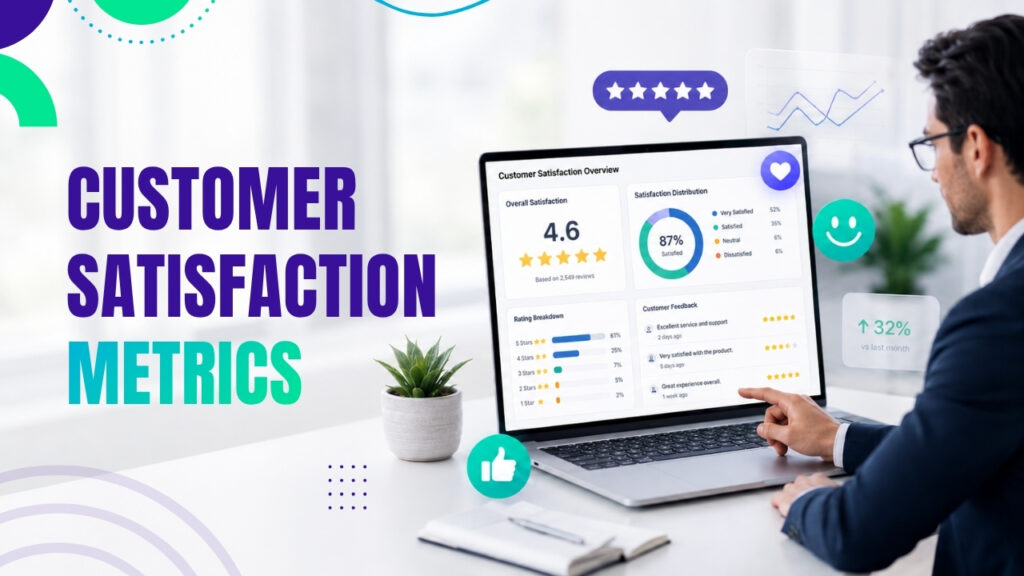
Customer satisfaction metrics are measurable indicators which help companies to analyze whether they meet customer expectations.
Monitoring important customer satisfaction KPIs like Customer Satisfaction Score(CSAT), Net Promoter Score(NPS), Customer Effort Score(CES), customer retention rate, customer churn rate, and customer lifetime value(CLV), lets businesses to gain insights into customer behavior and overall customer satisfaction levels.
All these customer experience metrics help organizations to make operational decisions based on data, improve customer service, products, and long-term relationships with their customers.
Whether you are an eCommerce business, SaaS company, retailer, healthcare provider, or financial institution, when they implement an effective customer satisfaction measurement strategy helps them to reduce customer churn, increase repeat purchases, and improve reputation of the brand.
Regularly tracking customer feedback metrics and customer service KPIs helps businesses to respond instantly to changing customer expectations and improve every phase of the customer journey.
Through this detailed blog, we will walk you through everything you need to know about customer satisfaction metrics, which includes the most crucial metrics to track, how to measure customer satisfaction, best practices for improving customer satisfaction, important tools, common mistakes to avoid, and new trends.
With the right customer satisfaction analytics, businesses can provide better experiences to customers, increase customer loyalty, and achieve business growth.
Also Read: How Businesses Can Improve Customer Satisfaction
What Are Customer Satisfaction Metrics?
These are measurable indicators which analyze the way customers perceive about your company, product, service, or support team.
Customer satisfaction metrics help businesses to detect if they are meeting expectations of their customers, and implement different strategies to improve their services or products.
Unlike financial metrics which prioritizes only on revenue or profit, customer satisfaction metrics track the quality of customer relationships. It provides insights regarding customer emotions, perceptions, customer loyalty, and overall experience with your brand.
Businesses collect these metrics through various methods, including:
- Customer satisfaction surveys
- Net Promoter Score (NPS) questionnaires
- Customer Effort Score (CES) surveys
- Online reviews
- Product ratings
- Customer interviews
- Website feedback forms
- Live chat surveys
- Social media sentiment analysis
- Customer support analytics
All these metrics when analyzed together, these data sources provide a complete view of the customer journey.
For example:
- An online retailer may monitor repeat purchase rates and product reviews.
- A healthcare provider may evaluate patient satisfaction after appointments.
- A hospitality business may analyze guest reviews and service quality scores.
Rather than only making decisions based on assumptions, organizations can use these metrics to make evidence-based metrics which improve customer experience and overall performance of business.
Also Read: Online Reputation Management Complete Guide
Why Are Customer Satisfaction Metrics Important?
Customer satisfaction directly influences revenue, brand reputation, customer loyalty, and long-term business growth. When customers regularly receive excellent experiences then they are more likely to:
- Purchase again
- Recommend the business to others
- Spend more over time
- Leave positive reviews
- Forgive occasional mistakes
- Remain loyal despite competitive offers
On the other hand, dissatisfied customers often:
- Stop purchasing
- Leave negative reviews
- Share poor experiences on social media
- Increase support costs
- Reduce referral opportunities
- Damage brand reputation
Also Read: Why Customer Reviews are Important for Business Growth
Benefits of Measuring Customer Satisfaction Metrics
Monitoring customer satisfaction metrics enables businesses to know about expectations of their customers, evaluate service quality, and find strategies for consistent improvement.
When organizations regularly analyze customer feedback and key performance indicators(KPIs), it lets them make informed decisions which improve customer experiences, customer loyalty, and support long-term business growth.
Below are the important benefits of tracking customer satisfaction metrics:
1. Gain Valuable Customer Insights
Customer expectations keep evolving over time due to which consistent tracking of customer satisfaction metrics is essential.
Customer satisfaction metrics help businesses to know the features that customers love the most about your products or services, identify changing customer buying behaviors, and know about emerging customer preferences.
By using these insights businesses can develop better products, improve services, and implement customer-focused business strategies.
Also Read: AI Tools to Analyze Customer Reviews
2. Improve Customer Experience and Loyalty
Tracking customer experience and loyalty helps businesses to improve every phase of customer journey, such as improving their website, providing better checkout experiences, better customer support, and post-purchase communication.
Businesses can resolve customer problems by personalizing their interactions with customers, offering consistent service. It helps businesses to achieve higher level of customer loyalty, encourage customers for repeat purchases, and build long-term relationships with their customers.
Also Read: How to Use Customer Feedback to Grow Your Business
3. Enhance Operational Performance
These metrics helps businesses to find strategies that help them to improve their products, services, and customer feedback that help organizations to make their processes smooth, offer training to staff, and offer a consistent customer experience and thereby reducing customer churn rates.
Also Read: How AI Can Analyze Customer Feedback
4. Drive Business Growth and Competitive Advantage
Organizations that consistently track customer satisfaction metrics are able to make smarter, data-driven decisions. Data-driven insights enables businesses to focus on investment, improve marketing strategies, increase customer lifetime value, and improve brand reputation.
When businesses consistently improve customer experiences and respond instantly to changing customer requirements, then businesses have more competitive advantage over their competitors and also achieve sustainable long-term business growth.
Also Read: How to Track Customer Feedback in Real Time
Characteristics of Effective Customer Satisfaction Metrics
Not all customer satisfaction metrics provide meaningful business insights. To support informed decision-making and continuous improvement, businesses should focus on metrics which are reliable, actionable, and aligned with their goals.
Below are the five key characteristics of effective customer satisfaction metrics.
1. Relevant
Customer satisfaction metrics are only effective when it matches with business objectives and improves customer experiences with the brand. Tracking relevant KPIs ensures that businesses track factors that directly influence customer satisfaction levels, customer loyalty, and improve overall business performance.
Also Read: Best Social Media Management Tool for Businesses
2. Measurable
These metrics should be based on the accurate and consistent data collected through surveys, customer feedback, and customer support analytics.
Reliable customer data helps businesses for meaningful comparisons and trend analysis over time.
3. Actionable
The best metrics give clear insights which help businesses to identify problems and also implement improvements. These metrics should guide business decisions that improve products, services, and customer experiences instead of simply reporting past performance of business.
4. Timely
Businesses have to consistently track customer satisfaction metrics on a timely basis to find existing trends, resolve problems of customers instantly, and respond quickly to changing customer expectations before they affect customer loyalty or customer retention.
5. Easy to Understand
With simple and clear customer satisfaction metrics, it becomes easier for teams across different departments to understand their performance, collaborate well, and make decisions based on data to increase customer satisfaction levels.
Also Read: Social Media Management Tips for Small Businesses
The 15 Most Important Customer Satisfaction Metrics
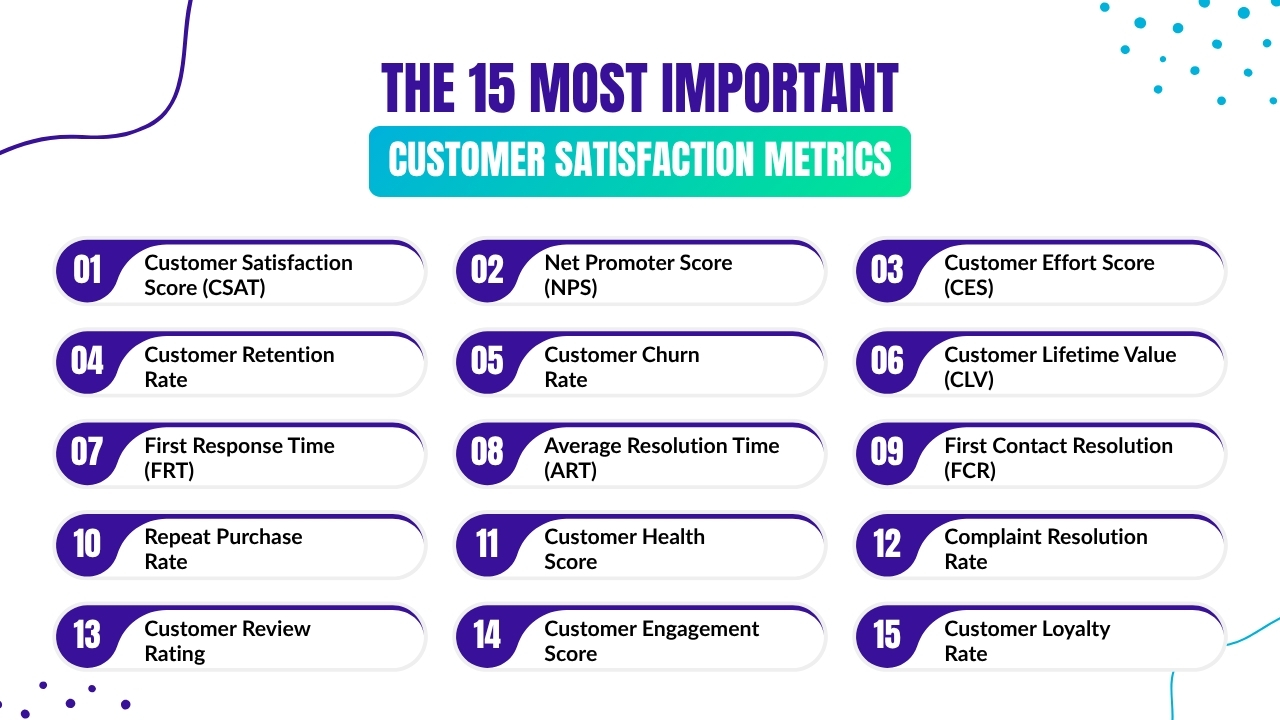
For businesses it is essential to track the accurate customer satisfaction metrics to know customer experiences, improve service quality, and build long-term quality products and services.
Rather than depending on a single KPI, it is essential for businesses to track multiple customer satisfaction KPIs to gain a complete view of the customer journey.
Below are the essential customer metrics every business should track.
1. Customer Satisfaction Score (CSAT)
It measures the way satisfied customers perceive your brand after a purchase, product delivery, or customer support experience.
Customers usually rate their satisfaction on a scale of 1-5 or 1-10. Higher CSAT scores indicate that customer experiences are positive, and effective in the service industry. Businesses must send CSAT surveys instantly after a purchase to gather right and timely customer feedback.
Also Read: How to Use Review Monitoring Software to Manage Your Online Reputation
2. Net Promoter Score (NPS)
It involves tracking customer loyalty by evaluating whether customers are more likely to recommend your business to others. On the basis of the way customers respond, they are classified as Promoters, Passives, or Detractors.
Higher NPS scores means more customer trust, customer satisfaction, and long-term customer loyalty which help businesses to find strategies that help them to improve their brand.
3. Customer Effort Score (CES)
This score measures how easy it is for customers to complete an interaction such as making a purchase, resolving an issue. If customers have to make less effort then it leads to higher customer satisfaction levels, and higher customer retention rates because customers prefer simple and easy experiences.
4. Customer Retention Rate
It measures the percentage of customers who continue purchasing from or engaging with a business over a certain period. It is a strong indicator of customer loyalty, customer satisfaction, and a company’s ability to main long-term relationships with their current customers.
Higher customer retention rates indicate satisfied customers, strong relationships, and effective customer service. Usually retaining customers is more cost-effective than acquiring new customers.
Also Read: How to Measure Customer Sentiment
5. Customer Churn Rate
It involves tracking the number of customers who have stopped using your products or service. Higher customer churn rate, indicates poor customer experiences, pricing problems, or high competition.
When businesses consistently track customer churn helps them to find customer problems early and implement strategies to increase customer retention rates.
Also Read: How to Respond to Negative Customer Reviews
6. Customer Lifetime Value (CLV)
It involves measuring the total revenue a customer is expected to generate whenever they purchase a product or services from your business. Higher customer lifetime value indicates higher customer loyalty as it helps businesses to make informed decisions regarding marketing.
7. First Response Time (FRT)
It involves measuring how instantly customer support responds to customer problems or queries. Faster response time indicates high customer trust, reduces customer frustration, and leads to higher customer satisfaction scores.
8. Average Resolution Time (ART)
It involves tracking the average time needed for businesses to completely resolve customer problems. Shorter resolution times, indicates efficient customer support process, and better service quality which leads to higher customer satisfaction and stronger relationships with customers.
9. First Contact Resolution (FCR)
It involves measuring the percentage of customer issues which get resolved when they interact with businesses for the first time. Higher FCR means less customer support expenses, increases customer satisfaction levels, and indicates the effectiveness of customer service teams.
10. Repeat Purchase Rate
It involves measuring how often customers return to your brand to make more purchases. Higher repeat purchase rates indicate higher customer satisfaction levels, high brand trust, and customer loyalty. It is a valuable metric for retail and eCommerce businesses.
11. Customer Health Score
Customer Health Score combines several indicators such as product usage, engagement levels, support interactions, and renewal chances into a single metric. Knowing this score, helps customer success teams to identify customers who are at the risk of churning and offering proactive customer support.
12. Complaint Resolution Rate
It involves measuring the number of customer complaints that get resolved successfully. Higher resolution rates indicate stronger customer service, customer trust, and reduces recurring customer problems and improves overall customer experiences.
13. Customer Review Rating
It involves measuring customer feedback across different review platforms like Google, Yelp, Facebook. Businesses by tracking average customer ratings, customer sentiment, and response rates help them to improve online reputation and also attract new customers to their brand.
Also Read: How AI Sentiment Analysis Software Turns Customer Feedback into Growth Opportunities
14. Customer Engagement Score
It involves measuring how actively customers interact with your business by analyzing their website visits, mobile app usage, email engagement, and social media participation.
Highly engaged customers are more likely to remain loyal and continue purchasing from your brand.
Also Read: How to Manage Online Review for Your Business
15. Customer Loyalty Rate
Customer Loyalty Rate measures how consistently you continue doing business with your company over time. It considers factors like repeat purchases, subscription renewals, referrals, and brand advocacy.
A high loyalty rate reflects positive customer experiences and contributes to sustainable business growth.
How to Measure Customer Satisfaction
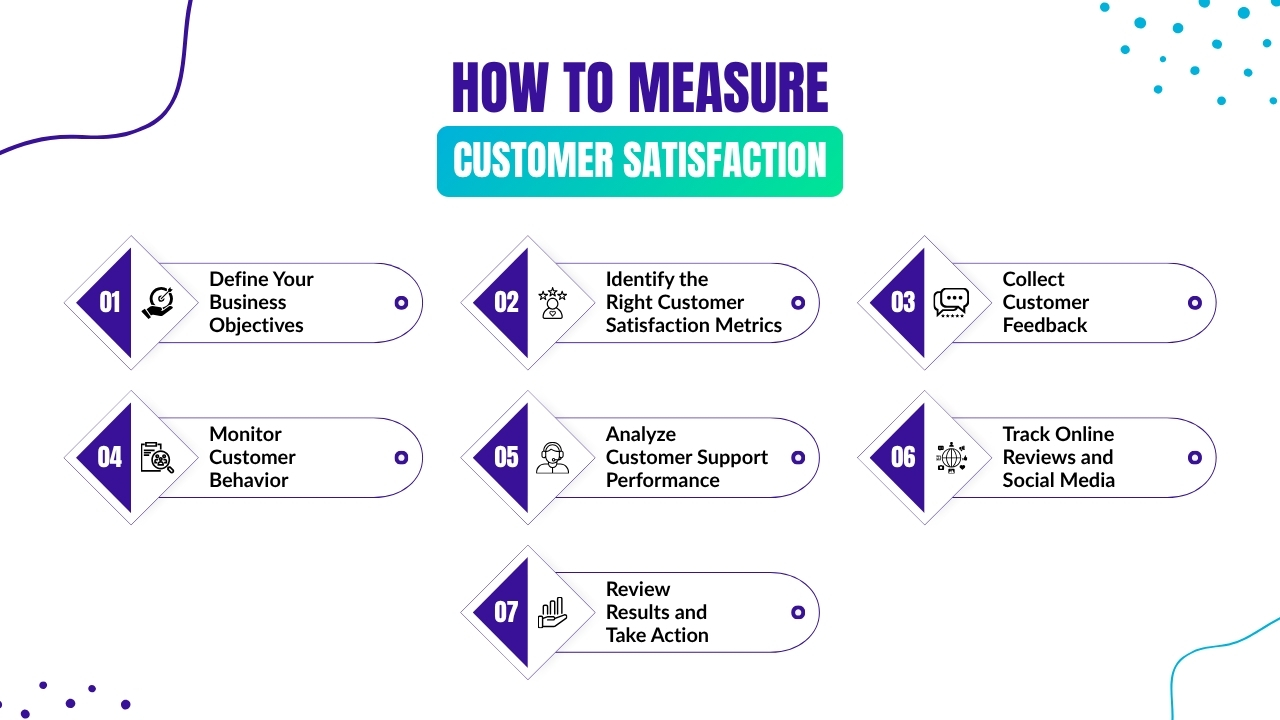
It requires a structured approach that combines direct customer feedback with behavioral data and performance analytics.
An effective customer satisfaction measurement strategy helps businesses to understand customer expectation, identify pain points, and make data-driven improvements which improve the overall customer experience.
Below are seven essential steps to measure customer satisfaction effectively.
1. Define Your Business Objectives
The first step is to establish clear business goals and choose your customer satisfaction metrics. These business objectives can be increasing customer loyalty, increasing customer service quality, reducing customer churn, increasing repeat purchases, increasing customer experience, product quality or improving the reputation of your brand.
With well-defined goals businesses can focus on the most relevant customer satisfaction KPIs that align well with your overall business strategy.
2. Identify the Right Customer Satisfaction Metrics
Different industries have different metrics for tracking customer satisfaction levels effectively. For instance, eCommerce businesses must track CSAT, repeat purchase rate, customer reviews, and customer retention rate.
While SaaS companies should focus on NPS, customer health score, churn rate, customer lifetime value, and feature adoption. So it is essential for businesses to select industry-specific customer satisfaction metrics which provide insights.
Also Read: What is Customer Sentiment Analysis
3. Collect Customer Feedback
Customer feedback is the foundation of every successful satisfaction measurement strategy. Businesses should use different channels to collect insights like Customer Satisfaction Score(CSAT) surveys, Net Promoter Score(NPS) surveys, Customer Effort Score(CES) surveys, website feedback widgets, live chat surveys, and email surveys.
When businesses ask for clear, valid queries instantly after customers buy a product or use a service, it helps them to improve customer response rates and gives more accurate customer feedback about customer experiences.
Also Read: Customer Sentiment Platform Vs Traditional Surveys
4. Monitor Customer Behavior
Every customer does not complete surveys that makes analyzing customer behavior equally important. It is essential for businesses to track indicators just as repeat purchases, website session duration, use of products, login frequency, cart abandonment, subscription renewals, and referral activity.
It is essential to analyze these customer behavior along with survey responses as it provides a complete understanding of customer satisfaction and customer engagement.
Also Read: Restaurant Review Sentiment Analysis
5. Analyze Customer Support Performance
Offering good customer support is also essential for businesses to increase customer satisfaction level. Businesses should track important service metrics such as First Response Time(FRT), Average Resolution Time(ART), First Contact Resolution(FCR), ticket volume, escalation rate, and complaint resolution time.
All these crucial metrics help businesses to identify service challenges, improve customer support, and ensure customers receive timely and effective assistance.
6. Track Online Reviews and Social Media
Often customers share honest opinions about your products or services on review platforms and social media. It is essential for businesses to track customer feedback on Google Reviews, Yelp, Facebook, LinkedIn, and Reddit.
Using customer sentiment analytics tools helps businesses to identify customer problems, emerging patterns, that allows businesses to act quickly and improve their brand reputation.
Also Read: Google Review Management Software
7. Review Results and Take Action
It is essential for businesses to gather customer data as it leads to impactful improvements. Businesses that review customer satisfaction metrics regularly such as weekly for customer support teams, monthly for managers, quarterly for executives, and annually for long-term planning.
Businesses must analyze new trends, comparing performance of businesses against their business goals, and implement changes based on customer feedback.
Consistently tracking and implementing improvements in operations helps organizations to provide better customer experiences, increase customer loyalty, reduce customer churn, and drive sustainable business growth.
Also Read: Brand Reputation Management Software
Best Tools for Measuring Customer Satisfaction
Implementing modern tools is essential to track customer satisfaction metrics by simplifying customer feedback collection, analyzing customer feedback, and generating insights.
With the right tools businesses can track customer experiences, improve service quality, and make data-driven decisions.
Below are six essential categories of tools for measuring customer satisfaction.
1. Survey Platforms
These platforms are one of the most effective tools for collecting customer feedback. They support Customer Satisfaction Score(CSAT), Net Promoter Score(NPS), and Customer Effort Score(CES) surveys, and also custom questionnaires, automated email surveys, mobile-friendly forms, and response analytics.
Through survey platforms it becomes easier for businesses to collect structured customer feedback and track customer satisfaction metrics across different areas.
Also Read: Sentiment Analysis Demo
2. Customer Relationship Management (CRM) Systems
CRM systems gather purchase history, customer interactions, service requests, communication records, customer retention patterns, and customer lifetime value to a centralized system.
When businesses have a complete view of each customer, CRM systems help businesses to provide personalized experiences and improve long-term relationships with customers.
3. Help Desk Software
Help desk software tracks customer support performance through metrics like First Response Time (FRT), Average Resolution Time (ART), ticket volume, agent productivity, and post-support satisfaction scores.
All these insights help organizations to improve services and provide faster, effective customer support.
4. Customer Experience (CX) Platforms
Customer Experience (CX) platforms collect survey results, sentiment analysis, predictive analytics, and experience tracking into detailed dashboards.
These tools give businesses a complete view of customer experiences that helps them to improve customer experiences.
5. Social Listening Tools
Social listening tools track important customer conversations across social media and review management platform. These tools help businesses to track brand mentions, analyze customer sentiment, track competitors, identify patterns, and manage online reputation which provide businesses with insights beyond surveys.
Also Read: Social Media Management Tool for Non-Profits
6. Business Intelligence and Analytics Platforms
Business intelligence tools convert customer satisfaction data into interactive dashboards and reports.
Organizations that track customer satisfaction patterns, customer retention, regional performance, department KPIs, and executive metrics enable them to make decisions based on data and consistently improve operations.
Conclusion
Tracking customer satisfaction metrics are essential for businesses to understand expectations of their customers, improve customer experiences, and drive business successfully for the long-term.
When businesses track important customer satisfaction KPIs like Customer Satisfaction Score (CSAT), Net Promoter Score (NPS), Customer Effort Score (CES), customer retention rate, and customer churn rate, it can help them to gain insights about customer behavior and also find strategies for continuous improvement.
These metrics help organizations make data-driven decisions, improve customer services and products, and build stronger relationships with customers.
Measuring customer satisfaction levels is only the initial step. It is essential for businesses to regularly analyze customer feedback, track performance patterns, and take impactful action to solve customer problems.
By using the right tools, implementing best practices, and consistently refining the customer experience can highly increase customer loyalty, build positive brand reputation, and increase revenue growth.
Ultimately, organizations that focus on customer satisfaction metrics and act on customer insights are more likely to reduce customer churn rates, increase customer retention, and create good customer experiences.
A customer-centric approach not just improves competitive advantage to organizations but also supports sustainable business growth and long-term success in a highly competitive market.
If you still have any query about customer satisfaction metrics then you may contact us at Clariv and we are more than happy to assist you.