Funny 1 star reviews can convert an ordinary restaurant experience into a memorable story. Customers sometimes use sarcasm, exaggeration, and humor to describe everything from a long wait to a confusing menu or an unexpectedly expensive meal.
While these reviews may make readers laugh, they can also reveal important lessons about restaurant mistakes, customer experience, and service quality. A complaint that sounds ridiculous at first may point to a genuine problem that a restaurant needs to address.
For restaurant owners and managers, negative reviews should not simply be ignored or treated as personal attacks. They can provide valuable customer feedback about food quality, staff behavior, waiting times, pricing, cleanliness, order accuracy, and overall restaurant service. Even an unreasonable review can highlight gaps in communication or customer expectations.
Analyzing online reviews also helps restaurants to identify recurring problems rather than focusing on individual customer complaints. With customer sentiment analysis, businesses can understand whether customers are frustrated, satisfied, disappointed, or impressed and discover the problems influencing those emotions.
Platforms like Clariv can help restaurants to organize customer feedback, identify review trends, and uncover recurring customer complaints across different channels.
Ultimately, the funniest one-star reviews are not just entertaining. They can become valuable lessons in restaurant reputation management, operational improvement, and customer satisfaction. By listening carefully, restaurants can convert criticism, even humorous criticism into opportunities to create better dining experiences.
Also Read: Funny Google Reviews How Humour Can Boost Your Restaurant Reputation
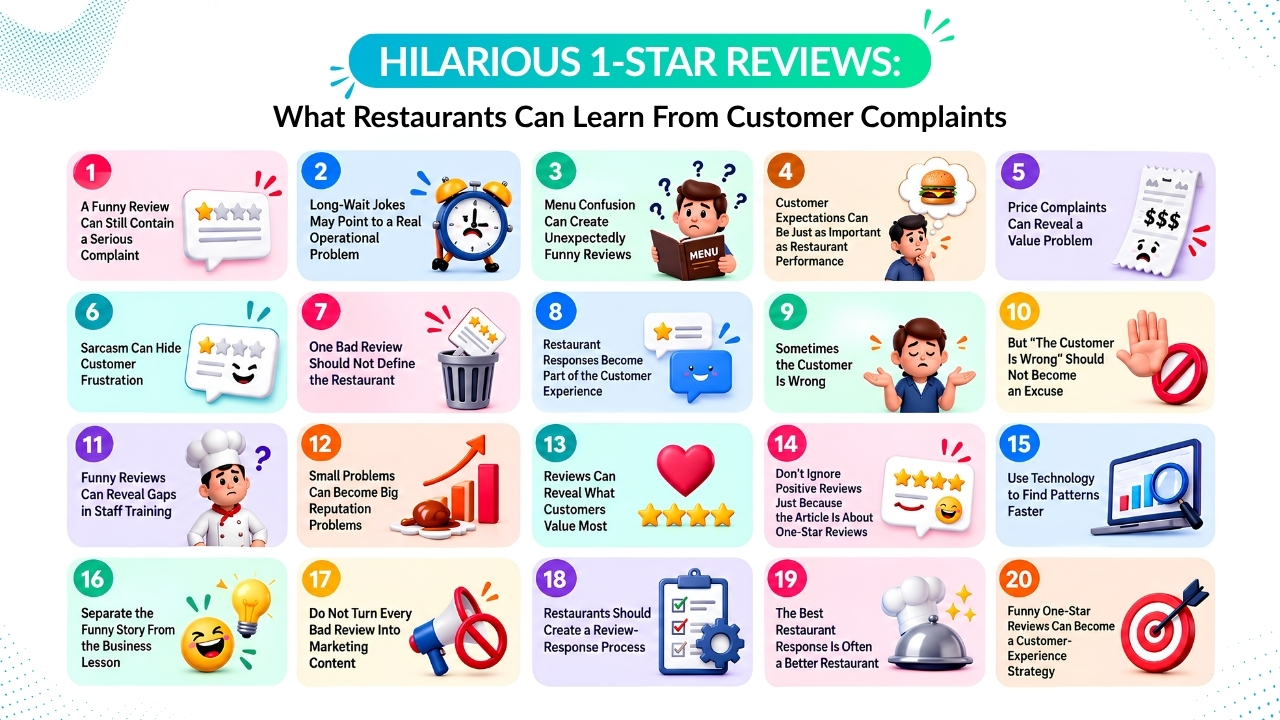
Hilarious 1-Star Reviews: What Restaurants Can Learn From Customer Complaints
1. A Funny Review Can Still Contain a Serious Complaint
The first lesson is simple: humor does not automatically make a complaint meaningless. Customers often use humor when they are frustrated. Rather than writing, “The service was slow,” they may write something like:
“By the time my food arrived, I had considered changing careers.”
The wording is funny, but the underlying complaint is straightforward. The customer waited too long for the food to get served.
Restaurants should learn to separate the tone of a review from the information inside it. A sarcastic review may reveal a real problem with service speed. A dramatic complaint about a meal may reveal poor food quality. A joke about the bill may indicate the customer did not believe the experience justified the price.
The question should not be, “Is this review funny?”
It should be:
“What experience caused the customer to write it?”
This is where customer sentiment analysis can become useful. Instead of manually reading every review and trying to interpret its tone, restaurant teams can use tools like Clariv to identify customer sentiment and recurring topics across reviews and other feedback channels.
Clariv says its platform analyzes customer emotions and identifies themes like service quality, wait times, pricing, staff behavior, and product problems. The joke may be memorable, but the underlying signal is what restaurants should act on.
Also Read: Funny Google Reviews What they Teach Us About Customer Experience
2. Long-Wait Jokes May Point to a Real Operational Problem
Customers waiting for their food to get served is one of the easiest restaurant operations to convert into a joke. A customer might say they had enough time to finish a novel before their food arrived. Another customer might joke that the kitchen was preparing the meal “one ingredient at a time.”
These comments can be funny. But if several customers are making similar jokes, then the restaurant should pay attention. A restaurant’s waiting experience includes much more than the time between ordering and receiving food.
Customers may wait:
- To be greeted
- To be seated
- To receive menus
- To place an order
- For drinks
- For food
- For the check
- To make payment
A restaurant may believe its food is being prepared instantly while customers are actually frustrated because nobody acknowledged them during the first ten minutes. That is why restaurants should examine the entire customer journey.
A funny review about customer waiting can be treated as an operational clue rather than simply an amusing complaint. If the same problem appears repeatedly, then managers should examine staffing, kitchen capacity, table management, order flow, peak-hour demand, and communication between front-of-house and kitchen teams.
Also Read: How to Measure Customer Sentiment
3. Menu Confusion Can Create Unexpectedly Funny Reviews
The food menu appears simple, but they create many customer expectations. A customer reads a dish description and builds a mental picture of what will arrive. If the actual dish looks, tastes, or feels different, then the customer may get disappointed.
This can create some wonderfully strange reviews. A customer may complain that a traditional dish contained an ingredient that they did not expect. Another customer may have misunderstood the size of a “small plate.” Someone unfamiliar with a cuisine may not understand how a dish is traditionally served.
The restaurant may know exactly what the dish actually means, while the customer may not know the importance. That is a communication problem.
Restaurants can reduce confusion with:
- Clear dish descriptions
- Ingredient information
- Portion guidance
- Spice-level explanations
- Allergen information
- Photos where appropriate
- Notes about traditional preparation
- Clear customization options
Restaurants should remember that employees see the menu every day. While customers may see the dish for the first time. Because what seems obvious to the restaurant may not be obvious to the guest.
Also Read: How to Manage Online Reviews for Your Business
4. Customer Expectations Can Be Just as Important as Restaurant Performance
Not every one-star review means the restaurant made a mistake. Because customers may have different expectations. One person may expect a quiet dining room. Another customer may enjoy a lively atmosphere. One customer may expect fast service. Another may prefer a slower, relaxed meal.
The problem happens when the customer’s expectation is completely different from what the restaurant provides. For instance, a customer may visit a casual restaurant and expect fine-dining service. Neither of the expectations of the customers may be realistic.
Restaurants can reduce these mismatches by communicating their identity clearly. Their website, menu, social media profiles, reservation information, and online listings should help customers understand:
- What type of restaurant it is
- What food it specializes in
- Its price range
- Its atmosphere
- Its service style
- Its reservation policies
- Its operating hours
Clear customer expectations can prevent unnecessary disappointment.
Also Read: How Restaurant AI Customer Feedback Tools Turn Reviews into Actionable Insights
5. Price Complaints Can Reveal a Value Problem
Some of the funniest restaurant reviews focus on prices. Customers may joke that the appetizer required a second mortgage or that the bill caused an emotional crisis.
The language is humorous, but restaurants should still examine repeated price complaints. A customer does not evaluate only price rather also evaluates value.
A $30 meal may feel reasonable when it includes good food, attentive customer service, generous food portions, a pleasant atmosphere, and a memorable experience.
The same price may feel excessive if the food is average, food portions are small, and service is poor.
Restaurants that receive price complaints should ask:
Are customers objecting to the price or to the value they receive for that price?
That distinction matters. The answer could involve food portion size, menu descriptions, ingredient quality, service, presentation, atmosphere, or simply a mismatch between the restaurant’s positioning and customer expectations.
Also Read: How to Respond to Negative Customer Reviews
6. Sarcasm Can Hide Customer Frustration
Some customers do not write direct complaints.
Rather, they use sarcasm.
For instance:
“Fantastic service. I especially enjoyed the part where nobody noticed us.”
Although the sentence may look humorous, it conveys dissatisfaction with staff attention.
Sarcasm can be difficult to analyze because the literal words may not match the customer’s actual emotion. Having a customer sentiment aware approach is useful here.
Clariv describes its AI as analyzing customer emotions and context in customer feedback instead of simply counting positive and negative words. It also says its system can identify recurring themes and changes in customer sentiment across feedback channels.
This matters because a sentence having positive words can still represent a negative experience.
“Fantastic service” may not indicate fantastic service at all. Rather the actual context matters.
Also Read: Why Customer Reviews are Important on Business Growth
7. One Bad Review Should Not Define the Restaurant
A single one-star review should not define a restaurant. Every customer has a different experience, and a customer complaint may be accurate, unfair, based on a misunderstanding, or caused by an unusual situation. Restaurants should consider the bigger picture before making decisions based on one negative rating.
Rather than focusing on individual reviews, businesses should look at repeated themes across their customer feedback.
- One complaint: If a customer mentions slow service, then that could be an isolated incident.
- Repeated complaints: Many customers mention slow service, which indicates a genuine operational problem.
- Identify patterns: Restaurants can examine recurring concerns about food quality, service speed, order accuracy, pricing, and ambiance.
- Use Clariv: Clariv can help analyze customer sentiment and identify recurring issues across feedback.
The goal is to turn individual complaints into actionable insights and improve the overall customer experience.
Also Read: Brand Reputation Management Software
8. Restaurant Responses Become Part of the Customer Experience
A funny one-star review may attract customer attention. But the restaurant’s response to such a one-star review can attract even more customers. This is why businesses should be careful while responding publicly.
If restaurants are having a defensive response then it might feel satisfying in the moment, especially when the review is obviously unfair. But potential customers are also reading the response. They may know what happened inside the restaurant. They will judge the business based on how professionally they communicate.
A good response should generally:
- Acknowledge the customer’s experience.
- Clarify important facts when necessary.
- Avoid personal attacks.
- Avoid sarcasm.
- Explain what the restaurant can do.
- Invite the customer to continue the conversation privately when appropriate.
Restaurants do not need to agree with every customer complaint. They need to demonstrate professionalism. Such distinction is essential.
Also Read: Restaurant Review Sentiment Analysis
9. Sometimes the Customer Is Wrong
Restaurants should not assume that every customer complaint is automatically valid. Some one-star reviews are clearly based on unrealistic expectations, misunderstandings, or circumstances unrelated to restaurant quality.
Restaurant one-star reviews can sometimes lack important context that makes it valuable for restaurant owners to provide a clear and professional explanation of what actually happened.
This is why restaurant managers should investigate before accepting or rejecting a complaint.
Ask:
- What actually happened?
- Was the customer present?
- Was the complaint about something the restaurant controlled?
- Did the customer misunderstand the menu?
- Was the policy clearly communicated?
- Have other customers reported the same issue?
The objective is not to automatically side with the customer of the restaurant. Rather it is to determine what the evidence indicates.
Also Read: Client Review Platform for Legal Services
10. But “The Customer Is Wrong” Should Not Become an Excuse
Restaurants should recognize that not every negative review is completely reasonable, but that does not mean there is nothing to learn from it. Even an unrealistic complaint can reveal gaps in customer communication and expectations.
For instance, customers may repeatedly complain that a specialty dish is too spicy, even when the menu clearly describes it as extremely hot.
- Improve menu descriptions: Make important details, such as spice levels, easier to notice.
- Offer alternatives: Provide milder options when possible.
- Ask preferences: Train staff to ask customers about spice tolerance before ordering.
- Learn from feedback: Look for recurring complaints rather than dismissing them immediately.
Rather than arguing with customers, restaurants can use negative feedback to improve customer experience, clarify expectations, and prevent similar misunderstandings in the future.
Also Read: Customer Satisfaction Metrics
11. Funny Reviews Can Reveal Gaps in Staff Training
A surprising complaint may indicate that employees need better training.
Assume a customer writes:
“I asked one simple question and received three completely different answers.”
That customer review may be funny but it may also indicate a staff training problem.
Employees should understand:
- Menu ingredients
- Allergen procedures
- Reservation policies
- Refund procedures
- Special requests
- Restaurant policies
- Common customer questions
Consistency also matters because customers should not receive completely different answers based on which employee they ask. When reviews show repeated communication problems, then restaurant managers should consider them as training opportunities.
Also Read: How to Use Review Monitoring Software to Manage Your Online Reputation
12. Small Problems Can Become Big Reputation Problems
A restaurant may consider a missing side dish, forgotten drink, delayed appetizer, billing mistakes, or missed table check as a minor mistake. However, customers experience these problems as part of their overall dining experience. Even a small problem can become memorable when it is ignored or handled poorly.
Quick service recovery can prevent a minor mistake from becoming a serious customer complaint. Restaurants can:
- Apologize sincerely: Show customers that their concern matters.
- Fix the problem quickly: Replace missing items or correct billing errors.
- Offer appropriate solutions: Provide a replacement or other reasonable assistance.
- Involve a manager: Step in when an issue requires additional attention.
The goal is not to achieve perfection. It is showing customers that the restaurant genuinely cares when something goes wrong.
Also Read: How Businesses Can Improve Customer Satisfaction
13. Reviews Can Reveal What Customers Value Most
Restaurant managers sometimes focus highly on what they want customers to notice. Customers may care about something completely different. A restaurant may invest highly in decor while customers repeatedly praise its friendly staff.
Other reviews may advertise elaborate dishes while customers repeatedly mention how fast and convenient food ordering is. Customer reviews reveal what customers actually remember. A restaurant can categorize positive and negative comments to identify these themes.
For instance:
Positive themes:
- Friendly employees
- Fast service
- Fresh food
- Large portions
- Comfortable ambience
Negative themes:
- Long waits
- High prices
- Confusing ordering
- Inconsistent food
- Poor communication
This gives restaurant managers a complete picture of the customer experience.
Also Read: Best Social Media Management Tools for Businesses
14. Don’t Ignore Positive Reviews Just Because the Article Is About One-Star Reviews
Negative feedback is more useful when restaurants compare it with positive reviews. Complaints and compliments together can reveal clear patterns in the customer experience.
For instance, if customers regularly criticize slow lunch service but praise dinner service, the restaurant may need to review its lunch staffing or workflow.
Restaurants can also:
Compare patterns: Look at what customers praise and criticize
Identify differences: Investigate why certain meals or services perform better
Improve weak areas: Use positive experiences as instances for improvement.
Learn from customers: Combine both negative and positive customer feedback to make better decisions.
Such a balanced approach helps restaurants understand what works and what needs improvement.
Also Read: Social Media Management Tips for Small Businesses
15. Use Technology to Find Patterns Faster
For restaurants with hundreds or thousands of customer reviews, manually reading every comment can be time-consuming. AI-powered sentiment analysis can help teams process large amounts of customer feedback and identify crucial patterns more efficiently.
Tools like Clariv bring reviews, delivery feedback, social interactions, and other customer conversations together in one place, that help restaurants to understand recurring problems.
Restaurants can use technology to:
- Identify common issues: They must detect concerns about food quality, slow service, order accuracy, pricing, and other areas.
- Monitor sentiment: They must track changes in customer sentiment over time.
- Spot problems early: They must identify negative customer spikes before they become larger reputation problems.
- Centralize feedback: They must give restaurant teams a complete view of customer experiences across locations.
For restaurant groups, having a centralized reputation management platform can make it easier to compare locations and respond to emerging problems quickly.
16. Separate the Funny Story From the Business Lesson
A ridiculous one-star review may make a restaurant manager think the customer is simply unreasonable. However, dismissing the review instantly can mean missing a useful business lesson. Restaurants should go beyond the emotion and ask what the feedback can teach them about the customer experience.
Managers can consider:
- Menu confusion: They must make descriptions and crucial details clearer.
- Long waiting times: They must review staffing, kitchen processes, and service speed.
- Price complaints: They must examine whether customers understand the value they receive.
- Policy confusion: They must convey restaurant rules more clearly.
- Unreasonable complaints: They must respond professionally without letting one review to influence business decisions.
This approach helps restaurants to separate the funny story from the useful lesson and make better reputation management decisions.
17. Do Not Turn Every Bad Review Into Marketing Content
Funny one-star reviews can look like easy social media content, but restaurants should use caution. Because if a customer is genuinely unhappy then they may feel embarrassed or ignored if their complaint becomes a joke. Humor can attract customer attention, but it should never come at the expense of customer trust or respect.
Before sharing a review, restaurants should ask:
- Is it harmless? Make sure the situation is genuinely lighthearted.
- Is privacy protected? Avoid exposing personal information.
- Could it embarrass the customer? Consider how the post may be received.
- Does it support the brand? Ensure the humor feels professional.
- Is there a lesson? Highlight useful insights when appropriate.
Humor should be used carefully, as it can support restaurant reputation management without making the business appear dismissive.
18. Restaurants Should Create a Review-Response Process
Review management practices should follow a consistent process instead of relying on whoever notices a new review first. A structured approach helps restaurants to respond professionally, identify recurring problems, and convert customer feedback into improvements.
Restaurant managers can follow these steps:
- Monitor reviews: They can track new feedback across crucial platforms.
- Categorize complaints: Identify issues involving food, service, pricing, cleanliness, waiting, or delivery.
- Determine urgency: Give serious safety customer concerns immediate attention.
- Investigate: They must speak with employees and check relevant information.
- Respond professionally: Keep replies clear, respectful, and concise.
- Track recurring issues: Look for patterns instead of treating complaints individually.
- Improve operations: Use repeated feedback to guide training and process changes.
Having a consistent review process helps restaurants to manage reviews objectively and improve the overall customer experience.
19. The Best Restaurant Response Is Often a Better Restaurant
By clearly responding to a negative review may attract customer attention, but genuine improvement creates greater long-term value. Restaurants should use repeated customer feedback to identify operational problems and make impactful changes.
For instance:
- Slow service: They must review staffing, workflows, and kitchen processes.
- Cold food: They must check food preparation, holding, packaging, and delivery procedures.
- Confusing reservations: They must simplify the booking process and provide clearer instructions.
- Rude interactions: They must strengthen employee training and communication.
- Repeated complaints: They must look for patterns and address the underlying process.
Although a witty response may satisfy readers temporarily, customers ultimately remember whether the restaurant improved. The strongest response to a one-star review is not always a clever sentence. Rather it is an impactful improvement that creates a better customer experience.
20. Funny One-Star Reviews Can Become a Customer-Experience Strategy
Funny one-star reviews can offer more than entertainment. But such reviews also act as a form of customer research showing restaurants what guests notice, remember, and find frustrating. Certain complaints may be unreasonable, while others may highlight genuine customer problems that deserve attention.
Restaurants can use these reviews to:
- Identify frustrations: They must identify recurring problems that affect customers.
- Understand expectations: They must learn what guests value during their dining experience.
- Spot patterns: They must find problems before they escalate.
- Improve service: They must use customer feedback to improve operations and staff performance.
- Build loyalty: They must give better experiences to customers that encourage them to return and recommend the restaurant.
In a competitive restaurant industry, consistently studying customer feedback helps restaurants to respond to problems early and create experiences that keep customers choosing them over competitors.
Conclusion
Funny 1 star reviews can make people laugh, but they can also provide valuable lessons for restaurants. Behind an exaggerated customer complaint, sarcastic comment, or unusual story, there may be genuine problems involving customer experience, food quality, service speed, pricing, communication, or staff behavior. Not every negative review is fair, but every customer review can encourage restaurants to look more closely at what customers are experiencing.
The key is to look beyond individual ratings and identify recurring customer complaints and patterns. One customer complaint about slow service may be an isolated incident, while repeated comments could reveal an operational problem that needs attention. Restaurants can use customer feedback to improve menus, train employees, simplify processes, and set clearer expectations.
Tools like Clariv can help restaurants to analyze customer sentiment, organize customer feedback, and identify recurring themes across customer reviews and other customer interactions. This makes it easier to turn large volumes of customer feedback into actionable insights.
Ultimately, restaurants do not need to fear every one-star review. Instead, they should listen, investigate, respond professionally, and improve where necessary. Sometimes, the funniest complaint can reveal the most important lesson and help create a better dining experience for future customers.
If you still have any query about lessons about restaurant mistakes from Funny 1 star reviews then you may write to us at Clariv and we are more than happy to assist you.