Understanding the way customers feel about a brand, product, or service is essential for businesses to improve customer experiences, build customer loyalty, and make informed business decisions.
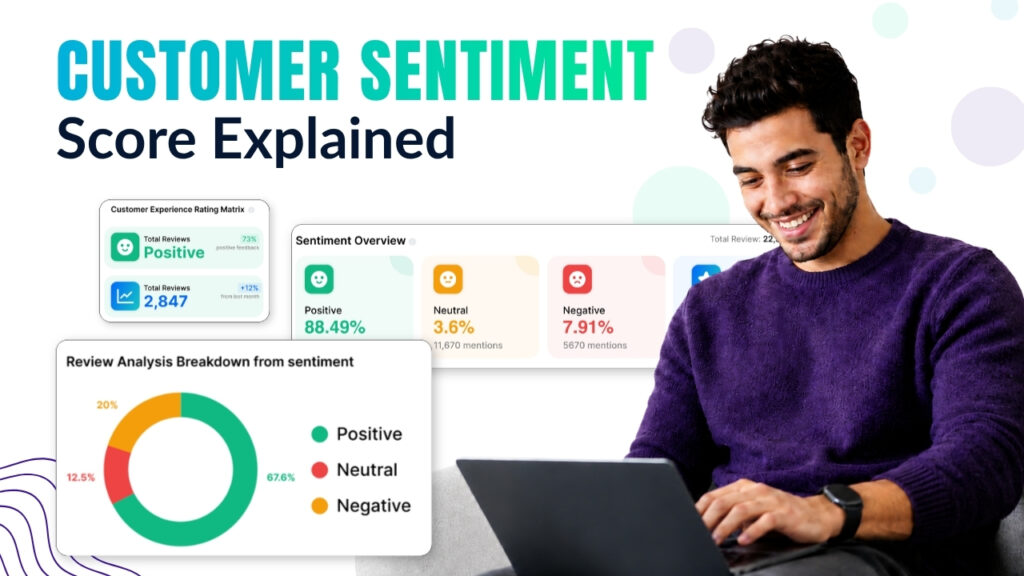
A Customer Sentiment Score offers a clear metric for evaluating whether customer feedback is positive, neutral, or negative.
Analyzing reviews, survey responses, social media feedback, and customer support conversations helps businesses to identify common trends and gain a better understanding of customer sentiment.
Customer Sentiment Analysis uses artificial intelligence and natural language processing to evaluate customer opinions, emotions, and recurring themes.
Unlike traditional ratings, Sentiment Analysis can show why customers feel satisfied or dissatisfied with products or services of a business. Businesses can identify specific problems related to product quality, pricing, service, delivery, waiting times, and overall customer experiences.
For restaurants, Customer Feedback is generated across multiple channels, which makes centralized analysis valuable. Platforms like Clariv can help businesses to track Customer Experience, identify Sentiment Trends, detect recurring complaints, and compare customer feedback across locations.
This information can support Reputation Management and help restaurant teams respond to emerging issues.
A reliable Sentiment Score can work along with other metrics like CSAT, NPS, Customer Retention metrics to offer a wider understanding of customer satisfaction, loyalty, and overall customer experience.
Businesses can also use Natural Language Processing(NLP) and Artificial Intelligence(AI) to process large volumes of customer feedback efficiently.
By combining these Customer Experience Metrics with operational data, organizations can generate Actionable Insights, prioritize improvements, strengthen customer relationships, and make more informed decisions.
Also Read: What is Customer Sentiment Analysis
What Is a Customer Sentiment Score?
A Customer Sentiment score is a score that measures the customer emotions and customer opinions which they have expressed through their feedback.
It helps businesses to understand whether customers feel positive, neutral, or negative about customer experiences with products or services.
Customer sentiment analysis involves processing large volumes of reviews, surveys, social media comments, chats, and customer support interactions to identify overall customer perceptions.
Key Sentiment Categories
- Positive sentiment: It indicates customers are satisfied, appreciate, enthusiastic, or approve about product or services.
- Neutral sentiment: It indicates that customers neither have a clear positive or negative opinion about products or services.
- Negative sentiment: It indicates that customers are dissatisfied, frustrated, disappointed, or have complaints about products or services.
A customer sentiment score transforms large volumes of customer feedback into a quantifiable measure that businesses can track and analyze over time.
However, customer sentiment is different from star ratings. A customer might give four stars while still complaining about slow service.
Customer sentiment analysis involves analyzing the language behind customer feedback to identify these details. Through Natural Language Processing tools businesses can interpret customer interactions and find meaningful insights from their customer feedback.
Also Read: Customer Satisfaction Metrics
Why Does Customer Sentiment Matter?
Traditional business metrics can show what happened in the business, but they may not explain why it happened. A restaurant might witness its average rating reduce from 4.5 to 4.2 that shows a change in customer opinions about your products or services without knowing the actual cause.
Customer sentiment analysis gives more deeper insights by analyzing the customer emotions, opinions, and recurring problems in customer feedback.
For example, analyzing 1,000 monthly reviews could reveal:
- Food quality: Strongly positive sentiment
- Staff service: Mostly positive sentiment
- Pricing: Mixed customer opinions
- Delivery time: Increasingly negative sentiment
- Order accuracy: Negative complaints have increased
These insights help managers to understand the underlying issues and identify the most effective areas for improvement.
Customer sentiment analysis goes beyond basic measurement by helping businesses to identify customer problems. It improves quantitative customer experience metrics by revealing important concerns, tracking emerging patterns, and delivering useful insights that support smarter and more effective business decisions.
Also Read: How Business Can Improve Customer Satisfaction
How Does Sentiment Analysis Work?
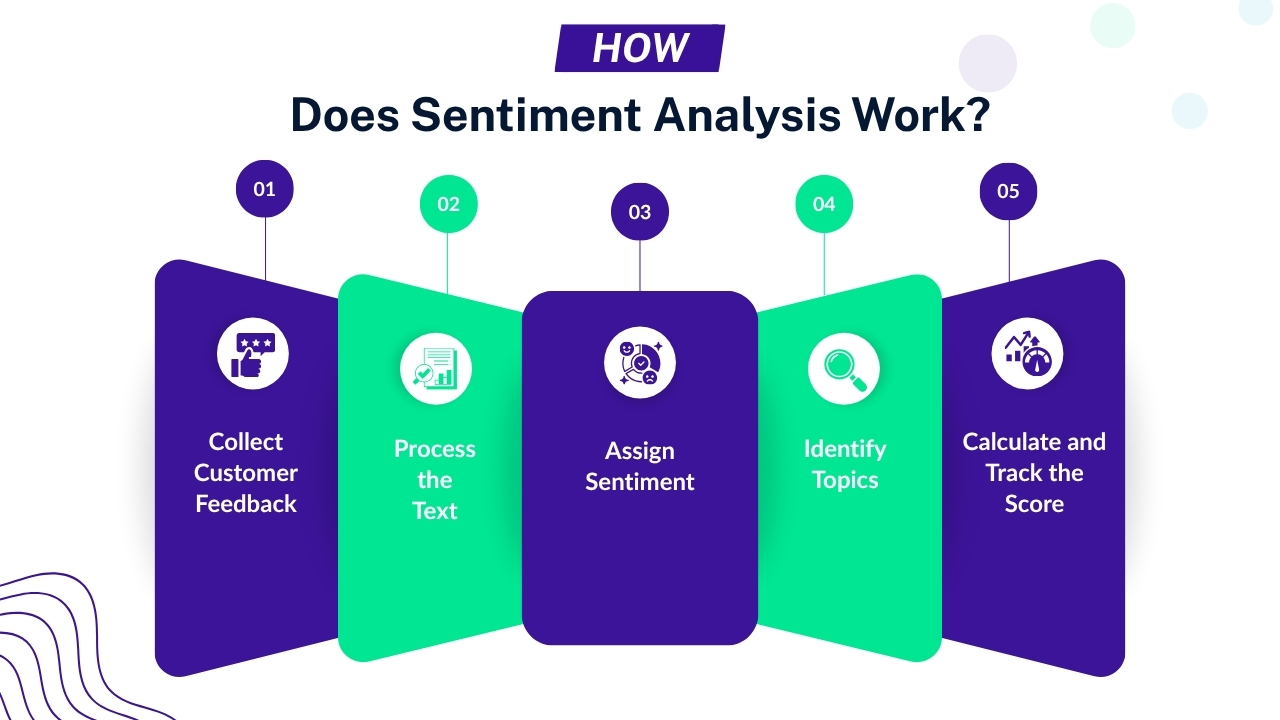
Modern sentiment analysis generally uses artificial intelligence, machine learning, and natural language processing to analyze written or spoken customer feedback.
A typical process looks like this:
1. Collect Customer Feedback
The initial step in Sentiment analysis is to gather customer feedback from relevant sources.
Based on the business, this could include:
- Online reviews
- Customer surveys
- Social media comments
- Customer support conversations
- Emails
- Chat transcripts
- Delivery feedback
- Website feedback
- Mobile app reviews
- In-store feedback
Gathering customers from several sources provides a more detailed view of overall customer sentiment. Businesses can combine data from customer reviews, surveys, social media, support interactions to identify regular customer patterns, reveal emerging problems, and better understand customer experiences rather than relying on data from a single channel.
Also Read: How to Use Customer Feedback to Grow Your Business
2. Process the Text
The system processes the language used by customers. Natural language processing tools help businesses to identify crucial words, phrases, context, and patterns.
Advanced sentiment analysis tools can identify certain topics, customer emotional patterns, and contextual indications within customer feedback.
For instance:
“The burger tasted great, but the delivery took 70 minutes.”
A basic customer sentiment system may classify customer feedback as mixed sentiment when a customer expresses both positive and negative opinions.
Food quality: Positive – The customer enjoyed the taste and quality.
Delivery speed: Negative – The customer experienced an extended delivery time.
Overall sentiment: Mixed – This feedback contains both positive and negative experiences. Such a detailed approach helps businesses to understand the aspects of the customer experience that are performing well and which areas require improvement.
Also Read: How to Respond to Negative Customer Reviews
3. Assign Sentiment
Once customer feedback has been processed, the system assigns a sentiment category or numerical score based on the emotional tone of the comment.
A basic model can use three categories while more advanced systems can measure sentiment intensity. This makes customer opinions easier to quantify and track.
Common sentiment levels include:
- Very positive: +2
- Positive: +1
- Neutral: 0
- Negative: -1
- Very negative: -2
With these scores businesses can measure changes in customer sentiment and identify areas that require customer attention or improvement.
Also Read: How AI Sentiment Analysis Software Turns Customer Feedback into Growth Opportunities
4. Identify Topics
Sentiment analysis becomes more effective when customer emotions are connected to specific topics. This helps restaurants to understand whether customers like or dislike products or services instead of viewing customer sentiment as a single overall score.
Common restaurant topics include:
- Food: Quality, taste, and portion size
- Service: Staff behavior and waiting time
- Pricing: Value and affordability
- Operations: Cleanliness, ambiance, and menu availability
- Delivery: Delivery speed and order accuracy
For instance, rather than simply reporting a negative system, the system can reveal that most negative customer feedback is for long delivery times or slow service, which helps managers to focus on their improvement efforts.
Also Read: Social Media Management Tips for Small Businesses
5. Calculate and Track the Score
Once sentiment has been analyzed and categorized, businesses can combine the results into a score, percentage, index, or trend.
Over time tracking these measures helps restaurant managers to understand whether customer sentiment towards your products or services is improving, declining, or remaining stable. Consistently measuring customer sentiment score makes comparisons more impactful.
Businesses can compare:
- Time periods: This month versus last month
- Locations: One restaurant versus another
- Days: Weekdays versus weekends
- Changes: Before and after menu updates
- Campaigns: Before and after promotions
- Products: One menu item versus another
- Segments: Different customer groups
Sentiment scoring methods can differ across platforms, so businesses should use a consistent internal methodology to ensure reliable tracking and impactful comparisons over time.
Also Read: Why Customer Reviews are Important for Business Growth
How to Calculate a Customer Sentiment Score
There is no specific single formula for calculating a Customer Sentiment Score because businesses can use different scoring methods based on business objectives.
The most important consideration is to select a clear method and apply it consistently while measuring customer feedback over time.
1. Calculate Net Sentiment
A simple formula is:
Net Sentiment = (Positive Feedback − Negative Feedback) ÷ Total Feedback × 100
For instance, if a restaurant analyzes 1,000 reviews:
- 650: Positive
- 200: Neutral
- 150: Negative
The calculation is:
(650 − 150) ÷ 1,000 × 100 = +50
Therefore, the restaurant’s Net Sentiment Score is +50. This score does not indicate 50% of customers were positive, rather it represents that customers feedback is both negative and positive.
Also Read: Restaurant Review Sentiment Analysis
2. Calculate Positive Sentiment Rate
The Positive Sentiment Rate shows the percentage of customer feedback classified as positive. This metric helps businesses to understand the proportion of favorable customer opinions within the total feedback analyzed. It can be tracked over time to identify improvements or declines in customer perception.
Formula:
Positive Sentiment Rate = Positive Feedback ÷ Total Feedback × 100
For instance:
- Positive feedback: 650
- Total feedback: 1,000
- Calculation: 650 ÷ 1,000 × 100
- Positive Sentiment Rate: 65%
It means that 65% of the analyzed customer feedback was classified as positive. Businesses can compare this percentage across periods, locations, products, or customer segments to identify meaningful changes.
Also Read: Brand Reputation Management Software
3. Use Weighted Sentiment Scores
Weighted sentiment scoring gives numerical values based on the customer’s emotions. This approach provides details instead of simply classifying customer feedback as positive, neutral, or negative.
Common values include:
- Very positive: +2
- Positive: +1
- Neutral: 0
- Negative: -1
- Very negative: -2
Businesses can calculate an average score across all customer feedback to track customer sentiment trends. When businesses apply the same scoring method over time, it helps businesses to track seasonal trends accurately and compare results across locations, periods, products, and customer segments.
Also Read: Customer Sentiment Analysis Vs Customer Feedback Analysis
What Is a Good Customer Sentiment Score?
A good Customer Sentiment Score is based on industry standards, customer expectations, feedback channels, and the specific characteristics of each business.
Businesses can use their historical sentiment data as a baseline to measure trends and identify significant changes over time instead of relying on comparisons with competitors.
For instance, if a restaurant group consistently records a net sentiment score between +40 and +55, a sudden decline to +20 indicates instant evaluation.
A useful sentiment monitoring approach should identify:
- Direction: Is sentiment improving or declining?
- Drivers: Which topics are influencing the change?
- Locations: Which branches are affected?
- Timing: When did the change begin?
- Duration: Is the change temporary or persistent?
- Cause: Did an operational change contribute to the shift?
Comparing present sentiment with past results allows businesses to identify meaningful changes and establish realistic benchmarks based on their own customer feedback patterns.
Why Topic-Level Sentiment Is More Valuable
An overall Customer Sentiment Score provides a quick overview of customer perception but it does not always explain the reason behind that result.
A restaurant with a score of +45 may seem to perform well, but managers still need to identify certain strengths and weaknesses.
Topic-level sentiment analysis connects customer emotions to specific aspects of their experience, that helps businesses to identify crucial strengths, reveal problems, focus on improvements, and make more informed operational decisions.
For example:
- Food quality: +75 — Strong positive feedback
- Staff: +68 — Favorable service experiences
- Ambiance: +55 — Generally positive
- Pricing: +10 — Mixed opinions
- Wait time: -30 — Customer concern
- Delivery: -42 — Major improvement area
These insights help managers to prioritize resources on delivery and waiting times while maintaining strengths in food quality and staff service.
Also Read: Customer Sentiment Platform Vs Traditional Surveys
How Restaurants Can Use Customer Sentiment Scores
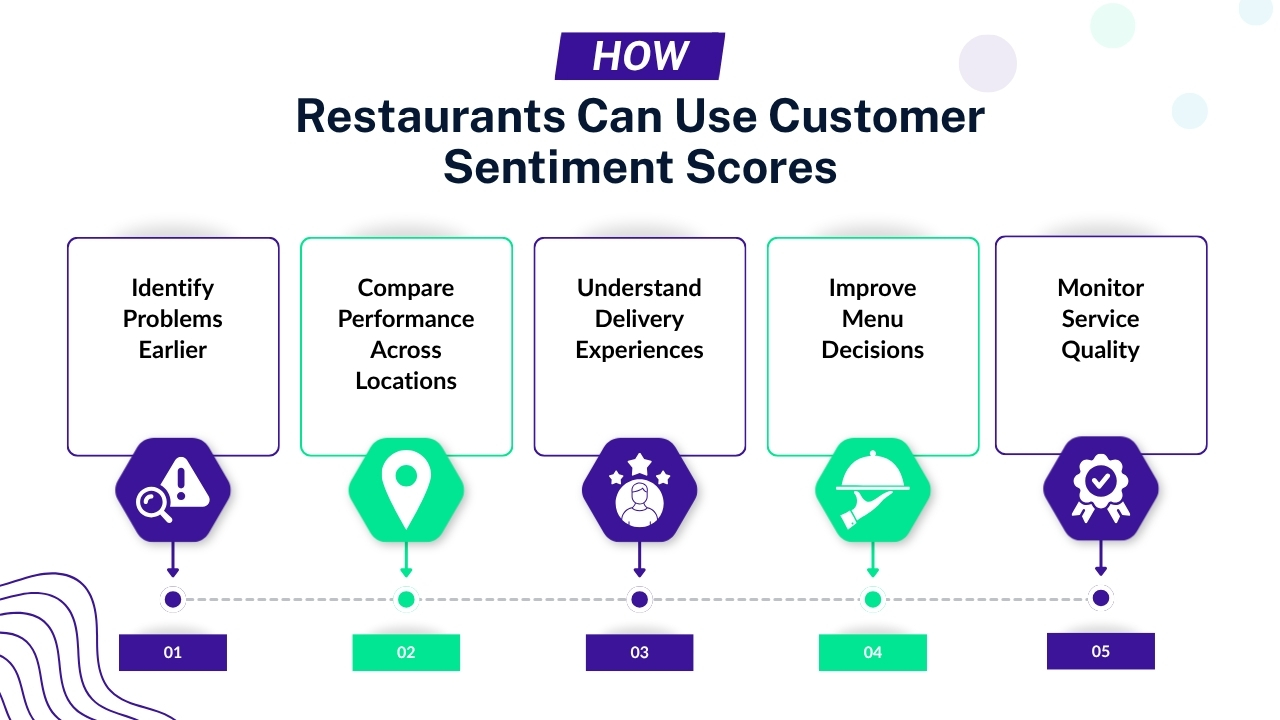
Restaurants generate customer feedback across many channels. Guests may leave reviews on Google, respond to surveys, rate delivery orders, comment on social media, or contact customer support. It creates a large amount of unstructured data.
For restaurant groups, analyzing thousands of reviews or feedback manually becomes difficult as the number of locations increases.
1. Identify Problems Earlier
Restaurants receive customer feedback through reviews, surveys, delivery platforms, social media, and support interactions. Analyzing this information manually can become difficult especially for restaurant groups with multiple locations.
Customer Sentiment Analysis can help businesses to identify sudden increases in negative feedback and recurring complaints. Common problems faced by customers include cold food, long wait times, missing items, incorrect orders, poor service, and delivery delays.
By detecting these patterns early, managers can analyze problems before they significantly affect ratings, customer retention, or revenue. Platforms like Clariv can help restaurant teams to track sentiment trends and identify recurring customer problems.
Also Read: How to Respond to Negative Customer Reviews
2. Compare Performance Across Locations
Restaurant groups can use sentiment data to compare customer experiences across different locations. For instance, if a franchise operates 50 restaurants and five locations show significantly more negative sentiment, managers can investigate those branches individually.
They may find longer wait times, delivery complaints, order inaccuracies, staffing challenges, or recurring food-quality problems.
Location-level sentiment analysis helps corporations to identify underperforming locations and focus operational improvements rather than treating every restaurant the same.
Also Read: Customer Satisfaction Metrics
3. Understand Delivery Experiences
Delivery feedback can show problems that may not appear in dine-in reviews. Customers may complain about cold food, missing items, incorrect orders, excessive delivery times, poor packaging, or preparation delays.
Through sentiment analysis businesses can categorize these customer complaints and identify the main causes of customer dissatisfaction.
Platforms like Clariv can help restaurants to bring feedback from delivery experiences together with reviews and social interactions, providing managers a broader view of customer perceptions across different channels.
Also Read: AI Tools to Analyze Customer Reviews
4. Improve Menu Decisions
Customer sentiment can offer valuable information for menu optimization. For instance, customers may describe a new dish as “too salty”, “overpriced”, “delicious”, or “worth ordering again.”
Restaurants can combine all these insights with sales data to find whether a menu item should be modified, repriced, or removed.
Sales data shows the products that customers purchase, while sentiment analysis can provide additional context about the reason behind customers liking or dislike particular items.
Also Read: Best Social Media Management Tools for Business
5. Monitor Service Quality
Sentiment analysis helps restaurants to identify recurring complaints related to customer service. Negative comments regarding slow service, long queues, unfriendly employees, poor communication, or inattentive staff can indicate operational weaknesses.
Using these insights restaurant managers can review staffing levels, employee training, shift schedules, and service processes.
After implementing changes, restaurants can continue tracking sentiment to find whether customer perceptions improve. This creates a continuous feedback cycle that supports better service quality and customer experience.
Also Read: AI Tools to Analyze Customer Reviews
From Sentiment Score to Sentiment Drivers
A Customer Sentiment Score should be viewed as a beginning rather than the final answer. A single number can indicate that customer perception has changed, but it does not necessarily explain what caused the change.
For instance, if a restaurant’s sentiment score falls from +55 to +35, managers should investigate the underlying factors before deciding what action to take.
Management can examine several areas:
- Customer groups: Which customers are expressing more negative opinions?
- Locations: Which branches are experiencing the decline?
- Topics: Are complaints related to food, service, pricing, or delivery?
- Timing: When did the negative trend begin?
- Channels: Are reviews, social media, surveys, or delivery feedback driving the change?
- Operations: Did staffing, menu, pricing, or service processes change?
- Recovery: Is sentiment improving, remaining stable, or continuing to decline?
It creates a continuous improvement cycle: Collect -> Analyze -> Identify -> Act -> Measure -> Improve, which helps businesses to turn customer feedback into practical decisions and measurable improvements.
Also Read: Sentiment Analysis Demo
How to Build a Customer Sentiment Monitoring Strategy
A successful Customer Sentiment Monitoring Strategy should focus on more than calculating a single score. Businesses need to define clear objectives, collect customer feedback from relevant channels, analyze specific topics, and connect customer sentiment with operational performance.
1. Define the Objective
Before choosing a scoring method, determine what the business wants to understand. A clear objective ensures that sentiment analysis supports specific business goals.
For example, businesses may monitor:
- Overall brand perception
- Product satisfaction
- Restaurant guest experience
- Delivery performance
- Customer support quality
- Location performance
- Response to a new product or service
Also Read: How to Track Customer Feedback in Real-Time
2. Choose Relevant Feedback Sources
Customer opinions are shared across multiple channels. Restaurants should identify the sources that are most relevant to their customers and combine them whenever possible.
Common sources include:
- Google and Yelp reviews
- Delivery platforms
- Social media
- Customer surveys
- Loyalty program feedback
- Website forms
- Customer support messages
Using multiple feedback sources can provide a wider understanding of customer sentiment.
Also Read: Social Media tools for Non-Profits
3. Establish a Consistent Scoring Method
Choose a scoring methodology and clearly document the way it works. Whether a business uses a 0-100 index, positive sentiment percentage, or net sentiment, the same approach should be applied consistently.
Consistency makes it easier to identify meaningful changes and compare results across different periods, locations, and customer groups.
4. Add Topic Analysis
Overall customer sentiment does not always explain why customers feel positively or negatively. Topic analysis provides useful detail by connecting sentiment with specific areas of the customer experience.
Restaurant topics may include:
- Food quality
- Service
- Pricing
- Delivery
- Cleanliness
- Staff behavior
- Waiting time
- Ambiance
- Menu availability
5. Establish Baselines
Businesses should track sentiment over time before setting targets. While historical data helps businesses to establish a normal sentiment range and makes unusual changes easier to identify.
For instance, a sudden decline from a usual sentiment level of restaurants may indicate an emerging operational problem.
6. Create Alerts
Not every negative comment from customers requires instant action. However, a sudden increase in negative sentiment around a specific topic may require investigation.
For instance, a 35% increase in negative delivery sentiment could prompt managers to review delivery times, order accuracy, packaging, or preparation processes.
7. Connect Sentiment With Operational Data
Sentiment becomes more valuable when it is combined with operational metrics like sales, average order value, wait time, table turnover, order accuracy, delivery time, customer retention, repeat visits, refunds, and labor levels.
Comparing these measures can help businesses to understand whether operational changes are influencing customer perceptions and identify opportunities for improvement.
How Sentiment Data Supports Customer Personalization
Customer sentiment data can help restaurants to create more relevant and timely customer engagement. Understanding customer opinions and experiences, helps businesses to customize communications while addressing specific concerns.
For instance, restaurants can:
- Follow up: It allows restaurants to reach out to customers who recently reported a negative experience and provide appropriate assistance.
- Personalize promotions: It allows restaurants to recommend related menu items to customers who frequently offer positive feedback regarding particular products.
- Improve relevance: Use sentiment insights to create communications that better match customer interests and experiences.
- Avoid over-personalization: Ensure customers do not feel that every comment is being individually monitored for marketing purposes.
The primary goal should be to improve customer experience and engagement, and not to overwhelm customers with irrelevant automated messages.
What Makes a Customer Sentiment Score Useful?
A Customer Sentiment Score becomes valuable when businesses can consistently track it, understand its drivers, and connect insights to measurable actions.
- Consistent: They must using the same scoring method with time to make reliable trends
- Actionable: It allows businesses to connect sentiment results to certain customer problems and business decisions.
- Detailed: It allows managers to analyze sentiment by topic, channel, product, and location.
- Timely: They must analyze new feedback quickly to identify emerging complaints and changing customer expectations.
- Outcome-focused: Compare sentiment trends with operational and financial metrics to measure improvements.
A sentiment score should not just appear on a dashboard. Instead the score should also determine customer problems, guide corrective actions, and measure whether those actions improve customer experiences and business performance.
Conclusion
A Customer Sentiment Score gives businesses a practical way to understand the way customers perceive their products, services, and overall customer experiences.
Unlike traditional star ratings, sentiment analysis involves analyzing customer comments to identify customer emotions, recurring topics, and specific factors affecting customer satisfaction or dissatisfaction.
Tracking customer sentiment across reviews, surveys, social media, delivery feedback, and other channels, help businesses to detect emerging customer issues and recognize strong areas of the business.
For restaurants, these insights can support better decisions around food quality, service, pricing, delivery, menu performance, and location-level operations.
Platforms like Clariv can help businesses to consolidate customer feedback, identify sentiment trends, and highlight recurring complaints across multiple channels.
However, a sentiment score should not be considered final because its greatest value comes from identifying the reasons behind changing customer perceptions and connecting those insights with operational data.
When businesses consistently collect, analyze, act on, and measure customer feedback, sentiment analysis can become a powerful tool for improving customer experience, loyalty, and long-term business performance.
If you still have any query about Customer Sentiment Score then you may write to us at Clariv and we are more than happy to assist you.