You’re scrolling through your business’s online reviews during your morning coffee, and there it is, a scathing one-star review claiming your customer service is “the worst they’ve ever experienced.” Your stomach drops. You want to fire back a defensive response, or worse, ignore it entirely and hope it gets buried under positive feedback.
But, believe us when we say this: a negative review isn’t your problem. How you respond to it is where your reputation is actually built or destroyed.
As per Bright Local, 89% of consumers read businesses’ responses to reviews, and 45% say they’re more likely to visit a business that responds to negative reviews than one that doesn’t respond at all.
Your competitors are treating review responses as damage control. That’s their mistake and your opportunity.
The businesses that thrive in today’s review-driven economy aren’t the ones without negative feedback; they’re the ones who’ve mastered the art and science of responding to it strategically. This isn’t about appeasing one unhappy customer. It’s about leveraging every piece of criticism as proof of your commitment to continuous improvement and customer satisfaction.
Let’s break down exactly how to turn your worst reviews into your most powerful marketing assets.
Also Read: Why Customer Reviews Are Important for Business Growth
Why Responding to Negative Reviews is Important?
Negative reviews don’t kill businesses; silence does. When a prospect sees a one-star review with no response, they don’t think it’s one bad experience. They think “this company doesn’t fix problems. That perception gap is where revenue walks out the door. Your response isn’t damage control; it’s a conversion tool.
Every answer you write demonstrates your problem-solving process to hundreds of silent shoppers in their research phase.
The business case is measurable:
- Week-old complaints become deal-breakers – 53% of customers expect responses within seven days. Miss that window, and you’ve told prospects you’re slow to act on problems, before they even become customers.
- Response gaps show up in revenue reports – ReviewTrackers’ analysis of 64,000 businesses found that companies responding to at least 25% of reviews captured 30-50% more revenue growth than silent competitors. And that margin is significant.
- Engagement reshapes perception without changing facts – Harvard Business School quantified this: when you respond to reviews, prospects rate you 0.12 stars higher than identical businesses that stay quiet. Same product, better perceived quality, just from showing up where it matters.
- Local search rankings favor the responsive – Google’s local algorithm weighs review engagement as a trust signal. Businesses that consistently respond outrank silent competitors with similar ratings. SEO isn’t just keywords anymore.
- Public responses have private audiences – That single reply? It’s working overtime. Between 10 and 50 potential customers will read each response during their buying journey. You’re not talking to one angry customer; you’re presenting to a boardroom of prospects.
- Service recovery beats flawless execution – The data backs up what retention teams know: customers whose complaints you resolve well show higher lifetime value and referral rates than customers who never had issues. A great recovery builds deeper trust than perfection ever could.
Also Read: How to Manage Online Review for Your Business
10 Ways on How to Respond to Negative Customer Reviews (Explained with Examples)
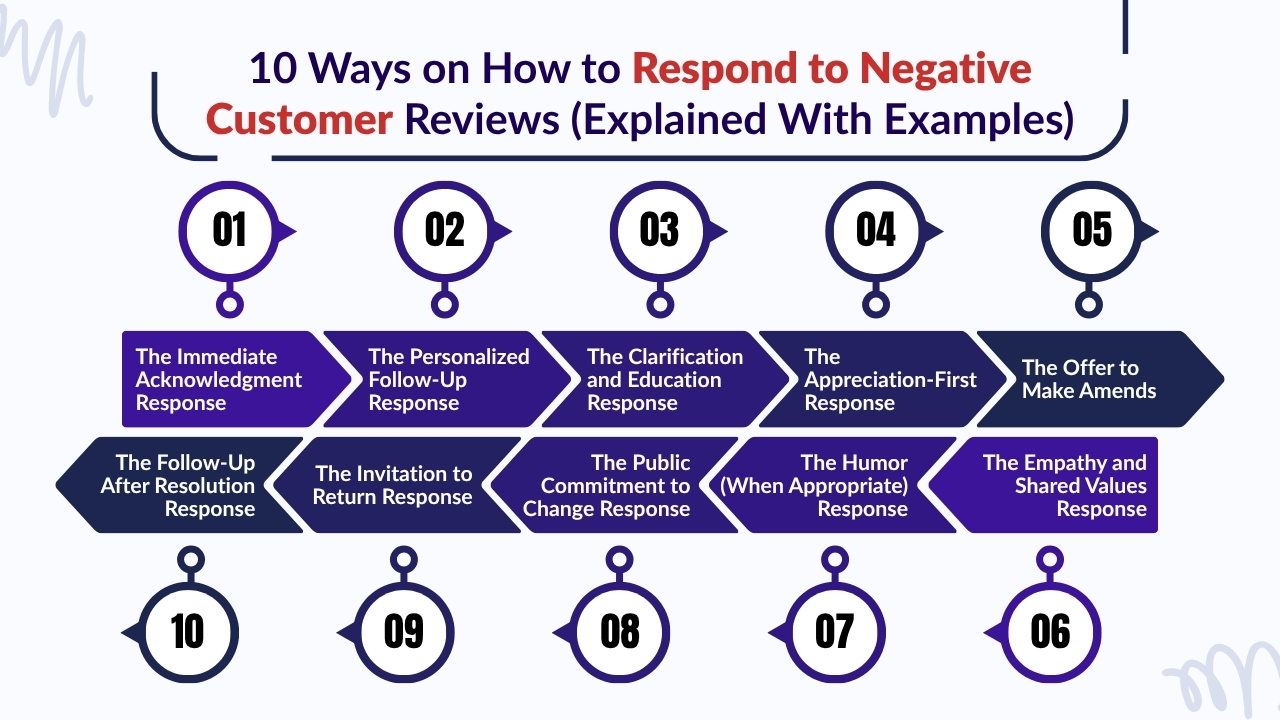
1. The Immediate Acknowledgment Response
- When to use it: The complaint is valid, and your business is clearly at fault.
- Why it works: A fast, honest response shows you’re paying attention, value feedback, and are committed to making things right. It quickly calms frustration by owning the mistake.
- How to execute it: Name the exact problem, take full responsibility, and skip the excuses. Let the customer know what you’re doing to fix the issue.
Example:
- Review: “Waited 45 minutes for our appetizers. The server never checked on us. Ruined our anniversary dinner. Will never return.”
- Your Response: “You’re right, waiting that long for appetizers is unacceptable, and we let you down on a special night. I’ve spoken with our team, and we’re putting new steps in place to ensure this doesn’t happen again. I’d like the chance to make this right for you. Please email me at [manager email], and on your next visit, your appetizers are on us + 20% apology discount on your total bill. Looking forward to seeing you again.Michael Torres, General Manager”
Also Read: How AI Analyze Customer Feedback
2. The Personalized Follow-Up Response
- When to use it: The review describes a complex or sensitive issue that needs more than a public reply.
- Why it works: Moving the conversation offline shows you care about resolving the issue, not just performing damage control for others to see. It protects privacy and signals genuine concern.
- How to execute it: Acknowledge the feedback publicly, invite the customer to connect directly, and provide a specific contact method.Example:
- Review: “The product arrived damaged, and customer service didn’t help when I called.”
- Your Response: “I’m sorry to hear about both the damaged item and the trouble reaching support. That’s not the experience we want for our customers. Please email me at [support email] with your order number. I’ll personally make sure this gets to the right member and will be resolved right away.Sarah Lee, Customer Care Manager”
Also Read: Google Review Management Software
3.The Clarification and Education Response
- When to use it: The review is based on a misunderstanding, misinformation, or incorrect expectations.
- Why it works: Respectfully correcting the facts demonstrates transparency and helps educate both the reviewer and anyone else reading the review.
- How to execute it: Thank the reviewer for their input, clarify the misunderstanding with facts, and invite further questions.Example:
- Review: “The warranty only lasts three months, which is way too short.”
- Your Response: “Thank you for your feedback. Just to clarify, our standard product warranty is actually 12 months, and you’re covered for any manufacturer defects during that time. If you’d like more details or need help with a warranty claim, reach out to us at [support email]. We’re here to help!
Alex Kim, Customer Relations”
Also Read: Restaurant Review Sentiment Analysis
4. The Appreciation-First Response
- When to use it: The customer offers constructive criticism, and you want to show you value their honesty.
- Why it works: Appreciating honest feedback builds trust and encourages more customers to share helpful suggestions, not just praise.
- How to execute it: Begin with gratitude, acknowledge the specific insight, and share how you’ll use it to improve.Example:
- Review: “Loved the food, but the music was so loud we couldn’t talk.”
- Your Response: “Thank you for your honest feedback about the music volume during your visit. We want our guests to enjoy not just great food, but also great conversation. I’ve already spoken with our staff about monitoring music levels, especially during peak hours, and we’re adjusting our sound system settings this week.
This is exactly the kind of insight that helps us deliver a better experience for everyone. I hope you’ll give us another try, and we’ll be sure to deliver an incredible experience this time.
– Jamie Patel, Restaurant Manager”
Also Read: How to Measure Customer Sentiment
5. The Offer to Make Amends
- When to use it: The customer experienced a service or product failure, and you want to show you’re willing to make things right.
- Why it works: Offering a specific remedy (refund, replacement, discount, etc.) demonstrates accountability and a sincere desire to make things right.
- How to execute it: Acknowledge the specific failure, apologize sincerely, outline how you’ll fix the situation, and give the customer a direct path to resolution.Example:
- Review: “My order was incorrect, and I couldn’t get anyone on the phone to fix it.”
- Your Response: I’m very sorry for the mistake with your order and for the frustration you experienced trying to reach us. That’s not what we want for our customers, and we need to do better. I’ve spoken with our fulfillment and support teams to ensure orders are double-checked before they go out, and we’re reviewing our customer service phone system to prevent missed calls in the future.
To make up for the inconvenience, we’d like to send you the correct order at no additional charge, along with a gift card for your trouble. Please email me directly at [support email] with your order details, and I’ll personally oversee the resolution.
—Linda Nguyen, Operations Lead”
6. The Empathy and Shared Values Response
- When to use it: The customer’s review reveals a deeper disappointment or frustration tied to your brand’s values or promises (e.g., “I expected better from you”).
- Why it works: Expressing empathy and aligning with the customer’s expectations can rebuild trust and demonstrate authentic brand integrity.
- How to execute it: Acknowledge the gap between your values and the customer’s experience, express genuine empathy, and share what you’re doing to align your actions with your brand standards.Example:
- Review: “I chose your company because you promise fast, reliable service. My package arrived five days late, and no one kept me updated. Very disappointed.”
- Your Response: “We completely understand your frustration and agree that we didn’t live up to the promise of fast, reliable service that you and we expect from our brand. Not keeping you informed was a failure on our part, and I apologize for the stress this caused. I assure you that I’ll look into this problem, solve it, and we’ll deliver the experience that our customers deserve going forward. Share your order details with us via email, and we’ll provide 10% discount coupon on your next order to make up for our mistake.
—Jordan Miller, Customer Experience Lead”
Also Read: Brand Reputation Management Software
7. The Humor (When Appropriate) Response
- When to use it: The complaint is light-hearted or minor, and your brand’s personality allows for a bit of humor. But never use it with serious or sensitive complaints.
- Why it works: A little humor (when appropriate) can diffuse minor frustrations and show your brand’s human side, making the response memorable and relatable.
- How to execute it: Lightly acknowledge the issue, add a touch of humor, and assure the customer you’re taking their feedback seriously.Example:
- Review: “Coffee tasted like rocket fuel. My heart is still racing!”
- Your Response: “Sounds like our barista accidentally set the coffee to ‘launch mode’, not exactly what we were going for! Thank you for letting us know. Next time, your cup’s on us, and we promise it’ll be energized, not orbital.
— Sam Brooks, Café Manager”
8. The Public Commitment to Change Response
- When to use it: Multiple reviews mention the same recurring issue, indicating a systemic problem.
- Why it works: Making a public commitment to change signals you’re listening to your customers and willing to improve.
- How to execute it: Acknowledge the pattern, openly commit to a specific improvement or policy change, and invite continued feedback.
Example: - Review: “Bathrooms are always messy during busy hours. This isn’t the first time I’ve mentioned it.”
- Your Response: “Thank you for bringing this to our attention again. It’s clear we need to step up our game, especially during peak times. Starting next week, we’re increasing our cleaning staff and adding bathroom checks every hour. Your feedback is helping us raise our standards, and we want you to notice the difference. Please let us know if there’s ever an issue again.
—Rebecca Tran, Store Manager”
9. The Invitation to Return Response
- When to use it: You’ve addressed the issue, and you want to rebuild the relationship by encouraging the customer to give your business another try.
- Why it works: A sincere invitation to return shows you’re committed to earning back the customer’s trust and business. It transforms a negative experience into an opportunity for loyalty.
- How to execute it: Acknowledge the past problem, explain what’s changed, and offer a personal invitation or incentive for the customer’s next visit.Example:
- Review: “My last visit was disappointing; the staff seemed distracted, and my order was wrong.”
- Your Response:“I’m sorry your last visit missed the mark. Since then, we’ve brought on new team members and provided extra training to improve service accuracy and focus. I’d love the chance to welcome you back for the experience you should have had. Please mention this review when you return, or contact me directly at [manager email] for a complimentary dessert.
—Chris Evans, Restaurant Owner”
Also Read: Why Customer Reviews are Important for Business Growth
10. The Follow-Up After Resolution Response
- When to use it: You’ve resolved a customer’s issue offline and want to publicly show your commitment to follow-through.
- Why it works: Publicly confirming the resolution demonstrates reliability and accountability, reassuring potential customers reading the review thread.
- How to execute it: Briefly thank the customer for allowing you to resolve things and invite further feedback.
- Example: Review (original): “My order was missing items, and I couldn’t reach anyone for help.”
- Follow-up (after resolving offline): “Thank you, [Customer Name], for giving us the chance to make things right. I’m glad we were able to replace your missing items and hope you’re satisfied with the outcome.
—Taylor Morgan, Customer Service Supervisor”
Also Read: Sentiment Analysis Demo
Common Mistakes to Avoid While Responding to Negative Customer Reviews
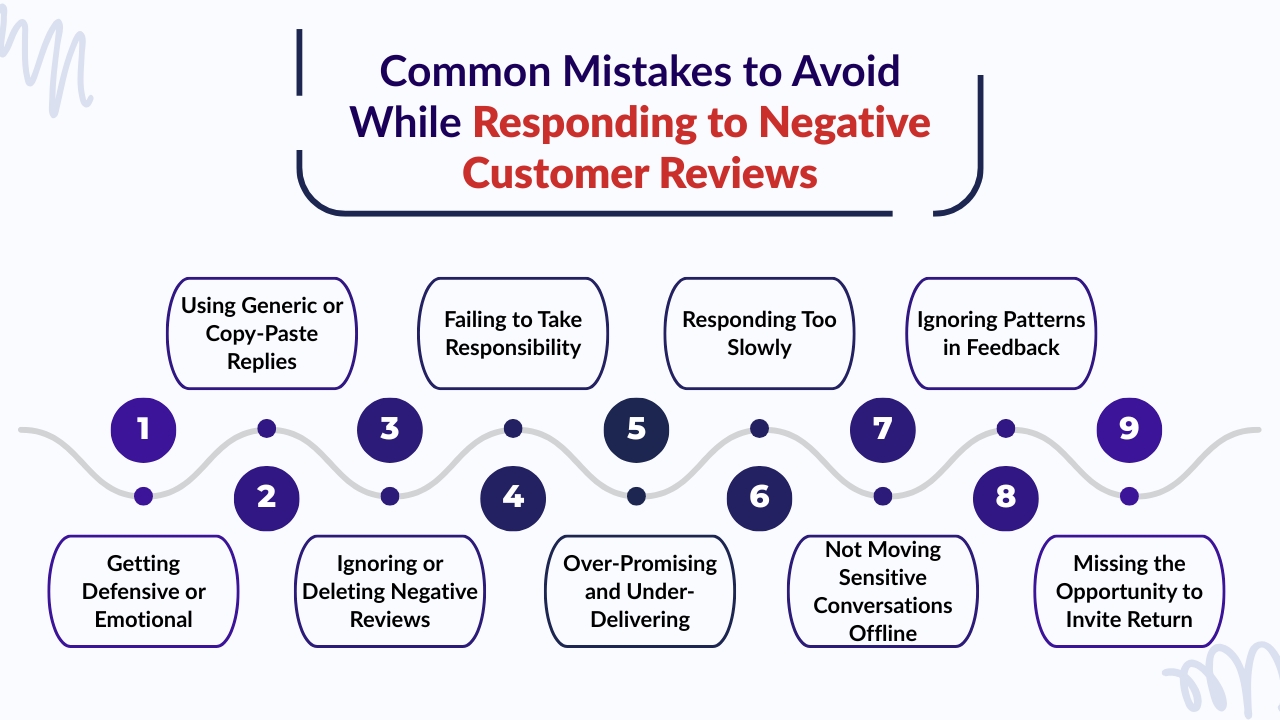
1. Getting Defensive or Emotional
It’s natural to feel protective of your business, but letting emotion guide your response often escalates the situation. Defensive replies can come across as argumentative or dismissive, making the customer feel unheard and discouraging others from reaching out.
2. Using Generic or Copy-Paste Replies
Customers quickly spot template or “canned” responses. These replies signal that you’re not truly listening and can make reviewers (and future readers) feel like their concerns are unimportant.
3. Ignoring or Deleting Negative Reviews
Hiding or ignoring criticism can erode trust. Most savvy consumers know that no business is perfect. When critical feedback disappears, it raises suspicions about transparency and willingness to improve.
4. Failing to Take Responsibility
Blaming the customer, your staff, or external circumstances without accepting any responsibility undermines your credibility. Owning the issue, even if it’s uncomfortable, demonstrates maturity and builds respect.
5. Over-Promising and Under-Delivering
Offering grand solutions or compensation in your response and then failing to follow through can be more damaging than the original complaint. Always ensure you can deliver on what you publicly promise.
6. Responding Too Slowly
Waiting days to address a negative review suggests that customer feedback software for small businesses isn’t a priority. A delayed response can frustrate the reviewer further and signal to others that their concerns might also go unaddressed.
7. Not Moving Sensitive Conversations Offline
Some issues require privacy or a more detailed discussion. Failing to offer a direct email or phone contact can prolong public disputes and make resolution harder to achieve.
8. Ignoring Patterns in Feedback
If multiple reviews mention the same problem and your responses are one-off apologies, it shows you’re not addressing root causes. Acknowledge trends and share what you’re doing to make systemic improvements.
9. Missing the Opportunity to Invite Return
If you resolve the issue but don’t invite the customer back to try your business again, you’re missing a chance to convert a critic into a loyal supporter.
Make Things Easier with Clariv, an AI-Powered Automated Tool to Manage Your Brand Reputation!
Clariv is an AI-Powered review management and customer sentiment analysis software that helps businesses track all the reviews and communication happening around your brand, and helps you manage it with ease.
Our one-of-a-kind tool leverages advanced AI, ML, and NLP to streamline review management, respond to customer feedback at scale, and provide a unified, real-time view of your brand’s online presence.
1. Automated Review Monitoring
- Tracks reviews and feedback across 80+ platforms (Google, Yelp, Facebook, TripAdvisor, and more) in real time.
- Instantly notifies your team of new or urgent reviews so nothing slips through the cracks.
2. AI-Powered Sentiment Analysis
- Accurately detects positive, neutral, or negative sentiment in every review and comment.
- Goes beyond star ratings to interpret customer emotions, happy, frustrated, concerned, or excited, so you understand the real story behind the feedback.
Also Read: Customer Sentiment Platform Vs Traditional Surveys
3. Automated Response Suggestions
- Generates tailored response templates for negative, neutral, or positive reviews, saving your team time while maintaining a human touch.
- Customizes replies based on review content, customer history, and your brand’s voice.
4. Negative Review Management
- Flags negative reviews for immediate attention and recommends priority actions.
- Helps resolve issues faster with suggested follow-up steps, escalation paths, and tracking of resolution status.
5. Pattern and Trend Detection
- Spot recurring issues (e.g., “slow service during lunch hours” or “product defects”) by analyzing thousands of reviews at scale.
- Provides actionable reports so you can address root causes and improve customer experience company-wide.
6. Unified Social Media Scheduling and Management
- Lets you create, schedule, and publish content across 15+ social platforms from a single, intuitive dashboard.
- Automates content planning with smart calendars and collaborative workflows for your team.
7. Auto-Tagging and Categorization
- Automatically sorts reviews and comments by topic—service, pricing, staff, product quality, etc., and urgency.
- Ensures the right team sees the right feedback instantly.
8. Seamless Integration and Ease of Use
- Connects with your existing tools in minutes, with over 50 plug-and-play integrations.
- Designed for teams of any size, across industries, with no steep learning curve, no expert setup required.
If you’d like to explore how Clariv can simplify your reputation management, see how it works in real-time and decide if it’s the right fit, get started by booking a free demo.
Final Thoughts
Every business gets negative reviews; it’s how you respond that truly defines your brand. By approaching feedback with honesty, empathy, and a willingness to improve, you not only address individual concerns but also build lasting trust with your wider audience.
Remember, each review is an opportunity to show what your business stands for and how much you value your customers.
With a thoughtful response strategy and the support of AI tools like Clariv, you can manage feedback with confidence, learn from every customer interaction, and turn challenges into meaningful growth.
Book a free trial today to understand more about how it works and how it can help your business.