Your competitor just got a 1-star review. They ignored it.
Three months later, they lost 22% of their website traffic, their Google ranking dropped two pages, and a deal worth $80,000 fell through because the prospect Googled them before signing.
This is not a hypothetical. This is Tuesday for businesses that treat customer reviews as background noise.
Here is the uncomfortable truth most business owners will not say out loud: you are not losing customers to better products. You are losing them to better-reviewed products.
And yet, review management sits at the bottom of the priority list.
The importance of customer reviews is not a soft, feel-good marketing concept. It is measurable. It shows up in your conversion rates, your search rankings, your customer retention numbers, and ultimately, your revenue.
This blog is not about collecting five-star reviews to feel good about your brand. It is about understanding reviews as a business intelligence system, a growth lever, and a competitive weapon, and learning how to manage customer reviews in a way that actually moves the needle.
Also Read: Google Review Management Software
Why Customer Reviews Matter Today?
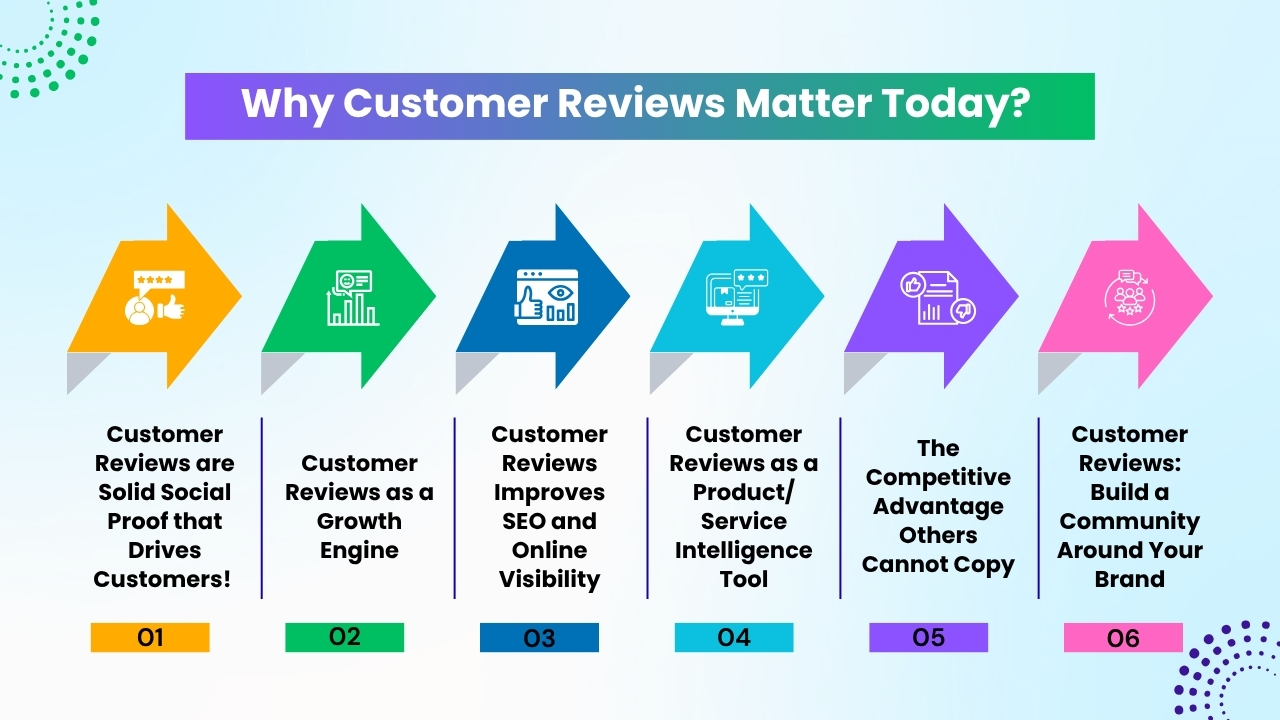
1. Customer Reviews are Solid Social Proof that Drives Customers!
People do not trust what brands say about themselves. They trust what other customers say. Reviews carry the credibility that no advertising budget can buy, because they come from someone with nothing to gain from writing them.
Advertising tells your story with your money. Reviews tell your story with someone else’s experience. That distinction is everything.
How Trust Works Differently at Each Stage
- New buyers have no history with you. Reviews become the shortcut their brain uses to trust your brand.
- Returning customers use reviews to validate that staying is still the right decision, closing the door on competitors before they even get a look in.
Both are directly influenced by how active, recent, and responsive your review profile looks today
The Real-World Reputation Impact
- A one-star rating increase = 5–9% revenue increase (Harvard Business School)
- 94% of consumers have avoided a business after reading a negative review
- Unanswered reviews compound damage silently across every touchpoint where someone looked you up and walked away
Also Read: How to Manage Online Reviews For Your Business
2. Customer Reviews as a Growth Engine
Every review your business collects is working around the clock, showing up in search results, answering buyer objections, building trust with prospects you have never spoken to, and nudging fence-sitters toward a decision. No sales call required. No follow-up email needed. Just real words from real customers doing the heavy lifting at every stage of the buyer journey, every single day.
That is what makes reviews a growth engine, not a feel-good metric.
Reviews Work Across the Entire Buyer Journey…
Reviews do not just influence the final purchase decision. They touch every stage of the funnel, and most businesses are leaving that leverage completely unmanaged.
- Awareness — Star ratings in search results stop the scroll before a prospect visits your site
- Consideration — Detailed reviews handle objections your sales team never knew existed
- Decision — A recent review from a peer in the same industry shows that it deals faster than any pitch deck
Reviews as Free, Authentic Marketing Content
Every review is zero-cost, authentic copy, generated without a brief, without a budget, and without the credibility problem that branded content carries. No copywriter can replicate the trust that comes from a real customer describing a real result in their own words.
La Colombe Cancelled Their Focus Groups Because Reviews Told Them To!
La Colombe, the Philadelphia-based artisanal coffee brand, was spending real time and real money on agency meetings and focus groups trying to understand what their customers wanted. The irony was that their customers were already telling them in reviews, in their own words, in real time, and nobody was properly listening.
When they moved to a sentiment-powered review platform, they analyzed real customer feedback across hundreds of reviews and found out that customers loved the real pumpkin flavour and lower calorie count in their seasonal cold brew.
That insight went straight into ad creative, email campaigns, and product page copy. Zero additional content spend. Measurably better performance.
Source: PowerReviews
Also Read: How AI Can Analyze Customer Feedback
3. Customer Reviews Improves SEO and Online Visibility
Reviews are ranking fuel, and most businesses are running on empty.
Do you know Google factors in review quantity, recency, and rating when determining local search placement?
A business with 300 recent, varied reviews will consistently outrank a competitor with 40 stale ones, regardless of how polished their website is or how much they are spending on paid search. For businesses competing in regional or service-based markets, this is not a marginal gain. It is the difference between being found and being invisible.
And it does not stop there.
It Provides Fresh Content That Writes Itself
Every new review adds indexed content to your digital footprint automatically, without your team writing a single word.
- Customers naturally write in the language your prospects search, service names, locations, and specific outcomes
- That organic keyword coverage compounds quietly over time and costs nothing
- No content calendar, no copywriter, no brief required
The Click-Through Rate Advantage
Star ratings appearing directly in search results increase click-through rates before a prospect even lands on your page. Your reviews are doing conversion work at the search engine level, not just on your website.
- Businesses with stronger review profiles see up to 25% higher click-through rates in local search
- Google Business Profile reviews are among the top-ranked signals in local pack placement
- Long-tail keywords in reviews drive targeted traffic that paid campaigns would cost significantly more to capture
Also Read: Google Review Management Software
4. Customer Reviews as a Product/Service Intelligence Tool
You can ignore one bad review. But the same complaint appearing across fifteen reviews over three months is a process failure your operations team needs to fix immediately. Most businesses panic when they see a negative review. The smartest ones take notes and leverage them to improve their product, service, customer experience, etc.
Review patterns are zero-cost, validated user research, delivered in real time, without a focus group, without a survey, and without the filter of internal bias.
- Customers repeatedly flagging the same feature? That is your next sprint priority
- Consistent praise for one aspect of your service? That is your retention anchor; protect it
- Recurring support complaints? That is an operational bottleneck your internal teams are too close to see
Also Read: Why Customer Reviews are Important for Business Growth
The Churn Reduction No One Talks About
Customers who see their feedback acknowledged and acted on are far less likely to leave. A thoughtful public response to a critical review, followed by a visible improvement, signals to every future reader that your business listens and adapts.
A Harvard Business Review study on TripAdvisor hotel reviews was carried out the study to track what happened when hotels simply started responding to their reviews, no major operational changes, no new marketing spend, just deliberate, consistent engagement with existing feedback.
The results were immediate and measurable. Hotels that started responding to reviews received 12% more reviews and their ratings increased by an average of 0.12 stars.
The study went further. Consumers are 33% more likely to upgrade their review if a business responds with a personalized message within a day. And on the cost side of ignoring reviews, one negative review can cost a company 30 potential customers.
Also Read: How to Use Customer Feedback to Grow Your Business
5. The Competitive Advantage Others Cannot Copy
We are living in a competitive market, and there is a very thin line between customers choosing you or your competitors.
Because
- Pricing can be matched overnight.
- Features can be replicated in the next update.
- Campaigns can be mirrored with enough budget.
But two years of authentic, consistent customer reviews that tell a coherent story about reliability and results?
That cannot be faked, bought, or fast-tracked. That review history is a compounding moat, and most businesses are not building it with the intentionality it deserves.
Also Read: How to Manage Online Reviews for Your Business
Competitor Reviews Are Intelligence, Not Just Benchmarks
Your competitors’ negative reviews are your next positioning strategy. Customers are publicly listing everything they hate about the alternative to you: the missing features, the poor support, and the broken promises. That is a free, continuously updated map of exactly where you can win.
So, make sure to:
- Read competitor reviews regularly; they reveal market gaps your sales team can exploit.
- Use recurring competitor complaints to sharpen your messaging and differentiate your pitch.
- The intelligence is free, public, and updated daily; most teams just aren’t paying attention.
6. Customer Reviews: Build a Community Around Your Brand
Businesses that actively collect, respond to, and showcase reviews are not just managing feedback; they are building a community of vocal advocates. Every customer who takes the time to leave a review is signaling that they care enough to speak up. That is not just loyalty. That is brand equity that compounds.
When prospects see a business that genuinely engages with its customers, responding to praise, addressing criticism, and closing the loop, they do not just see a product or a service. They see a business worth trusting. And trust, at scale, is what turns customers into the kind of advocates that no ad budget can manufacture.
- Businesses that respond to reviews see higher repeat purchase rates than those that don’t.
- An engaged review profile signals to prospects that real relationships exist behind the brand.
- Vocal, satisfied customers attract more customers, word of mouth at scale, without the word of mouth price tag.
Also Read: Google Review Management Software
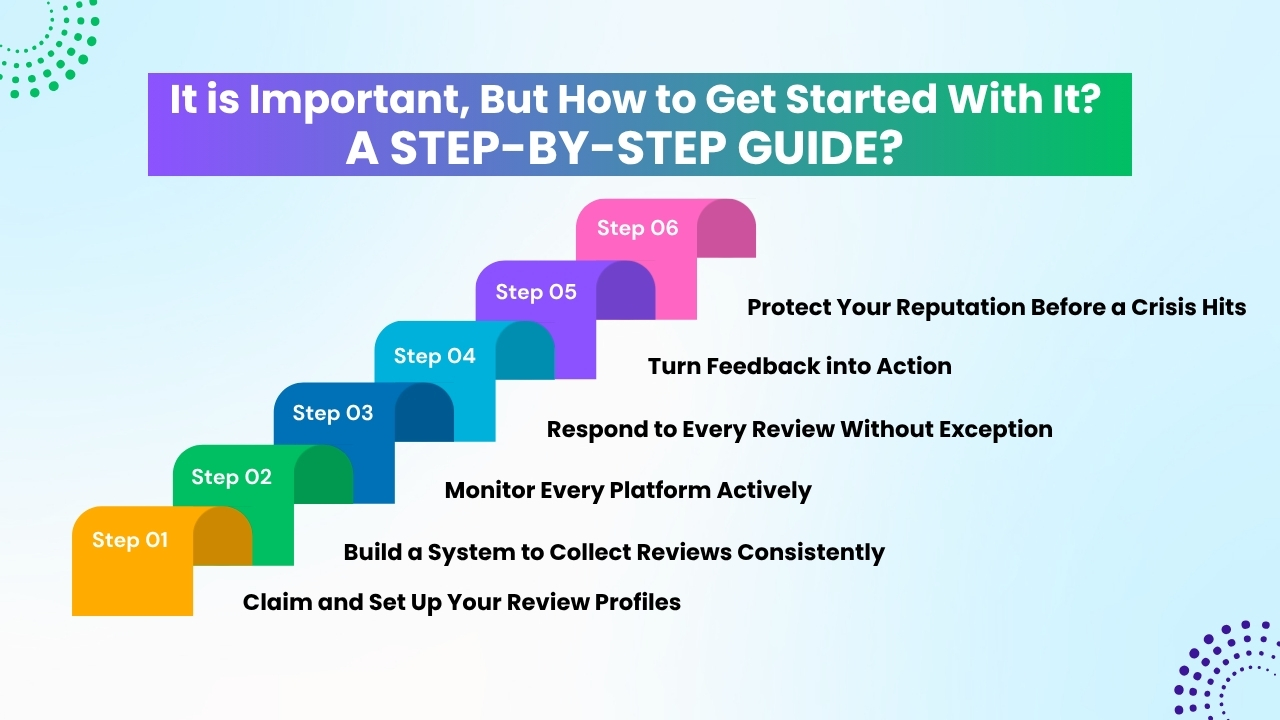
It is Important, But How to Get Started With It? A Step-by-Step Guide?
Understanding the importance of customer review management software is one thing. Actually building a system around them is where most businesses stall.
But you don’t have to. We have curated a step-by-step breakdown that helps you.
Step 1: Claim and Set Up Your Review Profiles
Before you can manage reviews, you need to be present where your customers are leaving them. Google Business Profile, Trustpilot, G2, Clutch, industry-specific platforms, wherever your buyers are, you need a complete, verified, and active presence.
- Claim and verify your Google Business Profile, fill every field completely.
- Identify the top 2–3 platforms where your target audience is most active.
- Ensure your business information, name, address, contact, and website are consistent across all platforms.
- Add photos, business hours, and service descriptions, and an incomplete profile signals neglect before a customer reads a single review.
Also Read: Funniest Google Reviews What Teach Us about Customer Experience
Step 2: Build a System to Collect Reviews Consistently
Reviews do not collect themselves. The businesses with the strongest review profiles are not lucky; they have a system that makes leaving a review effortless for the customer.
- Ask at the right moment, right after a successful delivery, a resolved support ticket, or a positive customer interaction.
- Make it frictionless, send a direct link to your review page, not a generic homepage.
- Train customer-facing teams to make the ask a natural part of the conversation, not an awkward afterthought.
- Automate follow-up review requests through your CRM or post-purchase email sequences.
The best time to ask is when the customer is at peak satisfaction, not a week later when the moment has passed.
Also Read: AI tools to Analyze Customer Reviews
Step 3: Monitor Every Platform Actively
Most businesses only read the reviews that find them. The ones managing their reputation effectively are monitoring every platform, every mention, in real time, not stumbling across feedback by accident.
- Set up Google Alerts for your business name to catch mentions across the web.
- Check your review platforms at least three times a week, daily if you are in a high-volume business.
- Track your overall rating trend month over month; a slow, quiet decline is as dangerous as a sudden drop.
- Assign a specific team member or role responsible for review monitoring; if everyone owns it, no one does.
Also Read: How to Use Your Review Monitoring Software to Manage Your Online Reputation
Step 4: Respond to Every Review Without Exception
Responding to reviews is not just courtesy. It is a strategy. Every response you write is read by far more people than just the reviewer; it is a public signal of how your business treats its customers.
- Respond to positive reviews with genuine, specific appreciation, not copy-paste templates that feel automated
- Respond to negative reviews within 24 hours, acknowledge the issue, take ownership, and offer a clear resolution
- Never get defensive publicly, even when the review is unfair or factually incorrect
- Keep responses concise, professional, and human. Avoid corporate language that feels scripted
A business that responds thoughtfully to a bad review often earns more trust than one with a perfect rating and zero engagement.
Also Read: How to Use Review Monitoring Software to Manage Your Online Reputation
Step 5: Turn Feedback into Action
Individual reviews are data points. Patterns across reviews are insights. And insights, acted upon, are what separate businesses that improve from businesses that stagnate.
- Look for recurring themes in negative reviews; they point to systemic issues, not isolated incidents
- Identify what customers consistently praise; that is your strongest differentiator. Double down on it
- Share review insights with product, operations, and customer success teams on a regular cadence
- Set a monthly review audit, what changed, what improved, what still needs attention
Also Read: Customer Sentiment Analysis Vs Customer Feedback Analysis
Step 6: Protect Your Reputation Before a Crisis Hits
The biggest mistake businesses make is waiting for a reputation crisis to start caring about review management. By the time a wave of negative reviews hits, the damage is already visible to prospects, to partners, and to anyone who searches your name.
- Have a response protocol in place before a crisis hits, not during it
- Define internally who responds, what tone to use, and what escalation looks like for serious complaints
- Regularly audit your profiles for fake, spam, or policy-violating reviews and report them to the platform
- Never ignore a cluster of negative reviews; silence is the worst possible response when your reputation is under pressure
- Track sentiment trends over time, a gradual shift in tone across reviews often signals a bigger operational issue before it becomes a public one
Also Read: Brand Reputation Management Software
To Get Started & Manage it All with Ease, Clariv is All You Need!
The six steps above work. But let us be honest about something: executing all of them consistently, across multiple platforms, for a growing business, while running everything else? That is where most teams quietly fall behind.
That is exactly the problem Clariv was built to solve.
Clariv is an AI-powered customer sentiment analysis tool that goes far beyond review collection. It reads every review, comment, message, and piece of feedback your customers leave, across every platform, and tells you the emotion behind it. Not just positive or negative. The full picture of how your customers feel, why they feel it, and what to do about it.
What Clariv Does For Your Business
- Collects feedback from every channel, Google, Yelp, social media, direct messages, support tickets, website forms, and even in-store feedback, all in one place
- Analyses sentiment with 95%+ accuracy, so you always know whether customer emotion is trending positive, negative, or neutral, and why
- Detects trends 6x earlier than manual monitoring, catching recurring issues before they snowball into a rating crisis
- Sends real-time alerts the moment negative sentiment spikes, so your team responds in minutes, not days, cutting response time by 70%
- Recommends exactly how to respond, the right tone, the right message, for every type of review your business receives
- Tracks sentiment week over week, so leadership always has a clear, data-backed picture of where the business stands in the eyes of its customers
- Delivers everything in one clean dashboard, reviews, trends, alerts, and reports, without switching a single tool
Clariv’s predictive sentiment insights don’t just show what happened; they give you a sense of what is coming. With AI-powered forecasting, you can anticipate sentiment shifts, identify churn risks early, and act before a small dissatisfaction becomes a lost customer.
Ready to See It in Action?
Clariv offers a 14-day free trial with full access to all Professional plan features, up to 100,000 sentiments per month. No credit card required. No complicated setup. Just instant clarity.
Book Your Free Demo and see the difference in the first week.
Conclusion
You have read this far, which means you already know reviews matter. You do not need another statistic to convince you.
What you need is to act on it.
Because, your competitors are not waiting. The gap between a business that manages reviews deliberately and one that does not is not just a ratings gap. It is a revenue gap. A trust gap. A growth gap that widens quietly every single month.
You now know what to do. You know why it matters, what it impacts, and how to build a system around it. The only thing left is the decision to start and to start today, not next quarter.
And when you are ready to manage it all without the manual effort, Clariv is where businesses that take reputation seriously begin.