Before we get to how to manage online reviews for your business, answer: when did you last check your online reviews?
Yesterday? Last week? Are you not sure?
That’s the problem.
- While you were focused on running your business, a frustrated customer left a one-star review on Google.
- Another one questioned your credibility on Trustpilot.
- Someone on Yelp warned people to “stay away.” And none of it got a response.
And those reviews? They’ve been sitting there, quietly costing you customers every single day.
93% of consumers say online reviews influence their purchasing decisions. A single unanswered negative review can drive away up to 30 potential customers. And businesses that actively manage their reviews grow revenue up to 9% faster than those that don’t.
Let that sink in.
The good news? It doesn’t have to be this way.
This guide will show you exactly why online review management is important, how to manage online reviews for your business in real time, at scale, and how to get started.
Your reviews are either working for you or against you. It’s time to take control.
Also Read: Google Review Management Software
What is Online Review Management?
Online review management is the process of monitoring, responding to, and learning from customer reviews across every platform where your business is mentioned, Google, Social Media, Yelp, Trustpilot, G2, the App Store, and anywhere else your customers are talking about you.
Here’s an example:
Imagine you run a business. Every week, new reviews come in across multiple platforms. Some are good. Some are complaints about your service or product quality. A few flag the same recurring issue across different customers.
Without a review management process, none of this reaches you in time. The complaints pile up unanswered. The recurring issue never gets flagged internally. And potential customers reading those reviews make their decision before you even know the conversation is happening.
With online review management, you:
- Get notified the moment a new review goes live, anywhere, on any platform
- Respond to complaints before they spiral into something bigger
- Spot recurring patterns early and fix the underlying problem
- Catch emerging issues before they escalate into a reputation crisis
It’s not just about damage control. It’s not just about replying to angry customers. It’s about building a system that keeps you informed, keeps your customers heard, and keeps your business improving, continuously.
Online review management covers three core actions:
Monitor → Respond → Learn
Monitor every platform your customers are on. Respond to every review, good, bad, and average. Learn from the patterns that emerge across all of it.
No matter where your customers are talking about you all of it feeds into your reputation. All of it needs to be managed. And the businesses that manage it well don’t just protect their reputation, they use it as one of their most powerful growth tools.
Also Read: Restaurant Review Sentiment Analysis
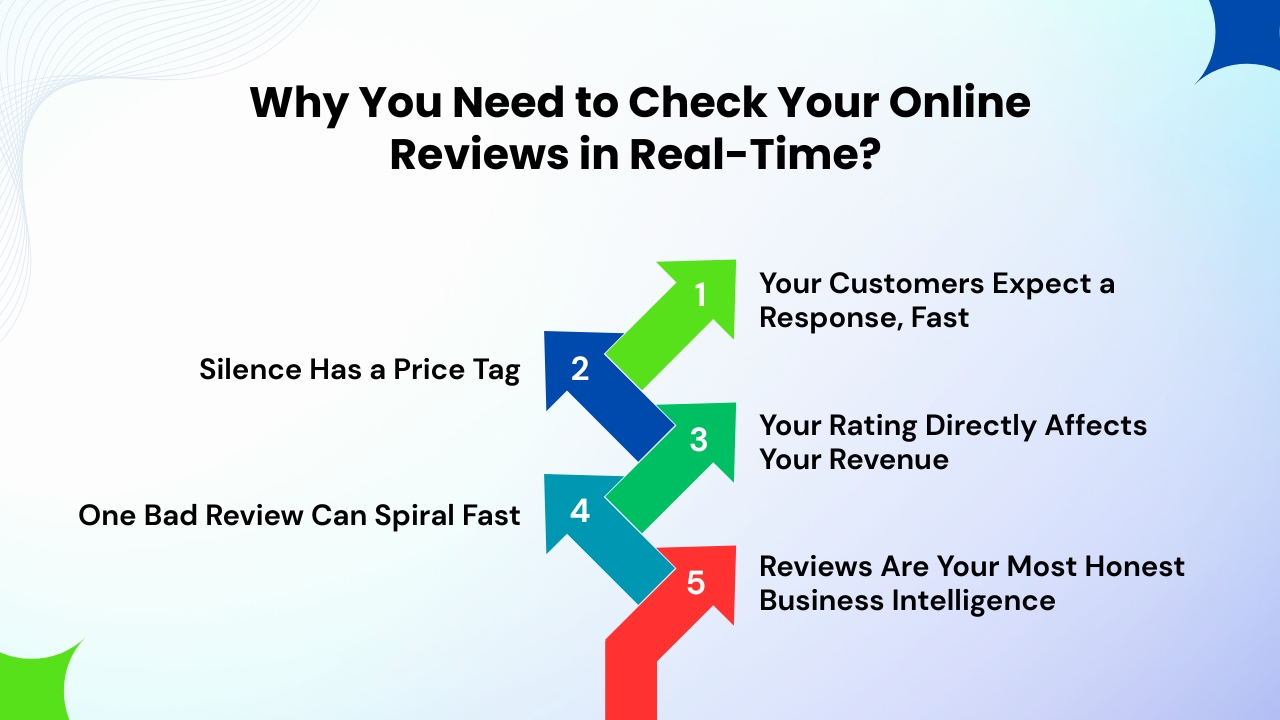
Why You Need to Check Your Online Reviews in Real-Time?
Real-time review monitoring isn’t a nice-to-have. It’s the difference between controlling your narrative and being controlled by it.
Here’s exactly why it matters:
1. Your Customers Expect a Response, Fast
52% of customers expect a reply within seven days. One in four expects it within 3 days. 21% expect it within 24 hours.
That’s a narrow window. Check reviews once a week, and you’re already too late for most of them.
What review management does: Real-time alerts mean you see every review the moment it goes live and respond within hours, not days. That speed alone sets you apart from the majority of businesses that don’t respond at all.
2. Silence Has a Price Tag
Responding to a 1 or 2-star review within 24 hours creates a 33% higher chance of the reviewer upgrading their score by up to three stars.
The same customer ready to damage your reputation can become an advocate if you respond fast enough.
What review management does: A clear response workflow ensures no review goes unanswered. One public response to a frustrated customer is visible to every future customer who lands on your page. It’s not just damage control, it’s trust-building at scale.
3. Your Rating Directly Affects Your Revenue
Every unanswered review and every missed complaint has a number attached to it.
A one-star improvement in rating can grow revenue by up to 9%. Customers spend 31% more with businesses that have excellent reviews.
What review management does: Consistent engagement gradually shifts your rating upward, not through shortcuts, but through genuine responses and timely review requests. Higher rating, better visibility, measurable revenue impact.
4. One Bad Review Can Spiral Fast
One negative review is manageable. A cluster with no responses is a crisis, and it builds faster than you think.
What review management does: Real-time monitoring is the circuit breaker. Catch it at Step 1, respond before it influences anyone else, and the spiral never starts.
5. Reviews Are Your Most Honest Business Intelligence
Your customers are telling you exactly what’s broken, what’s working, and what they wish you’d fix, for free, in plain language, every single day.
And yet most businesses treat this goldmine like a comment section. When you stop reading reviews as individual opinions and start reading them as patterns, everything changes.
What review management does: It turns a scattered feed of opinions into a live intelligence stream. Patterns surface. Gaps become visible. And the decisions you make stop being based on gut feeling and start being based on what your customers are actually experiencing.
Bottom line: Every hour a review goes unmonitored is an hour your reputation is being shaped without you.
Also Read: How to Measure Customer Sentiment
How to Manage Online Reviews for Your Business?
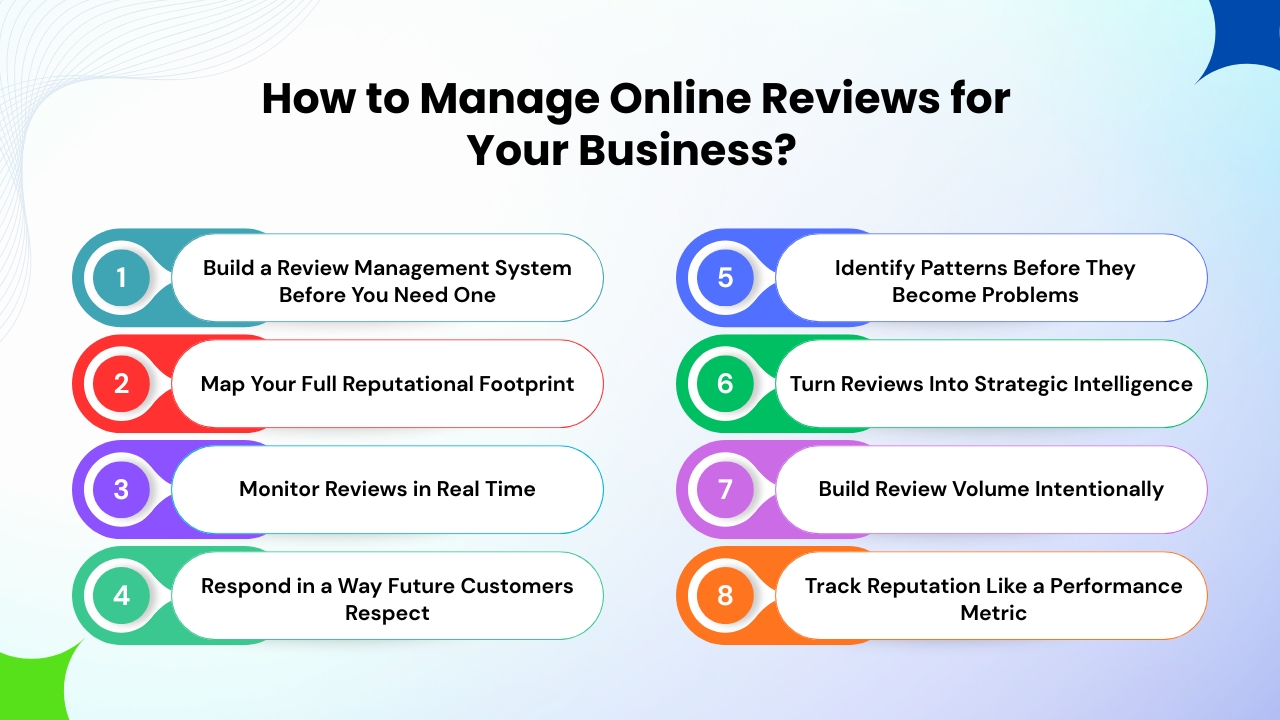
Most businesses approach review management reactively; they respond when they remember, check platforms when something feels off, and treat the whole thing as a fire to put out rather than a system to run. That’s not management. That’s damage control with a delay.
The businesses with consistently strong reputations aren’t lucky. They’re disciplined. Here’s the framework that separates them:
1. Build a Review Management System Before You Need One
Most businesses start thinking about review management after something goes wrong. By that point, you’re already reacting. The businesses that consistently win on reputation don’t wait for a crisis to build their process; they build the system first, so when something does go wrong, the response is immediate and controlled.
A review management system doesn’t need to be complicated. But it does need to be deliberate:
- Define who owns review management in your organization.
- Establish a clear response workflow, who responds, in what timeframe, in what tone, and what the escalation path looks like for serious complaints.
- Set monitoring cadence, real-time alerts for new reviews, weekly pattern analysis, and monthly performance tracking.
- Align review insights with the teams that can act on them, a recurring complaint about delivery should reach operations, not just sit in a marketing report nobody reads.
- Document response guidelines so anyone stepping in can maintain consistency, tone, structure, escalation triggers, and platform-specific nuances, all defined in advance.
Clariv Team Tip: The most common review management failure isn’t ignoring reviews, it’s having no clear ownership. When everyone is responsible, no one is. Before you invest in any tool or strategy, answer one question: who in your organization is accountable for this, today, every day? Everything else builds from that answer.
Also Read: Restaurant Review Sentiment Analysis
2. Map Your Full Reputational Footprint
Most companies believe they understand where their reviews live. They usually don’t.
Businesses tend to focus on established platforms such as Google, Trustpilot, Yelp, or industry-specific marketplaces.
But customer sentiment rarely stays contained within those channels.
Conversations about your brand also happen in social media comments, product forums, Reddit threads, app store reviews, and niche industry sites, whether you’re monitoring them or not.
So, make sure you look everywhere:
- Search platforms — Google Business reviews
- Dedicated review platforms — Trustpilot, Yelp, G2, Capterra
- Marketplace feedback — Amazon, Etsy, or any platform you sell on
- App store reviews — if you offer a digital product
- Social media — Instagram comments, Facebook reviews, X threads, LinkedIn mentions
- Industry-specific platforms relevant to your niche
When you map this ecosystem clearly, you stop managing reviews in isolated pockets and start managing your full public reputation.
3. Monitor Reviews in Real Time
Periodic checking just doesn’t cut it anymore. A weekly review sweep might feel organized, but in practice, it means negative feedback can sit unanswered for days while potential customers are already reading it.
Reputation moves faster than that. In real-time, you have to track in real-time as well.
It helps businesses to:
- Receive instant alerts the moment a new review is posted across any platform
- Track every channel in one centralized place
- Detect negative sentiment and emerging complaint clusters immediately
- Respond while the conversation is still active
You can centralize this process using AI-powered sentiment analysis platforms like Clariv, which aggregate reviews and feedback from multiple channels, flag emerging negative sentiment, and alert in real-time (all-automated).
Also Read: Brand Reputation Management Software
4. Respond in a Way Future Customers Respect
The most common mistake businesses make with review responses is assuming the conversation is between them and the reviewer.
It isn’t.
Every response is written for the hundreds of potential customers who will read it later. Your tone, clarity, and willingness to resolve problems shape how credible your business appears.
Strong responses tend to follow a simple structure:
- Acknowledge the customer’s experience within 24-48 hours.
- Show that the issue is taken seriously and personalize the message for them.
- Offer a constructive path forward.
- Maintain professionalism without sounding scripted and always thank them for the feedback.
Here’s something from the Clariv team: The 3-star review is the most valuable review you’re probably ignoring. These reviewers are being genuinely honest; they liked enough to stay but were disappointed enough to say so. That’s your most actionable feedback, and most businesses scroll right past it.
Something you should know: The Clariv automatically reviews the feedback and curates personalized messages. Less time and better, personalized responses.
5. Identify Patterns Before They Become Problems
Individual reviews can be misleading.
One customer complaining about delivery delays might simply have had an unfortunate experience. But if several reviews begin describing the same problem, something operational is likely happening behind the scenes.
This is where many businesses miss the signal. They read reviews individually rather than collectively.
A more accurate way to interpret reviews is through patterns.
- Repeated complaints about delivery delays may indicate logistics issues
- Several comments about confusing onboarding may point to UX friction
- Multiple mentions of a product defect may signal quality control problems
A cluster of reviews saying the same thing is evidence.
Sentiment analysis platforms like Clariv help businesses detect these clusters quickly by grouping similar feedback across hundreds of reviews.
6. Turn Reviews Into Strategic Intelligence
Most businesses see reviews as a reputation management problem. In reality, they are one of the richest sources of customer intelligence available.
Customers explain exactly what they value, what frustrates them, and what they expected instead. When analyzed collectively, reviews reveal patterns about how your business is performing.
For example:
- Consistent praise for a particular feature highlights your strongest value proposition
- Repeated complaints about onboarding indicate friction in the customer journey
- Feedback about pricing reveals how customers perceive value
Clariv helps you surface these insights by organizing review sentiment into themes and tracking how those themes evolve.
What initially looks like scattered comments becomes a clear picture of how customers actually experience your brand.
Also Read: How AI Sentiment Analytics Software Turns Customer Feedback into Growth
7. Build Review Volume Intentionally
A common misconception in reputation management is that the goal is a perfect rating. But volume matters more than perfection.
A business with 400 reviews and a 4.2 rating often appears far more credible than a business with 40 reviews and a 4.8 rating. Customers trust signals that look statistically meaningful.
That’s why businesses should focus on generating reviews consistently rather than chasing perfect ratings.
The most effective review strategies focus on moments when customers are already satisfied.
- After a successful purchase or delivery, maintain the consistency throughout.
- Following a resolved support request
- When repeat customers complete another transaction
- When customers provide positive feedback directly, they avoid artificial feedback.
The Tip from the Clariv Team: Make the review process frictionless with direct links.
The result is a review profile that feels real and trustworthy to potential customers.
Also Read: How to Measure Customer Sentiment
8. Track Reputation Like a Performance Metric
If reviews influence customer decisions and the data makes clear they do, then reputation deserves to be tracked with the same rigor as sales performance, marketing metrics, or operational KPIs. What gets measured gets managed. What gets ignored quietly deteriorates.
Here’s what you should manage:
- Average rating trends across platforms
- Review response time
- Percentage of reviews receiving responses
- Recurring complaint categories
- Overall sentiment trends
Managing online reviews isn’t about defending your brand from criticism. It’s about staying close to the real experiences customers are having with your business.
Because the truth is simple: your reputation is already being shaped every day by the conversations customers are having about you.
The only question is whether you’re actively managing that narrative or discovering it after the damage is done.
Here’s How Top Brands Like Starbucks, Airbnb, and Domino’s Pizza are Making the Most Out of Their Online Reviews.
Here are 3 top businesses that used online review management to fundamentally transform their growth and the numbers that prove it.
A. Case Study 1: Domino’s Pizza — How Customer Reviews Saved a $12 Billion Brand
Who they are: One of the world’s largest pizza chains, operating 19,000+ locations across 90+ countries.
The challenge: By 2008, Domino’s stock had hit an all-time low of $2.61 per share. Customer reviews were brutal — “tastes like cardboard,” “rubbery crust,” bland and boring.
Most businesses would have ignored it. Domino’s did the opposite.
What they did: They used their harshest customer reviews as the brief for a complete product overhaul. They displayed negative reviews on a Times Square billboard and publicly responded to their worst critics. And they turned every piece of negative feedback into a way to rebuild the product customers had been asking for.
The results:
- Same-store sales jumped 14.3% in the first quarter after the campaign,
- Stock rose from $2.61 to over $252 per share by 2018, an 89x increase
- Customer satisfaction scores improved by 12 percentage points
- Domino’s overtook Pizza Hut to become the world’s largest pizza chain by sales
(Source: Campaign Live | Aaron Allen & Associates)
B. Case Study 2: Airbnb — Building a $75 Billion Business on Review Trust
Who they are: The world’s largest short-term rental marketplace, with 7 million+ listings across 220+ countries.
The challenge: Airbnb was built on a premise that should have been impossible, convincing strangers to sleep in each other’s homes. The entire platform lived or died on one thing: the credibility of its review system.
What they did: Airbnb built review management into the core architecture of the platform. They introduced simultaneous review disclosure to eliminate retaliatory reviewing. They created the Superhost program, rewarding hosts who maintained exceptional review scores with increased visibility. They invested in over 535 product upgrades specifically targeting the metrics that feed into reviews, cleanliness, check-in, accuracy, and communication.
The results:
- Listings rated 4.9 stars or above generate 18.2% more revenue and 9.7% higher occupancy rates
- Superhosts receive 22% more bookings than non-Superhosts
- Positive reviews directly influence 90% of Airbnb bookings
- Over 460 million reviews submitted — the foundation of every booking decision on the platform
(Source: Hostaway | Airbnb Global Quality Report)
C. Case Study 3: Starbucks — Turning Customer Feedback Into Product Innovation
Who they are: The world’s largest coffeehouse chain, with 38,000+ stores across 80+ countries and annual revenues exceeding $35 billion.
The challenge: By the late 2000s, rapid expansion had diluted the Starbucks experience. Sales were declining, stores were closing, and customer reviews consistently reflected a brand that had lost touch with what made it special.
What they did: When Howard Schultz returned as CEO in 2008, customer feedback became the primary input for the brand’s recovery. They temporarily closed all 7,100 U.S. stores to retrain every barista, a decision driven directly by service complaints surfacing in reviews.
They launched My Starbucks Idea, a platform turning customer feedback directly into product development. Menu changes, mobile ordering, and loyalty program improvements all trace back to what customers were saying in reviews.
The results:
- Market capitalization grew to over $100 billion at its peak
- The Starbucks app became the most widely used loyalty app in the restaurant industry, with 31 million active U.S. members
- My Starbucks Idea generated 150,000+ customer ideas, hundreds of which were implemented directly into the product
(Source: GWO SEVO — Starbucks Customer Management Case Study)
To Manage Reviews at Scale, You Need the Right Customer Sentiment Analysis Tool. But, How to Choose Right One?
By now, one thing is clear: manually tracking reviews across every platform, every day, doesn’t scale. The volume is too high, the platforms are too many, and the signals are too easy to miss without the right system in place.
But choosing a customer sentiment analysis tool isn’t a decision to make based on a feature checklist. The market is full of platforms that promise everything and deliver dashboards full of data that nobody acts on. The right tool isn’t the one with the most features; it’s the one that actually helps your team understand what customers are feeling, spot problems early, and make faster, smarter decisions.
Here are the key things experienced teams evaluate before choosing a platform:
1. Emotion and Sentiment Detection
Most basic tools label feedback in three buckets: positive, negative, and neutral. That’s not sentiment analysis. That’s traffic lights.
The tool should identify the emotion behind the feedback, frustration, disappointment, satisfaction, excitement, and confusion, so you understand not just what customers said, but how intensely they felt it.
Also Read: Best Social Media Management Tools for Non-Profits
2. Cross-Channel Feedback Coverage
Your customers don’t confine their feedback to one platform. They leave reviews on Google, vent on X, comment on Instagram, submit support tickets, and fill out post-purchase surveys, often about the same experience.
The right platform pulls feedback from every channel and surfaces it in one place, so your team never has to switch between tabs to understand what’s happening.
3. Theme and Pattern Detection
Reading individual reviews one by one doesn’t scale. And even when you do read them, spotting patterns manually is slow, inconsistent, and easy to get wrong.
The platform should automatically group feedback into themes so recurring complaints, emerging product issues, and consistent praise surface without anyone having to manually connect the dots. What looks like scattered feedback becomes a clear, organized picture of what customers are actually experiencing.
4. Real-Time Monitoring and Alerts
If you’re finding out about a spike in negative sentiment the next morning, you’re already behind. Negative feedback escalates fast, especially on social media, and the window to respond before it compounds is narrow.
The right tool alerts you the moment sentiment starts trending in the wrong direction, so the right person can act while the conversation is still active.
5. Actionable Insights, Not Just Data
Raw sentiment scores don’t help anyone improve anything. A dashboard full of graphs that nobody knows how to act on isn’t a tool; it’s a reporting exercise.
The platform should translate feedback into clear, actionable insights that your product team, marketing team, and customer support team can actually use and move forward accordingly.
6. Competitive Sentiment Analysis
Your reputation doesn’t exist in isolation. Customers compare you to alternatives, and their reviews often reference those alternatives directly.
The right tool gives you visibility into how your sentiment compares to competitors, so you understand not just how customers feel about you, but whether you’re winning or losing the perception battle in your market.
7. Easy Integrations With Existing Systems
The right platform integrates smoothly with the tools your team already uses, CRM, helpdesk, marketing automation, analytics dashboards, so review intelligence flows directly into the workflows where decisions actually get made.
8. Scalability and Data Security
The platform should handle growing feedback volumes without losing the ability to surface meaningful patterns. And because it’s analyzing customer data, it needs to meet strong data protection standards and comply with relevant privacy regulations, not as a nice-to-have, but as a baseline requirement.
Also Read: Sentiment Analysis Demo
Meet Clariv, Your AI-Powered Customer Sentiment Analysis + Social Scheduling Tool
As your business grows, so does the volume of conversations happening about it. Reviews on Google. Comments on Instagram. Support tickets. Direct messages. In-app feedback. Every one of these channels is generating signals about what your customers are feeling.
Keeping up with all of it manually is overwhelming, but that’s the gap Clariv was built to close.
Clariv is an AI-powered customer sentiment analysis platform that brings every one of those conversations into one place and tells you not just what customers are saying, but what they’re feeling, what’s changing, and what needs your attention right now.
Instead of manually reading hundreds of reviews across a dozen platforms, your team gets a single, real-time view of customer sentiment across every channel with patterns, themes, and alerts.
With Clariv, businesses can:
- Analyze customer emotions with 95%+ accuracy, going beyond positive, negative, and neutral to identify the specific emotions driving customer feedback.
- Monitor feedback from every channel in one place and help you create personalized responses, all automated.
- Detect trends and recurring issues early — before they compound, and opportunities surface before competitors notice them.
- Track brand sentiment over time — understand how customer perception is shifting, not just what it looks like today.
- Receive alerts when negative sentiment spikes — so your team can act while the conversation is still manageable.
- Surface competitive sentiment — see how your reputation compares to competitors and where you’re winning or losing the perception battle.
- View all insights in a single dashboard instead of switching between multiple tools.
And that’s not all.
Clariv also includes social media scheduling, allowing teams to plan and publish posts while simultaneously monitoring how audiences react to them, creating a feedback loop.
Start with a 14-day free trial, no credit card required, and see exactly what your customers are telling you, across every channel, in real time.
Conclusion
Most businesses discover their reputation problems too late. A cluster of unanswered reviews. A pattern of complaints that nobody connected. A shift in customer sentiment that showed up in the revenue figures before it showed up anywhere else.
It doesn’t have to work that way.
The businesses that understand this don’t treat review management as a reputation task. They treat it as a core business discipline, one that keeps them close to what customers are actually experiencing, helps them fix problems before they compound, and gives them the kind of competitive intelligence that most businesses are leaving on the table.
That’s exactly what Clariv was built to support, not to replace the human judgment that goes into a thoughtful response or a smart business decision, but to make sure the signals that inform those decisions never get missed, never get buried, and never arrive too late to act on.
If you’re ready to stop reacting and start managing, Clariv is where that starts.
Start your 14-day free trial. No credit card required. Book a demo and see Clariv in action.