In 2018, United Airlines lost $1.4 billion in market value in a single day. Not because of a crash. Not because of a financial scandal.
Because of one viral video and their tone-deaf response to it.
Passengers were already angry. Social media was already flooded with negative sentiment. But United’s team wasn’t listening fast enough. By the time they responded, the damage was done.
Now ask yourself: Is your business listening right now?
We are not talking about checking mentions occasionally or checking star ratings once a month. But, actually listening to every review, every support ticket, every tweet, every survey response in real time, at scale.
If the answer is no, you’re flying blind.
That’s the exact problem customer sentiment analysis was built to fix.
Also Read: How to Measure Customer Sentiment
What is Customer Sentiment Analysis, Exactly?
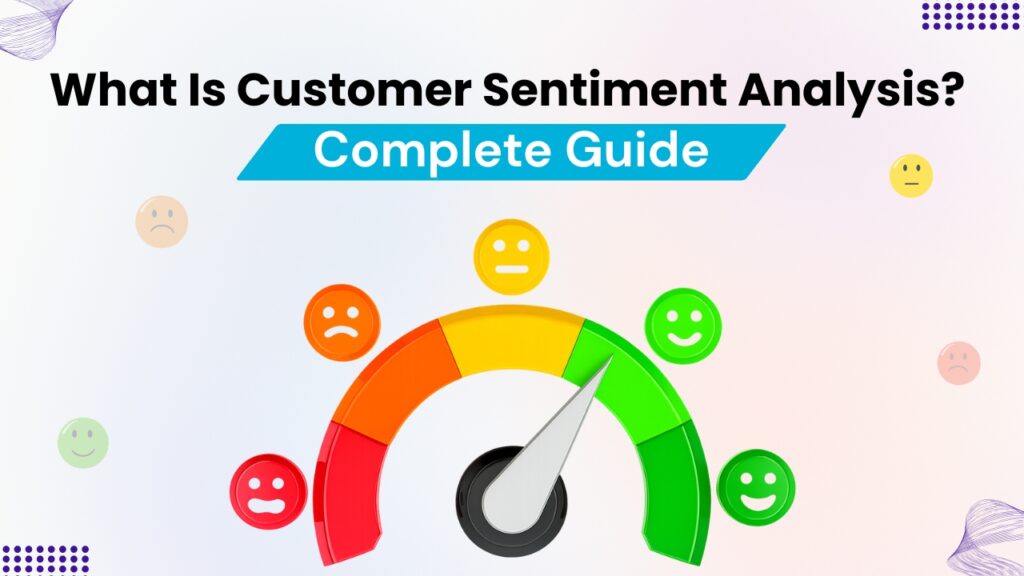
It’s the process of using AI and Natural Language Processing (NLP) to automatically detect the emotion behind customer feedback at a scale no human team could match. Positive. Negative. Frustrated. Delighted. Churning.
The companies winning right now aren’t just collecting customer feedback. They’re decoding it and acting on it faster than their competitors even notice there’s a problem.
This guide is for the teams who want to do the same.
We’ll cover how sentiment analysis actually works, where it creates real business impact, and how to build a system around it, whether you’re just getting started or trying to go deeper with what you already have.
Let’s get into it.
Also Read: Sentiment Analysis Demo
Let’s Now Understand the Full Picture of What Is Customer Sentiment Analysis.
At its core, customer sentiment analysis is about turning unstructured text into a business signal.
Every day, your customers are leaving traces everywhere:
- a 3-star review with a specific complaint buried in paragraph two,
- a support chat that starts politely but ends in frustration,
- a tweet that got 200 likes from people who feel the same way.
None of that is in your dashboard. None of that shows up in your NPS score.
Sentiment analysis pulls it out.
Technically, it uses Natural Language Processing (NLP) to read text the way a human would, but at machine speed. It identifies not just what someone said, but how they feel about it.
And it operates at three levels most people don’t know about:
- Document-level — What’s the overall tone of this review? Positive, negative, or neutral?
- Sentence-level — Within that review, which specific sentences carry negative emotion?
- Aspect-level — What exactly are they feeling negative about? The price? The delivery? The support agent?
Also Read: Customer Sentiment Platform Vs Traditional Surveys
Here’s what that looks like in practice:
The product itself is great, but the shipping took forever and customer support was completely useless.
A basic star rating tells you: 3 stars. Aspect-level sentiment analysis tells you:
- Product → Positive.
- Shipping → Negative.
- Support → Negative.
Now you know exactly where to fix things. That’s the difference between data and direction.
Is Customer Sentiment Analysis Really Important in 2026?
Short answer? It’s not a nice-to-have anymore. It’s table stakes.
Customers are louder than ever. They’re leaving reviews, posting on Reddit, venting on X, filling out surveys, and chatting with support bots, all at the same time, across a dozen different channels. And they expect you to be listening to all of it.
The businesses that are winning in 2026 aren’t just collecting that feedback. They’re decoding it in real time and responding before the damage is done.
Still not convinced? Let the numbers do the talking.
The Market Is Exploding, For a Reason
As per Business Research Insights, the global sentiment analytics market is projected to reach $6.36 billion in 2026, growing to $12.6 billion by 2035 at a CAGR of 7.9%. That’s not speculative growth, that’s businesses putting real budget behind emotional intelligence.
And the reason is simple: real-time sentiment monitoring is now a non-negotiable capability for enterprises in 2026. Customer perceptions shift faster than traditional surveys can detect, compressing the gap between signal and action.
The old way doesn’t cut it anymore.
Also Read: Restaurant Review Sentiment Analysis
6 Reasons It Matters More Than Ever in 2026
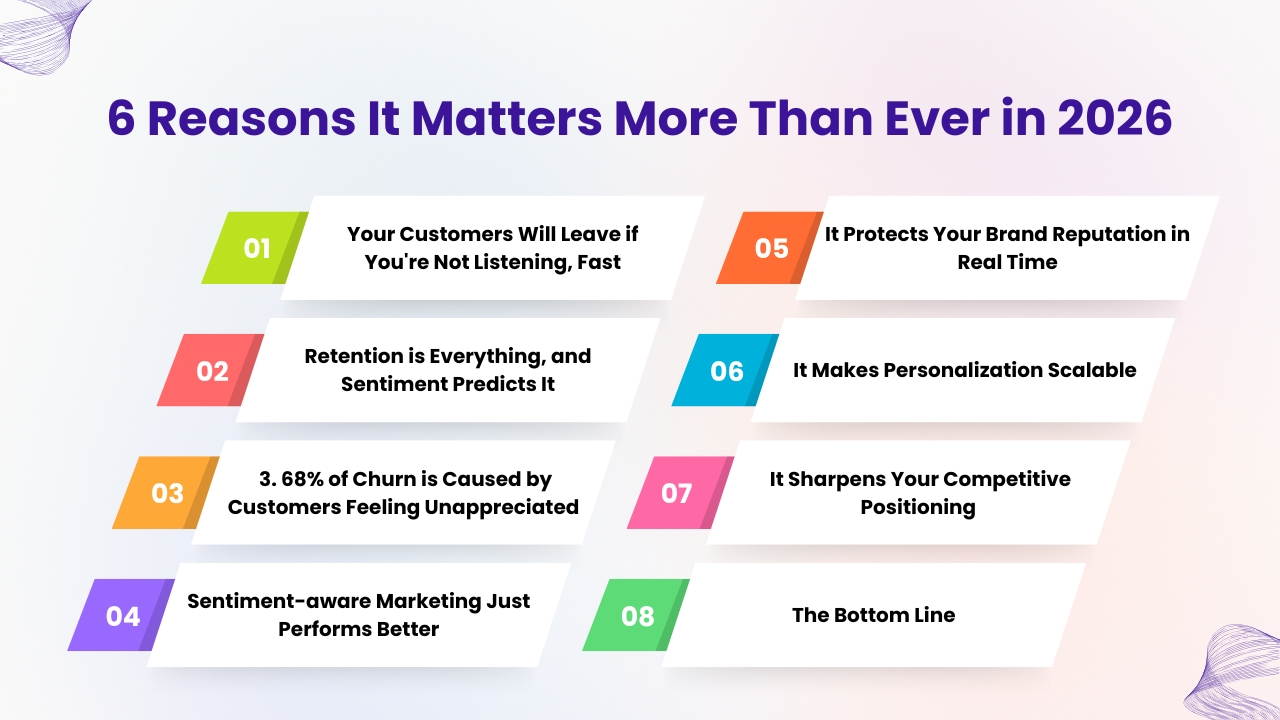
1. Your customers will leave if you’re not listening, fast
According to the 2025 Sprout Social Index, 73% of social users say they’ll buy from a competitor if a brand doesn’t respond on social media.
That’s not a preference. That’s a threat. And sentiment analysis is the early warning system that makes sure you never miss the signal.
2. Retention is everything, and sentiment predicts it
Here’s the math that should keep every business leader up at night: a mere 5% increase in customer retention rates can boost profits anywhere from 25% to 95%.
Sentiment analysis is one of the most direct levers you have to move that number. It spots the frustrated customers before they churn, not after they’ve already left and taken their wallet with them. So, you have a chance to win them with targeted offers and messages.
Also Read: Brand Reputation Management Software
3. 3. 68% of churn is caused by customers feeling unappreciated
68% of customer churn happens simply because customers feel unappreciated. Not because of pricing. Not because a competitor was better. Because nobody made them feel heard.
Sentiment analysis closes that gap. It tells you exactly who is feeling ignored and why, so you can fix it before it becomes a goodbye.
4. Sentiment-aware marketing just performs better
Ads optimized based on positive sentiment perform 2.3x better in terms of engagement than generic or tone-deaf campaigns, according to a Sprout Social study.
When you know how your audience feels, your messaging lands differently. That’s not a coincidence, it’s a signal-driven strategy.
Also Read: How AI Sentiment Analysis Software Turns Customer feedback into Growth Opportunity
5. It Protects Your Brand Reputation in Real Time
Sentiment analysis gives you a live pulse on how your brand is being perceived, across every channel, every day.
Businesses get the best ROI by capturing sentiment after the customer expresses it. Still, before it can be widely shared, there’s a window to address and resolve it before it spreads. Instead of finding out about a reputation issue after it’s gone viral, you see the early spike in negative sentiment and respond while it’s still containable. That’s not damage control, that’s prevention.
6. It Makes Personalization Scalable
Personalization is only possible when you understand context. Sentiment analysis provides that context, at scale.
According to the 2025 Sprout Social Index, more personalized service leads to higher customer retention and increased lifetime value. Sentiment analysis makes that personalization achievable across thousands of interactions simultaneously. And, it helps you stand out and achieve a competitive edge.
7. It Sharpens Your Competitive Positioning
Sentiment analysis doesn’t just tell you how your customers feel, it tells you where you stand in the market.
When you track sentiment trends over time, patterns emerge that go far beyond individual feedback. You see which aspects of your product are consistently praised, which are consistently criticized, and where the gap between customer expectation and reality is widest. That clarity directly informs how you position, price, and communicate your product with evidence instead of assumptions.
8. The Bottom Line
In 2026, the gap between businesses that use customer sentiment analysis and those that don’t isn’t just an insight gap. It’s a revenue gap.
Your customers are already telling you everything: what they love, what’s breaking, what’s pushing them away. The only question is whether you’re actually hearing it.
Real-World Use Cases of Customer Sentiment Analysis
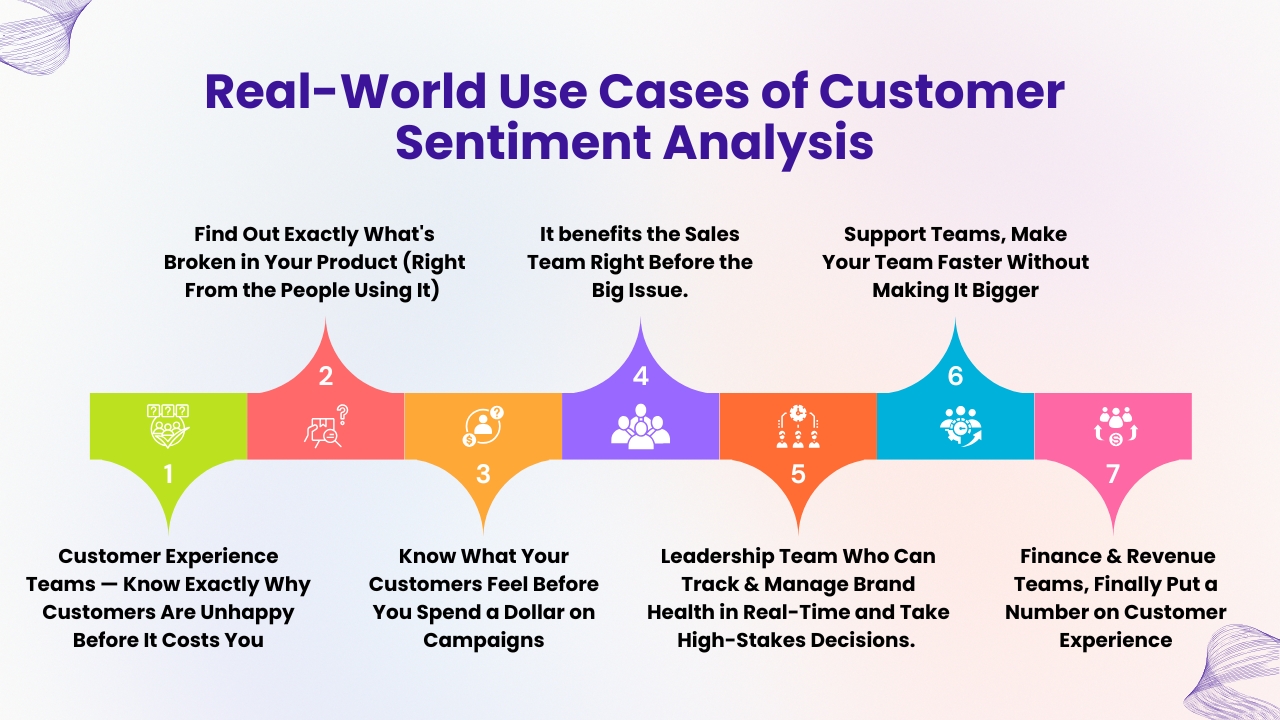
1. Customer Experience Teams — Know Exactly Why Customers Are Unhappy Before It Costs You
Every CX team knows the feeling. You’re deep in tickets, your queue is overflowing, and somewhere in there is a pattern that’s quietly pushing customers out the door, but nobody has time to find it.
Sentiment analysis changes that dynamic completely. Instead of your team manually reading through hundreds of responses to spot a trend, the system flags it automatically.
For example, you can see the context and get to the core of the problem, understand the feelings, and can address it:
- A five-star product rating with a comment that ends with, would give six stars if the billing team actually picked up the phone.
- A support ticket opened with love, the product closed with I’m genuinely considering cancelling.
- A Reddit thread with 400 upvotes titled Am I the only one who can’t get a straight answer from support?” and 200 comments saying no, you’re not.
With the right customer sentiment analysis tool, you can see all alerts in real time and respond before they compound.
That’s the difference. The best CX teams aren’t faster at fixing problems; they’re better at never having them in the first place.
Also Read: Google Review Management Software
2. Find Out Exactly What’s Broken in Your Product (Right From the People Using It)
Here’s an uncomfortable truth most product teams won’t say out loud: a lot of roadmap decisions are made based on whoever spoke up loudest in the last sprint planning meeting.
Sentiment analysis replaces that with something better, a continuous, unfiltered signal from the people actually using your product.
- Not a survey you sent to 200 customers.
- Not a feature request from your three most vocal enterprise accounts.
The real, unfiltered voice of your entire user base.
And it gets specific. Aspect-level sentiment doesn’t just tell you customers are unhappy, it tells you they’re unhappy with the mobile checkout flow, not the product itself. That specificity changes everything.
You stop rebuilding things that you feel like rebuilding. Instead, you fix the ones that your customers want to improve, and that’s costing you activations, renewals, and reviews.
3. Know What Your Customers Feel Before You Spend a Dollar on Campaigns
Most marketing teams are making expensive bets on messages they think will land.
Sentiment analysis tells you what’s already landing, in your customers’ own words.
- The exact phrases they use when they love your product.
- The specific frustrations that keep coming up before someone switches to a competitor.
- The emotional triggers that drive a purchase decision versus the ones that create hesitation.
For example, you can use:
- A review that says, switched from [competitor] because their pricing feels dishonest.
- A tweet that says, ” Finally, a tool that doesn’t require a PhD to set up.
- A survey response that says, I recommended this to my whole team because it saved us hours.
And all the reviews, that’s your USP. That’s your marketing messaging. Right there. Unfiltered, unprompted, and already resonating.
And when a campaign goes live, you know within 48 hours whether it’s hitting. Not after you’ve burned the budget, while there’s still time to pivot.
4. It Benefits the Sales Team Right Before the Big Issue.
Most sales teams find out an account is unhappy at the worst possible moment, during a renewal conversation, when the customer already has one foot out the door.
Sentiment analysis gives you the signal weeks earlier. When integrated into your CRM, it flags which accounts are showing signs of frustration across support tickets, survey responses, and product feedback, long before they raise their hand or threaten to leave.
For example, with customer sentiment analysis, you could get to know about:
- A support ticket that closes with I guess that’ll have to do, technically resolved, emotionally unresolved.
- An NPS response that gives you a 7 but adds it’s fine, but we’ve been looking at alternatives.
- A product feedback form whose tone shifted from enthusiastic six months ago to flat and transactional today.
That early warning turns a potential churn into a saved account. And on the flip side, it tells you which customers are genuinely delighted and ready for an upsell conversation that won’t feel forced.
5. Leadership Team Who Can Track & Manage Brand Health in Real-Time and Take High-Stakes Decisions.
NPS reports. Quarterly reviews. Churn analysis. By the time these land on a leadership team’s desk, the moment to act has usually passed.
Sentiment analysis gives leadership a live, directional view of brand health, not a snapshot from 90 days ago.
- You see trust building or eroding in real time.
- You spot a competitor’s customers growing frustrated before your sales team does.
- You catch an internal policy change that’s quietly creating friction with your best accounts.
With customer sentiment analysis, you can fix it before it shows up in your revenue numbers.
It’s not just a customer experience tool. In the hands of a leadership team that knows how to use it, it’s a strategic compass.
6. Support Teams, Make Your Team Faster Without Making It Bigger
Your support team is spending hours every week doing something that shouldn’t require a human at all, reading through tickets to figure out which ones are urgent, which ones are frustrating, and which ones are about to escalate.
Sentiment analysis automates that completely. Here’s how?
- A ticket that opens with “this is the third time I’m reaching out about the same issue” gets flagged as high urgency instantly.
- A chat transcript where the customer’s tone shifts from polite to clipped mid-conversation gets escalated before the agent even realizes what happened.
- A batch of tickets all containing the phrase “still waiting” gets grouped and surfaced as a pattern, not handled one by one, and is buried in a queue.
Your best agents stop spending time on tickets that didn’t need them. They spend it on the conversations that actually do. And the customers who are genuinely at risk get a human response before they’ve even thought about leaving a bad review.
7. Finance & Revenue Teams, Finally Put a Number on Customer Experience
CX has always struggled with one problem: proving its business impact in numbers that leadership actually cares about.
Sentiment analysis fixes that.
- A campaign goes live, and brand sentiment moves from 0.62 to 0.81 over 30 days.
- A product fix ships, and negative sentiment around the checkout flow drops by 40% in two weeks.
- A new support protocol rolls out, the ratio of frustrated-to-satisfied interactions flips from 60/40 to 30/70 within a month.
These aren’t soft metrics. They’re directional, trackable, and directly correlated to retention, revenue, and growth. And more importantly, they give every team the language to walk into a boardroom and show exactly what their work is moving.
That’s what gets customer experience a permanent seat at the revenue table.
All of This Is Only Possible With the Right Tool!
Reading through everything above, one thing becomes clear.
Customer sentiment analysis isn’t a single feature. It’s a system, one that needs to work across multiple channels, multiple teams, and multiple data sources simultaneously. And the difference between getting real business value from it versus just having another dashboard nobody checks comes down entirely to the tool you choose.
The right sentiment analysis tool doesn’t just tell you whether feedback is positive or negative. It tells you which product, team, touchpoint, and customer segment, broken down in real time, in a way that every team can actually act on.
So before we get into how to choose one, here’s what the right tool actually needs to do.
Also Read: Best Social Media Management Tools for NonProfits
What to Look for in a Customer Sentiment Analysis Tool?
Most tools will claim they perform sentiment analysis. What they won’t tell you is that there’s a big difference between a tool that labels feedback positive or negative and one that gives your business something to actually act on.
Here’s what the right tool needs to do.
- Go beyond positive and negative: Emotion detection, aspect-level breakdown, and topic categorization. Not just a three-way sentiment split. When a customer says, “Love the product, but the checkout nearly made me quit, you need to know it’s the checkout, not the product. That’s what the best tool can simplify.
- Pull from every channel: Reviews, social comments, support tickets, DMs, in-app feedback, in-store responses, all in one place. A tool that only monitors two channels is giving you a fragment and calling it the full picture.
- Send real-time alerts: A weekly digest tells you what went wrong seven days ago. The right tool notifies you the moment sentiment shifts, so your team responds while there’s still time to fix it.
- Detect trends, not just snapshots: Individual feedback is useful. Patterns are powerful. You need a tool that shows you whether sentiment is improving or deteriorating over time, and which topics keep coming up before they become a crisis.
- Predict what’s coming: The best tools don’t just show what happened, they forecast what’s likely next. Churn risks. Sentiment dips. Escalation patterns. Before they hit your metrics.
- Be simple enough for every team to use: If only your data team could read the dashboard, the insights would never reach the people who need to act on them. The right tool gives CX, product, marketing, and leadership a shared, real-time view without a manual.
Tools like Clariv are built exactly around this, pulling feedback from every channel into one unified dashboard, with real-time alerts, aspect-level analysis, predictive signals, and sentiment tracking across 50+ languages and multiple locations.
But, What is Clariv, & How This A Customer Sentiment Analysis Can Help?
Most sentiment analysis tools were built for data teams. Clariv was built for the people who actually have to act on the data.
It pulls customer feedback from every channel your customers already use and consolidates it into a single, clean, unified dashboard. No switching between platforms. No manual tagging. No digging for answers that should’ve taken 30 seconds to find.
But we know, reading about features is one thing. Seeing them work on your actual customer feedback is another.
Clariv’s 14-day free trial gives you full access to all Professional plan features, including up to 100,000 sentiments per month. No credit card. No sales call required before you can log in. Just connect your channels, and start seeing what your customers are actually saying within minutes of signing up.
And if you’d rather see it in action before diving in, the demo walkthrough shows you exactly how teams like yours are using it across CX, product, marketing, and leadership.
Start Your Free 14-Day Trial — No credit card required.
Book a Free Demo — See it live with your own use case.
Final Thoughts
Customer sentiment analysis isn’t a trend. It isn’t a tool for enterprise companies with dedicated data teams. And it isn’t something you figure out later when the business is bigger.
It’s the practice of actually listening, systematically, consistently, and at a scale that turns what customers feel into something your entire business can act on.
The businesses that get this right don’t just have happier customers. They make sharper decisions. They move faster. And they rarely get blindsided, because the signal was never missing. They just built a system to hear it.
That’s what this guide was really about. You now have everything you need to start.
If you’re ready to put it into practice, Clariv is a good place to begin.