Your customers are talking. The question is, are you listening fast enough?
- Every review left on Google,
- every complaint buried in a support ticket,
- every tweet that didn’t tag you directly, they all carry signals.
Signals about what’s working, what’s breaking, and what your competitors haven’t figured out yet.
But here’s the gap most business leaders don’t talk about: the problem was never a lack of customer feedback. It’s the overwhelming volume of it. A business can receive thousands of touchpoints a month across email, social media, review platforms, and surveys. By the time your team manually reads, categorizes, and interprets even a fraction of it, the moment to act has already passed.
This is exactly where AI sentiment analysis changes the game.
It doesn’t just tell you that customers are unhappy. It tells you why, where, how many, and what to do next.
In this article, we’ll break down exactly how AI sentiment analysis software works, and more importantly, how forward-thinking businesses are using tools like Clariv to turn raw customer feedback into measurable growth opportunities.
Also Read: Customer Sentiment Platform Vs Traditional Surveys
The Hidden Cost of Ignoring Customer Sentiment
Most business leaders think they know their customers. They track NPS scores, skim reviews, and hold quarterly feedback meetings. But knowing that customers are unhappy is very different from knowing when and acting fast enough to matter.
Every day, customer feedback goes unanalyzed; there’s a real dollar amount attached to that silence.
1. Poor Experiences Are Quietly Killing Revenue
72% of customers switch to a competitor after just one negative interaction. There’s no loyalty buffer large enough to absorb that, especially when you’re not catching problems in real time.
For businesses, this isn’t a customer service issue. It’s a revenue issue.
Also Read: How AI Sentiment Analysis Software Turns Customer Feedback into Growth Opportunities
2. Bad Experiences Don’t Stay Private
95% of customers who have a bad experience will tell others about it.
In the age of Google reviews and viral tweets, that’s a permanent public record, not a dinner table conversation. CMOs spending heavily on acquisition can lose the entire investment over a complaint the team never even saw.
3. By the Time You See It, It’s Too Late
Quarterly surveys and monthly NPS reports were built for a slower world.
Today, sentiment shifts in hours. Manual analysis takes days. By the time your team spots a pattern in the feedback, the churn has already started.
4. Churn Is Predictable, If You’re Listening
Churn is almost always preceded by signals. An unanswered complaint. A repeated frustration. A quiet drop in engagement. Without sentiment analysis, those signals are invisible until they become cancellations.
A 5% reduction in churn can increase revenue by 25–95%. That’s not marginal. That’s transformational for any business willing to listen early enough to act.
5. Bad Business Reputation
87% of C-suite executives name reputation risk as their single greatest area of concern.
One viral complaint or a wave of negative reviews during a product launch can directly impact investor confidence and sales pipelines. Leaders need an early warning system, not a retrospective report.
6. What Silence Actually Costs You
Unanalyzed feedback quietly drains businesses through lost revenue from preventable churn, wasted acquisition spend, wrong product decisions, missed competitive intelligence, and brand erosion that builds up review by review.
The cost is real. It’s just invisible, until it isn’t.
Also Read: Brand Reputation Management Software
What Is AI Sentiment Analysis?
Every day, your customers are leaving signals everywhere.
- A five-star review praising your onboarding.
- A tweet complaining about slow delivery.
- A support ticket is frustrated about a missing feature.
- A comment on your competitor’s Instagram post, wishing they offered what you do.
AI sentiment analysis is the technology that reads all of it instantly and tells you how people feel, why they feel that way, and what you should do about it.
It goes beyond counting positive and negative words. It understands context, emotion, and intent, the difference between “this is insane value” (positive) and “this pricing is insane” (negative). Two sentences. Same word. Completely opposite meaning. AI catches that.
Something to not miss: Not all sentiment tools are built the same. Basic tools flag keywords. They’ll tell you that negative appeared 40 times this week. That’s it.
Real AI sentiment analysis understands nuance. It recognizes sarcasm. It understands what customers are feeling about your brand.
Also Read: What is Customer Sentiment Analysis
How Does AI Sentiment Analysis Work & Change Things?
At its core, it does three things, and each one changes how your business operates:
1. Listens — across every channel where your customers are talking. Reviews, social media, emails, surveys, support tickets, forums.
2. Interprets — not just what was said, but the emotion and urgency behind it. Frustrated. Delighted. Confused. At risk of leaving.
3. Surfaces — the patterns, trends, and priority issues your team needs to act on. In real time. Without anyone manually reading a single review.
How does it transform things?
1. Marketing stops guessing and starts winning campaigns
It gives your marketing team real customer language, emotions, and pain points, so every campaign, ad, and message is built on what customers actually feel, not what the team assumes. Better targeting. Higher conversions. Less wasted budget.
2. Product stops building in the dark
It feeds your product team a direct signal from real users, what’s breaking, what’s missing, what’s loved, so the roadmap reflects customer reality, not internal opinions. Ship what customers need. Stop building what they don’t want.
3. Customer Success stops reacting and starts retaining
It flags at-risk customers before they cancel, so your CS team reaches out at exactly the right moment, with exactly the right context. Turn potential churn into long-term loyalty.
4. Sales stops pitching blind
It surfaces what prospects and customers care about most, their real objections, desires, and frustrations, so your sales team walks into every conversation already knowing what matters.
5. Operations stops firefighting
It pinpoints exactly which process, touchpoint, or experience is generating the most friction, so your ops team fixes the right things first, not just the loudest ones. And, also, what’s working in the business’s favor, your teams can double down. Less chaos. More efficiency.
6. Leadership stops waiting for reports
It gives every executive a live, real-time view of brand health, customer trust, and market sentiment, so decisions are made on what’s happening now, not what happened last quarter.
All in all, your entire team stops working in silos and starts moving as one.
Every leader. Same dashboard. Same customer truth. Zero misalignment. That’s not just efficiency. That’s a competitive advantage.
Delta Airlines processes 30K brand mentions daily and reduces the financial impact of operational disruptions by approximately 22% year-over-year.
Delta Airlines processes over 30,000 brand mentions daily, categorizing them into positive, negative, and neutral sentiments. During a 2024 IT outage, their sentiment system flagged that customers were most frustrated by the lack of information, not the delays themselves.
Shifting their response to frequent, transparent updates reduced negative sentiment by 37% within 24 hours. Their sentiment-based crisis protocol has since reduced the financial impact of operational disruptions by approximately 22% year-over-year.
Also Read: Sentiment Analysis Demo
6 Ways AI Sentiment Analysis Turns Feedback Into Growth
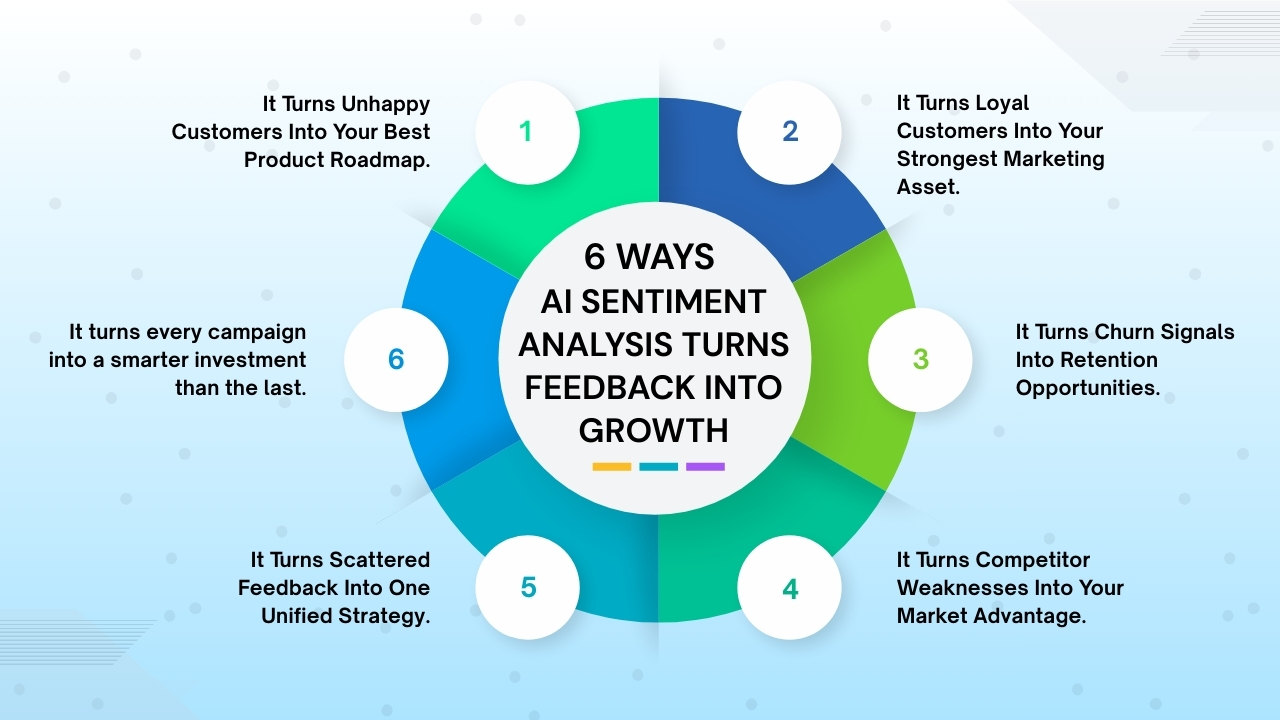
1. It turns unhappy customers into your best product roadmap
Most product teams build based on what’s loudest internally, not what’s hurting customers most.
The result?
- Features no one asked for.
- Bugs that linger for months.
- Friction that quietly drives churn while the team ships updates that miss the point entirely.
AI sentiment analysis changes this by aggregating every complaint, frustration, and feature request across different channels and helps your product team build a roadmap rooted in real customer need, so every sprint closes the gap between what you ship and what customers actually want.
Also Read: Restaurant Review Sentiment Analysis
2. It turns loyal customers into your strongest marketing asset
The most powerful marketing copy your team will ever write already exists in your customers’ own words.
- It’s in the five-star review that describes exactly why they chose you.
- The tweet praises a specific feature.
- The email thanking your support team for solving a problem that competitors couldn’t.
Most businesses never mine this. They use internal language, internal assumptions, and internal priorities that customers don’t recognize or connect with.
AI sentiment analysis flips this. It identifies recurring themes of praise, the exact language customers use, and the specific experiences that generate genuine delight, and helps your marketing team mirror that language back in every campaign, ad, and message.
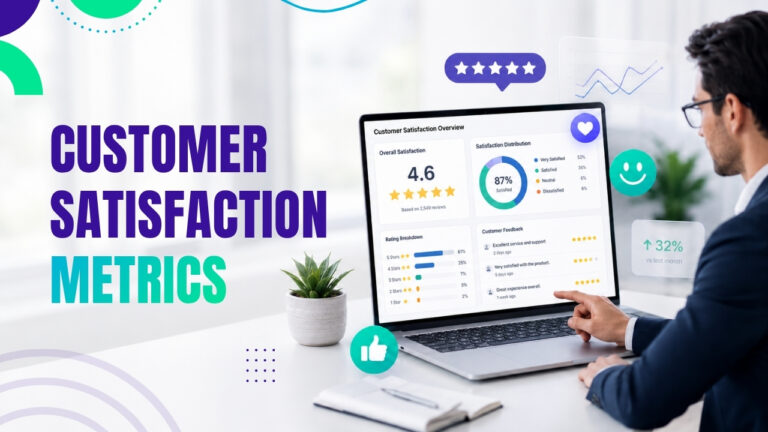
Also Read: Customer Satisfaction Metrics
3. It turns churn signals into retention opportunities
Churn is rarely sudden. It’s a slow burn.
- It starts with a frustration that goes unaddressed.
- Then, a support ticket felt dismissive.
- Then three weeks of silence, where the customer stops engaging.
They don’t do it suddenly. They drift. And, you don’t realize, until it’s done.
A customer sentiment analysis detects the early warning signs: a spike in negative sentiment from a specific customer segment, a drop in positive mentions after a product update, a recurring complaint that’s accelerating in volume, and alerts your customer success team before the decision is made.
Also Read: Online Reputation Management Complete Guide
4. It turns competitor weaknesses into your market advantage
Your competitors’ unhappy customers are telling you exactly how to win.
- Every one-star review on a competitor’s G2 page,
- every frustrated tweet,
- every forum complaint
is a window into what the market wants and isn’t getting.
Most businesses never look.
But, AI sentiment analysis monitors public sentiment across your competitive landscape, tracking what their customers complain about, what’s missing from their product, and where trust is eroding, and helps you position your brand directly in that gap.
Also Read: How to Respond to Negative Customer Reviews
5. It turns scattered feedback into one unified strategy
Here’s a problem every growing business faces: feedback lives everywhere and means different things to different teams.
- Your support team sees complaints.
- Your marketing team sees reviews.
- Your product team sees feature requests.
- Your leadership team sees NPS scores.
Everyone has a piece of the picture. Nobody has the whole thing.
This creates misalignment at the strategic level. It is worse. But the customer sentiment analysis tool consolidates every feedback signal into a single, real-time view that every department and every leader can act from, and is all aligned around the same customer reality.
Also Read: Customer Sentiment Analysis Vs Customer Feedback Analysis
6. It turns every campaign into a smarter investment than the last
Most marketing teams treat campaigns as isolated events. Launch. Measure. Move on.
The problem with this approach is that every campaign generates an enormous amount of customer sentiment:
- how people reacted, what resonated,
- What fell flat,
- What triggered frustration, and almost none of it gets carried forward into the next campaign.
The learnings evaporate. The budget resets. The cycle repeats.
AI sentiment analysis breaks this cycle by capturing exactly how customers responded to every message, launch, and touchpoint and feeding those insights directly into the next campaign’s strategy.
That’s the compounding effect of treating every campaign as a learning opportunity. Your messaging gets sharper. Your targeting gets tighter. Your ROI grows with every cycle. Every campaign is better than the last.
Also Read: How Restaurant AI Customer Feedback Tools Turns Review into Actionable Insights
How to Choose the Best AI Sentiment Analysis Software?
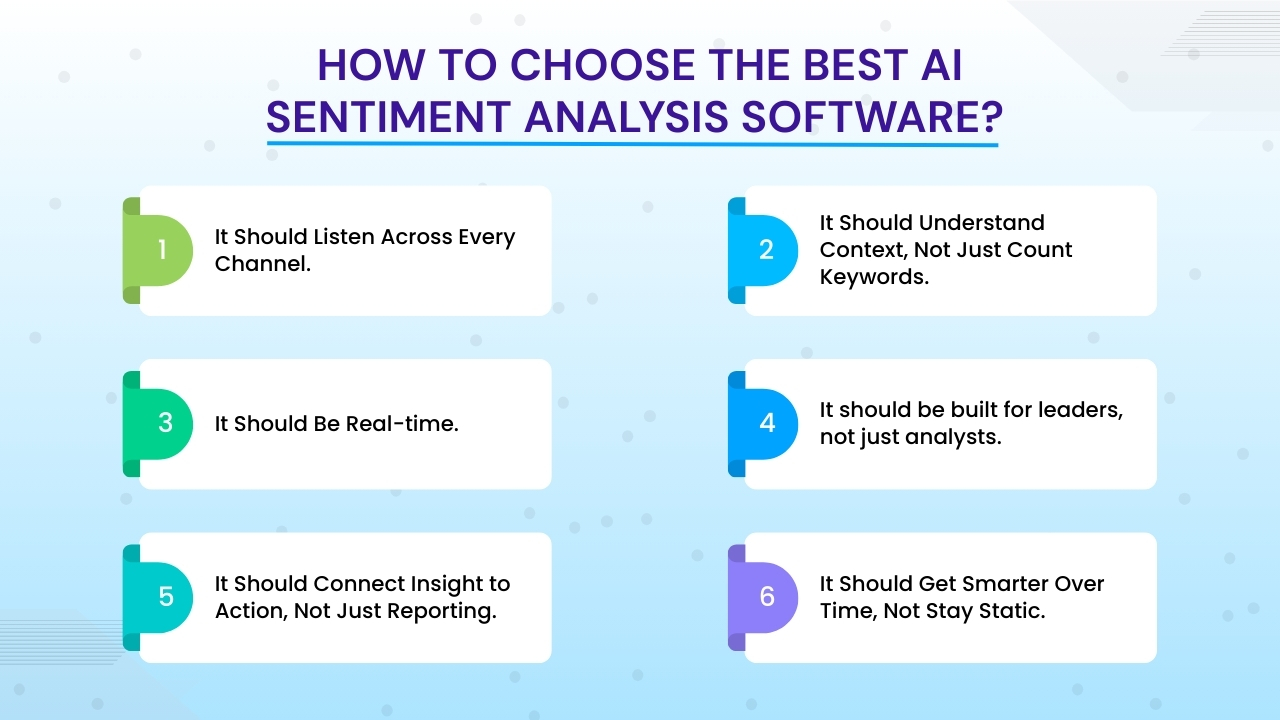
Choosing the wrong tool doesn’t just waste budget. It creates a false sense of security; you think you’re listening, but you’re missing everything that matters.
Here’s exactly what to look for before you commit.
1. It should listen across every channel
Most basic tools monitor one or two channels. A review platform. Maybe Twitter.
But your customers don’t stay in one place. They complain on Reddit, praise you on Google, and ask questions on LinkedIn, often on the same day.
The right tool captures feedback from every channel simultaneously, reviews, social media, support tickets, surveys, emails, and forums, so you never have a blind spot. If it can’t listen everywhere, it can’t give you the full picture.
2. It should understand context, not just count keywords
A tool that flags “negative” 40 times a week is not sentiment analysis. That’s a word counter.
Real AI sentiment analysis understands nuance. It knows that surprisingly good is positive. That “not what I expected” could go either way. That “I’ve recommended this to everyone I know” is your highest-value customer signal.
Look for a tool that detects emotion, urgency, and intent, not one that simply sorts feedback into red and green buckets.
3. It should be real-time
Sentiment moves fast. A product issue that generates 50 complaints on Monday morning can become a viral thread by Monday afternoon.
Weekly or even daily reports don’t give you the window you need to act. By the time the report lands in your inbox, the damage is already done.
The right tool surfaces negative sentiment spikes the moment they appear, so your team can respond instantly. That’s the whole point.
4. It should be built for leaders, not just analysts
Most enterprise tools are built for data teams. They’re powerful, complex, and completely inaccessible to the CEO, CMO, or COO who actually needs to act on the insights.
The right tool translates complex sentiment data into clear, role-specific insights that every leader can understand and act on without needing a data scientist to interpret the dashboard.
Also Read: AI Tools to Analyze Customer Reviews
5. It should connect insight to action, not just reporting
A dashboard full of sentiment data is only valuable if it tells you what to do next.
Look for a tool that doesn’t just show you what customers feel, but helps you act on it. Whether that’s flagging an at-risk customer segment for your CS team, surfacing a trending complaint for your product team, or identifying the right moment to launch a campaign for your CMO.
Insight without action is just an expensive report. The right tool closes the gap between knowing and doing.
Also Read: How to Manage Online Reviews for Your Business
6. It should get smarter over time, not stay static
A good sentiment tool learns. The longer it runs, the better it understands your specific customers, your industry language, and your brand context.
Look for a tool that improves with every feedback signal it processes, so your insights six months from now are sharper, faster, and more accurate than they are today.
Also Read: How AI can Analyze Customer Feedback
Clariv as an AI-Powered Customer Feedback Analysis Tool for Growth Opportunities!
There are plenty of sentiment tools out there. Most collect data. Some visualize it. Very few actually help you act on it.
Here’s what makes Clariv different.
1. Smart Customer Sentiment Breakdown: It reads feedback like a human would
It picks up emotions, context, and the topics customers care about most, instantly telling you what’s driving satisfaction and what needs immediate attention.
95%+ emotion detection accuracy. 3x faster insight discovery. Zero manual reading required.
Trend & Pattern Detection: It connects the dots before you even know there’s a pattern.
Instead of digging through hundreds of feedback points manually, Clariv spots rising issues, repeated complaints, and shifts in customer mood, automatically.
Detect recurring issues 6x earlier. Uncover 40% more trends through automation. No more surprise dips in ratings or customer experience.
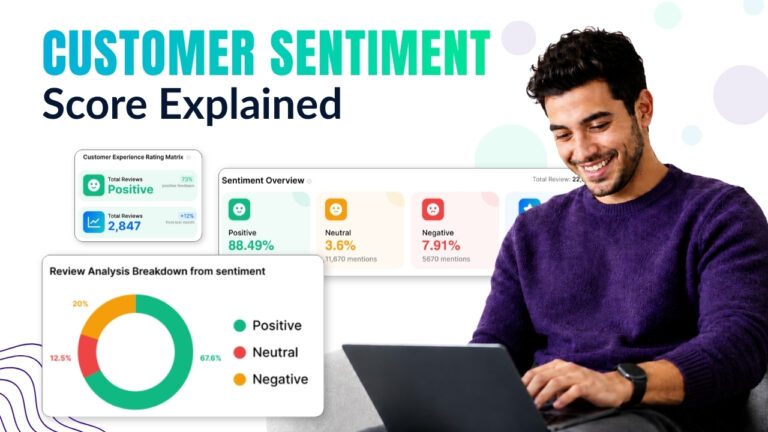
Also Read: Customer Sentiment Score Explained
2. Predictive Sentiment Insights. It tells you what’s coming, not just what happened
Clariv’s ML-powered forecasting engine anticipates sentiment shifts, spots churn risks early, and predicts future trends, so you stay ahead of customer expectations instead of scrambling to catch up.
25% better forecast accuracy. 50% fewer last-minute escalations.
3. Real-Time Alerts on Negative Sentiment: It finds problems so you don’t have to hunt for them
The moment customer sentiment drops, Clariv notifies you instantly, so you catch issues early, long before they spread, escalate, or damage your ratings.
70% faster response time to customer issues. Fewer rating drops. More control over your brand reputation, every single day.
4. Social Media Scheduling: It connects insight directly to action
This is where Clariv goes further than every other tool on the market.
Most sentiment tools stop at insight. Clariv connects that insight directly to your social media scheduling, so when positive sentiment is peaking, your team publishes content that rides that momentum at exactly the right moment.
Also Read: Social Media Management Tools for Non-Profits
5. Single Unified Dashboard, Everything in one place, always
Reviews, comments, trends, alerts, reports, and real-time insights, all in one clean, easy-to-read dashboard. No switching tabs. No juggling tools. No digging for answers.
6. In-Store & On-Site Feedback, it captures what happens offline, too
Not all customer feedback happens online. Clariv collects and analyzes feedback from kiosks, tablets, QR codes, and in-person forms, giving you a complete picture of customer experience across every location, not just every channel.
Online and offline. All in one view.
7. 50+ Languages — Built for businesses without borders
Whether your customers are in California, Manchester, or Miami, Clariv processes and analyzes sentiment across 50+ languages in one unified dashboard.
Every customer. Every market. Every language. Understood.
Easy Setup, Live in minutes, not months.
No steep learning curve. No IT dependency. No complicated onboarding.
Clariv is built for business leaders, not data scientists. Connect your channels, and you’re live with insights flowing into your dashboard immediately.
Expert assistance available. 24/7 support included. Always.
8. Flexible Pricing, Built for businesses at every stage
Whether you’re a growing startup or a scaling enterprise, Clariv has a plan that fits.
Start with a 14-day free trial. No credit card required. Access all Professional plan features with up to 100,000 sentiments per month. Upgrade, downgrade, or cancel anytime.
No risk. No lock-in. Just clarity from day one.
Final Thoughts
Customer feedback has always existed. The difference today is how fast it moves, how far it travels, and how much it shapes what people decide about your brand, before you even know a conversation is happening.
AI sentiment analysis has made it possible for any business, regardless of size, industry, or market, to listen at scale, understand deeply, and act at the speed customers expect.
If you’re curious about how customer sentiment analysis works and changes things for your business, experience it in real-time with Clariv. Get started with a 14-day free trial. No credit card required. No rigid commitment. Just a clearer picture of what your customers are really thinking.