If you’re leading customer experience, marketing, or product strategy today, you already know this: feedback is everywhere.
It’s in reviews. It’s in support tickets. It’s in chat transcripts. It’s in social comments. And yes, it’s still in surveys.
But,
- Are traditional surveys giving you the full picture of how your customers actually feel?
- Or are you only hearing from the 5 to 30% who chose to respond?
Most of the time, it’s 5% or less.
You are making decisions for all your customers based on just 5 to 30% or fewer reviews. That’s a huge gap.
Most businesses still rely heavily on post-purchase surveys, NPS forms, and quarterly feedback questionnaires. And while those methods once worked well, customer behavior has changed. Today’s customers don’t wait for your survey link. They share opinions in real time, publicly and emotionally.
In fact, studies show that 73% of customers expect brands to understand their unique needs.
That’s where the conversation shifts from traditional surveys to a customer sentiment platform powered by AI.
In this guide, we’ll break down the basics of customer sentiment platforms, real differences between traditional customer surveys and AI-powered customer sentiment platforms, where traditional surveys fall short, and what AI-driven sentiment analysis makes possible for businesses serious about customer experience.
Also Read: How to Measure Customer Sentiment
What is Customer Sentiment Analysis Platform vs Traditional Surveys?
When businesses talk about listening to customers, they usually mean one of two things: sending surveys or analyzing real customer conversations at scale.
While both aim to capture feedback, they operate very differently, and the depth of insight they deliver differs.
Let’s break it down clearly.
What Is a Customer Sentiment Analysis Platform?
A customer sentiment analysis platform is an AI-powered system that automatically analyzes customer conversations across multiple channels to understand emotions, tone, intent, and satisfaction levels in real time.
Instead of waiting for customers to fill out a form, it listens to:
- Customer reviews
- Social media comments
- Support tickets
- Chat transcripts
- Emails
- Call transcripts
- App store feedback
Using Natural Language Processing (NLP) and machine learning, the platform detects whether sentiment is positive, negative, or neutral and, more importantly, why.
What It Delivers:
- Real-time customer sentiment tracking
- Emotion detection (frustration, excitement, confusion, anger)
- Theme and trend identification
- Early churn signals
- Competitive and brand perception insights
- Predictive customer experience analytics
Instead of structured answers to predefined questions, you get organic, unfiltered customer voice at scale.
What Are Traditional Customer Surveys?
Traditional surveys are structured feedback tools where businesses ask customers predefined questions after an interaction, purchase, or milestone.
Common formats include:
- NPS (Net Promoter Score) surveys
- CSAT (Customer Satisfaction Score) surveys
- Post-purchase feedback forms
- Quarterly feedback questionnaires
Surveys usually rely on rating scales (1–5, 1–10) and optional open-text responses.
What They Deliver:
- Quantitative satisfaction scores
- Specific answers to targeted questions
- Controlled, structured feedback
- Benchmarking metrics (like NPS over time)
However, surveys depend entirely on customers choosing to respond and on how honestly or thoroughly they answer.
Also Read: Sentiment Analysis Demo
The Core Difference in One Line
Traditional surveys ask customers what they think.
Customer sentiment analysis platforms analyze what customers actually say, everywhere.
Why are Traditional Surveys Not Enough Now & Brands are Shifting towards Customer Analysis Platforms?
For years, surveys were the standard way to measure customer satisfaction. Send a form, collect ratings, analyze feedback, repeat.
But customer behavior has changed.
Today, customers don’t wait for surveys. They express opinions instantly, in reviews, support chats, emails, and social conversations. If you’re only tracking survey responses, you’re capturing a fraction of your customer voice.
Meanwhile, businesses using AI-powered customer sentiment analysis platforms are monitoring real-time emotions, emerging issues, and churn signals across all channels, not just from those who respond.
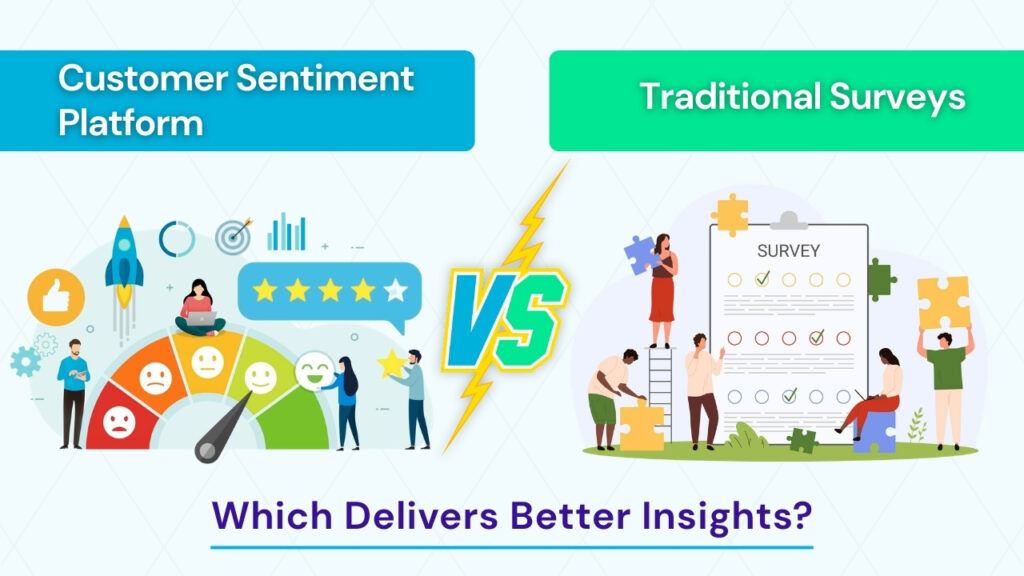
Traditional Surveys vs Customer Sentiment Analysis Platforms
| Critical Area | Traditional Surveys | Customer Sentiment Analysis Platform |
| Customer Coverage | Limited to 20–30% average response rates. Most customers never respond. | Captures insights from nearly all customer conversations across channels. |
| Type of Data | Structured ratings (NPS, CSAT) + limited text comments. | Unstructured, real conversations analyzed using AI and NLP. |
| Speed of Insights | Delayed, insights come after survey cycles close. | Real-time sentiment detection and alerts. |
| Emotional Understanding | Focused on scores; emotion depends on optional comments. | Automatically detects frustration, urgency, confusion, satisfaction, and trends. |
| Bias Risk | Often overrepresents extremely happy or unhappy customers. | Includes everyday organic feedback, reducing extreme bias. |
| Churn Signals | Reactive dissatisfaction shows up after it grows. | Proactive, negative sentiment trends flag early risk. |
| Scalability | Manual effort needed for open-text analysis. | Processes thousands to millions of interactions instantly through automation. |
| Decision Impact | Periodic satisfaction snapshots. | Continuous customer intelligence for faster decisions. |
Starbucks started its deep brew AI program to collect customer sentiment at scale.
Starbucks needed a way to monitor brand perception at scale, across thousands of daily social mentions, and turn that unstructured data into decisions that actually moved the business forward.
What They Did: Starbucks deployed AI sentiment analysis to continuously monitor social media conversations and online reviews, proactively identifying negative feedback before it spread and capitalizing on positive sentiment to strengthen brand positioning.
The Result: The ability to detect sentiment shifts in real time gave Starbucks’ marketing and CX teams a continuous feedback loop, allowing them to adjust campaigns, address complaints faster, and make product decisions grounded in actual customer voice rather than delayed survey data.
Also Read: Restaurant Review Sentiment Analysis
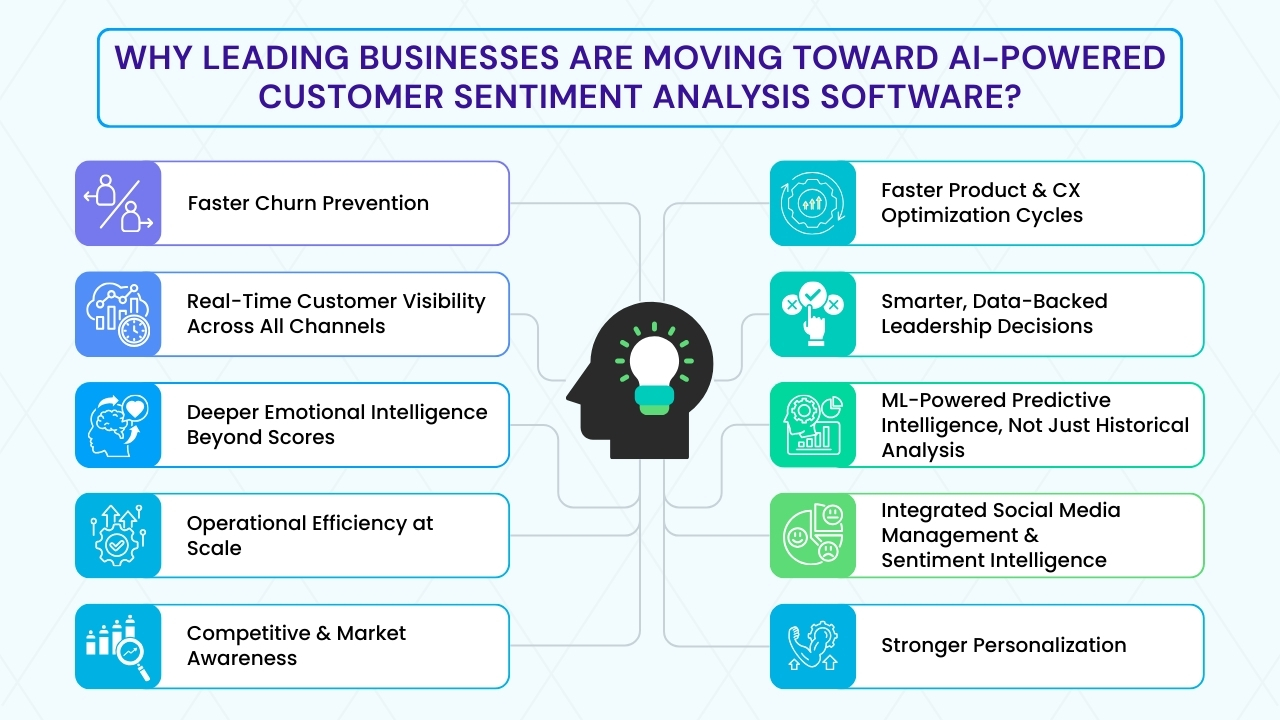
Why Leading Businesses Are Moving Toward AI-Powered Customer Sentiment Analysis Software?
Customer feedback hasn’t slowed down. It has multiplied.
Every day, customers are expressing opinions across reviews, chats, emails, communities, support tickets, and social platforms. The challenge is no longer collecting feedback. It’s understanding it, fast enough to act.
That’s why leading businesses are moving toward AI-powered customer sentiment analysis software. Not because surveys stopped working entirely, but because they don’t move at the speed of customer reality anymore.
Here’s the real impact organizations are seeing
1. Faster Churn Prevention
Churn rarely happens suddenly. It builds gradually through unresolved friction, repeated complaints, or declining engagement.
Traditional surveys detect dissatisfaction after it becomes visible in scores. By then, the damage is often done.
AI-powered customer sentiment analysis software identifies early warning signals hidden inside everyday conversations
Subtle language like:
- This is getting frustrating.
- I’ve had to contact support twice.
- Still waiting for a resolution.
These signals often appear weeks before churn.
By identifying early dissatisfaction patterns, businesses can intervene proactively, reducing churn and improving retention before revenue is affected.
2. Real-Time Customer Visibility Across All Channels
Modern customers interact across multiple channels, and their sentiment shifts quickly.
AI sentiment analysis provides real-time dashboards and alerts, giving leadership teams immediate visibility into:
- Reviews
- Support conversations
- Emails
- Social mentions
- Call transcripts
This gives decision-makers a live dashboard of customer emotion instead of a quarterly snapshot.
- That means product teams spot recurring complaints faster.
- Marketing teams see brand perception shifts early.
- CX teams respond before issues escalate publicly.
And make decisions accordingly to better manage their brand reputation across different channels.
3. Deeper Emotional Intelligence Beyond Scores
A satisfaction score tells you what customers selected. It doesn’t explain emotional intensity.
Two customers may rate you a 7, but one may feel mildly neutral while the other is on the verge of switching.
AI-powered sentiment analysis detects tone, urgency, frustration, delight, confusion, and emerging themes automatically.
This level of emotional context helps teams:
- Prioritize critical issues
- Identify product friction
- Improve onboarding experiences
- Strengthen brand perception
- Improve customer experience, throughout
- Improve product or service
Clariv goes beyond positive or negative tagging; it clusters themes and emotional drivers, helping product and CX teams understand what’s actually influencing customer perception.
4. Operational Efficiency at Scale
As customer interactions grow, so does the volume of feedback.
Manually reviewing thousands of open-text responses, chat transcripts, and reviews is not scalable. It slows teams down and turns analysts into data sorters instead of insight drivers.
AI-powered sentiment analysis platforms automatically process large volumes of unstructured data, clustering themes, detecting anomalies, and highlighting high-impact risk areas in seconds.
The result?
- Faster decisions.
- Lower operational overhead.
- Higher productivity without increasing team size.
5. Competitive & Market Awareness
Surveys only tell you what your customers think when you ask them.
But customers are constantly discussing competitors publicly, and those conversations reveal switching triggers and market expectations.
AI-powered sentiment analysis tools monitor brand and competitor mentions across public platforms, helping businesses understand:
- Why customers choose alternatives
- Where competitors are underperforming
- How market perception is shifting
Clariv supports continuous brand sentiment monitoring, allowing businesses to track their positioning relative to competitors across the broader customer conversation landscape.
That kind of external visibility turns customer feedback into strategic market intelligence.
6. Faster Product & CX Optimization Cycles
When feedback lives inside spreadsheets or scattered reports, improvement cycles slow down. Teams debate opinions instead of acting on patterns.
AI-powered customer sentiment analysis software automatically clusters recurring themes and highlights anomalies across thousands of conversations.
For example:
- Repeated complaints about onboarding steps
- Confusion around pricing tiers
- Feature-related friction emerging after a new release
Instead of manually scanning feedback, platforms like Clariv surface high-impact themes in real time, helping product and CX teams prioritize what truly affects customer perception. That means faster iteration, smarter roadmap decisions, and fewer blind launches.
7. Smarter, Data-Backed Leadership Decisions
Executives don’t just need metrics; they need clarity on what’s driving those metrics.
Traditional surveys provide satisfaction scores. But they rarely explain the root cause behind the score movement.
AI sentiment analysis transforms unstructured feedback into:
- Sentiment trends over time
- Theme-based impact analysis
- Risk alerts
- Emerging opportunity signals
With this, leadership teams gain a live pulse of customer emotion instead of waiting for periodic performance reviews.
It leads to more confident strategic decisions, whether it’s reallocating budget, adjusting messaging, or refining service workflows.
8. ML-Powered Predictive Intelligence, Not Just Historical Analysis
Most traditional feedback systems tell you what already happened.
AI-powered sentiment analysis, enhanced with machine learning, goes further; it identifies patterns and predicts what’s likely to happen next.
By analyzing historical sentiment trends, recurring friction themes, and behavioral shifts, ML models can:
- Predict rising churn risk segments
- Forecast potential reputation dips
- Identify product adoption slowdowns
- Detect dissatisfaction trends before they spike
Clariv combines sentiment intelligence with machine learning models to surface predictive signals, helping businesses move from reactive reporting to forward-looking strategy.
- Instead of asking, Why did this happen?
- You start asking, What’s about to happen, and how do we prepare?
That’s future intelligence working, and that shift changes how leadership plans.
Also Read: Social Media Management Tools for Non-Profits
9. Integrated Social Media Management & Sentiment Intelligence
Today, brand reputation lives on social platforms.
Customers don’t just leave feedback; they post opinions publicly. A single unresolved complaint can influence hundreds or thousands of potential buyers.
When social management and sentiment analysis exist in separate tools, teams operate in silos, listening in one dashboard and acting in another.
Clariv bridges that gap.
Beyond customer sentiment analysis, Clariv also supports social media management and scheduling, allowing businesses to monitor brand sentiment and act from the same ecosystem. Teams can align posts with real-time audience emotion, respond to negative sentiment faster, and proactively manage brand perception.
This integrated approach strengthens social reputation management and ensures businesses are not just listening, but leading the conversation.
Also Read: Brand Reputation Management Software
10. Stronger Personalization
Most personalization strategies rely on behavioral data such as page visitors, purchase history, usage frequency, etc.
It is useful, but behavioral data only shows what a customer did, not how they felt while doing it. And emotion directly influences decision-making.
Traditional analytics systems miss this emotional layer.
AI-powered customer sentiment analysis tools fill that gap by analyzing tone, language patterns, urgency signals, and recurring emotional themes across conversations.
This allows businesses to:
- Identify emotionally frustrated segments before churn
- Detect delighted users who are ready for upsells or advocacy programs
- Recognize confused customers who need education, not promotion
- Tailor messaging based on emotional state, not just activity
When personalization includes emotional intelligence, that’s where modern customer experience strategies outperform traditional segmentation models. Marriott International, Scaling Guest Feedback Across 7,000+ Properties
With over 7,000 properties worldwide, Marriott had no scalable way to consistently monitor what guests were saying or to act on it quickly enough to matter.
What They Did: Marriott implemented AI sentiment analysis to process guest reviews across social media, review platforms, and internal surveys simultaneously. The system identified recurring themes, room cleanliness, staff friendliness, and quality at both the property and corporate levels, allowing them to benchmark performance and surface best practices across their entire portfolio.
The Result: Properties using real-time sentiment monitoring were able to respond to guest concerns before they escalated. Hotels that respond to online reviews see 85% of guests more likely to see guests return. And, a brand operating at Marriott’s scale, that retention impact compounds significantly across millions of annual stays.
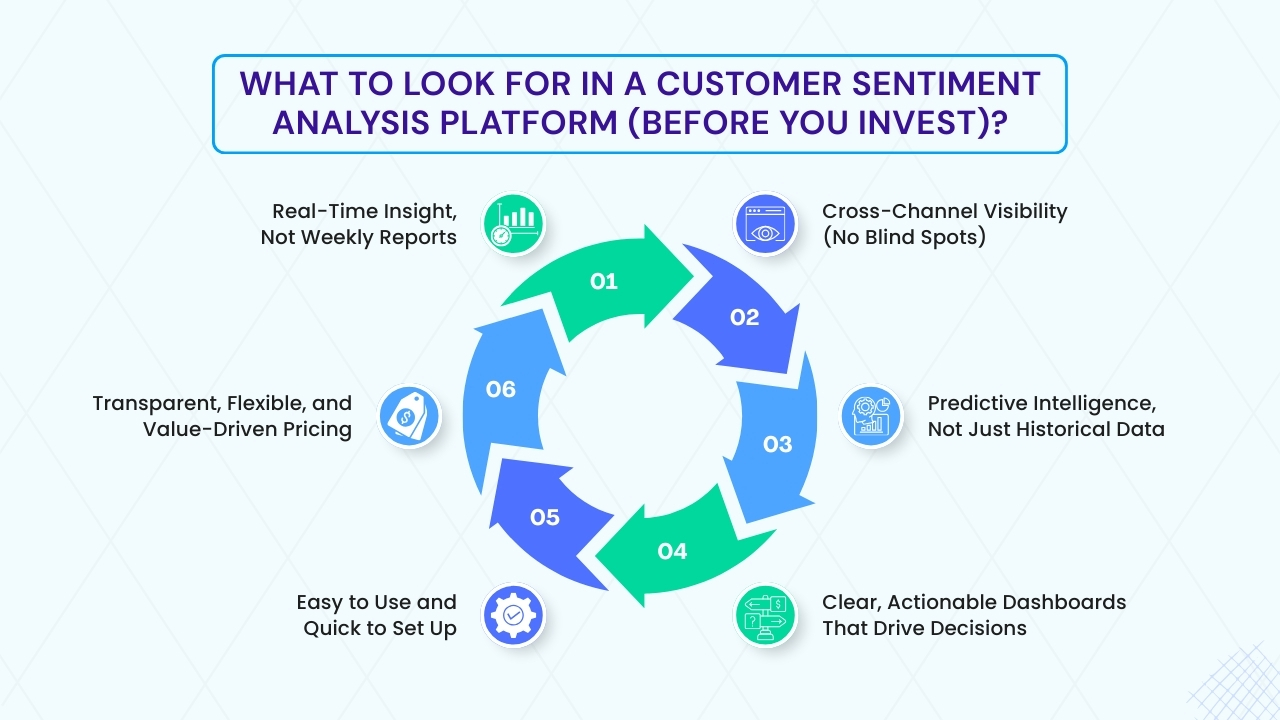
What to Look for in a Customer Sentiment Analysis Platform (Before You Invest)?
If you’re considering moving beyond traditional surveys, the real question isn’t: Should we use sentiment analysis?
It’s: Which platform will actually help us make better business decisions?
Because not every tool that says AI-powered delivers real intelligence.
Here’s what truly matters.
1. Real-Time Insight, Not Weekly Reports
Customer sentiment changes fast.
If a product update causes frustration today, you can’t wait for next month’s report to discover it.
A strong platform should:
- Monitor conversations as they happen
- Alert you to sudden negative spikes
- Show live sentiment trends
If insights are delayed, decisions are delayed.
2. Cross-Channel Visibility (No Blind Spots)
Customers don’t stay in one channel. They leave reviews, message support, comment on social media, and send emails.
If your sentiment tool only analyzes one data source, you’re still seeing a partial reality.
So, while choosing your customer sentiment analysis tool, make sure it combines all the data sources for you, and you get to see one single source of truth for all. Ithelpsp in unified idea and better decisions.
3. Predictive Intelligence, Not Just Historical Data
Looking at past complaints is helpful. Predicting the future is powerful.
A modern platform you choose should have machine learning capabilities, so instead of just collecting past and present information, you can also predict the future, which helps you:
- Detect early churn signals
- Identify rising dissatisfaction patterns
- Highlight emerging product friction
- Flag reputation risks before they trend
This moves your team from reactive firefighting to proactive prevention.
4. Clear, Actionable Dashboards That Drive Decisions
A sentiment platform shouldn’t overwhelm you with data; it should make decisions easier.
The right solution provides simple, easy-to-read dashboards that clearly show:
- What’s driving negative or positive sentiment
- Which themes need urgent attention
- How sentiment is trending over time
More importantly, it should go beyond visualization and offer clear recommendations, so your team knows exactly what to prioritize next.
Insight is valuable. Actionable insight is powerful.
5. Easy to Use and Quick to Set Up
Insight should not come with complexity.
If a tool takes weeks to implement, requires heavy technical support, or demands specialized analysts just to interpret data, it becomes a burden, not a solution.
A modern sentiment platform should be:
- Intuitive for all teams (CX, marketing, product, leadership)
- Fast to onboard with minimal setup time
- Designed so users can start seeing value within days
- Supported with helpful documentation and guidance
Platforms that are easy to adopt encourage wider usage across departments, increasing impact and reducing resistance to change.
6. Transparent, Flexible, and Value-Driven Pricing
Pricing matters more than ever, especially when shifting from traditional tools (like surveys) to advanced AI platforms.
A good sentiment solution should offer:
- Transparent pricing tiers
- Value that scales with usage
- Options for businesses of different sizes (startups to enterprises)
- Clear ROI justification (e.g., time saved, issues resolved faster, churn reduced)
Avoid tools that hide critical features behind expensive packages or surprise you with steep add-on costs.
You want a platform that grows with your business, not ahead of your budget.
How to Make the Shift From Traditional Surveys to Customer Sentiment Analysis?
Shifting away from survey-dependency doesn’t mean shutting everything down overnight.
The smartest approach is gradual:
- try out different customer sentiment analysis platforms through the free demo,
- See how it works in your business workflows, and then make the right choice.
To get things started, you can try the free demo for Clariv:
Why Businesses Choose Clariv?
Clariv is an AI-powered customer sentiment analysis platform that helps businesses go beyond scores and surface the emotions, patterns, and signals that actually drive customer experience decisions.
How does it help?
1. Smart Emotion Detection That Actually Understands Context
Most tools tell you a review is negative. Clariv tells you why, detecting the specific emotion, context, and topic behind every piece of feedback with 95% of accuracy and 3x faster, so your team always knows what to act on first, instantly.
2. Trend & Pattern Detection Before Issues Escalate
By the time a trend shows up in your survey data, it’s already affecting your ratings. Clariv connects the dots across channels automatically, surfacing recurring issues and emerging patterns weeks before they become visible problems.
3. Predictive Sentiment Intelligence
Clariv doesn’t just show you what happened; it gives you a clear signal of what’s coming with 25% of better forecasting. Through AI-powered forecasting and 50% fewer last minute exclations, your team moves from reactive reporting to forward-looking strategy and achieves better retention.
4. Instant Alerts on Negative Sentiment
You shouldn’t have to hunt for problems. Clariv notifies your team the moment sentiment drops, giving you the window to respond before a single complaint turns into a reputation risk.
5. One Dashboard. Every Insight. Zero Tool Switching.
Everything your team needs, reviews, trends, alerts, reports, and sentiment scores, lives in one clean, easy-to-read dashboard. No tab switching, no manual digging, just instant answers.
6. Seamless Integration With Your Existing Tools
Clariv connects with the business tools your team already uses, no complex setup, no data exports, no workflow disruption. Just real-time, connected insights from day one.
Ready to See It in Action?
The shift from surveys to real-time sentiment intelligence doesn’t have to be complicated. Clariv is designed to get you up and running fast with full access to every feature from day one.
Start your 14-day free trial, full access to all Professional plan features, up to 100,000 sentiments per month. No credit card required. Cancel anytime.
Final Thoughts
The way customers communicate has fundamentally changed. They share opinions continuously, across multiple channels, in their own words and on their own terms. Waiting for survey responses means waiting for a fraction of that conversation to reach you.
The businesses gaining a real edge in customer experience today aren’t just collecting more feedback; they’re understanding it faster, more accurately, and at a scale that surveys were never designed to handle.
AI-powered customer sentiment analysis doesn’t replace your instincts or your team. It gives them better information to work with.
If you’re at the point where survey data feels incomplete, where you know there’s more to the customer story than what’s coming back in your NPS scores, it might be worth exploring what a sentiment-first approach looks like for your organization.
Clariv offers a 14-day free trial, no credit card required, no commitment. Just a clearer picture of what your customers are actually telling you.