Ever wonder what your diners are really thinking?
You know that feeling when you’re scrolling through your restaurant’s reviews at 11 PM, and you come across one that just says food was okay with three stars? And you’re sitting there thinking, okay? OKAY?
- What does that even mean?
- Was it the seasoning?
- The temperature?
Did their pasta arrive thirty seconds later than they expected?
Here’s the thing: your guests are talking. They’re sharing their experiences, their expectations, their little moments of joy (or disappointment) in those review boxes on Google, Yelp, and OpenTable. But here’s what most restaurant owners miss: words don’t always mean what they seem to mean.
- That okay might actually be hiding genuine disappointment.
- That enthusiastic amazing could be hiding a subtle complaint buried three sentences later. And that wall of text praising your ambiance?
- There might be a critical insight about your service speed tucked right in the middle that you’re completely missing.
A survey found that 33% of restaurant-goers would avoid a restaurant with an average 3-star review on major review sites like Yelp or Google.
This is where sentiment analysis comes in, and no, before you click away, this isn’t some complicated tech jargon that only data scientists understand. It helps you read between the lines of what your customers are actually saying about your restaurant.
Ready to decode what your diners are really telling you? Let’s dive in.
What is Customer Sentiment Analysis & How it Works?
Customer Sentiment Analysis in restaurant businesses is the process of understanding how diners feel about their experience by analyzing the words they use in reviews, feedback, surveys, and social comments, not just the star rating they leave behind.
Instead of asking Did we get 4 stars?, sentiment analysis helps restaurants answer deeper questions like:
- Were guests happy with the food taste or just the portion size?
- Was the service genuinely warm or simply fine?
- Did a long wait ruin an otherwise great dining experience?
Sentiment analysis goes beyond simple ratings to decode why guests feel a certain way. For example, a neutral or three-star review can contain both praise and criticism in the same paragraph, the kind of mixed sentiment humans often miss, but machines can detect systematically.
Also Read: How to Measure Customer Sentiment
How Sentiment Analysis Works in Restaurants?
Restaurants receive feedback from multiple touchpoints, Google Reviews, Yelp, OpenTable, delivery apps, and in-store surveys. Sentiment analysis uses AI and Natural Language Processing (NLP) to read this unstructured text and identify emotional signals hidden in guest language.
For example:
- The food was good, but we waited too long → Mixed sentiment
- Amazing ambiance, but the server seemed rushed → Positive + service concern
- Okay experience, probably won’t return → Neutral on the surface, negative intent underneath
This allows restaurants to spot patterns that manual review often misses.
In plain English, sentiment analysis is the process of determining whether a piece of text expresses a positive, negative, or neutral emotion.
But here’s where it gets interesting for restaurants: it’s not just about labeling reviews as happy face or sad face. Modern sentiment analysis can detect:
- The overall vibe (positive, negative, neutral, or mixed)
- Intensity levels (mildly pleased vs. absolutely ecstatic)
- Specific emotions (frustrated, delighted, disappointed, impressed)
- What exactly triggered those feelings (was it the food, service, ambiance, or value?)
When is the Restaurant Review Sentiment Analysis Important?
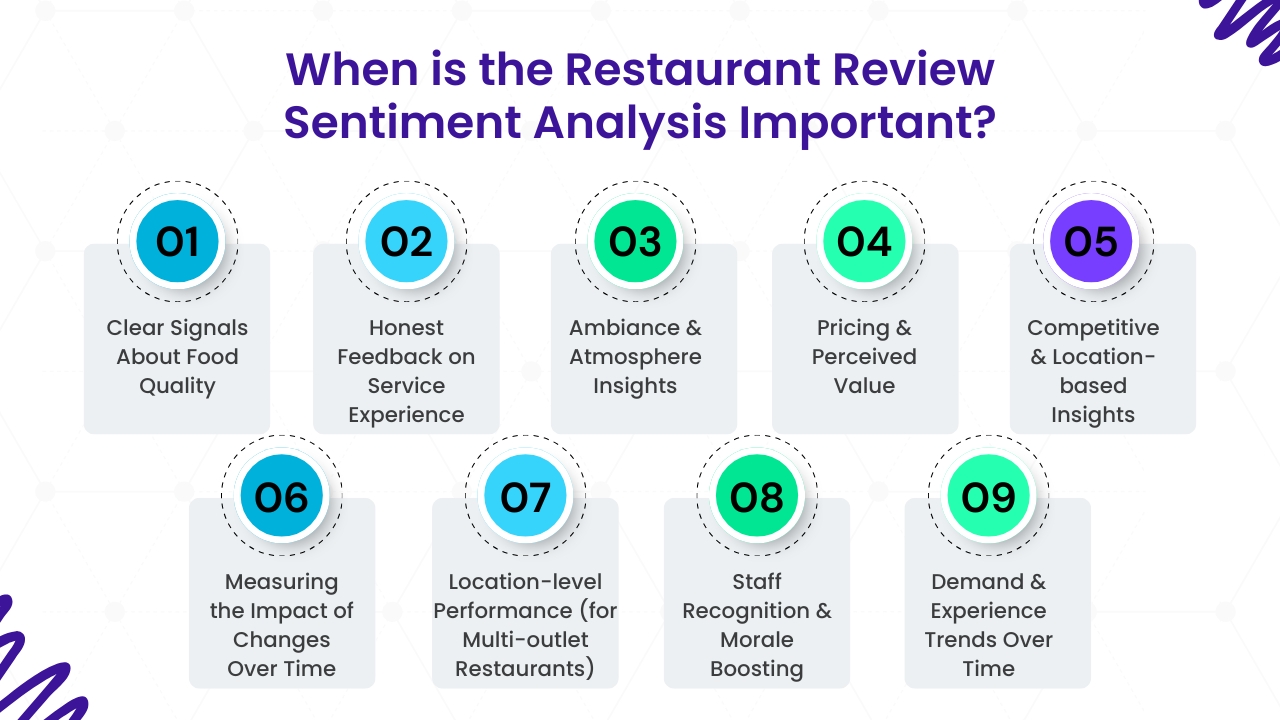
You’re busy running a restaurant, not sitting around analyzing feelings all day. So, sentiment analysis has gone from nice to have to absolutely important. It is because there are specific moments in your restaurant’s life cycle when understanding customer emotions becomes make-or-break.
Let’s talk about when sentiment analysis stops being optional and starts being your secret weapon.
1. Clear Signals About Food Quality
Sentiment analysis reveals how guests feel about taste, freshness, portion size, consistency, and presentation. A dish that gets frequent good, but…comments may look fine on the surface, but sentiment data can show growing disappointment around seasoning, temperature, or value for money, long before ratings start dropping.
For example, you can see that your truffle pasta gets mentioned a lot. But sentiment analysis tells you how people feel about it. Maybe it gets mentioned 50 times, but 30 of those are complaints about portion size. Meanwhile, that humble side salad nobody talks about? It’s getting consistent, quiet praise.
You learn: What dishes create genuine delight vs. which ones just create conversation. There’s a big difference.
Starbucks uses customer sentiment analysis & reported 50% higher revenue through loyalty members!
Starbucks actively analyzes customer sentiment across reviews, social media, and its mobile app feedback to understand customer emotions around service speed, personalization, and in-store experience.
Starbucks reported that insights from customer feedback and digital sentiment helped drive over 50% of U.S. sales through loyalty members, showing how listening to customer sentiment improved engagement and retention.
Also Read: Best Social Media Management Tools for Non Profits
2. Honest Feedback on Service Experience
Service-related emotions are often buried inside longer reviews. Sentiment analysis helps restaurants detect recurring frustrations around wait times, staff attentiveness, order accuracy, or front-of-house coordination. This makes it easier to identify training gaps and fix operational issues that directly impact repeat visits.
For example, customers often won’t complain directly about service to your staff. They’ll smile, tip okay, then go home and write”service was slow but food was great in their review. One comment like that? Easy to miss. Fifteen comments like that in a month? You have a problem.
Sentiment analysis catches these whispers before they become screams. It’ll show you:
- Which shifts have the most service complaints
- Whether it’s speed, attentiveness, or knowledge that’s the issue
- If specific servers are getting mentioned (positively or negatively)
- Whether your improvements are actually working
You learn: The invisible friction points in your guest experience that people don’t say to your face.
3. Ambiance & Atmosphere Insights
In restaurants, ambiance has a massive influence on customers’ overall experience. Guests frequently comment on noise levels, seating comfort, cleanliness, lighting, and overall vibe. Sentiment analysis groups these emotions, helping restaurants understand whether their ambiance supports the experience they want to deliver or quietly turns guests away.
For example, one cafe discovered that while their coffee got decent reviews, the sentiment around their cozy atmosphere and perfect work spot was through the roof. They leaned into it, added more comfortable seating, better WiFi, and quieter corners. They went from coffee shop to destination workspace, and revenue followed.
You learn: What emotional experience you’re actually selling beyond the food.
4. Pricing & Perceived Value
Sentiment analysis helps restaurants understand whether guests feel the price is worth the experience. This one’s sensitive, but crucial. By tracking these emotions at the menu-item level, restaurants can adjust pricing, portions, or value messaging before dissatisfaction impacts repeat visits.
People rarely say your prices are too high directly. Instead, they say things like:
- Good, but not worth the price
- Expected more for what we paid
- Generous portions, great value
- A bit pricey but totally worth it
Sentiment analysis identifies these value perceptions across hundreds of reviews, indicating whether your pricing aligns with your perceived value. Sometimes you’re undercharging for an experience people love. Sometimes you’re overcharging for something they think is just okay.
You learn: Whether your pricing strategy aligns with customer perception and where you have room to adjust.
5. Competitive & Location-Based Insights
Sentiment analysis can even help you with competitor review analysis as well.
Sentiment analysis of competitor reviews helps restaurants understand why diners choose others over them. By analyzing what guests praise or complain about in nearby competitors, such as pricing, portion sizes, service speed, or ambiance, restaurants can identify gaps and opportunities in their own offering and position themselves more clearly in the market.
If three nearby restaurants all have negative sentiment around takes forever to get the check, and you implement tableside payment? Boom, competitive advantage.
You learn: Market opportunities hiding in plain sight.
6. Measuring the Impact of Changes Over Time
Made changes to your menu, staffing, pricing, or layout? Sentiment analysis helps you see whether those changes actually improved guest perception, not just sales.
You think it’s working, but sentiment analysis tells you for sure. Compare sentiment scores before and after your changes and see the actual impact. No more guessing. No more, I think customers like the new layout. You’ll know, with data.
You learn whether your decisions are improving guest experience or accidentally making it worse. And, also, you get to know about the ROI on your operational changes and where to invest next.
Domino’s saw sales increase by 14.3% in one quarter.
Domino’s is one of the most cited examples of using customer feedback and sentiment to transform its brand. The company openly acknowledged negative sentiment around taste and quality, then rebuilt products and messaging based on customer perception.
After acting on customer sentiment, Domino’s saw same-store sales increase by 14.3% in one quarter, one of the strongest turnarounds in restaurant history.
7. Location-Level Performance (for Multi-Outlet Restaurants)
For restaurants with multiple locations, sentiment analysis shows how experiences differ across outlets, even with the same menu and pricing.
For example, you’ve got multiple locations, but one is struggling, and the others are already rocking it, and you can’t tell which is which from overall numbers.
Sentiment analysis breaks it down location by location. Suddenly you see:
- Location A: 78% positive sentiment – customers love the food, hate the parking
- Location B: 62% positive sentiment – great parking, inconsistent food quality
Same star ratings. Completely different problems.
The real power? You spot which location needs help before sales drop, see which team has figured something out worth copying, and stop spreading yourself thin across every location equally.
For franchise owners, this becomes your quality control system, catching issues before corporate inspections or angry escalations.
You learn: Where consistency breaks down and which locations can become internal benchmarks.
8. Staff Recognition & Morale Boosting
Sentiment analysis doesn’t only surface problems, it also highlights praise. When specific servers, hosts, or kitchen teams get consistent positive mentions, that feedback can be used for recognition and motivation.
Plot twist: sentiment analysis isn’t just about finding problems. It’s about catching people doing things RIGHT.
Imagine walking into Monday’s meeting with Jessica, you got mentioned by name eight times last week. Customers said you made their anniversary perfect.’
That hits differently than generic good job.
What happens next:
- Recognized employees feel genuinely valued
- Others see what excellence looks like
- Service quality rises because people know it matters
One owner started weekly Sentiment Spotlights, sharing top customer compliments. Service sentiment increased 15% in three months, not from training, just from showing people they’re being noticed.
You learn: Who your real MVPs are, what behaviors create magic, and how to keep great people around longer.
9. Demand & Experience Trends Over Time
Sentiment patterns change by season, time of day, or even local events. Sentiment analysis helps restaurants spot these shifts early.
Your restaurant stays at 4.3 stars all year. You’re stable, right?
Wrong. Sentiment analysis shows:
- January: 82% positive
- October: 68% positive
Same stars. Declining experience. You’re slowly bleeding regulars who just stop coming back.
Track trends to catch:
- The summer AC problem is tanking your ambiance scores
- Weekend service is suffering because you’re understaffed during peak times
- New menu items that customers tolerate vs. genuinely love
- Whether your $50K renovation actually improved the experience
Because running on yesterday’s assumptions is how you wake up wondering where your customers went.
For example, weekend brunch sentiment may be glowing while weekday dinner sentiment dips, signaling staffing or pacing issues.
You learn: When and where guest expectations change and how to adapt before complaints pile up.
How to Get Started with Restaurant Review Sentiment Analysis?
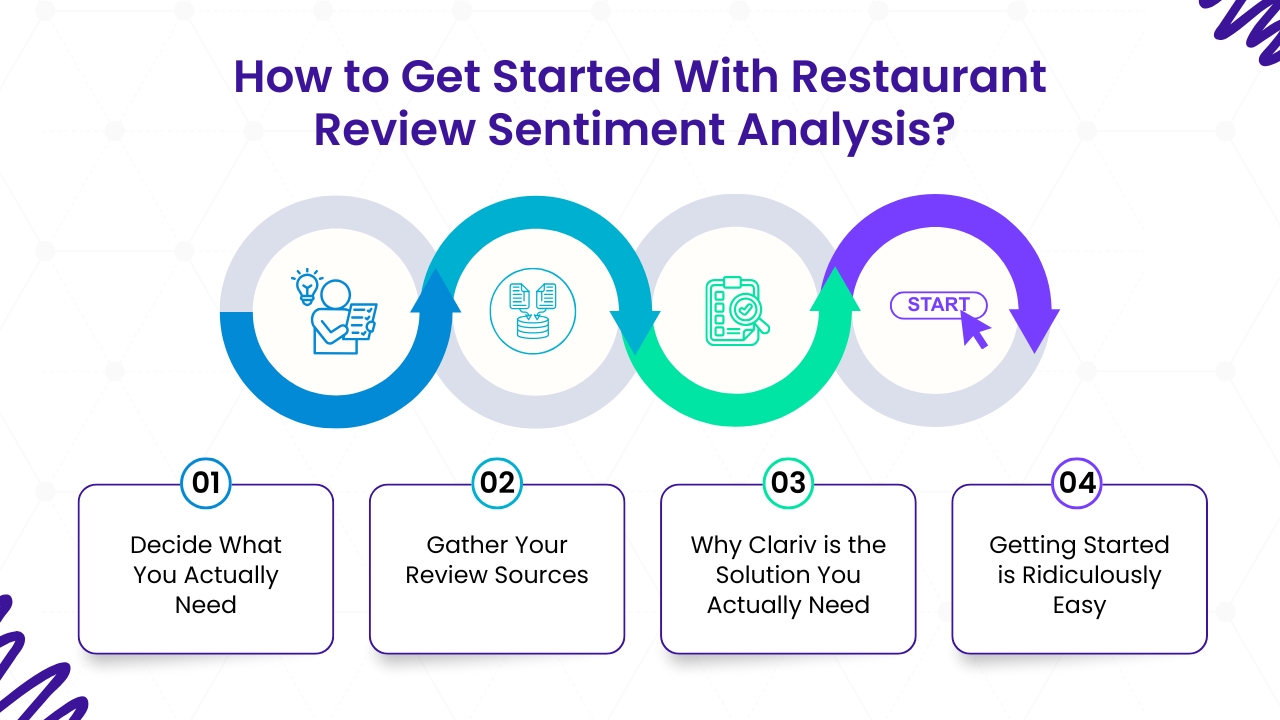
Alright, you’re sold on the idea. Now what? How do you actually make this happen without becoming a data scientist or hiring a team of analysts?
Good news: getting started is way easier than you think. Let me walk you through it.
Step 1: Decide What You Actually Need
Before jumping into tools, ask yourself:
- How many locations do you have? (Single spot vs. multi-location changes your needs)
- What’s your review volume? (20 reviews a month vs. 200 makes a difference)
- Where are your reviews coming from? (Google, Yelp, Facebook, TripAdvisor, all of the above?)
- What’s your actual goal? (Fix immediate problems? Track long-term trends? Beat competitors?)
Be honest about your bandwidth, too. Are you looking for a set it and forget it solution, or do you want to dive deep into the data regularly?
Step 2: Gather Your Review Sources
You need to know where your customers are talking about you:
- Google Business reviews
- Yelp
- TripAdvisor
- Facebook comments and reviews
- Instagram mentions
- OpenTable feedback
- Direct feedback forms or emails
- Third-party delivery platforms (UberEats, DoorDash, etc.)
Most restaurants are getting feedback from 5-8 different places. That’s a lot to monitor manually, which is exactly why you need automation, and this is where Clariv becomes essential.
Step 3: Why Clariv Is the Solution You Actually Need
You could try DIY spreadsheets or basic review platforms with simple sentiment features. But if you’re serious about understanding your customers and staying ahead of problems, you need a tool built specifically for this.
Clariv is an AI-powered customer sentiment analysis platform that does the heavy lifting for you. It gives you instant visibility into customer emotions, feedback, and market trends across all your channels.
Here’s what makes Clariv different and why restaurant owners are switching to it:
It Reads Reviews Like a Human (But Never Gets Tired)
Clariv doesn’t just scan for keywords or count stars. It reads every review and message like a human would, picking up emotions, context, and the topics people actually care about.
It knows that:
- The steak was burnt to a crisp = negative (obviously)
- I’d die for this dessert = positive (despite mentioning death)
- It was fine, nothing special = neutral leaning negative
- Not the worst I’ve had = actually kind of negative despite the double negative
You instantly see what’s driving customer satisfaction and what needs attention, no guessing, no manual reading through hundreds of comments.
The numbers: 95%+ accurate emotion detection and 3x faster insight discovery compared to manual analysis.
Clariv Spots Problems Before They Explode
Instead of you digging through feedback manually, trying to connect dots, Clariv does it automatically.
Each piece of feedback gets assigned a sentiment score. Think of it like a rating scale from very negative (-1) to very positive (+1), with neutral hanging out at zero. The system also tags what aspects of your restaurant each sentiment relates to.
It spots rising issues, repeated complaints, and changes in customer mood across all your locations and channels. For example: Your brunch service sentiment dropped 23% this month, or Customers are raving about your new cocktail menu.
See What’s Coming, Not Just What Happened
Here’s where Clariv gets really powerful: it doesn’t just show you yesterday’s sentiment. It uses AI-powered forecasting to help you anticipate what’s coming next.
You can spot churn risks before customers leave, predict future sentiment trends, and stay ahead of customer expectations instead of constantly playing catch-up. It’s like having a crystal ball, except it’s actually based on data patterns.
Here’s what makes this a game-changer: one review saying your service was slow might be a fluke. Ten reviews mentioning it over two weeks? That’s a pattern you need to address. Twenty reviews praising your outdoor seating in September? That’s an opportunity to lean into.
Know Exactly How Customers Feel About Your Brand
Clariv shows you precisely how customers feel about your brand across every single channel. You see the emotions behind reviews, comments, and messages, so you always know where you stand.
No more wondering if people are happy with us? You’ll have real-time sentiment scoring, week-over-week tracking, and instant visibility into the topics customers talk about most.
It’s like taking your restaurant’s emotional pulse, 24/7.
Get Instant Alerts When Things Go Wrong
You don’t have to hunt for problems or remember to check dashboards. Clariv notifies you the moment customer sentiment drops.
Whether it’s a spike in negative reviews, a service issue at a specific location, or complaints about a particular menu item, you know immediately. You catch issues early, long before they spread or damage your ratings.
The numbers: Instant alerts when negative sentiment spikes, 70% faster response time to customer issues, and reduced rating drops through early intervention.
Everything You Need in One Dashboard
Stop juggling six different tabs and tools. Clariv puts everything, reviews, comments, trends, alerts, and reports in one clean, easy-to-read dashboard.
No switching between Google Reviews, Yelp, Facebook, and Instagram. No digging for answers. Just instant clarity on what’s happening with your customer experience.
The numbers: 80% fewer tool switches with one unified hub, 1 dashboard for all channels and locations, and hours saved weekly through organized, centralized insights.
Integrates With Everything You Already Use
Clariv doesn’t make you abandon your existing tools. It integrates seamlessly with your favorite business platforms, your POS system, reservation software, social media accounts, and delivery platforms.
All your platforms, finally working together. No juggling. No hassles. Just real-time, connected business insights flowing into one place.
Also Read: Sentiment Analysis Demo
Step 4: Getting Started Is Ridiculously Easy
Here’s what the setup actually looks like with Clariv:
- Sign up for the 14-day free trial (no credit card required)
- Connect your review sources (takes about 10 minutes, Google, Yelp, social channels, everything)
- Let Clariv’s AI analyze your data (it processes historical reviews so you see patterns immediately)
- Configure your alerts (decide what you want to be notified about)
- Start getting insights (literally that same day)
No technical expertise needed. No complicated implementation. You get expert assistance during setup, easy configuration, and 24/7 support if you need help.
The Bottom Line
Your customers are already telling you everything you need to know. They’re spelling out what works, what doesn’t, and what would make them raving fans. The problem? You can’t see the patterns buried in hundreds of reviews while actually running a restaurant.
That’s what sentiment analysis fixes.
And here’s the kicker: you get your time back. No more midnight review deep-dives. No more wondering if complaints are one-offs or trends. No more reactive firefighting when issues you missed finally explode.
The Question Is Simple: What Are You Waiting For?
Clariv gives you instant visibility into customer emotions, spots problems 6x earlier, predicts trends before they hit, and puts everything in one dashboard. 95%+ accuracy. Real-time alerts. Insights you can actually use.
Book a free demo for 14 days. No credit card. No commitment. Just connect your reviews and see what you’ve been missing.