Have you ever wondered what customers really think about your brand? Not just what they say in reviews, but how they actually feel, their reactions, emotions, and impressions that don’t always make it into words.
That’s where customer sentiment comes in. It helps you understand whether people love your brand, feel neutral about it, or are quietly getting frustrated.
91% of high-ROI companies track customer sentiment in real time, meaning brands that monitor customer emotions are far more likely to see strong returns from their CX initiatives.
Measuring customer sentiment isn’t complicated. It’s simply about paying attention to the signals your audience already gives you, through feedback, social media, surveys, and everyday interactions. When you know how customers feel, you make better decisions, create better experiences, and improve your products with confidence.
Before we get into the different ways to measure sentiment, let’s quickly break down what it really means and why it matters for any growing business.
What is Customer Sentiment Analysis?
Customer sentiment analysis is the process of understanding how customers feel about your brand, products, or services. Instead of just looking at what they say, sentiment analysis helps you uncover the emotion behind their words, whether they’re happy, frustrated, confused, or excited. It’s basically a way for businesses to read between the lines and understand the overall mood of their customers.
As per IBM, it’s about using technology to figure out whether customers feel positive, negative, or neutral based on what they write or say.
Let’s understand with a simple example,
When a customer writes a review like: The coffee tasted amazing, but the service was slow. Sentiment analysis helps you understand the emotions behind it.
- The positive part (coffee tasted amazing) shows that the product is strong,
- while the negative part (service was slow) highlights a clear problem in the customer experience.
By breaking feedback into these emotions, businesses can see exactly what customers love and what frustrates them. It also helps you spot repeated issues early, strengthen what’s already working, and create a better overall experience that keeps customers happy and loyal.
What are the Benefits of Customer Sentiment?
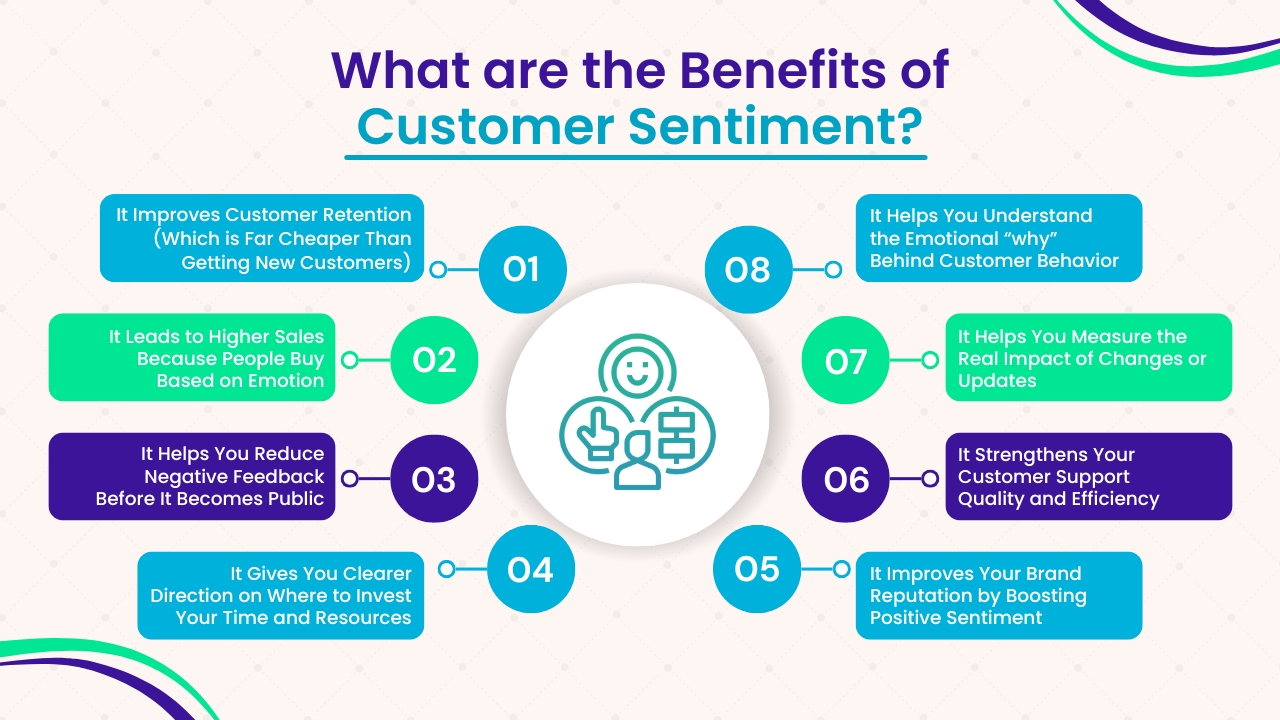
1. It improves customer retention (which is far cheaper than getting new customers)
Acquiring new customers is expensive, often 5 to 7 times more expensive than retaining the ones you already have. That’s why sentiment analysis is such a game-changer. It helps you spot when customers are starting to feel unhappy or disconnected, even if they aren’t saying it directly.
For example, if you notice a rise in comments like
- It used to be better or
- Not as smooth as before,
That’s an early warning sign.
Addressing those small frustrations promptly keeps customers from drifting away and makes them feel genuinely cared for. The result? Stronger loyalty without blowing up your budget.
2. It leads to higher sales because people buy based on emotion
Most buying decisions are emotional, not logical, and sentiment analysis helps you understand exactly what those emotions are.
Studies show that over 70% of buying decisions are influenced by emotion, which means happier customer sentiment directly leads to more confident purchases and stronger revenue.
When customers repeatedly express positive feelings like smooth experience, super helpful, or loved the service, it tells you what’s driving conversions. You can double down on that.
On the other hand, if sentiment shows people feeling confused, overwhelmed, or frustrated, you can remove those barriers before they impact sales.
3. It helps you reduce negative feedback before it becomes public
Not every unhappy customer leaves a bad review right away; they often show subtle signs first, like wording that feels hesitant or mildly disappointed. Sentiment analysis catches these early signals so you can take action before they turn into public complaints.
For example, if customers quietly mention things like not as good as last time or could be faster, fixing those issues early prevents them from spilling onto social media or review platforms. This keeps your brand reputation healthier and more in control.
4. It gives you clearer direction on where to invest your time and resources
Sentiment insights make it easier to prioritize what actually matters to customers. If people consistently praise something like super easy to use, you know that simplicity is worth investing in.
But if many mention hard to navigate or took longer than expected, that tells you exactly where improvement will make the biggest impact.
This kind of clarity matters because businesses that align decisions with customer data are up to 3X more likely to see significant performance improvements.
No wasted efforts, just smart, focused action.
5. It improves your brand reputation by boosting positive sentiment
A strong brand reputation is built on how customers feel about you, and sentiment analysis helps you understand what customers love about your business.
- Is it your service?
- Is it your product?
- Is it your staff?
- Is it the overall experience?
When you know what they love and what brings them back, you can actually make it a highlight of your brand. You can focus on that and make sure it will remain the same.
For example, if you notice customers 70% of customers say things like super friendly, very reliable, or great experience, you can highlight these strengths in your messaging and marketing. And since 93% of customers say reviews influence their decisions, stronger sentiment means a stronger brand image.
6. It strengthens your customer support quality and efficiency
Support teams perform better when they know how customers feel before they even start the conversation. Sentiment analysis highlights urgency and emotional tone, helping agents prioritize and respond more effectively.
For example, if you see a message like I’ve tried this three times and nothing works! carries frustration. Sentiment tools flag this, so support agents can approach with empathy and provide quicker solutions. This reduces escalations, shortens response times, and improves the overall support experience.
Companies that use sentiment-aware support practices often report up to 20% higher customer satisfaction scores, simply because customers feel understood and taken seriously.
7. It helps you measure the real impact of changes or updates
Whenever you introduce a new feature, redesign something, or update your process, sentiment analysis gives you immediate feedback on how customers feel about the change. Instead of waiting weeks for data or surveys, you can see emotional trends right away.
Example: After updating a dashboard, you may notice customers shifting from comments like hard to find things to so much cleaner now.” hat emotional shift tells you the update was successful and genuinely improved the user experience. This real-time sentiment insight helps you adjust quickly and avoid investing in updates that customers don’t value.
8.It helps you understand the emotional “why” behind customer behavior
Traditional analytics tell you what customers did, clicked, dropped off, abandoned a cart, or completed a purchase. But sentiment analysis tells you why, because emotions shape behavior more than actions alone.
For example, you might see a high drop-off rate on a page and assume it’s a technical issue. But sentiment from customer comments could reveal they felt overwhelmed or unsure, meaning the issue is clarity, not functionality. Understanding this emotional why helps you fix root problems, not surface-level symptoms, leading to bigger improvements overall.
Before Measuring Sentiment, A Quick Reality Check
Understanding customer sentiment sounds simple: read reviews, check social comments, run surveys, track behaviours… but real businesses know it gets messy fast. Feedback lives across too many places, customers talk differently on every channel, and it’s nearly impossible to see emotional patterns without spending hours digging through data.
That’s usually where businesses start missing early warning signs, overlook subtle frustrations, or misread what customers actually want.
And this is exactly the point where a platform like Clariv becomes meaningful,not as a tool you must use, but as the clarity layer that makes measuring sentiment easier, faster, and more accurate.
Before We Get Into the Process… Read this!
Before we walk through how to measure customer sentiment, there’s something you should know.
Manually checking, tracking, and managing customer sentiment is honestly last century. Reading every review, scanning social media, going through emails, tracking survey responses, digging through support messages, it’s slow, scattered, and impossible to scale.
By the time you measure anything manually, the sentiment has already shifted.
And that’s where AI-powered solutions come in. When you integrate the right tool, sentiment analysis becomes clearer, faster, and far more accurate.
One such tool that brings this clarity into action is Clariv.
What is Clariv?
Clariv is an AI-powered customer sentiment analysis tool that helps you understand customer emotions, feedback, and market trends across all your channels without manually sifting through data. It quietly connects with your existing systems, support tools, social platforms, product analytics, review sites and brings everything into one unified view.
Now that you know the modern way to measure sentiment, let’s walk through the process of measuring customer sentiment (the modern way).
Steps to Measure Customer Sentiment?
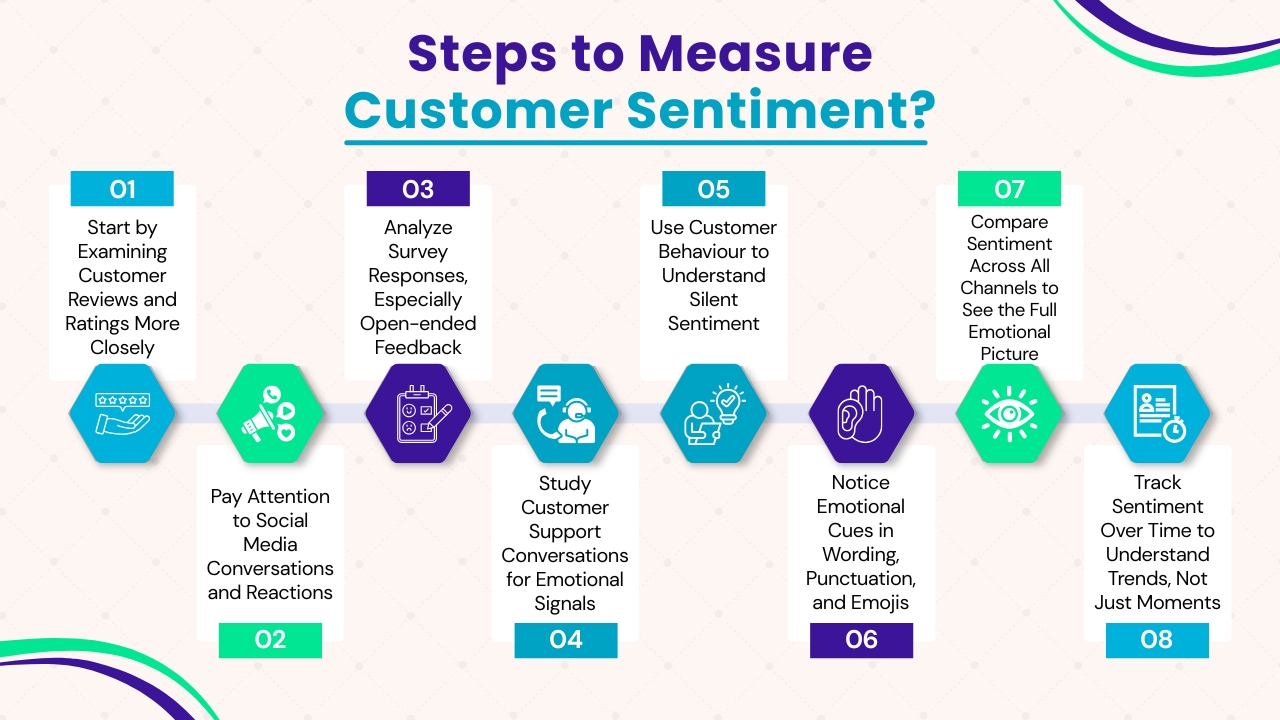
Measuring customer sentiment becomes far easier once you understand where emotions live and how to interpret them. Customers express how they feel in different ways, sometimes clearly, sometimes subtly, and sometimes without saying a single word.
Here’s a detailed, simple breakdown of how to measure it.
1. Start by examining customer reviews and ratings more closely
Reviews often tell the most honest story. Customers explain what delighted them and what disappointed them, giving you a window into their emotional experience. To measure sentiment:
- Read the wording carefully
- Identify emotions behind the phrases
- Separate positive and negative elements
- Notice if similar emotions appear in multiple reviews
Example: Love the product, but delivery took longer than expected.
→ Positive sentiment toward product quality
→ Negative sentiment toward delivery time
When you plug this into Clariv, the platform automatically pulls reviews like this from all your channels, reads the emotional tone behind both the praise and the complaint, and displays the sentiment clearly in one dashboard, so patterns like great product, slow delivery become obvious without manually checking.
2. Pay attention to social media conversations and reactions
Social media is where customers express real-time emotion, whether excitement, frustration, confusion, or delight. Measuring sentiment here means watching:
- recurring emotional keywords
- shifts in tone after updates
- positive vs negative phrasing
- emerging emotional themes
Example: After a feature update, you might see comments like:
- Why did they change this? Or
- This feels confusing now.
Customer sentiment analysis helps you understand emotional friction forming
When Clariv is connected, it quietly gathers these scattered comments from different social platforms and reads the emotional tone behind them, helping you see when customer feelings start shifting, without manually checking each post or mention.
3. Analyze survey responses, especially open-ended feedback
Surveys are a direct line to what customers feel, but the real emotional insight comes from the open-ended responses, not the rating itself. Even a 4 or 5-star rating may hide mild frustration, hesitation, or confusion.
When measuring sentiment from surveys, look at:
- the emotional tone behind their explanation
- whether their wording reflects satisfaction, confusion, or disappointment
- Repeated emotional themes across different respondents
- contradictions between score and comment
Example: A customer might rate your service ⭐⭐⭐⭐ but write: Pretty good overall, but I struggled to understand things at first. This shows mild frustration despite a high rating.
When you integrate your survey tool with Clariv, these open-ended responses automatically flow into one place. Clariv reads the emotional tone behind comments like struggled, confusing, or easy and groups them into clear sentiment themes, so you don’t miss subtle emotions hidden behind positive ratings.
4. Study customer support conversations for emotional signals
Support interactions often contain the strongest emotions because customers reach out when something feels urgent or frustrating. Their tone, choice of words, and repeated attempts all reveal how they’re feeling. When measuring sentiment in support:
- Notice the emotional tone at the start (already tried, confused, urgent)
- track repeated complaints or frustrations
- identify escalation cues (this keeps happening, again, still not fixed)
- observe if the tone softens or worsens by the end
Example: I’ve tried this multiple times already, and it still isn’t working.
→ This clearly reflects frustration and loss of patience.
When your support conversations are connected to Clariv, the platform automatically scans messages like this, detects emotional cues such as multiple times or still isn’t working, and highlights them as rising frustration patterns, making it easy to spot issues before they grow.
5. Use customer behaviour to understand silent sentiment
Not all customers express their emotions through words. Many simply change their behaviour, and those actions can reveal how they feel more accurately than written feedback. Behavioural sentiment shows up when customers:
- Repeatedly drop off during a specific step
- Stop using a feature they previously loved
- reduce their overall engagement
- hesitate during key processes like checkout or onboarding
These actions often signal confusion, frustration, or mistrust, even if no one sends a complaint.
Example: If many users consistently abandon the checkout page at the same point, that drop-off reflects emotional hesitation or confusion, even if you never receive a single message about it.
When your behavioural data is connected to Clariv, it automatically pairs these silent patterns with emotional feedback from other channels, helping you understand why customers drop off. Instead of guesswork, you get a clearer emotional explanation behind behavioural shifts.
6. Notice emotional cues in wording, punctuation, and emojis
Customers don’t always write long messages; sometimes a short phrase, punctuation choice, or even an emoji communicates exactly how they feel. These subtle cues are incredibly important when measuring sentiment because they often reveal emotions customers don’t explicitly state.
When analyzing these cues, look for:
- punctuation differences (“!!!” for excitement or urgency, “…” for hesitation or disappointment)
- emojis that signal mood (😍 = delight, 😡 = anger, 😕 = confusion)
- capitalization or tone shifts (“LOVE this” vs. “love this…”)
- phrasing that suggests sarcasm or reluctance
Example: Amazing update!!! 😍 → Signals high excitement and satisfaction
So-called Amazing update… → Suggests disappointment or sarcasm
When these short expressions flow into Clariv, its AI automatically interprets these emotional markers and organizes them into positive, negative, or mixed sentiment buckets.
7. Compare sentiment across all channels to see the full emotional picture
A single comment on one platform doesn’t tell the whole story. True sentiment emerges when you bring together what customers say (and don’t say) across multiple touchpoints. When measuring sentiment across channels:
- Compare reviews, social comments, support messages, and survey responses
- Look for emotions that repeat across different platforms
- Notice whether certain experiences trigger the same sentiment everywhere
- observe if emotions shift over time or stay consistent
This helps you understand whether an issue is isolated or widespread.
Example: If reviews mention hard-to-find options, support chats say I can’t locate this, and social media comments say where is this feature?, It’s clearly not a one-off problem; it’s a consistent emotional pattern across channels.
When these signals come into Clariv, the platform brings all channels together into a single view, making cross-channel emotional patterns easy to spot without jumping between tools. Instead of guessing whether feedback aligns, you can instantly see the complete emotional storyline.
8. Track sentiment over time to understand trends, not just moments
Sentiment isn’t static; it changes as your product evolves, your service improves, or customer expectations shift. Measuring sentiment over time helps you understand:
- whether customers are becoming happier or more frustrated
- How product updates or changes affect emotions
- whether certain issues are improving or worsening
- which moments create emotional peaks or dips
This long-term perspective helps you make better decisions, because emotions measured over time reveal trends that one-off comments can’t show.
Example: If sentiment slowly shifts from easy to a bit confusing over a few weeks, that gradual change signals a deeper usability issue, even if no major complaints appear.
When your data is connected to Clariv, you can see these sentiment movements clearly through trend patterns. Clariv helps highlight when emotional tone is improving, dipping, or shifting, so you catch early signals before they become bigger problems.
To Wrap!
As you’ve seen, customer sentiment isn’t just another metric; it’s a lens that helps you understand how customers truly experience your brand. Once you start listening to these emotional signals with more intention, it becomes easier to stay aligned with what your customers value and expect.
Whether you’re refining a process, improving communication, or enhancing a product, sentiment gives you the direction needed to move with more clarity and confidence.
It’s a small shift in awareness that can create a big shift in results.
And if you’d like a simpler way to bring all your customer feedback, emotions, and patterns into one clear view, try out Clairv. Book your 14-day free trial and get started right away.