Your brand’s reputation isn’t built in boardrooms anymore; it’s shaped in review sections, social media comments, and Reddit threads you didn’t even know existed. One negative review can deter up to 30 potential buyers.
Last week, a single negative review cost a mid-sized SaaS company a $50K enterprise deal. The prospect Googled them, found a 2-star complaint on page one, and ghosted the sales team.
But Why?
You can’t manage what you can’t monitor. And if you’re still tracking brand reputation with Google Alerts and manual searches, you’re already losing.
The companies winning the reputation game aren’t working harder; they’re using smarter systems. But here’s where most businesses mess up: they think any reputation tool will do. Six months later, they realize it can’t analyze sentiment, integrate reviews, or alert them when a crisis hits at 9 PM on a Friday.
In this guide, we’re breaking down the non-negotiable capabilities every brand reputation management platform needs to have. Because your brand deserves better than damage control. It deserves intelligence.
Let’s dive in.
Also Read: Sentiment Analysis Demo
What is Brand Reputation Management Software?
Brand reputation management software is a digital platform that monitors, analyzes, and helps you respond to what people are saying about your business across the internet in real-time.
As Jeff Bezos once said, A brand for a company is like a reputation for a person… and in today’s digital world, that reputation is built or broken online.
Think of it as your brand’s early warning system and intelligence hub combined. Instead of manually checking review sites, social media, forums, and news outlets every day (which is impossible at scale), the software does it for you automatically. But it goes far beyond just collecting mentions.
How does it work?
Modern reputation management platforms use AI and machine learning to:
- Crawl the web continuously – Monitoring social media platforms, review sites (Google, Yelp, Trustpilot), news outlets, blogs, forums, and industry-specific sites for any mention of your brand
- Analyze sentiment – Using natural language processing to determine if mentions are positive, negative, or neutral, and even detect emotions like frustration or satisfaction
- Alert you instantly – Sending real-time notifications when negative sentiment spikes or a potential crisis emerges
- Centralize responses – Giving you one dashboard to manage and respond to reviews and comments across all platforms
- Track trends – Showing you how your reputation is changing over time and how you compare to competitors
Also Read: How to Measure Customer Sentiment
Top 10 Brand Reputation Management Software’s Key Features You Should Know About
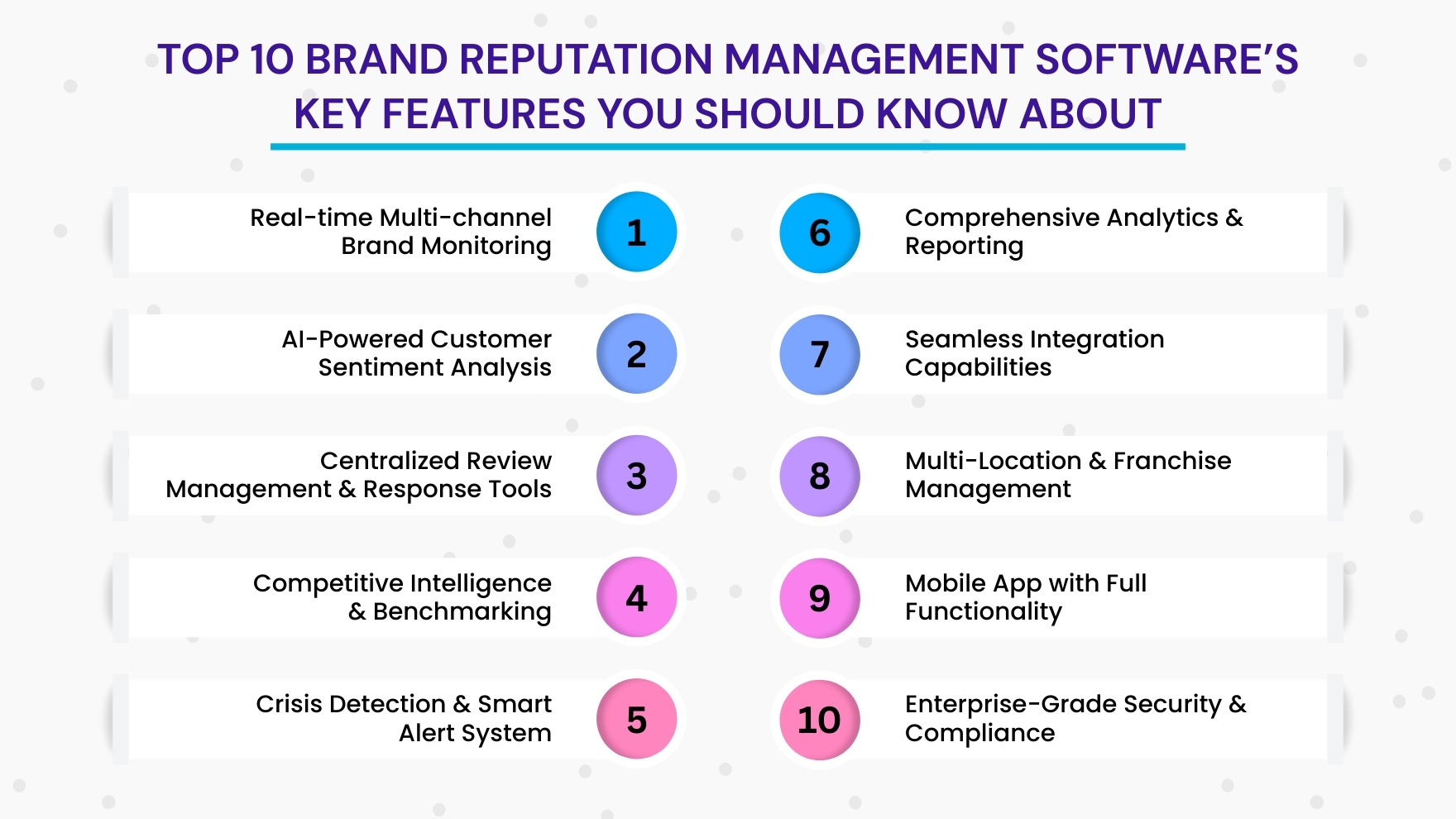
Choosing the right brand reputation management software comes down to one thing: features that actually move the needle. Not just alerts that tell you what happened, but intelligence that helps you act before damage is done.
Below are the must-have features every serious reputation management platform should offer. If your current tool isn’t checking most of these boxes, it might be time to rethink your stack.
Keep reading…
1. Real-Time Multi-Channel Brand Monitoring
One of the most critical features of reputation management platform solutions is continuous tracking of your brand mentions across every platform where conversations happen, social media (Facebook, Instagram, LinkedIn, etc.), review sites (Google, Yelp, etc.), blogs, forums (Reddit, Quora), etc.
Why it matters:
You can’t manage conversations you don’t know about. A crisis doesn’t start on your website; it starts in a Reddit thread at 2 AM or a viral tweet during lunch hour. By the time you hear about it through traditional channels, it’s already too late.
What to look for in brand monitoring tools:
- Comprehensive platform coverage – Not just the big social networks, but niche forums and review sites specific to your industry
- Keyword and hashtag tracking – Monitor your brand name, product names, executive names, and industry terms
- Visual brand monitoring – Logo detection in images and videos (for advanced platforms)
Red flag: Tools that only monitor 2-3 platforms or require manual setup for each new channel.
Clariv is a comprehensive brand reputation management software that monitors across all major platforms and allows you to customize your monitoring scope, ensuring you never miss a mention, regardless of where the conversation happens.
2. AI-Powered Customer Sentiment Analysis
This essential feature of customer sentiment analysis software uses advanced natural language processing (NLP) and machine learning to automatically analyze the tone, emotion, and context of every mention, categorizing them as positive, negative, or neutral, and detecting emotions like frustration, excitement, disappointment, or satisfaction.
Why it matters:
- Spot brewing PR crises before they explode
- Identify product issues customers are complaining about
- Find brand advocates and positive trends to amplify
- Understand the emotional temperature of your audience
Must-have features of online reputation management software for sentiment analysis:
- AI/ML-powered analysis – Not just keyword matching (searching for hate or love), but true contextual understanding
- Sentiment scoring and trends – Visual dashboards showing sentiment over time
- Emotion detection – Going beyond positive/negative to identify specific emotions
- Context awareness – Understanding sarcasm, slang, and nuanced language
- Multi-language support – If you operate globally
Why Clariv excels here: Clariv’s advanced sentiment analysis engine doesn’t just count keywords; it understands context, emotion, and intent, giving you actionable insights about how customers actually feel about your brand.
3. Centralized Review Management & Response Tools
A core feature of modern review management software is a unified dashboard that aggregates reviews from all platforms (Google, Facebook, Yelp, Trustpilot, industry-specific sites) and gives you tools to respond quickly and consistently.
Why it matters:
The stats are brutal:
- 53% of customers expect a response to a negative review within a week of posting
- If a negative review is ignored, 59% of customers won’t give the business a second chance
- Businesses that respond to at least 25% of their reviews make 35% more in earnings
But here’s the problem: Your reviews are scattered across 10+ platforms. Logging into each one individually is time-consuming and inefficient. By the time you find all your reviews, the critical response window has closed.
Essential features of review management software:
- Centralized dashboard – See all reviews from all platforms in one place
- Response templates – Pre-approved responses for common scenarios (speed + consistency)
- Team collaboration features – Assign reviews to team members, track response status
- Response tracking – See which reviews have been addressed and which are pending
- Review request automation – Trigger review requests after positive customer interactions
- Filtering and sorting – Quickly find negative reviews, unanswered reviews, or reviews by platform
Why Clariv excels here: As complete review management software, Clariv brings all your reviews into one streamlined dashboard, so you can access and respond faster, turning potential reputation disasters into opportunities to show customers you care.
Also Read: Restaurant Review Sentiment Analysis
4. Competitive Intelligence & Benchmarking
Advanced brand monitoring tools can track your competitors’ brand mentions, sentiment, and reputation metrics alongside your own, providing context for your performance and insights into market positioning. So, you identify gaps, learn from their mistakes, their learnings, and make decisions accordingly.
Why it matters:
Your reputation doesn’t exist in a vacuum. A 4.2-star average sounds good until you realize your top three competitors are all at 4.7 stars. Or maybe your sentiment is down 10% this quarter, but your competitor’s is down 25% because of an industry-wide issue.
What to look for in competitive monitoring features:
- Competitor sentiment tracking – Monitor mentions and sentiment for key competitors
- Share of voice analysis – See what percentage of industry conversations mention your brand vs. competitors
- Side-by-side dashboards – Visual comparisons of key metrics
- Industry benchmarks – Compare your performance to industry averages
- Competitive alert triggers – Get notified when competitors experience reputation spikes (positive or negative)
Let’s understand with an example: A hotel chain noticed its competitor’s sentiment dropped sharply after implementing a new booking fee. They capitalized on the moment with a no hidden fees campaign and captured 12% more bookings that quarter.
Why Clariv excels here: Clariv doesn’t just track your brand; it gives you competitive intelligence that helps you understand your position in the market and make smarter strategic moves.
5. Crisis Detection & Smart Alert System
One of the most critical features of brand reputation management software is automated monitoring that detects sudden spikes in negative sentiment, unusual mention volume, or specific crisis keywords and immediately alerts the right people through multiple channels.
Why it matters:
Brand crises escalate fast. What starts as a single complaint can become a trending hashtag in hours. If a negative review is ignored, 59% of customers won’t give the business a second chance. Now multiply that by thousands if a crisis goes viral.
The difference between a contained incident and a full-blown reputation disaster? Response time.
Must-have features of online reputation management software for crisis detection:
- Customizable alert thresholds – Set your own triggers (e.g., alert when negative mentions increase 50% in one hour)
- Multi-channel notifications – Email, SMS, Slack, push notifications—whatever ensures you see it
- Escalation workflows – Different severity levels trigger different team members
- Crisis keywords – Monitor specific high-risk terms (product recall, lawsuit, contamination, etc.)
- Anomaly detection – AI that recognizes unusual patterns even without hitting preset thresholds
- Weekend/after-hours coverage – Crises don’t only happen 9-5
Why Clariv excels here: Clariv’s intelligent alert system doesn’t just notify you when something bad happens; it learns your patterns, detects anomalies, and ensures the right people are alerted at the right time.
6. Comprehensive Analytics & Reporting
Essential features of a reputation management platform can be able to transform raw mention data into actionable insights, tracking KPIs like sentiment scores, response rates, share of voice, and reputation trends over time.
Why it matters:
Data without insights is just noise. Your CEO doesn’t want to know you had 2,847 mentions last month; they want to know:
- Is our reputation improving or declining?
- Which products/services get the most positive/negative feedback?
- How quickly are we responding to reviews?
- Which platforms drive the most engagement?
- What topics are customers talking about most?
- How do you compare to competitors?
- What ROI are you getting?
Different metrics for different leaders & departments.
What to look for in analytics features:
- Customizable dashboards – Build views for different stakeholders (executives want summaries, marketing wants details)
- Trend analysis – Track sentiment, volume, and other metrics over time (week, month, quarter, year)
- KPI tracking – Monitor Net Promoter Score (NPS), sentiment scores, response rates, review ratings
- Exportable reports – PDF, PowerPoint, Excel for sharing with stakeholders
- Executive summaries – One-page overviews for leadership
- Visual data representation – Charts, graphs, heat maps that make patterns obvious
- Custom date ranges – Compare specific periods or campaigns
Why Clariv excels here: As a comprehensive reputation management platform, Clariv transforms complex data into clear, visual insights that help you track performance, prove ROI, and make data-driven decisions about your reputation strategy.
Also Read: Social Media Management Tools for Nonprofits
7. Seamless Integration Capabilities
Modern online reputation management software must offer the ability to connect with your existing business tools, CRM systems, customer support platforms, social media management tools, and review platforms.
Why it matters:
Your reputation data shouldn’t live in a silo. When a customer leaves a negative review, your customer service team should see it in their ticketing system. When sentiment improves, your sales team should know. When a VIP client mentions you positively, it should be logged in your CRM.
Integrations turn brand reputation management software from a standalone tool into part of your entire customer experience ecosystem.
Integration features to look for:
- CRM integration – Salesforce, HubSpot, Zoho, Pipedrive
- Customer support platforms – Zendesk, Intercom, Freshdesk, Help Scout
- Social media management – Hootsuite, Buffer, Sprout Social
- Review platforms – Direct connections to Google, Yelp, Trustpilot, G2, Capterra
- Communication tools – Slack, Microsoft Teams, email platforms
- Analytics platforms – Google Analytics, Tableau, Data Studio
- API access – For custom integrations with proprietary systems
- Zapier/webhook support – Connect to thousands of other apps
Why Clariv excels here: Clariv integrates seamlessly with your existing tech stack, ensuring reputation data flows where it’s needed most without forcing your team to juggle multiple platforms.
8. Multi-Location & Franchise Management
For businesses operating multiple locations, branches, franchises, or regional offices, this reputation management platform feature allows you to manage reputation separately for each location while maintaining centralized brand-level oversight and control.
Why it matters:
- A negative review about slow service at your Dallas location shouldn’t pollute your Seattle metrics.
- Franchise owners need location-specific insights to improve their individual performance.
- Corporate needs to see which locations are thriving and which need support.
What to look for in multi-location features:
- Location hierarchy management – Organize by region, district, or custom structure
- Location-specific dashboards & leaderboards – Each location sees only its data
- Roll-up reporting – View individual locations + aggregate brand metrics
- Location comparison tools – Rank and compare performance across all locations
- Customizable permissions – Location managers see their data, regional managers see their region, and corporate sees everything
- Location-specific alerts – Different thresholds and notification recipients per location
Why Clariv excels here: Clariv’s multi-location management gives franchise owners and location managers the autonomy they need while providing corporate with the oversight and brand control they require, all in a single, unified platform.
9. Mobile App with Full Functionality
Native mobile applications (iOS and Android) that provide complete brand reputation management software functionality on the go, not just notifications, but full monitoring, response, analytics, and management capabilities from your phone or tablet.
Why it matters:
- Respond to critical reviews immediately, anywhere
- Monitor brand health during travel or off-hours
- Get push notifications for urgent alerts
- Check sentiment before important meetings
- Handle weekend crises without a laptop
- Approve team responses on the go
- View real-time dashboards during presentations
What to look for in mobile features:
- Full feature parity – Everything you can do on desktop, you can do on mobile
- Native apps – Not just mobile-responsive web, but actual iOS/Android apps
- Push notifications – Customizable alerts that work even when the app is closed
- Offline access – View recently cached data without an internet connection
- Dashboard viewing – See all analytics and sentiment trends in mobile
- Voice-to-text – Dictate responses instead of typing on small screens
- Fingerprint/Face ID – Secure, quick authentication
- Multi-account support – Switch between clients or locations easily
Why Clariv excels here: Clariv’s mobile app isn’t a watered-down notification tool; it’s the full platform in your pocket, with intuitive touch interfaces designed specifically for mobile use, ensuring you can manage your reputation anywhere, anytime, without compromise.
10. Enterprise-Grade Security & Compliance
You’re using reputation management software to protect your brand, but if that software gets breached and exposes customer data, you’ve created the reputation crisis you were trying to prevent.
So, make sure your brand reputation management software includes advanced security infrastructure, data protection measures, and regulatory compliance certifications that protect your reputation data and ensure your reputation management platform meets industry standards for enterprise use.
What to look for in security features:
- SOC 2 Type II certification – Independent audit of security controls
- ISO 27001 certification – International security management standard
- GDPR compliance – Full compliance with the EU data protection regulation
- Data encryption – Both at rest (stored) and in transit (transferred)
- Role-based access controls – Granular permissions limiting who sees what
- Two-factor authentication (2FA) – Additional login security layer
- Single Sign-On (SSO) – Enterprise authentication via SAML, OAuth
- Regular security audits – Third-party penetration testing
- Data retention policies – Control how long data is stored
- Right to deletion – Comply with “right to be forgotten” requests
- Uptime guarantees – SLA ensuring 99.9%+ availability
- Data backup and recovery – Regular backups with disaster recovery plans
- Vendor security assessments – Due diligence on third-party integrations
Why Clariv excels here: Clariv maintains enterprise-grade security with SOC 2 Type II certification, GDPR and CCPA compliance, comprehensive data encryption, and industry-specific compliance options to protect your reputation.
Final Thoughts
Managing your brand reputation manually isn’t just inefficient; it’s a risk. Conversations happen fast, sentiment shifts overnight, and one ignored review can cost you more than you’d expect.
The right brand reputation management software doesn’t just monitor mentions; it gives you the clarity to understand what customers feel, the speed to respond when it matters, and the intelligence to stay ahead of problems before they escalate.
Whether you’re a growing business or an established brand, the features covered in this guide aren’t just nice-to-haves. They’re the foundation of a reputation strategy that actually works.
If you’re evaluating your options, Clariv brings together real-time monitoring, AI-powered sentiment analysis, review management, and actionable reporting in one place, designed to make reputation management less overwhelming and more effective.
Try Clariv free for 7 days and see the difference for yourself. No credit card required. No commitments. Just clarity.