Most small businesses don’t have a dedicated marketing team, a six-figure ad budget, or the luxury of spending hours crafting the perfect Instagram caption. What you do have is a story worth telling, a product or service people genuinely need, and a handful of platforms that can connect you directly to your next customer for free.
But simply being on social media isn’t enough anymore.
Small and medium-sized businesses agree that social media positively impacts their business performance, yet more than half (54%) admit struggling to keep their content fresh and stay up to date with social media trends. That gap, between showing up and showing up effectively, is exactly where most small businesses lose ground.
But that’s exactly what we’ll help you solve with our best social media management tips for small businesses.
And, don’t worry, this guide isn’t going to tell you to “post consistently” and “engage with your audience.” You already know that. What we’re going to do instead is give you 15 social media management tips that are rooted in real data, built for resource-limited teams, and specific enough to actually move the needle.
Also Read: Best Social Media Management tools for NonProfits
How Social Media Management Tips Give an Edge to Small Businesses?
Here’s a perspective most marketing guides won’t give you: social media is not a level playing field, but it can be.
Large brands have budgets. Small businesses have agility, authenticity, and proximity to their customers. The right social media management best practices let you use that to your advantage.
41% of small and local businesses depend on social media to drive revenue. And the opportunity is only growing. Of the 5.44 billion internet users globally, 5.07 billion are active social media users, representing a potential reach of over 62.6% of the world’s total population.
For a small business, that’s not an abstract statistic. That’s your next customer scrolling through their feed right now.
But reach without strategy is noise. The businesses that actually grow through social media aren’t necessarily the ones with the biggest budgets; they’re the ones that manage it smarter.
Here’s exactly how the right social media management tips give small businesses a real, compounding edge:
Cost-efficiency that levels the playing field. Unlike paid advertising, where bigger budgets usually win, organic social media rewards creativity and consistency. A well-managed social presence can generate leads and build brand awareness at a fraction of what larger competitors spend on traditional marketing.
Direct access to customer intelligence. Every comment, share, and reaction is a data point about what your audience actually cares about. Small businesses that treat social media as a listening tool, not just a broadcasting channel,l gain insights that inform product development, customer service, and marketing strategy simultaneously.
Relationship-building at scale. While enterprise brands struggle with authenticity, small businesses have a natural advantage: they can be genuinely human. The right social media management tool helps you maintain that authenticity even as you grow, creating community rather than just an audience.
Agility as a competitive weapon. Large companies need approvals, committees, and compliance reviews. You can respond to trends, customer feedback, and market shifts in real-time. This responsiveness, when managed properly, transforms social media from a nice-to-have into a genuine competitive edge.
Compounding brand equity over time. Every post, reply, and piece of content you publish is an asset that builds on itself. A well-managed social presence accumulates followers, trust, searchability, and brand recognition that grows month over month. Small businesses that start managing social media strategically early create a moat that becomes increasingly difficult for competitors to close.
Precision targeting without a big budget. Social platforms give small businesses access to audience targeting tools that were once exclusive to enterprise marketing teams. You can reach exactly the right person, by location, interest, behavior, and buying intent, with even a modest content and ad strategy.
Also Read: Brand Reputation Management Software
15 Best Tips for Managing Social Media for Small Businesses
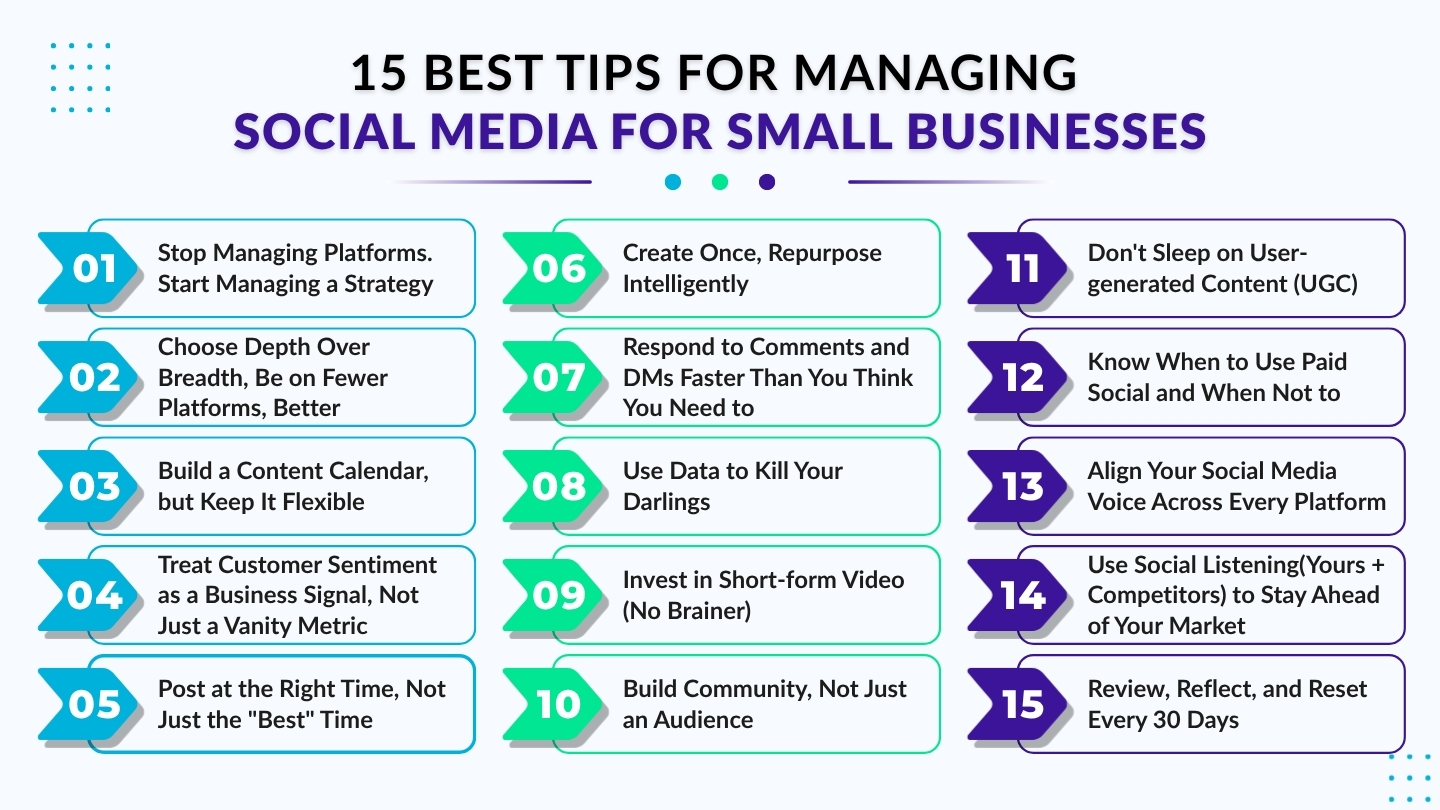
1. Stop Managing Platforms. Start Managing a Strategy.
Most small businesses approach social media platform by platform, post on Instagram, then hop to Facebook, then remember LinkedIn exists. This fragmented approach is exhausting and ineffective.
The smarter move is to build one unified content strategy and then distribute it across platforms. Start by asking: What is the single outcome I want from social media this quarter? Brand awareness? Lead generation? Customer retention? Every piece of content should ladder up to that goal.
Expert take: Most small business owners confuse activity with strategy. Posting every day is an activity. Posting with a clear conversion goal, tracked and adjusted weekly, is a strategy.
2. Choose Depth Over Breadth, Be on Fewer Platforms, Better
Facebook is the most popular platform among SMBs, with 82% of respondents using it to promote products and connect with customers, followed by Instagram (71%), YouTube (69%), and TikTok (58%).
The mistake? Trying to be everywhere at once.
For a small business with limited bandwidth, being genuinely excellent on two platforms beats being mediocre on six. Pick the platforms where your audience actually spends time, and commit to those. A local restaurant should probably own Instagram and Facebook. A B2B service business should go deep on LinkedIn. A lifestyle brand targeting Gen Z should be all-in on TikTok.
This is a core best practice social media strategy that experienced marketers swear by, but beginners consistently ignore.
With Clariv, you can manage all your chosen platforms from a single dashboard and manage the posts without the cognitive load of switching between apps, which makes staying consistent on your chosen platforms dramatically easier.
Also Read: Customer Sentiment Platform Vs Traditional Surveys
3. Build a Content Calendar, But Keep It Flexible
A content calendar is the backbone of any sustainable social media management best practice. It lets you plan, avoid last-minute panic posting, and ensure you’re hitting the right mix of content types (educational, promotional, behind-the-scenes, community-driven).
But your calendar should have planned slots and reactive slots. Leave 20-30% of your schedule open for real-time content, trending moments, customer shoutouts, and news hooks. The brands that feel most alive on social media are the ones that balance planning with spontaneity.
Clariv’s visual calendar grid makes it easy to see your entire month at a glance, identify gaps, shuffle posts around, and maintain that balance between planned and reactive content, all without spreadsheets.
4. Treat Customer Sentiment as a Business Signal, Not Just a Vanity Metric
Here’s an underused helpful tip for social media: the comments, DMs, and reactions your audience leaves aren’t just engagement metrics; they’re direct market research.
Are people consistently asking the same question in your comments? That’s a content gap. Are they tagging friends in your posts? That’s a signal to make more of that content. Are negative reactions clustering around a specific product or message? That’s a warning worth heeding before it becomes a crisis.
Most small businesses read their comments casually. Smart ones systematize this.
Clariv’s AI-powered sentiment analysis is built exactly for this. It categorizes customer reactions across your platforms, helping you understand not just what people are saying, but how they feel, so you can respond faster, spot patterns earlier, and make content decisions backed by real emotional data rather than gut instinct.
Also Read: How AI Sentiment Analysis Software Turns CustomerFeedback into Growth
5. Post at the Right Time, Not Just the “Best” Time
Every tool will give you a “best time to post,” and most of them are based on averages, not your audience. In 2024, internet users spent an average of 143 minutes daily on social media platforms. But when your specific audience is in that window matters far more than global averages.
The helpful tip for social media here: use your own analytics. Look at your top 10 performing posts from the last 90 days and note the day and time they were published. That’s your actual best time to post, not what some industry report says.
Clariv goes further with AI-powered peak-time suggestions that learn from your actual audience behavior and recommend optimal posting windows for each platform, so you’re not guessing.
6. Create Once, Repurpose Intelligently
Small business owners don’t have time to create unique content for every platform every day. Nor should they.
The principle of smart content repurposing is one of the most powerful social media management tips available: one core idea can become a LinkedIn article, a Twitter/X thread, an Instagram carousel, a TikTok video, and a Facebook post — each adapted for that platform’s native format and audience behavior.
The keyword is adapted, not just copied and pasted. A caption that works on Instagram will often fall flat on LinkedIn. The tone, length, and format need to shift.
Clariv’s AI assistant makes this practical — it helps you repurpose posts across different platforms with one click, adapting tone and structure while preserving your original voice. That’s hours saved every week.
7. Respond to Comments and DMs Faster Than You Think You Need To
Speed of response is one of the most underrated competitive advantages a small business has over a large brand. Big companies have customer service queues. You can reply in minutes.
78% of Twitter users expect a reply to their customer service questions within one hour. And that expectation is spreading across platforms. A fast, genuine reply to a comment or DM doesn’t just satisfy that one person; it signals to everyone watching that your business is real, responsive, and trustworthy.
Set aside 10-15 minutes in the morning and evening to monitor and respond across your channels. With Clariv’s unified dashboard, you don’t need to open five apps to do this; every interaction lives in one place. And, it even helps with personalized, automated responses to the comments, mentions, DMs, etc., so you don’t have to.
Also Read: How to Manage Online Reviews for Your Business
8. Use Data to Kill Your Darlings
You will fall in love with certain content ideas. Some of them won’t perform. Kill them faster.
One of the most important expert recommendations for social media management is to let data, not ego, drive content decisions. Regularly audit your top and bottom performers every month. Look for patterns: What format consistently underperforms? What topic always drives saves and shares?
Social listening tools help adjust campaigns, spot opportunities, and address issues before they escalate, creating a more confident, data-informed approach to measuring success.
Clariv’s performance dashboard consolidates reach, clicks, comments, sentiment, and best-performing posts across every platform in one clean view, so your monthly content audit takes 20 minutes instead of half a day.
9. Invest in Short-Form Video (No Brainer)
This is not a trend. It is the format.
On TikTok, brands posting short videos (31-60 seconds) weekly hit up to 2.11% reach and rack up 3x more engagement than longer or horizontal formats. Instagram Reels, YouTube Shorts, and TikTok have collectively shifted audience expectations; people now expect to see your brand, not just read about it.
For small businesses, this doesn’t mean hiring a videographer. A phone, decent lighting, and a genuine point of view are enough to start. Talk about your process. Show a before-and-after. Answer a frequently asked question on camera. Authenticity outperforms production value in short-form video almost every time.
Clariv’s short-form video scheduling (across TikTok and YouTube Shorts) lets you batch-upload and schedule your videos to go live at peak engagement windows, so the distribution is handled even when you’re not online.
10. Build Community, Not Just an Audience
There is a meaningful difference between an audience and a community. An audience consumes. A community participates.
Small businesses are uniquely positioned to build genuine communities because they have something large brands don’t: a face, a story, and a real relationship with their customers. Use that. Ask questions in your captions. Feature customer stories. Create inside references your regulars will recognize. Celebrate milestones publicly.
90% of social media users follow at least one brand, and 74% of consumers rely on social media to help guide their purchasing decisions. The businesses that convert those followers into buyers consistently are the ones that have built an actual community, not just a follower count.
Clariv’s collaboration features and team commenting tools help you stay on top of community engagement even when multiple people are managing your accounts, keeping the voice consistent and the response time fast.
11. Don’t Sleep on User-Generated Content (UGC)
Your happiest customers are your best marketers, and most small businesses aren’t leveraging them.
84% of millennials say user-generated content on social media influences their purchasing decisions, and 70% of people trust content from real customers over branded content.
Ask for it proactively. Create a branded hashtag. Run a simple challenge. Feature customer photos in your Stories. When someone tags your business, reshare it (with credit). UGC costs you nothing and converts better than almost any content you can create yourself.
The best practice social media strategy here is to make UGC collection systematic, not something you do when you remember. Build it into your monthly content calendar as a dedicated content type.
12. Know When to Use Paid Social and When Not To
Organic social has its ceiling. For most small businesses, a modest paid budget used strategically will outperform a much greater organic effort.
The keyword is strategically. Don’t boost posts randomly. Use paid social for specific, measurable goals, driving traffic to a landing page, retargeting website visitors, and promoting a time-sensitive offer to a laser-targeted audience.
Businesses that invest in social media advertising see a return of $5.20 for every $1 spent.
Start small, even $5-$10 a day on a well-targeted Facebook or Instagram ad can generate meaningful results for a local small business. Test one variable at a time, track your results, and scale what works.
13. Align Your Social Media Voice Across Every Platform
Inconsistency in brand voice is more damaging than most small businesses realize. When your Instagram feels fun and casual, your LinkedIn reads like a press release, and your Facebook page hasn’t been updated in six months — customers notice. It erodes trust.
Your brand voice should adapt to each platform’s norms (LinkedIn is more professional, TikTok is more raw), but the underlying personality, values, and tone should remain consistent.
Document your brand voice in a simple one-page guide: 3-5 adjectives that describe your tone, examples of phrases you’d use and phrases you’d never use, and notes on platform-specific adaptations. Share it with anyone who posts on your behalf.
Clariv’s team collaboration features, including real-time status tags and one-click feedback on any post, make it easy to enforce brand voice consistency across team members before anything goes live.
Also Read: Brand Reputation Management Software
14. Use Social Listening(Yours + Competitors) to Stay Ahead of Your Market
Most small businesses use social media to broadcast. Smart ones also use it to listen.
Social listening means monitoring mentions of your brand, your competitors, and relevant industry keywords, even when you’re not tagged. It tells you what customers actually think, what questions the market is asking, and where your competitors are falling short.
This is a social media management best practice that’s often dismissed as a “big brand thing.” It isn’t. For a small business, social listening can reveal your next product idea, a PR issue before it blows up, or a competitor weakness you can capitalize on immediately.
Clariv’s smart recommendations engine analyzes what’s resonating with your audience and surfaces content gap alerts, timing nudges, and also what your target audience is saying about your competitors(good or bad), so you’re not just listening passively, you’re acting on those signals with precision.
15. Review, Reflect, and Reset Every 30 Days
The best social media management tips in the world mean nothing without a regular review cycle. Social media moves fast. What worked in January may not work in March. Algorithm changes, audience shifts, and cultural moments make this a constantly evolving game.
Set aside 30 minutes at the end of every month to ask: What were my top 3 performing posts? What flopped? Did I achieve my goal for this month? What’s one thing I’ll do differently next month?
This habit compounds. Small refinements made monthly turn into significant performance improvements over a year.
Clariv’s performance dashboard makes this 30-minute review genuinely actionable with every metric, from reach to sentiment to best-performing posts, in one clean view across all your platforms. So, the monthly reviews become easier to understand, act on, and change.
Final Thoughts
Social media for small businesses doesn’t have to feel like shouting into a void. It doesn’t have to mean spending hours every day glued to your phone, chasing trends you don’t understand, or guessing at what might work.
The social media management tips that actually move the needle are the ones rooted in clarity, about your goals, your audience, your content, and your data. They’re the ones who treat social media not as a chore, but as a genuine business tool.
Start with two or three tips from this list that match your current biggest challenge. Build the habit. Add more as your capacity grows.
And if you want a platform that makes the execution side of all of this dramatically easier, from scheduling and sentiment analysis to team collaboration and performance tracking, Clariv is built specifically to give small businesses the infrastructure that large brands take for granted.
To know more about Clariv and understand how it works inside your business operations, book a free demo today. No commitment. No credit card required.