Your customers are maybe talking about your brand.
- Maybe they’re praising your customer service on Twitter.
- Maybe they’re complaining about your pricing in an Instagram comment.
- Maybe they’re recommending you to a friend on Reddit or warning them to stay away.
Here’s the uncomfortable question: Would you even know?
Most businesses think they’re on top of their brand reputation. They check their Instagram comments. They monitor @mentions. They read reviews when they remember to. But here’s what’s actually happening: your customers are talking about you in dozens of places, Google reviews, TikTok videos, Facebook groups, Reddit threads, YouTube comments, and you might not know about everything.
But you can’t manage what you can’t see.
And even if you could see everything, understanding it all is a problem of its own. This is where most brand monitoring falls apart. You’re collecting data, but you’re missing the story.
Because reputation isn’t built on what people say, it’s built on how they feel. Over 90% of consumers admit that a brand’s online reputation directly influences their purchasing decisions
And in 2026, feelings spread faster than facts. One genuinely frustrated customer can spark a thread. One delighted user can start a trend. The difference between a brand crisis and a brand win often comes down to catching those signals early and knowing what to do with them.
So let’s talk about how the smartest brands are actually doing this…
What Is Sentiment Analysis, Exactly?
Sentiment analysis is teaching a computer to read emotions.
Think about it like this: when your friend texts you “yeah, sure, sounds great 🙄, you know they’re not thrilled. You picked up on the sarcasm, the eye-roll emoji, and the context. You understood the feeling behind the words.
Sentiment analysis does the same thing, but at scale, across thousands of conversations about your brand.
At its core, sentiment analysis takes text, a tweet, a review, a comment, a mention, and asks one simple question: Is this positive, negative, or neutral?
- I absolutely love this product! → Positive
- Worst customer service ever. → Negative
- I ordered on Tuesday. → Neutral
Simple enough, right?
But here’s where it gets interesting (and useful): modern sentiment analysis doesn’t just read words, it reads context.
It knows that “This product is sick!” is probably positive, while “I feel sick after using this” definitely isn’t. It catches sarcasm. It understands that “not bad” is actually mild praise. It recognizes that I guess it’s fine carries a different weight than It’s absolutely fine!
For example,
Let’s say you launch a new product feature. Within 48 hours, you’re seeing mentions across Twitter, Instagram, Reddit, and your app store reviews.
Manually, you might catch some of the loud complaints or obvious praise. But sentiment analysis shows you the full picture: 67% positive, 28% neutral, 5% negative, and that 5% is specifically frustrated about the same onboarding issue.
Now you’re not guessing. You know. And you can act.
That’s the power of sentiment analysis: it turns your brand’s reputation from a gut feeling into actual, actionable intelligence.
Also Read: How to Measure Customer Sentiment
How Sentiment Analysis Helps Businesses Track and Manage Brand Reputation Across Platforms?
Your brand reputation isn’t living on one platform anymore. It’s scattered across Google reviews, Instagram comments, Twitter threads, TikTok videos, Reddit discussions, Facebook groups, YouTube reactions, and probably a dozen other places you haven’t thought to check.
And every single one of those conversations is shaping how people perceive your brand.
Sentiment analysis brings all of that chaos into one clear picture and gives you the tools to actually do something about it.
Here’s how:
Tracking Your Brand Reputation
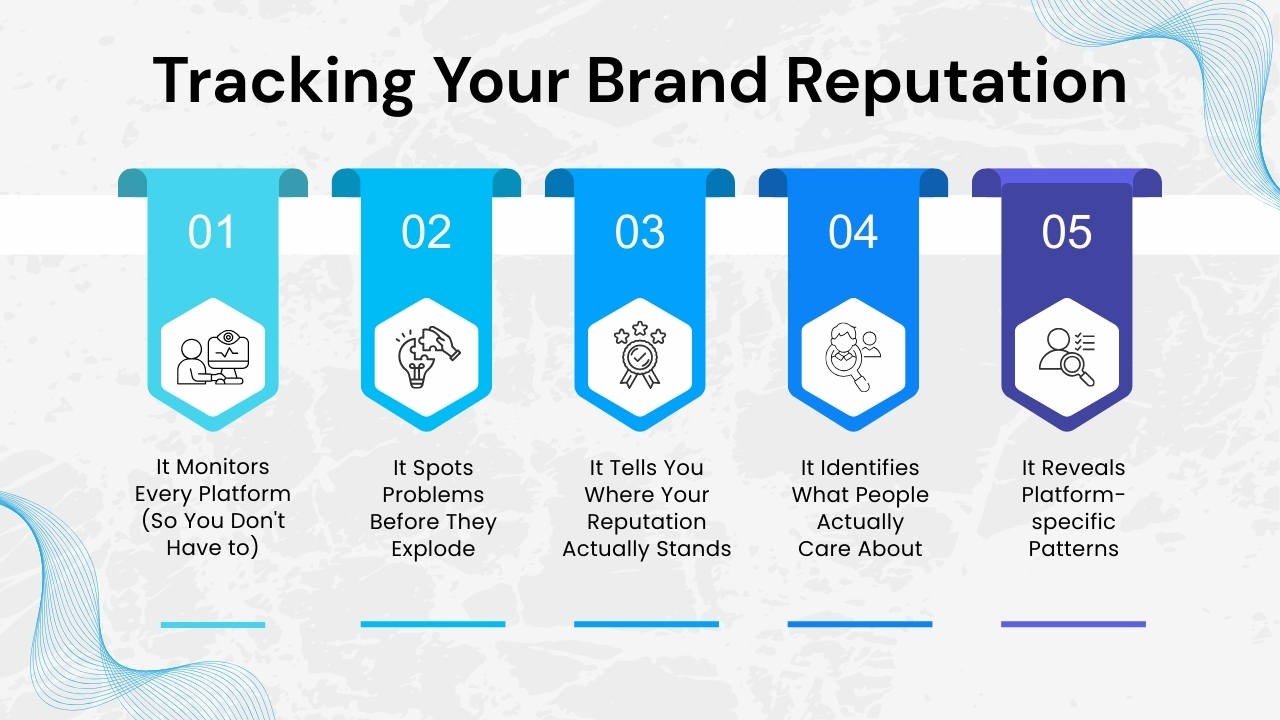
1. It Monitors Every Platform (So You Don’t Have To)
Nobody has time to manually check Twitter, then Instagram, then Google reviews, then Reddit, then TikTok comments, then LinkedIn, then… You get the point.
Sentiment analysis tools pull mentions from across platforms automatically. Every review, comment, tag, and mention gets captured—even the ones that don’t directly tag your brand.
The result? You see the complete conversation, not just the fragments happening where you remember to look.
2. It Spots Problems Before They Explode
Here’s the truth about brand crises: they rarely come out of nowhere. They build slowly, quietly, in scattered complaints across different platforms.
And, sentiment analysis sees the pattern and helps you change things around. It doesn’t care that one complaint was on Facebook and another on Reddit. It’s tracking the theme, not the platform. It notices that negative sentiment around this specific issue is appearing consistently, even if quietly.
Early warning = early action. You catch the spark before it becomes a fire.
Because here’s what most businesses don’t realize: by the time a complaint is loud enough for you to notice manually, it’s often already too late. The frustrated customer has already told their friends. The Reddit thread is already gaining traction. The tweet is already getting retweeted.
3. It Tells You Where Your Reputation Actually Stands
“How’s our brand doing?” is a vague question without data.
With sentiment analysis, you get concrete answers:
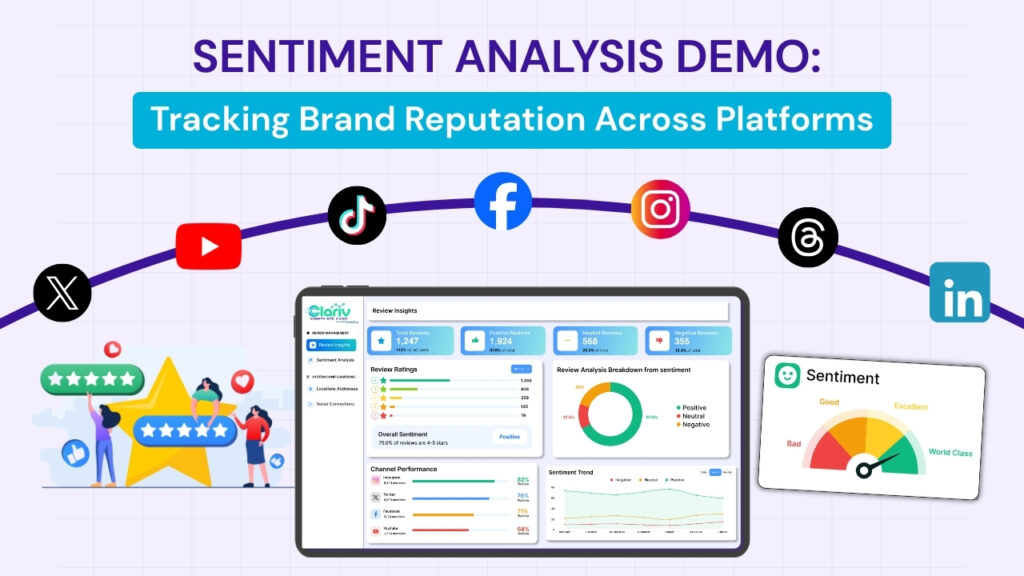
- Overall sentiment score: 73% positive, 18% neutral, 9% negative
- Platform breakdown: Instagram is overwhelmingly positive, but Reddit sentiment is dropping
- Trend tracking: Sentiment dipped 15% after last week’s price increase
- Competitor comparison: Your sentiment is higher on customer service, lower on pricing
No more guessing. Just facts.
4. It Identifies What People Actually Care About
Not all negative feedback is created equal. One person complaining about your logo color? Probably not urgent. Fifty people are frustrated about your checkout process? That’s a pattern worth addressing.
Sentiment analysis doesn’t just tell you that people are unhappy, it shows you why. It clusters similar complaints, highlights recurring themes, and points you toward the issues that actually matter to your customers.
You stop reacting to random complaints and start fixing systemic problems.
5. It Reveals Platform-Specific Patterns
Your brand might be crushing it on Instagram but struggling on Google reviews. You might have great sentiment around your product but terrible sentiment around your shipping times.
Sentiment analysis reveals these inconsistencies. It shows you where your brand experience is falling short and where it’s exceeding expectations, platform by platform, touchpoint by touchpoint.
The insight? Different audiences have different expectations, and you need to know what matters where.
Managing Your Brand Reputation
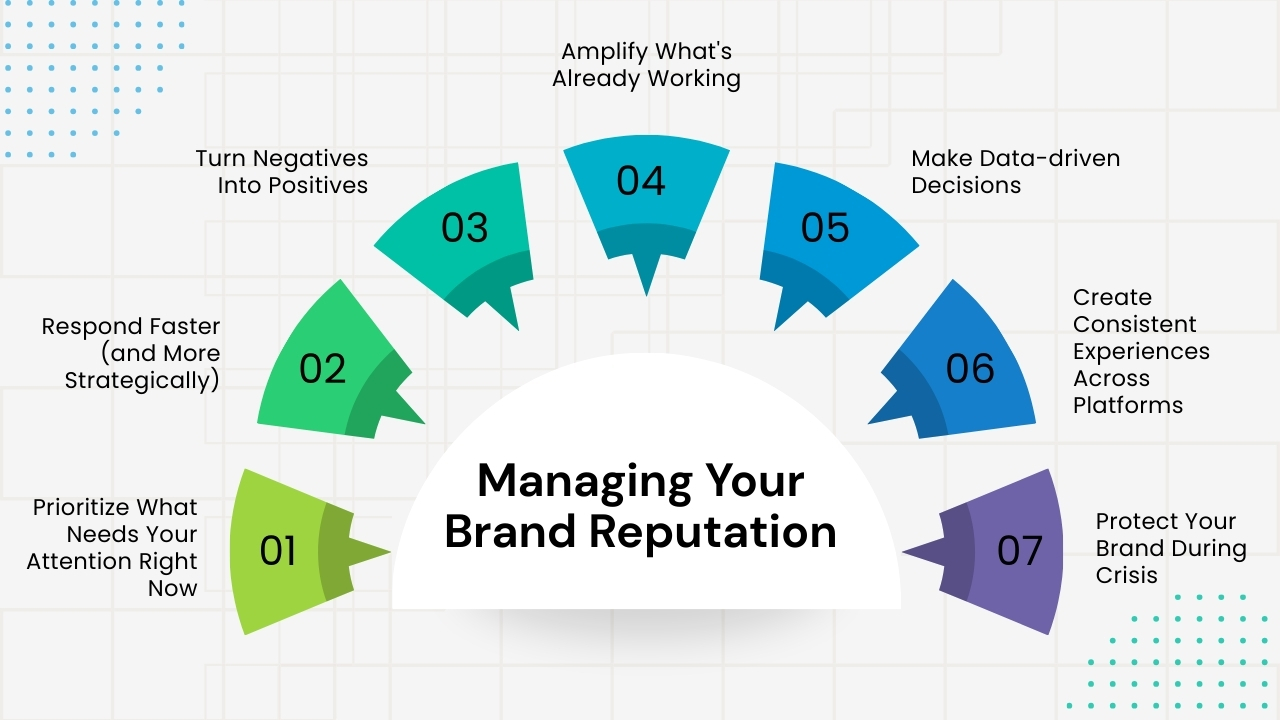
Tracking is only half the battle. Here’s where sentiment analysis becomes your reputation management powerhouse:
1. Prioritize What Needs Your Attention Right Now
When you’re getting hundreds of mentions daily, you can’t respond to everything. Sentiment analysis helps you triage:
- High negative sentiment + high visibility = address immediately
- Neutral mentions with questions = respond when possible
- Positive sentiment = engage, thank, and amplify
The right customer sentiment analysis can help you automatically flag urgent issues based on sentiment intensity and reach, so your team focuses on what actually moves the needle.
You work smarter, not harder.
2. Respond Faster (and More Strategically)
Speed matters. A customer venting frustration on Twitter at 2 PM doesn’t want to hear back three days later. 42% of consumers expect a response to their complaint on social media within 60 minutes.
With real-time sentiment tracking, you can:
- Set up alerts for negative sentiment spikes
- Route platform-specific issues to the right team members
- Respond while the conversation is still fresh
The difference? A complaint handled in 30 minutes vs. 3 days can be the difference between a resolved customer and a viral disaster.
3. Turn Negatives Into Positives
Here’s something most brands miss: negative sentiment isn’t the end of the story, it’s the beginning of an opportunity.
When you spot negative feedback early through sentiment analysis, you can:
- Reach out proactively to resolve the issue
- Turn frustrated customers into impressed ones
- Publicly demonstrate your commitment to customer satisfaction
People remember brands that made things right more than brands that never made mistakes. And, as per Harvard Business Review, brands that respond to negative reviews see a 33% increase in customer spending.
4. Amplify What’s Already Working
Sentiment analysis doesn’t just catch problems—it highlights wins.
When you see positive sentiment clustering around:
- A specific product feature → spotlight it in your marketing
- Your customer service team → celebrate and share those stories
- A recent campaign → lean into what’s resonating
You stop guessing what your customers love and start amplifying it strategically.
5. Make Data-Driven Decisions
Should you change your pricing strategy? Launch in a new market? Revamp your customer service approach?
Sentiment analysis gives you the evidence to make those calls:
- Track how sentiment shifts after product updates
- Compare sentiment across different customer segments
- Measure the impact of your reputation management efforts over time
Your decisions stop being based on hunches and start being backed by customer reality.
6. Create Consistent Experiences Across Platforms
Once you know where sentiment is strong and where it’s weak, you can address inconsistencies:
- Negative sentiment on Reddit about the complex setup? Create better onboarding content.
- Low engagement on LinkedIn compared to Instagram? Adjust your content strategy.
- Great product reviews, but poor shipping feedback? Fix your logistics.
The goal? A consistently positive reputation everywhere your customers interact with you.
7. Protect Your Brand During Crisis
When something goes wrong, a product issue, a PR misstep, a service outage, sentiment analysis becomes your crisis management dashboard.
You can:
- Monitor how quickly negative sentiment is spreading
- Track which platforms are most affected
- Measure whether your response is working
- Know when the crisis is actually over (sentiment returns to baseline)
You’re not flying blind during the most critical moments.
Also Read: Best Social Media Management Tools for Non Profits
The Complete Picture: Track + Manage = Control
Here’s what this looks like in practice:
Monday morning: Your sentiment analysis dashboard shows a 12% drop in positive sentiment on Google reviews over the weekend. The common thread? Complaints about a new checkout process.
Monday afternoon: You’ve identified the specific friction point, prioritized it with your product team, and crafted a response acknowledging the issue.
Tuesday: You’ve rolled back the problematic feature and responded personally to every affected reviewer.
Wednesday: Sentiment is recovering. You’re monitoring the trend and documenting what you learned for next time.
That’s the power of tracking AND managing together. You see the problem, understand it, act on it, and measure whether your actions worked.
For End-to-End Sentiment Analysis, Clariv Can Help!
Tracking sentiment across platforms is one thing. Actually, managing your brand reputation based on what you find? That’s where most businesses hit a wall.
You need a system that doesn’t just collect data, it turns that data into action. A system that shows you the complete picture, alerts you to problems before they spiral, and helps you make smarter decisions faster.
That’s exactly what Clariv does. Here’s how it solves the problems you’re facing right now:
1. Problem: I can’t read every review and comment manually
Solution: Smart Sentiment Analysis That Reads Like a Human
Clariv reads every review, comment, and message the way a human would, picking up on emotions, context, and the topics people genuinely care about.
Is this product a hit, praise, or criticism? Is interesting approach, genuine interest, or polite disappointment? Clariv knows the difference.
You get instant clarity on what’s driving customer satisfaction and what’s quietly frustrating them, with 95%+ accurate emotion detection and 3x faster insight discovery than manual analysis.
You stop drowning in feedback and start understanding it.
2. Problem: By the time I notice a problem, it’s already viral
Solution: Early Warning System That Catches Issues Before They Explode
Remember those scattered complaints that turned into a viral crisis? Clariv connects those dots automatically.
It tracks patterns across every platform, spotting that the same issue is popping up on Facebook, then Reddit, then Instagram, and flags it before it becomes your next PR nightmare.
With 6x earlier detection of recurring issues and 40% more trends uncovered through automation, you’re catching sparks before they become fires.
You get the heads-up when you can still do something about it.
3. Problem: I’m always reacting, never planning ahead
Solution: Predictive Insights That Show You What’s Coming
Most tools show you yesterday’s sentiment. Clariv shows you tomorrow’s.
AI-powered forecasting helps you anticipate sentiment shifts, identify customers at risk of churning, and predict emerging trends before your competitors do.
The result? 25% better forecast accuracy, 50% fewer last-minute escalations, and the ability to act before problems hit your bottom line.
You stop firefighting and start getting ahead of issues.
4. Problem: I don’t know which complaints actually matter.
Solution: Topic Analysis That Shows You What Customers Really Care About
It’s not enough to know customers are unhappy. You need to know why.
Clariv automatically identifies the topics customers talk about most, pricing, customer service, product quality, shipping, user experience, and shows you which topics are driving positive sentiment and which are causing frustration.
No more reading through hundreds of reviews trying to find patterns. Clariv surfaces them automatically.
You know exactly what’s worth fixing and what’s just noise.
5. Problem: My multi-location business is impossible to monitor
Solution: Location-Based Sentiment Tracking
Multi-location businesses face a unique challenge: your brand reputation isn’t just one score; it’s dozens of individual reputations across different cities, regions, or countries.
Clariv breaks down sentiment by location, so you can see exactly where your brand is thriving and where it needs attention. Maybe your Seattle location is crushing it while your Miami branch is struggling with service complaints.
Now you know where to celebrate and where to intervene.
6. Problem: Different platforms are telling different stories.
Solution: Platform-Specific Sentiment Breakdown
Your Instagram audience might love you, while your Google reviewers are frustrated. Your LinkedIn followers might be engaged, while your Reddit discussions are turning negative.
Clariv breaks down sentiment by platform, so you can understand how your brand is perceived in different communities and adjust your strategy accordingly.
You see the complete picture, not just the platform you remembered to check.
7. Problem: I’m juggling too many tools and still missing things
Solution: One Dashboard for Everything
No more toggling between Google reviews, Instagram comments, Twitter mentions, Reddit threads, and five different analytics tools.
Clariv seamlessly integrates and brings everything into one clean, intuitive dashboard, reviews, sentiment trends, alerts, topic analysis, platform comparisons, location breakdowns, the works.
Teams using Clariv report 80% fewer tool switches and hours saved every week through centralized insights.
Everything you need to know about your brand reputation, in one place.
8. Problem: I can’t respond fast enough to negative feedback
Solution: Real-Time Alerts When Sentiment Drops
You don’t need to stare at dashboards all day. Clariv watches your brand reputation for you and alerts you the moment something needs attention.
- Negative sentiment spike on Google reviews? You’re notified immediately.
- Sudden drop in customer mood after a product update? Alert sent.
- Pattern of complaints emerging across platforms? Flagged before it spreads.
Teams using Clariv see 70% faster response times to customer issues and significantly fewer rating drops through early intervention.
You catch problems when 30 minutes of action can prevent 3 days of damage control.
9. Problem: I don’t know if my reputation is getting better or worse.
Solution: Sentiment Tracking Over Time
Brand reputation isn’t static, it shifts based on campaigns, product launches, policy changes, seasonal trends, and countless other factors.
Clariv tracks your sentiment over time, showing you week-over-week and month-over-month trends. Did that price increase hurt sentiment? Did your new customer service initiative improve it? Is sentiment trending up or down overall?
You see the trajectory, not just the snapshot, so you know if your efforts are working.
10. Problem: I don’t know how we compare to competitors
Solution: Competitive Sentiment Benchmarking
You’re not operating in a vacuum. Your customers are comparing you to competitors, whether you realize it or not.
Clariv helps you understand how your sentiment stacks up against the competition. Are you winning on customer service but losing on pricing? Is your product sentiment strong, but your brand sentiment weak?
You know where you’re leading and where you’re falling behind.
Try Clariv Free for 14 Days
Book Free Demo and get full access to Professional plan features, up to 100,000 sentiments per month, all the AI-powered insights, real-time alerts, and the complete dashboard.
No credit card required. Cancel anytime. Set up in minutes.
✓ No Credit Card Needed
✓ Expert Support Available
✓ Easy Setup
✓ 24/7 Assistance
Conclusion
Your customers are already telling you everything you need to know. How do they feel about your brand? What’s working. What’s frustrating them? What would make them choose you over competitors? What might make them leave?
The question is whether you’re set up actually to hear them.
If you’re ready to stop wondering and start knowing, if you want to see your complete brand reputation in one place, catch issues before they escalate, and make smarter decisions faster, Clariv is built for exactly that.
Try it free for 14 days. No credit card. No pressure. Just see what happens when you finally have visibility into every conversation shaping your brand.
Your reputation is too important to leave to chance.